
A Stone Grown in Many Places, Not One
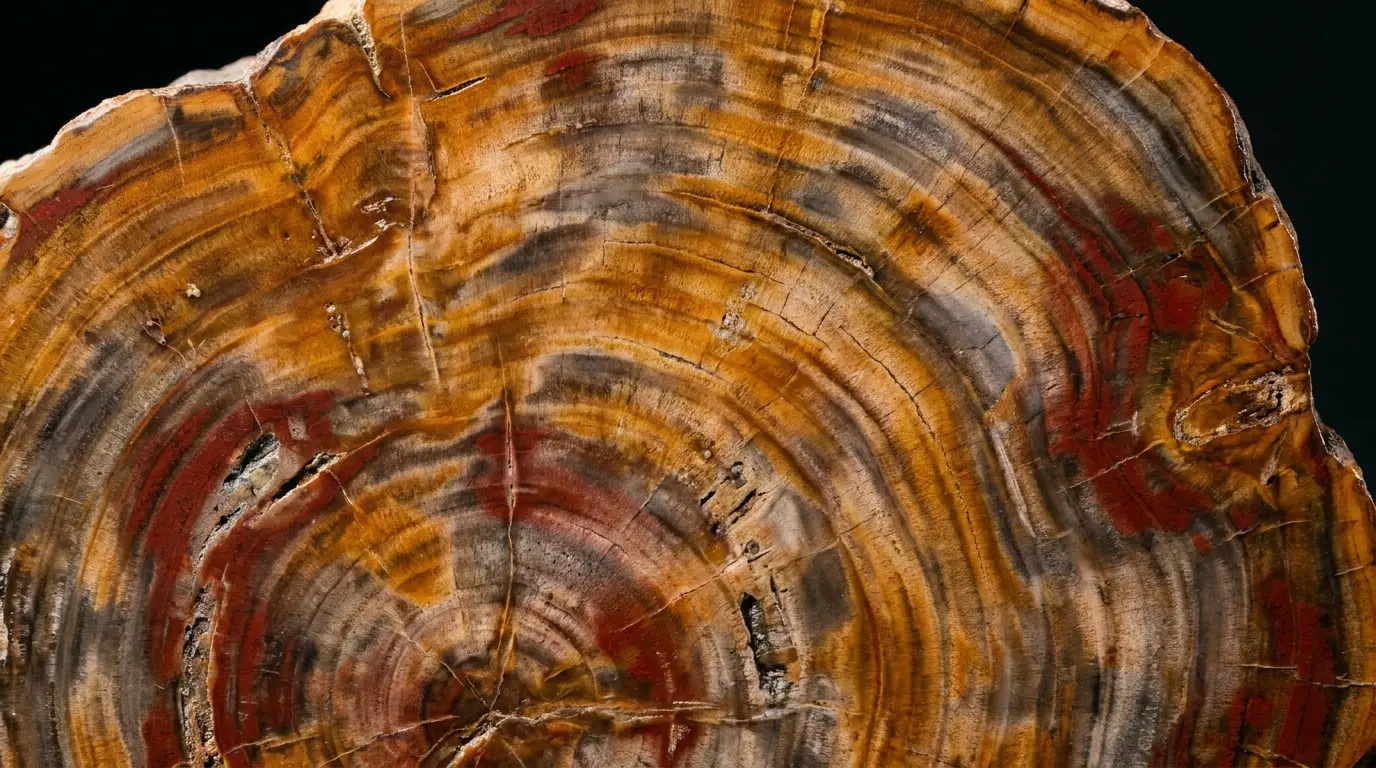
Petrified wood is not rare on a global scale. Fossilised forests lie scattered across every continent except Antarctica, wherever ancient trees were buried fast enough — by ash, mud, or river sediment — to be sealed away from oxygen before they could rot. What is rare is petrified wood with clean colour, tight grain, and a trunk large enough to become furniture rather than a curiosity on a shelf. That distinction is where the real map begins.
The Major World Deposits
A handful of regions account for most of the petrified wood known to science and to collectors:
- Arizona, United States — the Petrified Forest National Park, roughly 225 million years old, one of the most studied deposits on Earth, protected and largely off-limits to extraction today.
- Patagonia, Argentina — extensive fossil forests linked to volcanic ash falls, producing large trunks but often heavily fractured.
- Lesvos, Greece — a UNESCO-listed petrified forest from volcanic burial around 20 million years ago, smaller in scale but exceptionally preserved.
- Indonesia — abundant material, mostly dense and dark, widely traded as raw stone.
- Madagascar — the deposit Medusa works with, concentrated in the island's southwest, dated to the Triassic, around 230 million years old.
Each site tells a different geological story: a different tree species, a different mineral bath, a different pressure and time. That is why no two deposits — and no two trunks — ever produce the same stone twice.
Why Madagascar Stands Apart
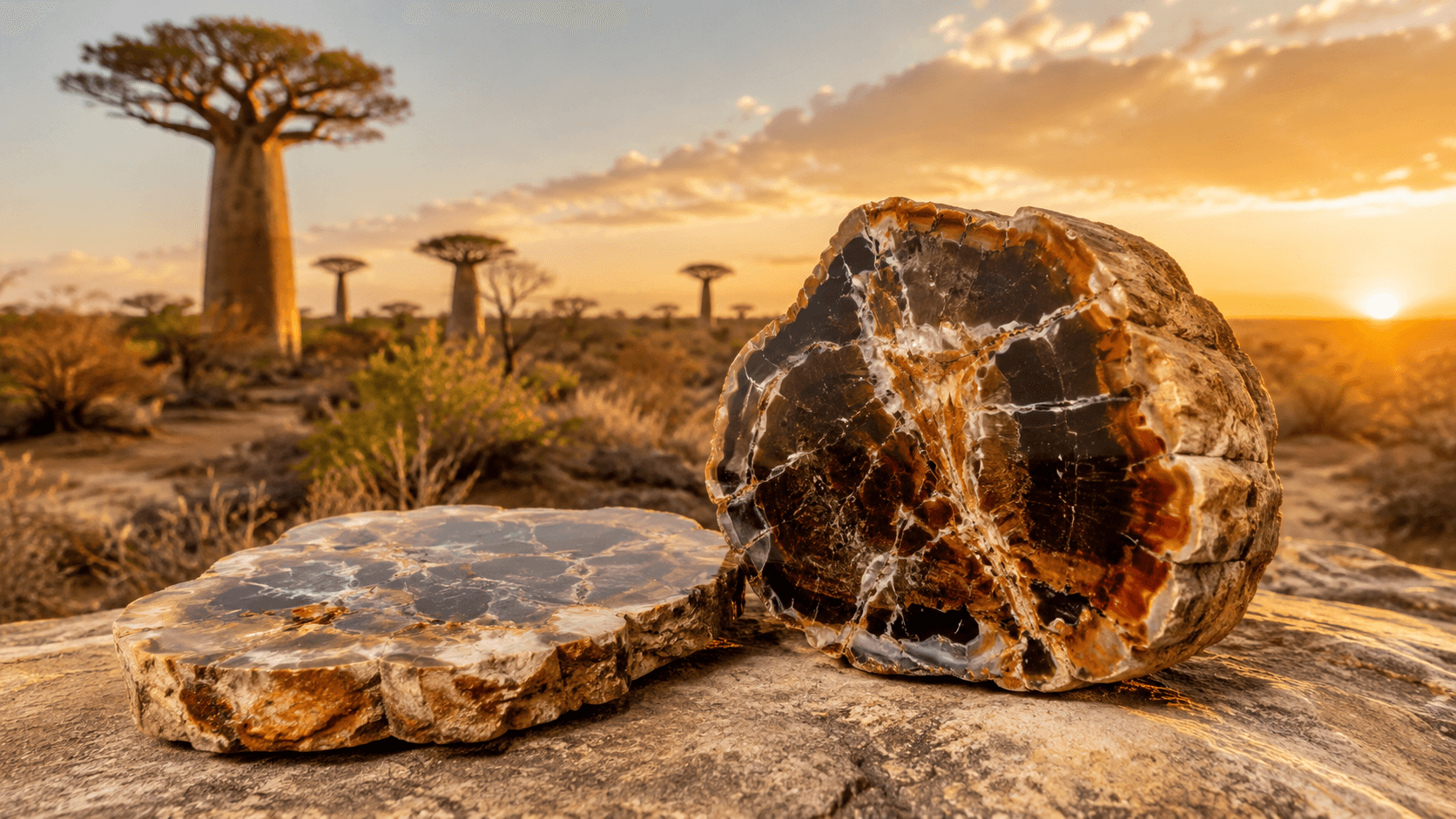
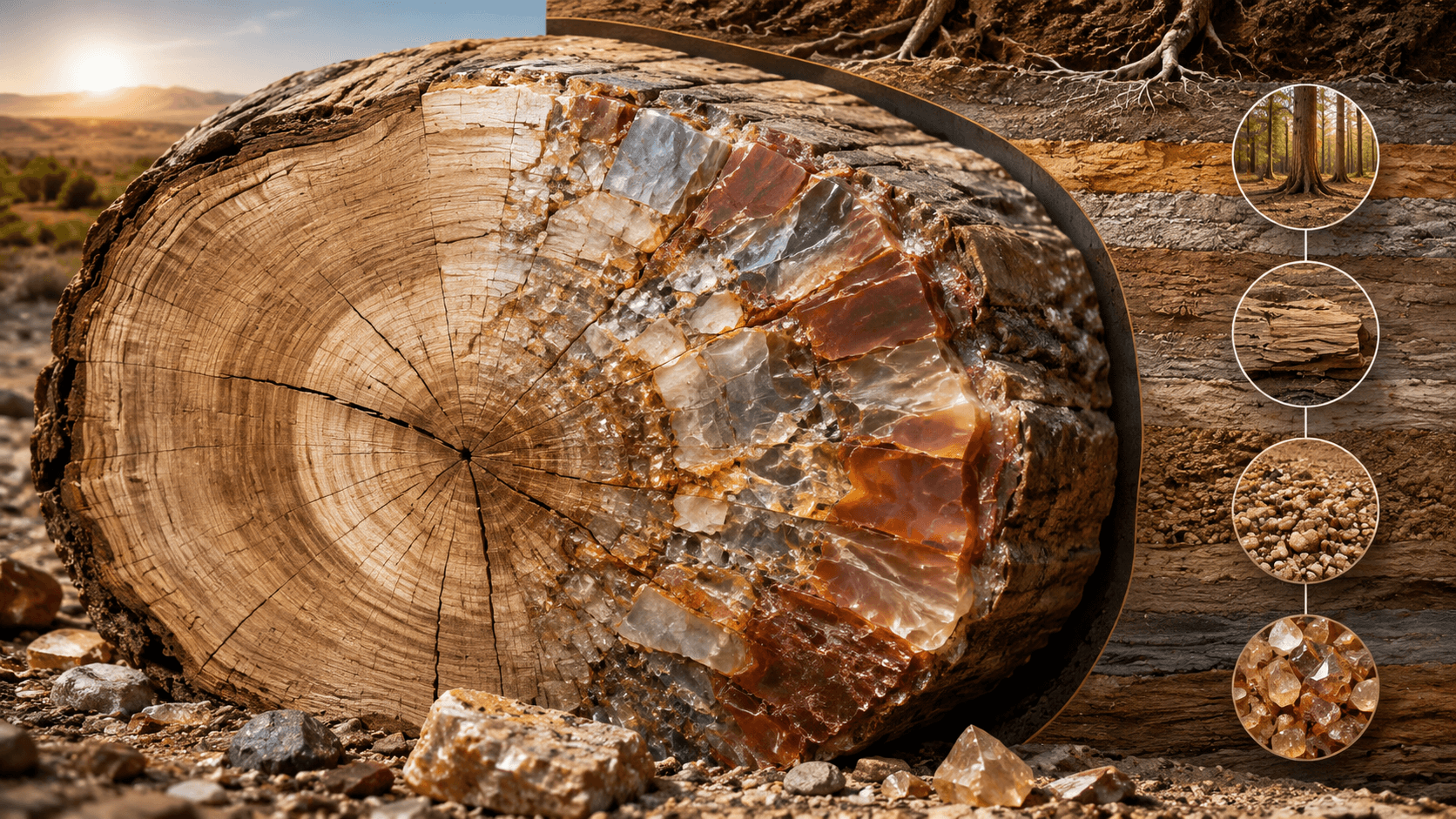
The southwest of Madagascar sits on ancient sedimentary basins that, some 230 million years ago, buried entire conifer forests under fine-grained sediment. Groundwater rich in dissolved silica moved through the wood, cell by cell, replacing organic tissue with quartz before decay could take hold. The result is fossilised trunks that kept their original architecture — rings, fractures, the grain of the living tree — while becoming, mineralogically, stone.
What sets this region apart from other deposits is less the process, which is common to petrified wood everywhere, and more the outcome: trunks of real size, with mineral impurities that produced a wide and often vivid palette. Iron gave ochres and reds. Manganese gave blacks and violets. Traces of chromium and cobalt, rarer, gave the greens and blues that collectors prize most.
A deposit is a place. A trunk is an individual — and its colour existed nowhere else before it, and will exist nowhere else after it.
One Tree, One Name, One Colour
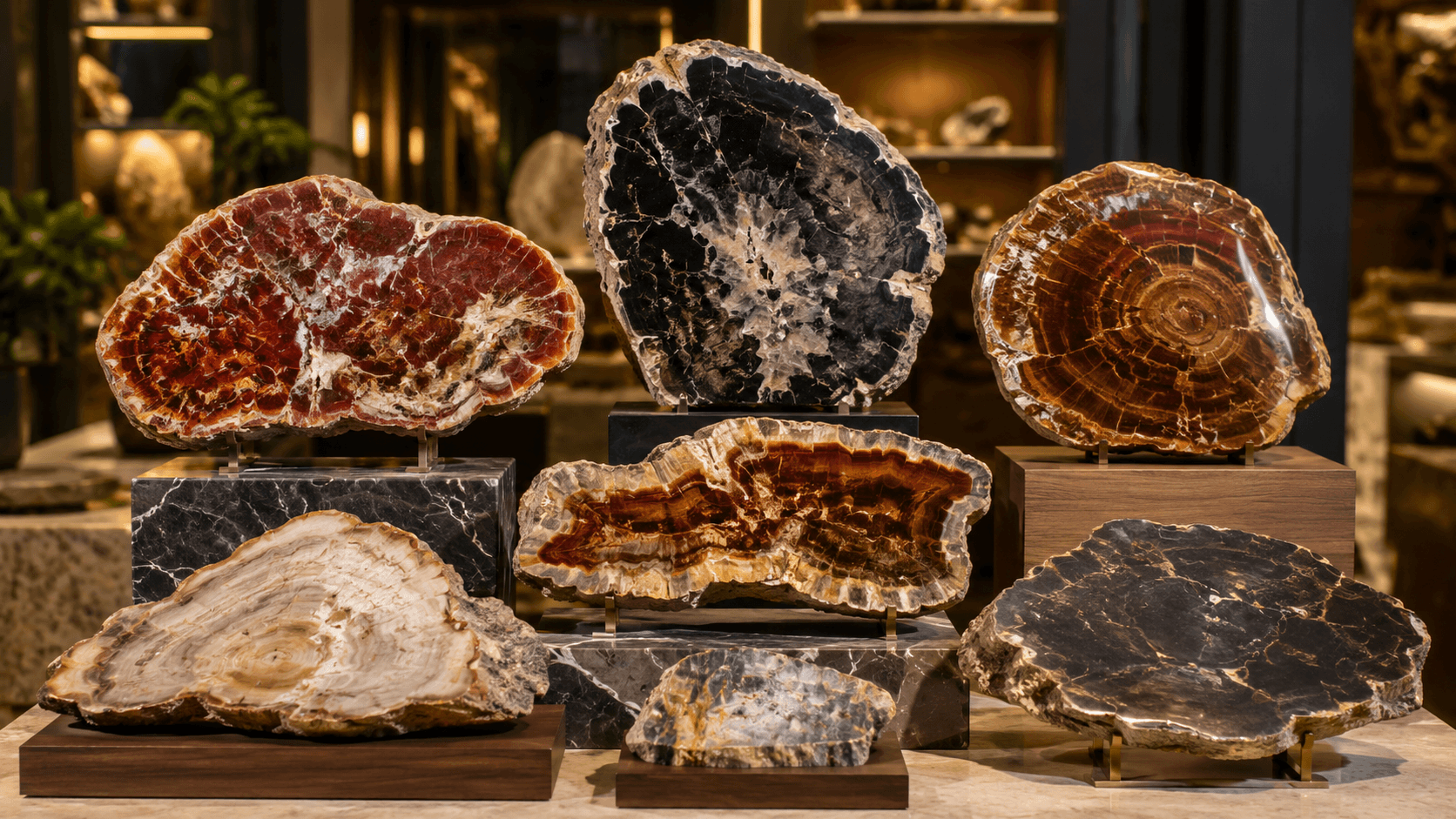
Medusa does not sell petrified wood as an undifferentiated raw material. Each trunk we bring up from the ground in southwestern Madagascar is treated as what it is: a single tree, felled by geological accident 230 million years ago, with its own mineral history and its own colour signature. We give each one a name — Ambra for amber tones, Argentea for silver-grey, Fusca for deep brown, Umbra for near-black, Viridis for green — because a category label would erase the point. These are not product lines. They are individuals, and once a trunk is cut into tables, vasques, or objects, that particular tone is gone from the world. The next trunk pulled from the same ground will not repeat it.
What the Stone Physically Is
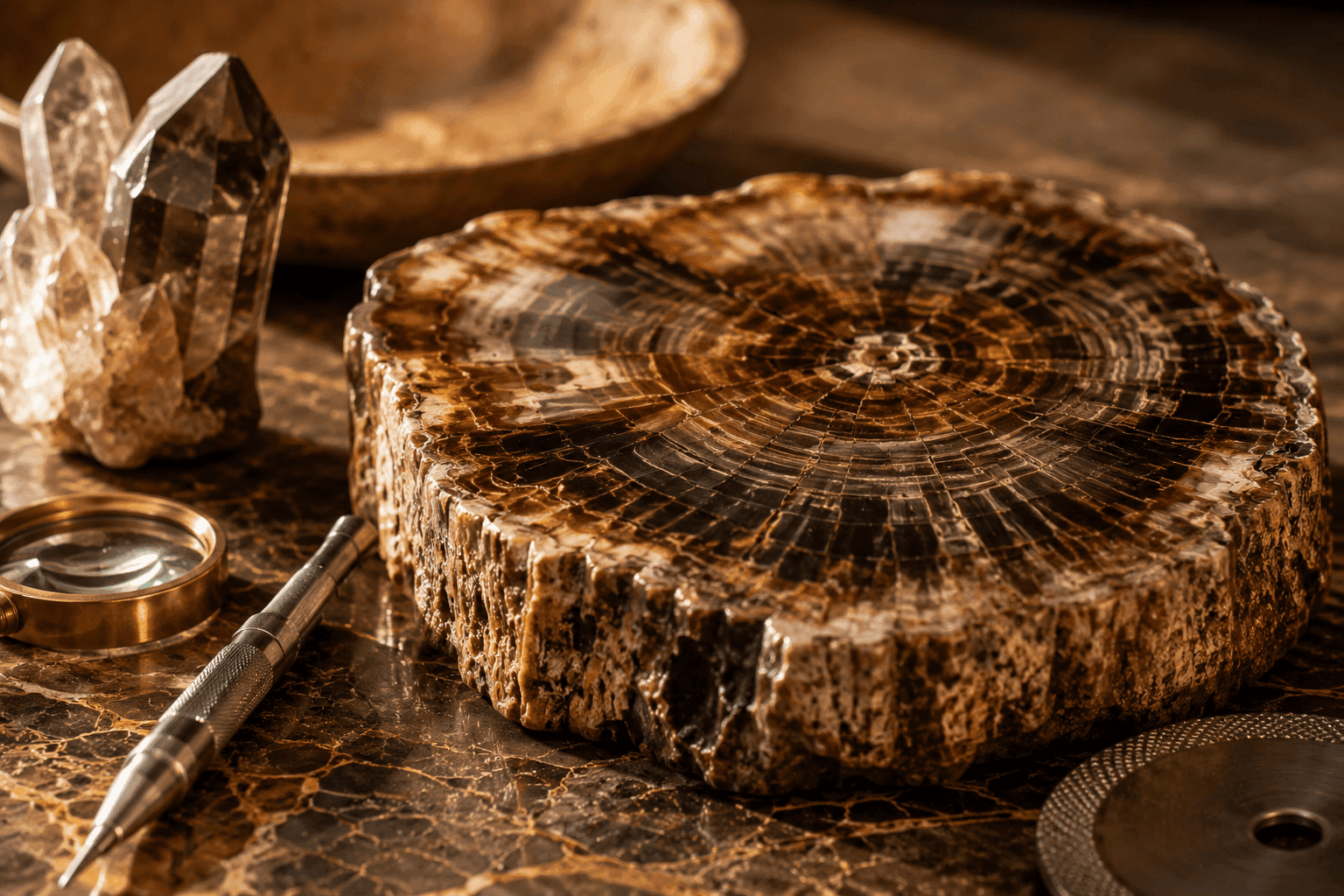
Wherever it is found, petrified wood is chemically the same category of stone: fossilised organic tissue replaced by silica, almost entirely quartz. That single fact explains everything about how it behaves once it leaves the ground:
- Hardness of 7 on the Mohs scale — harder than steel, resistant to scratching under normal use.
- Density — noticeably heavier than any comparable piece of ordinary wood or most natural stones.
- Thermal and UV stability — indifferent to sun exposure, heat, or cold; it will not fade, crack from dryness, or warp.
- Water resistance — quartz does not absorb moisture, which is precisely why the material works as a vasque, a basin, or an outdoor surface without sealing or maintenance.
Origin changes the colour and the grain. It does not change the physics.
From Ground to Interior
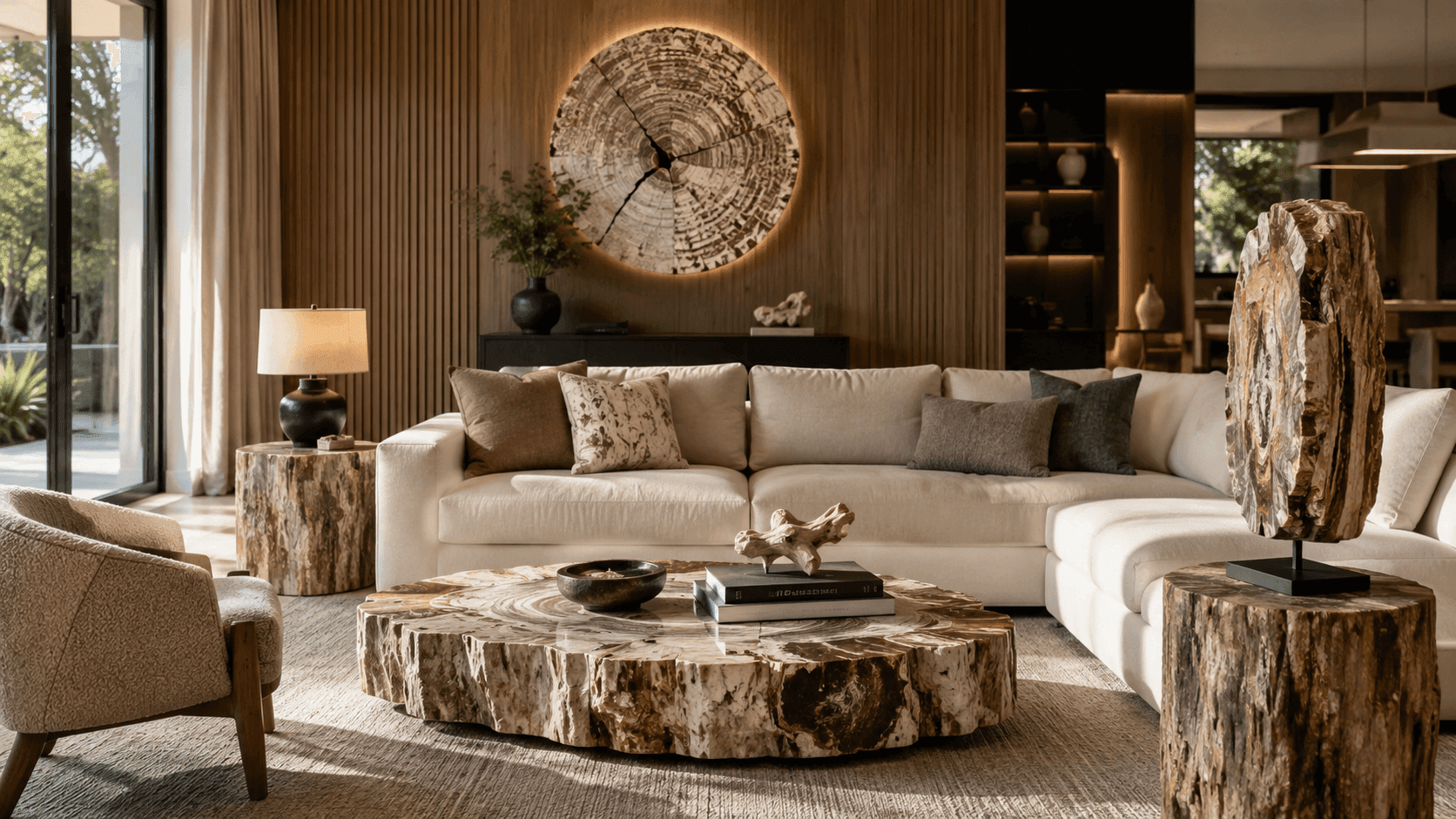
A trunk found in the sandy soil of southwestern Madagascar and a trunk found in Arizona share an origin story but rarely share a destiny. Many deposits are protected by law and cannot be commercially extracted at all — which is part of why supply worldwide is genuinely limited, whatever the volume of raw material still buried. Madagascar remains one of the few regions where extraction, cutting, and finishing can still be done responsibly, trunk by trunk, by hand.
That is the stage where Medusa's work begins: identifying a trunk, assessing its density and colour, and deciding — sometimes over weeks — how it should be cut to reveal what 230 million years left inside it.
Discover the trunks currently available, each named and unrepeatable.
Visit the ShopFrequently Asked Questions
Where is most petrified wood found?
The largest known deposits are in Arizona (USA), Patagonia (Argentina), Lesvos (Greece), Indonesia, and Madagascar. Each formed under different geological conditions and at different periods.
Is Madagascar petrified wood different from other origins?
The mineralisation process is the same everywhere — silica replacing organic tissue — but Madagascar's southwestern deposits are notable for trunk size and for a wide range of colours produced by iron, manganese, chromium, and cobalt.
How old is Madagascar's petrified wood?
Around 230 million years, dating to the Triassic period, making it among the oldest fossilised wood commercially available.
Can petrified wood from different origins be mixed in one interior?
Physically, yes — the material behaves identically regardless of origin. Aesthetically, Medusa recommends choosing trunks with a coherent colour story, since each one is unique and won't be duplicated.