
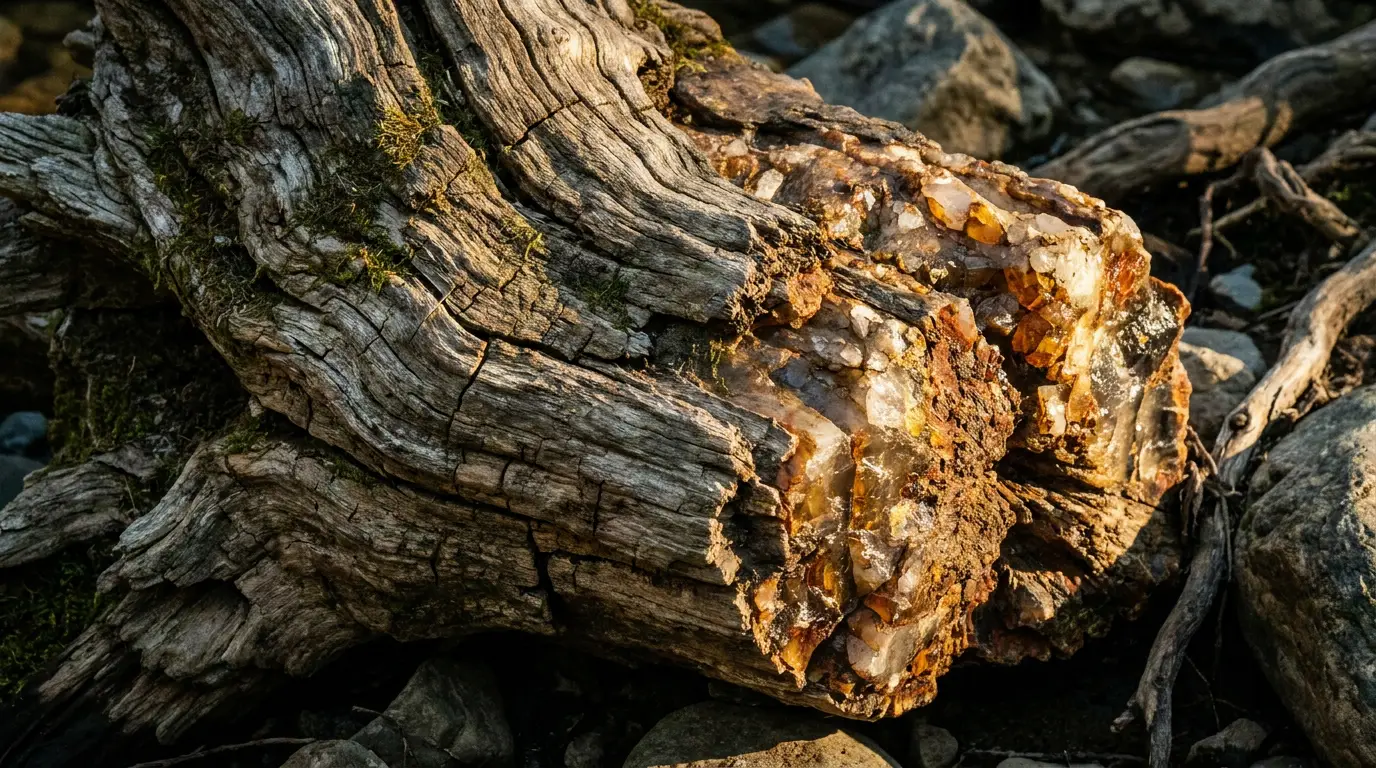
How to Identify Petrified Wood
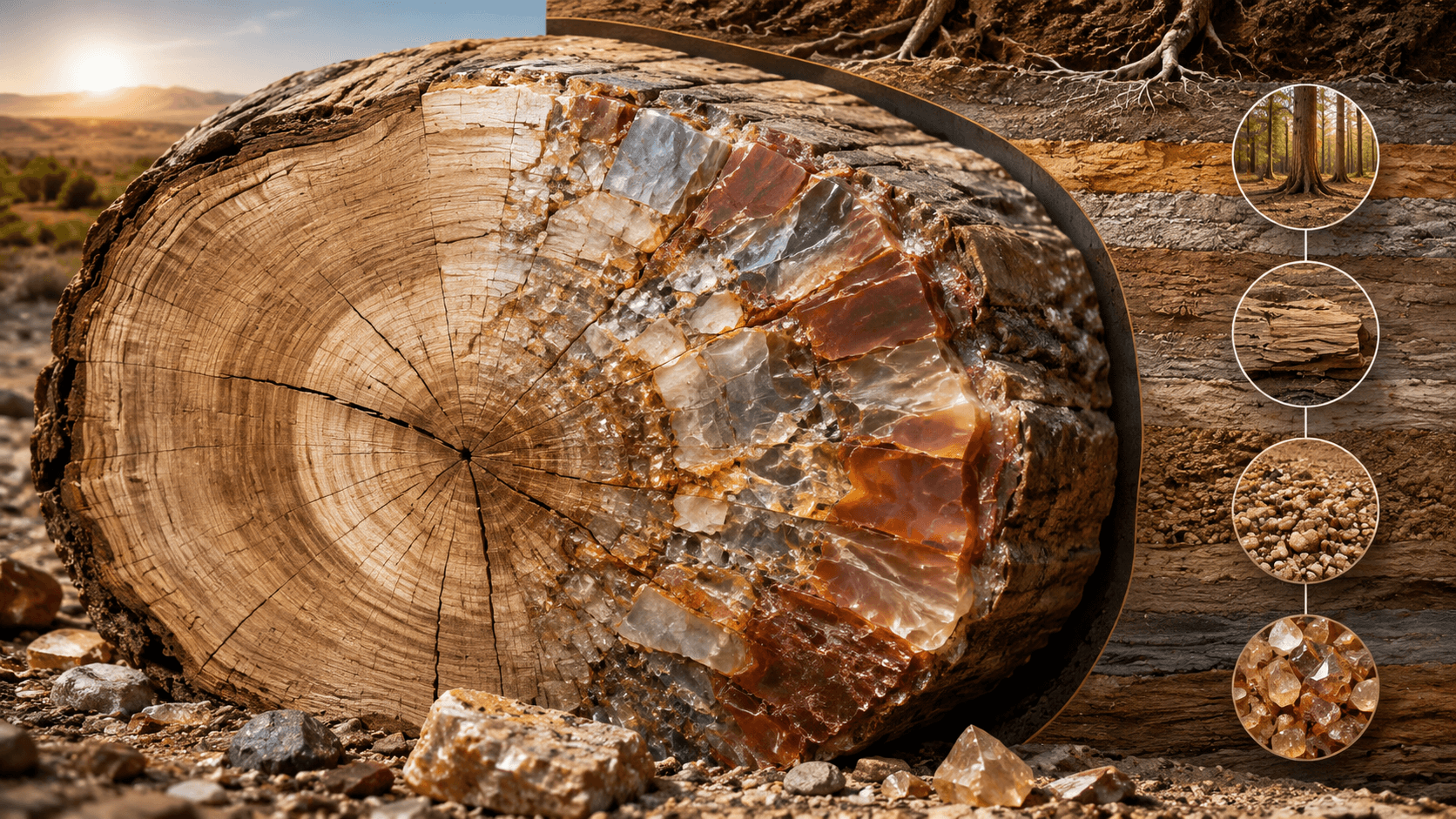
Learning how to identify petrified wood starts with a simple contradiction: it looks like timber and behaves like stone. Most people meet it for the first time and hesitate — the surface shows bark texture, growth rings, sometimes even insect galleries, yet the object in their hands is cold, dense, and unmistakably mineral. That hesitation is precisely the identification process at work. Petrified wood is fossilized wood: over millions of years, groundwater rich in dissolved silica infiltrated a buried trunk and replaced its organic tissue, cell by cell, with quartz. The result preserves the architecture of a living tree while trading its chemistry entirely for stone.
To identify a genuine specimen with confidence, four checks matter more than any single glance: weight, hardness, structural pattern, and color logic. None of them requires special equipment.
What Does It Look Like?
Visually, petrified wood keeps the signature of the tree it once was. You can often still read the grain direction, the concentric rings marking seasonal growth, sometimes radiating cracks from the heartwood, occasionally the rougher texture of what was once bark. What has changed is the material underneath that surface. Instead of the warm, fibrous look of dry timber, the surface has a mineral sheen once polished — glassy in places, dense and opaque in others, depending on how completely silica replaced the original cells. Colors run far beyond the browns of ordinary wood: ochre, deep red, near-black, sometimes green or bluish streaks, arranged in bands or swirls that follow the old growth pattern rather than sitting randomly on the surface. If a "wood" object shows tree rings but has the color range of a mineral and none of wood's give or warmth, you are very likely holding petrified wood.
The Weight Test
Pick the piece up. Genuine petrified wood is noticeably heavier than a piece of ordinary wood of the same size — quartz is far denser than cellulose. A palm-sized fragment that feels unexpectedly heavy, almost like holding a stone of similar volume, has already passed the first and most reliable test. Resin casts and dyed reconstitutions, sold occasionally as "petrified wood" décor, feel light by comparison. Weight alone won't confirm authenticity on its own, but its absence is enough to rule a piece out.
The Hardness Test
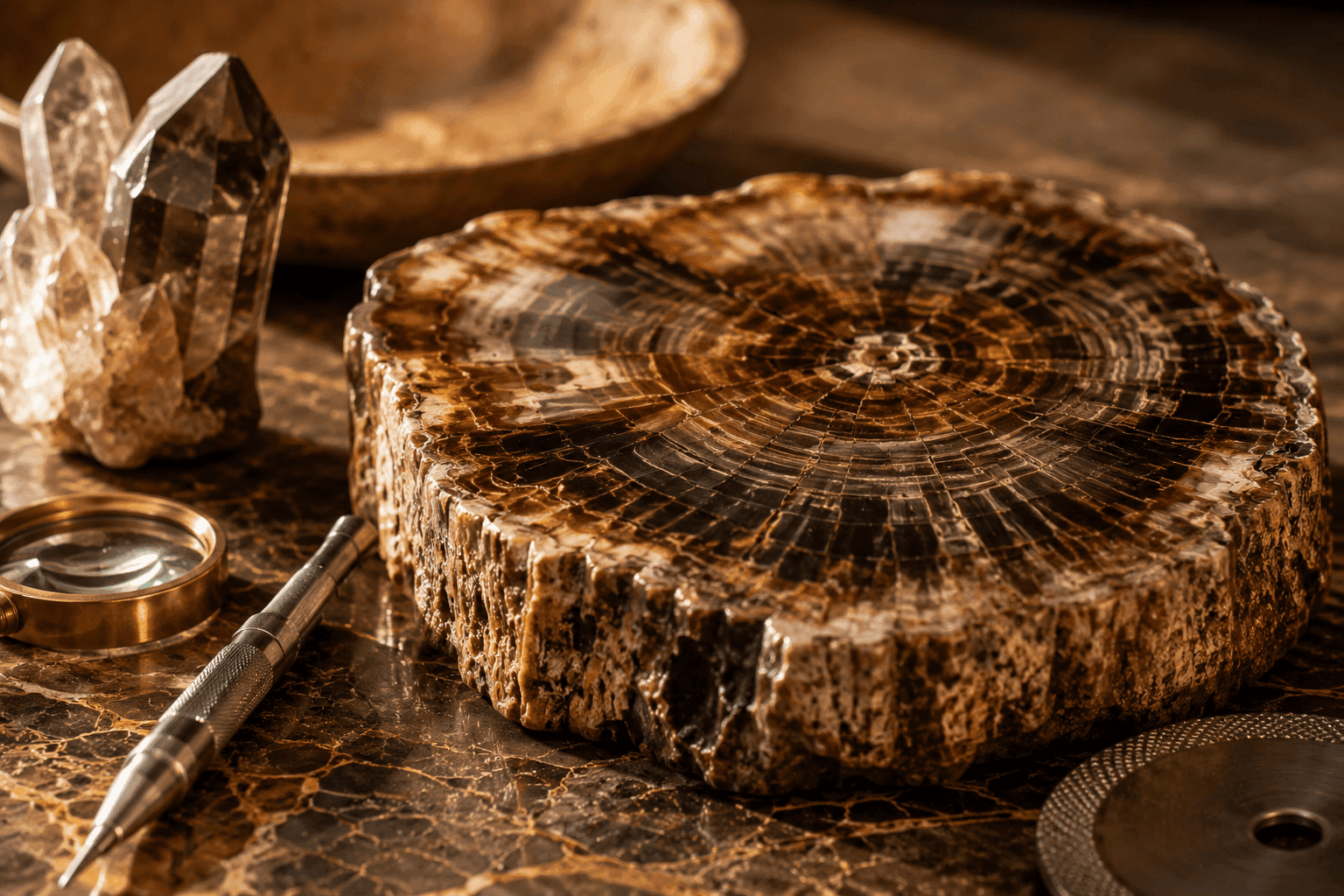
Petrified wood is silicified wood, meaning its structure is essentially quartz — a hardness of 7 on the Mohs scale. Practically, this means a steel blade or a house key will not scratch it, where they would easily mark real timber or a soft imitation. This single property explains everything else about the material: petrified wood does not swell with humidity, does not fade under UV light, does not fear frost, and takes a polish that ordinary wood could never hold. If a specimen scratches under a fingernail or a coin, it is not petrified wood — full stop.
Reading the Structure and the Color
Beyond weight and hardness, identification comes down to reading the internal logic of the piece. Authentic petrified wood shows growth rings that are continuous and organic in shape — irregular, slightly asymmetric, following the biological rhythm of a living tree rather than a printed or molded repeat pattern. Cracks, when present, tend to radiate from a central point, a signature of how the trunk dried and fractured before mineralization sealed it permanently.
Color, meanwhile, tells a story of chemistry, not decoration. The palette comes from trace metals present in the groundwater at the moment of fossilization:
- Iron oxides produce the reds, oranges, and ochres most commonly seen.
- Manganese produces blacks and violet-blacks, often in streaks or spots.
- Chromium and cobalt, far rarer, produce the greens and blues collectors prize most.
These minerals infiltrated the wood unevenly, which is why a single cross-section can carry three or four distinct tones in one polished face — a detail no synthetic reproduction convincingly fakes.
Why Each Trunk Tells a Different Story
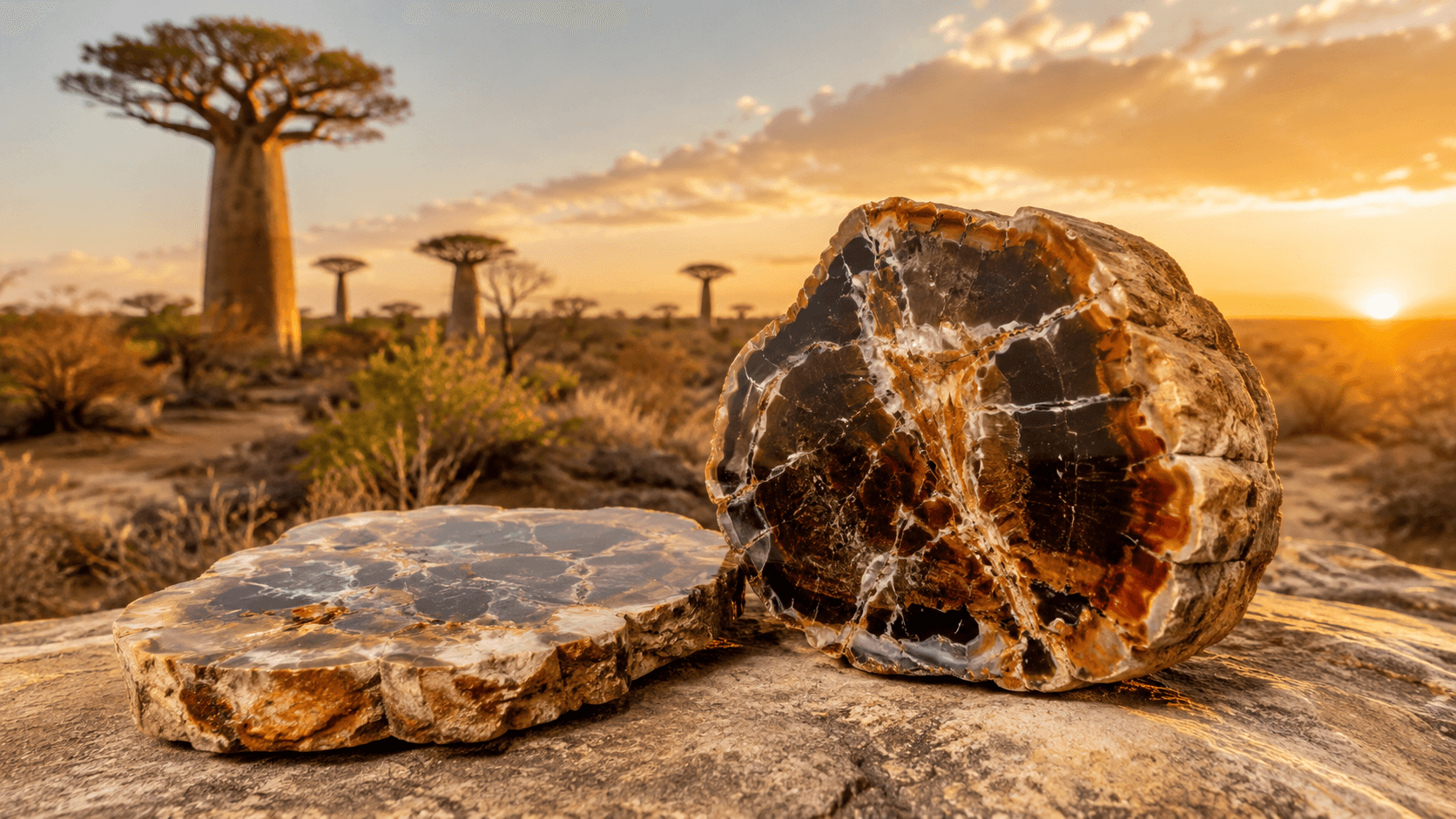
At Medusa, this chemistry is also why we treat every trunk as an individual rather than a category. Each log recovered from the southwest of Madagascar carries its own mineral history — its own exposure to iron, manganese, chromium — and therefore its own color signature. We name each trunk rather than label it: Ambra for amber tones, Argentea for silvered grey, Fusca for deep brown, Umbra for near-black, Viridis for the rare greens. These are not product lines. They are individual trees, brought up one at a time, each with a coloration that cannot be reordered once the block is cut.
A tree does not repeat itself twice. Once a trunk is sliced, its exact shade is gone for good.
This is also the deepest layer of identification: authenticity in petrified wood is not just mineral, it's singular. A slab cut from Ambra will never match another slab perfectly, because no two trunks mineralized under identical conditions. Buyers learning to identify real petrified wood should expect this irregularity — it is proof of origin, not a flaw.
From Ancient Trunk to Finished Object
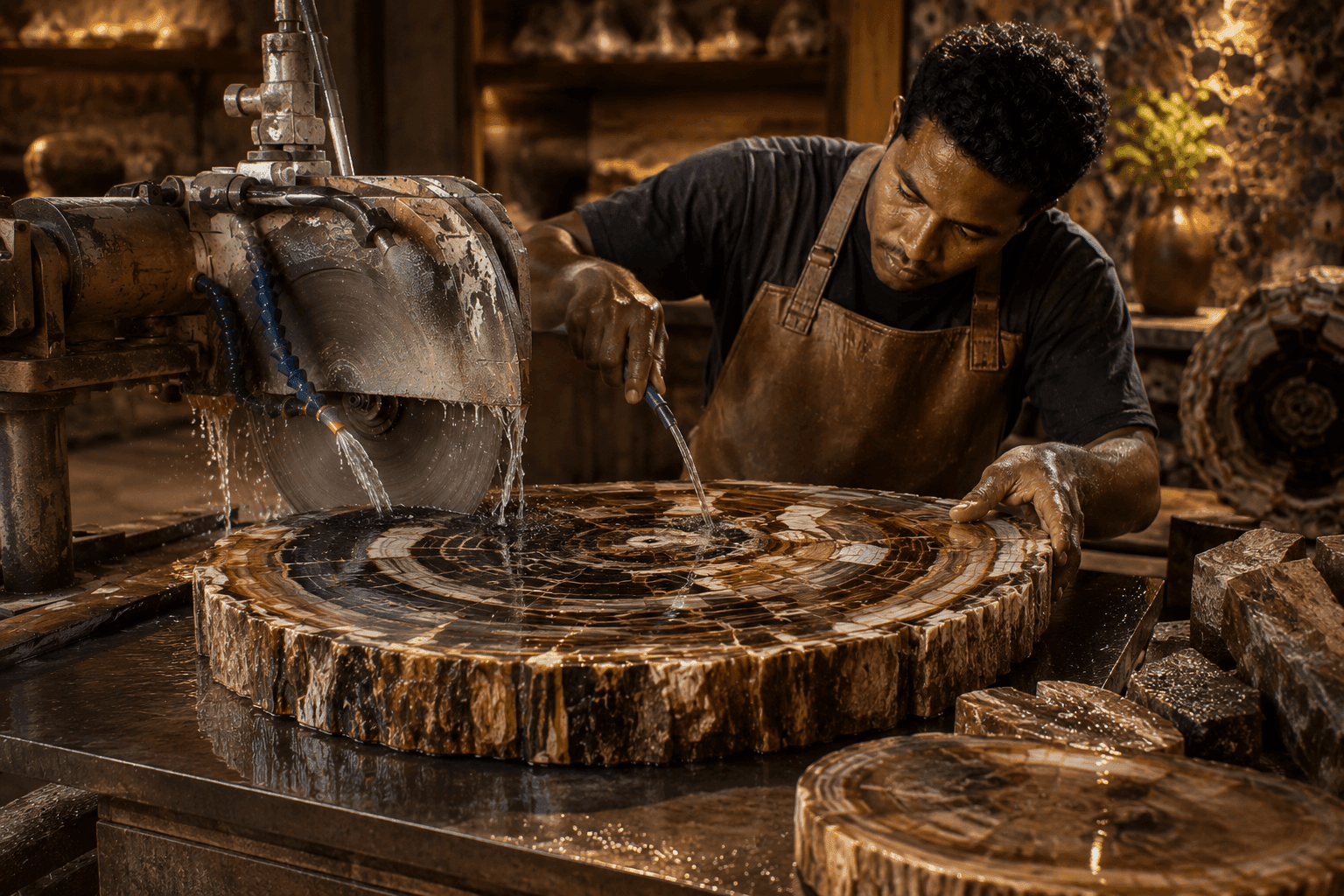
Our trunks date to the Triassic, roughly 230 million years old, recovered from the arid southwest of Madagascar where fossilization conditions were unusually favorable. Turning a raw block into a table, a washbasin, or a sculptural object takes patience: cutting quartz requires diamond tooling, and each trunk's internal color map dictates how it should be sliced to reveal its best face. This is craftsmanship applied to geology — the artisan doesn't shape the material so much as reveal what mineralization already wrote inside it, millions of years before anyone was there to see it.
Discover named trunks available now, each with its own story.
Visit the ShopFrequently Asked Questions
Is petrified wood actually wood?
No, not anymore. The organic wood tissue has been fully replaced by silica over millions of years. What remains is quartz that preserves the tree's original structure — its rings, grain, and sometimes bark texture — but chemically it is stone.
How can I identify petrified wood without tools?
Check the weight first: it should feel notably heavier than ordinary wood of the same size. Then test hardness — a key or blade should not scratch the surface, since the material rates 7 on the Mohs scale. Genuine specimens also show continuous, organic growth rings rather than repeating patterns.
Why do pieces from the same trunk look different?
Mineralization is uneven. Trace metals like iron, manganese, chromium, or cobalt infiltrated each trunk unevenly during fossilization, producing bands and gradients of color across a single log. This is also why Medusa names each trunk individually rather than treating it as a uniform product.
Does petrified wood need special care?
Very little. Because it is essentially quartz, it is insensitive to water, heat, UV exposure, and frost. A simple wipe is generally enough; no oiling or specific treatment is required, unlike natural timber.