
A Tree Turned to Stone
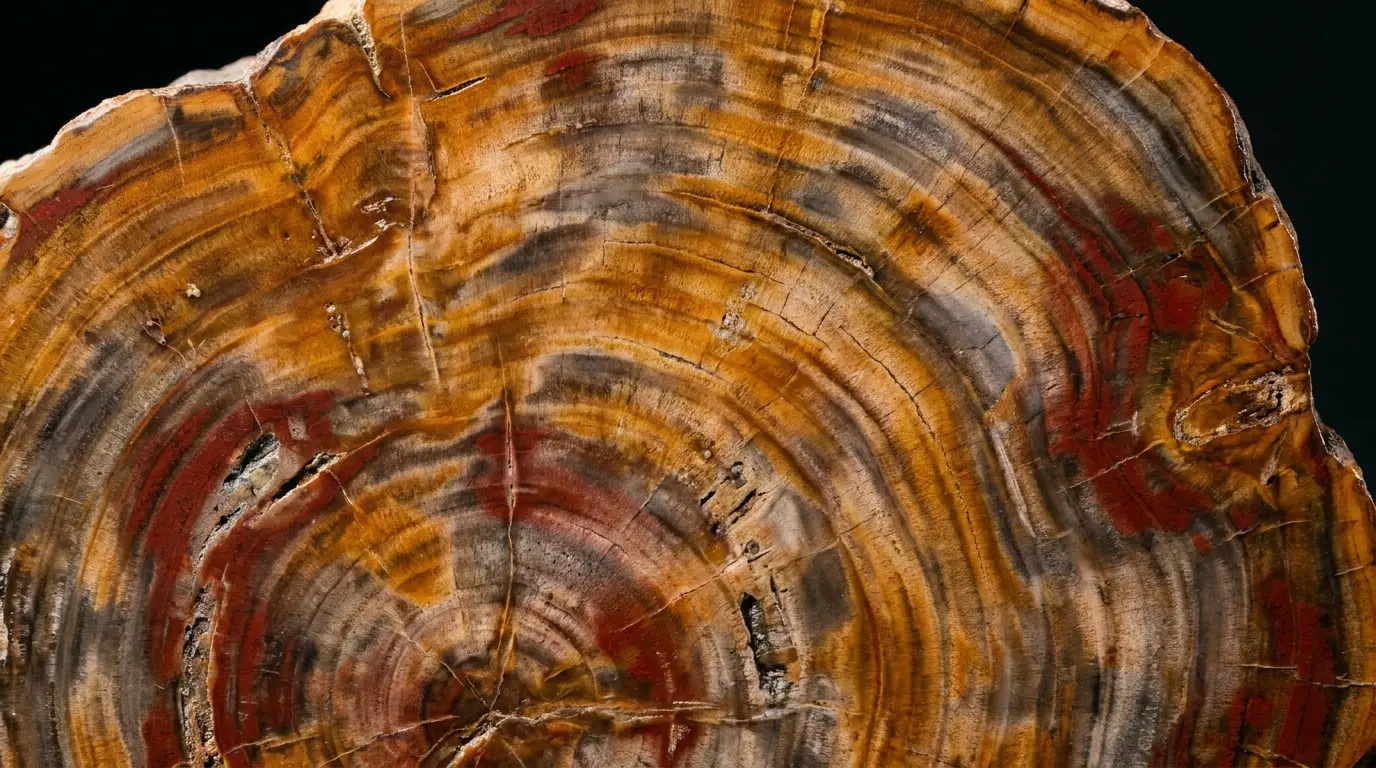
Petrified wood is exactly what its name suggests, and something far stranger. It is a tree — a real one, with bark, growth rings and knots — that has become stone. Not fossilised in the sense of an imprint left behind, but transformed cell by cell, the original wood replaced by mineral so faithfully that the microscopic structure of the living plant remains legible under polish.
The word comes from the Latin petra, stone. What you hold in your hands is no longer organic matter. It is quartz that has taken the shape, the grain and the memory of a tree that stood roughly 230 million years ago, during the Triassic period.
That gap in time is the first thing to sit with. When these trees were alive, dinosaurs had not yet reached their full reign. The continents wore different names and different shapes. And yet the ring you can trace with a fingertip on a polished slab was laid down by a single growing season, one summer among millions, preserved with an accuracy that no drawing could match.
How Wood Becomes Stone
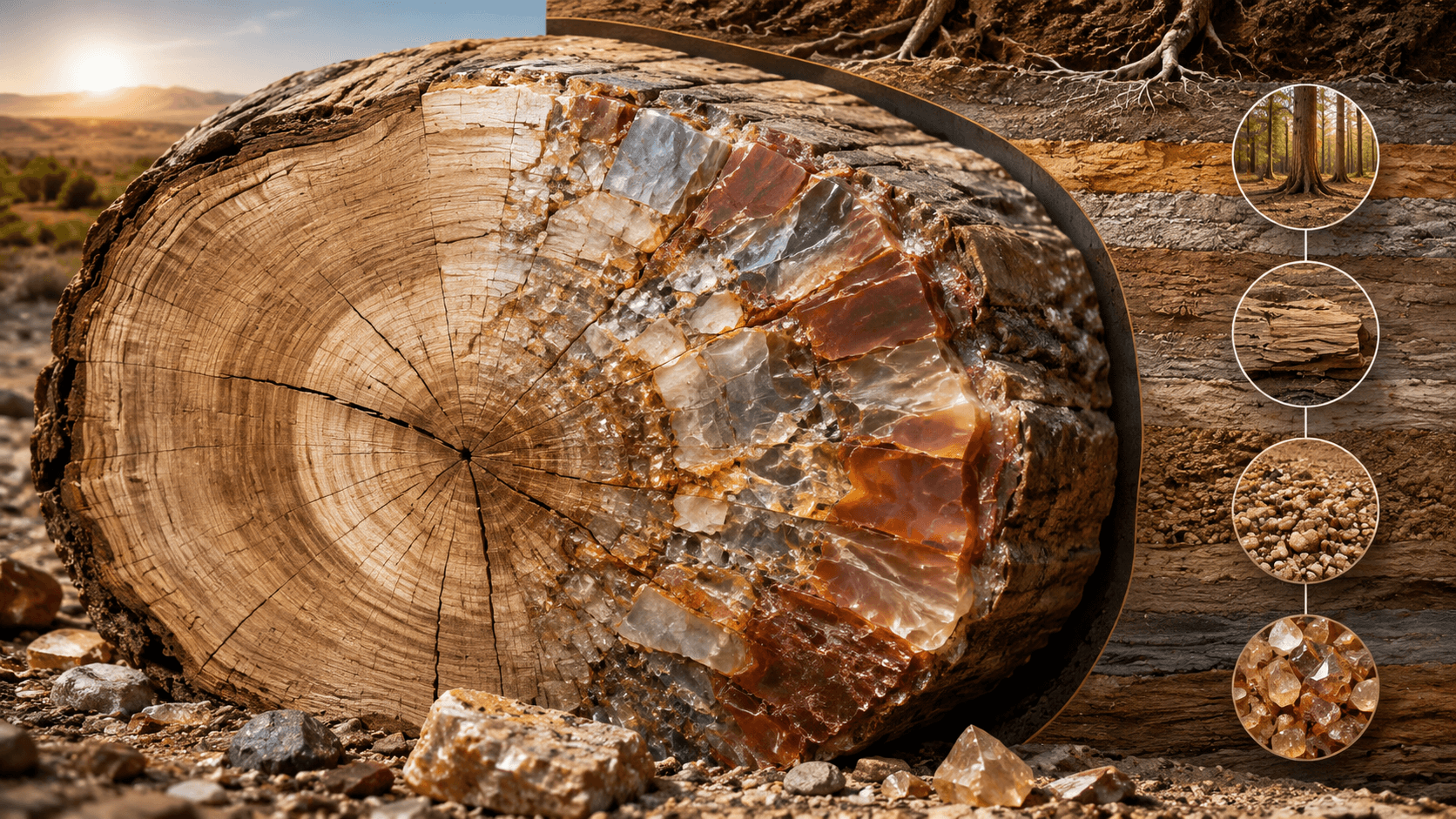
The process is called permineralisation, and it depends on an accident of burial. A tree falls and is quickly covered — by volcanic ash, by river sediment, by mud — before it can rot in open air. Cut off from oxygen, decay stalls.
Then groundwater takes over. Charged with dissolved silica, it seeps through the buried trunk. Molecule by molecule, silica precipitates inside the wood's cellular walls and empty spaces. Over an immense span of time, the organic material breaks down and departs; the mineral stays, holding the exact form it inherited.
- Rapid burial protects the wood from rot and physical destruction.
- Silica-rich water infiltrates the structure with patience, not speed.
- Molecular replacement preserves cells, rings and grain rather than crushing them.
- The result is quartz — hard, dense and permanent — in the shape of a tree.
This is why petrified wood is heavy and cold to the touch, and why it behaves nothing like timber. It is stone through and through.
It is not wood remembering that it was once alive. It is stone that has learned the shape of life and refuses to forget it.
Where It Comes From: The Southwest of Madagascar
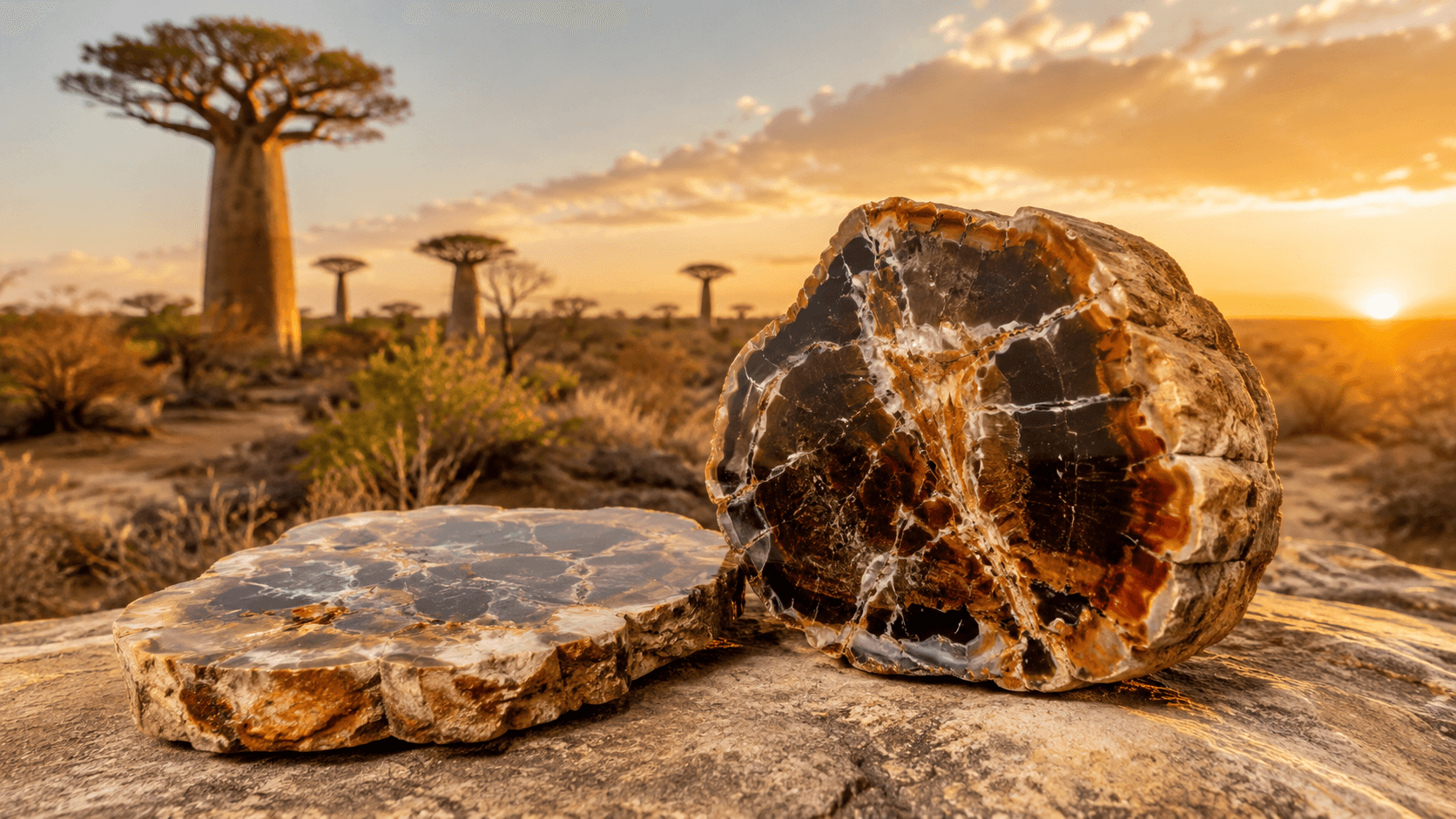
The petrified wood at Medusa comes from a single region: the southwest of Madagascar. There, entire forests were buried and mineralised in the Triassic, and the earth still holds their trunks intact.
We do not buy tonnage. Each trunk is raised from the ground one by one, whole, as an individual. This distinction matters more than it may first appear. A trunk is not a raw material to be portioned out like a quarried block of marble; it is a specific tree, with its own dimensions, its own bark, its own internal palette. When it comes up from the ground, it comes up as itself.
Because of this, no two Medusa pieces are ever truly alike. A table drawn from one trunk cannot be reproduced from another. The colour, the grain, the way a knot interrupts the rings — all of it belongs to that single tree and to no other.
Why It Wears Colour
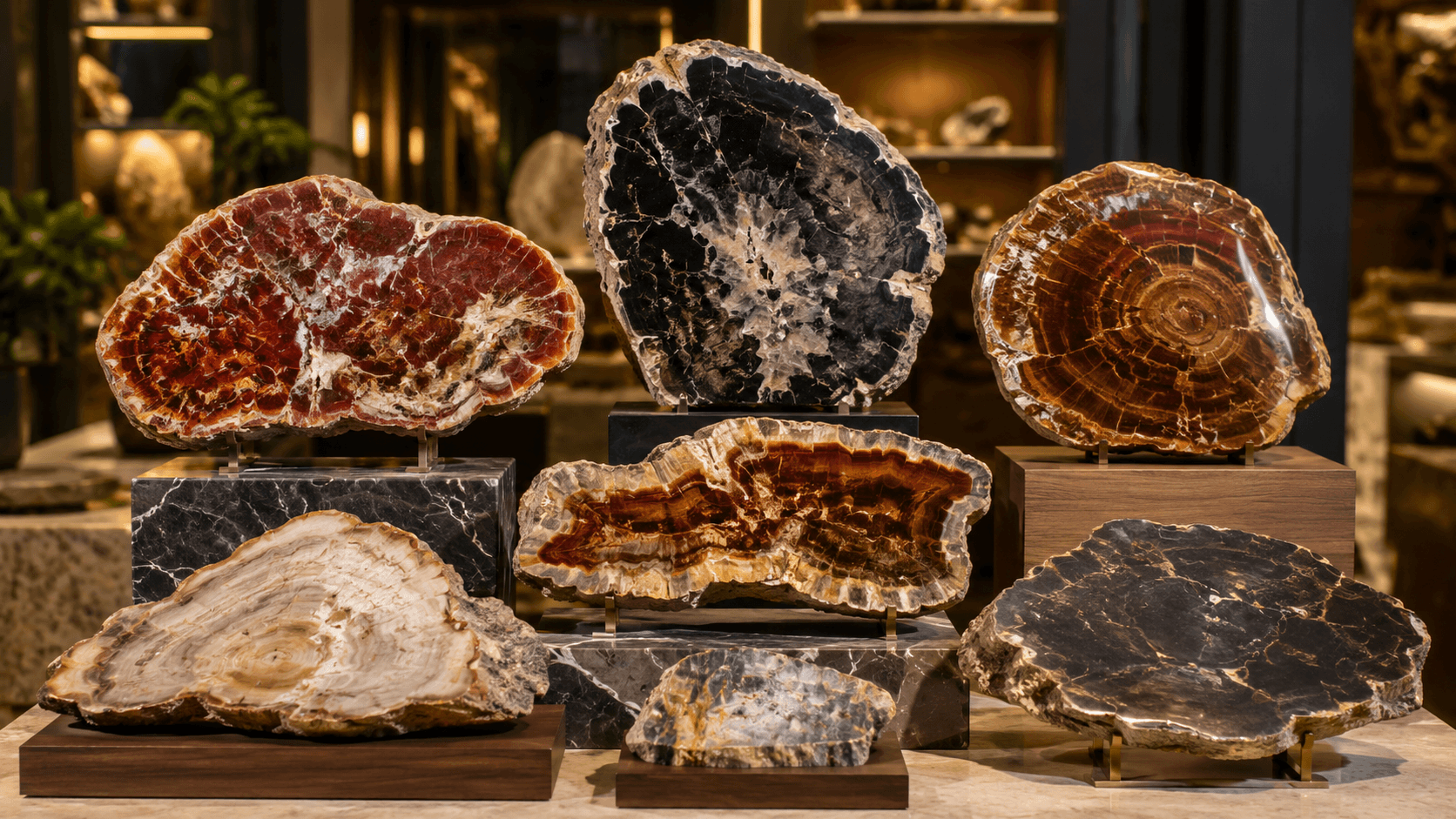
The colours in petrified wood are not decoration added after the fact. They are a record of chemistry. As silica filled the wood, trace metals travelled with the groundwater and settled into the stone, each leaving its own hue:
- Iron produces reds, ochres and warm browns.
- Manganese brings blacks and violets.
- Chromium and cobalt give the rarer greens and blues.
Because the mineral bath was different for every buried trunk, every tree took on its own signature colour. This is the heart of how we think about our material, and why we give each trunk a name rather than a category.
- Ambra — amber, warm and golden.
- Argentea — silvered, cool and pale.
- Fusca — deep brown.
- Umbra — dark, shadowed.
- Viridis — green, the mark of chromium.
These are not product lines. They are individual trees. And there is a hard truth built into this: when a trunk is cut, its colour is spent. There is no second trunk with that exact tone waiting behind it. Débité once, the shade is gone for good. To choose a Medusa piece is to claim a colour that will not exist again.
The Physical Reality: Quartz, Not Timber
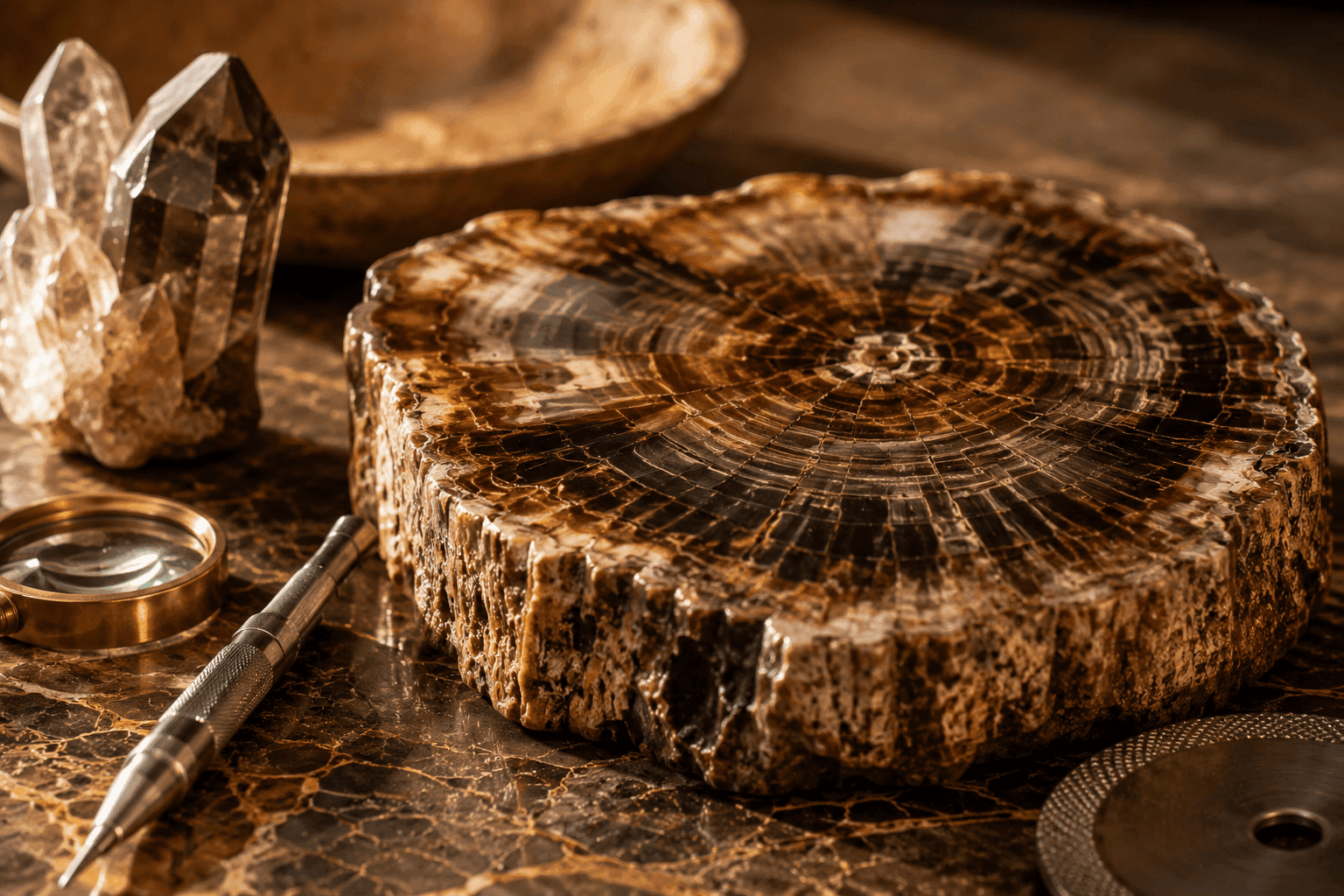
Understanding petrified wood as quartz explains everything about how it lives in a home. It measures 7 on the Mohs scale of hardness, harder than a steel blade and than most things it will ever meet in daily use.
Its behaviour follows from its nature:
- Water leaves no mark. A vessel carved from it is entirely at ease with liquid.
- Heat does not trouble it. It was born of geological time; a hot dish is nothing.
- UV does not fade it. The colour is mineral, not pigment, and sunlight cannot bleach it.
- Frost does not crack it. It endures outdoors as calmly as indoors.
This permanence is why we shape petrified wood into pieces meant to be used, not merely admired from a distance — tables, basins, objects that will outlast the rooms they stand in.
From Trunk to Object
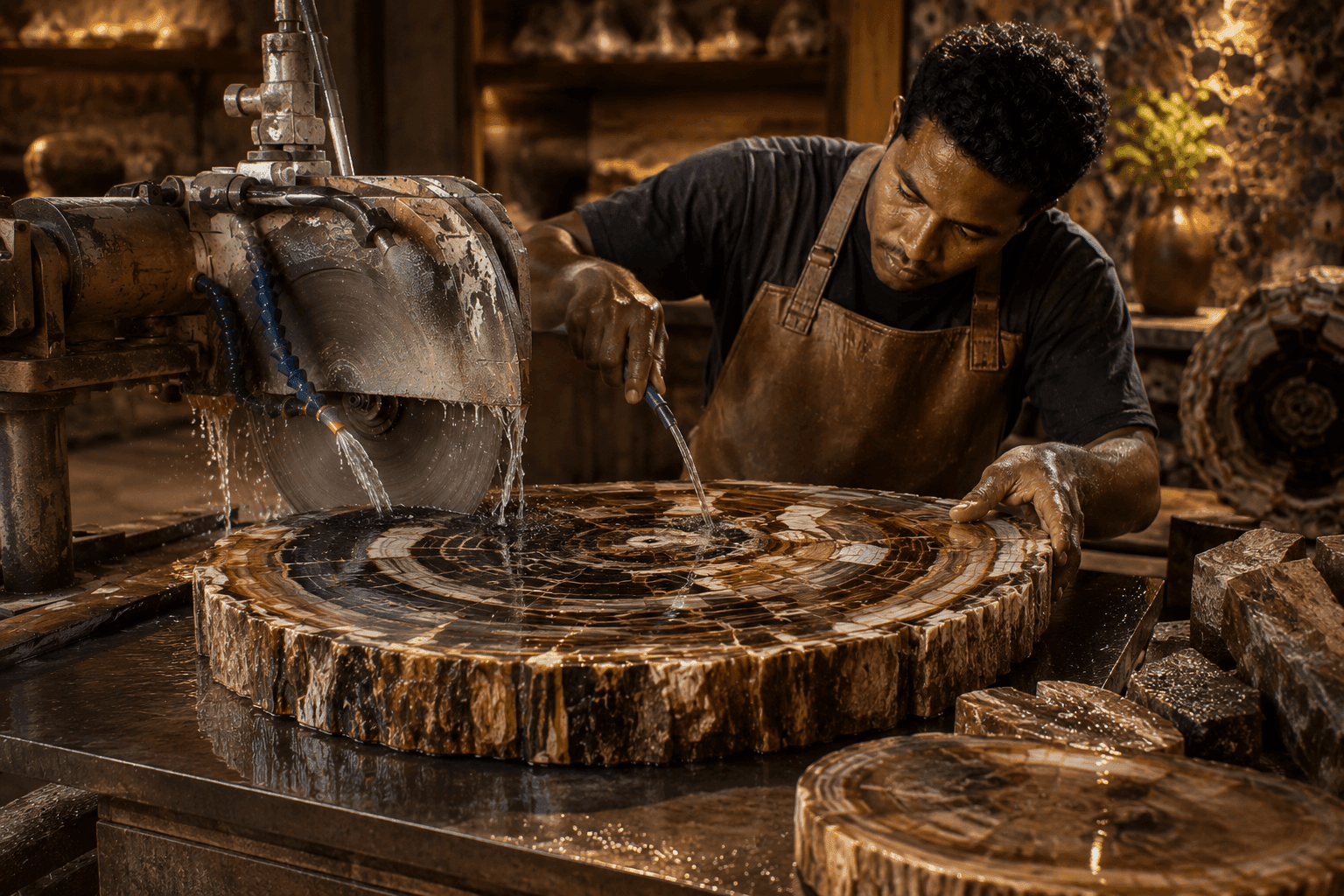
Working a material this hard is unforgiving. Petrified wood is cut and polished with diamond tooling, slowly, because a mistake cannot be sanded away as it could in timber. The artisan reads the trunk first — its rings, its fractures, the direction of its grain — and decides where the stone wants to open.
A polished surface reveals what raw stone conceals: the fine detail of the growth rings, the contrast of the veins, the depth of the colour laid down by ancient water. The craft does not invent any of this. It uncovers what the tree and the earth spent 230 million years composing.
The finished piece — a table, a basin, a sculptural block — carries the name of its trunk. It remains that individual tree, now brought into a living space.
Discover the named trunks currently available and find the one that belongs in your home.
Explore the collectionFrequently Asked Questions
Is petrified wood real wood?
No — not any longer. It began as a real tree, but the organic material has been entirely replaced by silica. What remains is quartz that preserves the tree's structure. It is stone, with the shape and grain of wood.
How old is petrified wood?
The petrified wood we work with dates to roughly 230 million years ago, the Triassic period. Each trunk was buried, cut off from decay, and slowly mineralised over an immense span of time.
Can petrified wood be used for tables and basins that get wet?
Yes. Because it is quartz, it is indifferent to water, heat, UV light and frost. A basin or table made from it can be used freely indoors or out, with no risk of staining, warping or fading.
Are two petrified wood pieces ever identical?
No. Each Medusa piece comes from a single trunk lifted whole from the southwest of Madagascar, with its own colour and grain. Once a trunk is cut, its exact shade is gone — it cannot be reproduced from another tree. For pricing on a specific piece, please consult us for a quote.