
What Petrification Actually Means
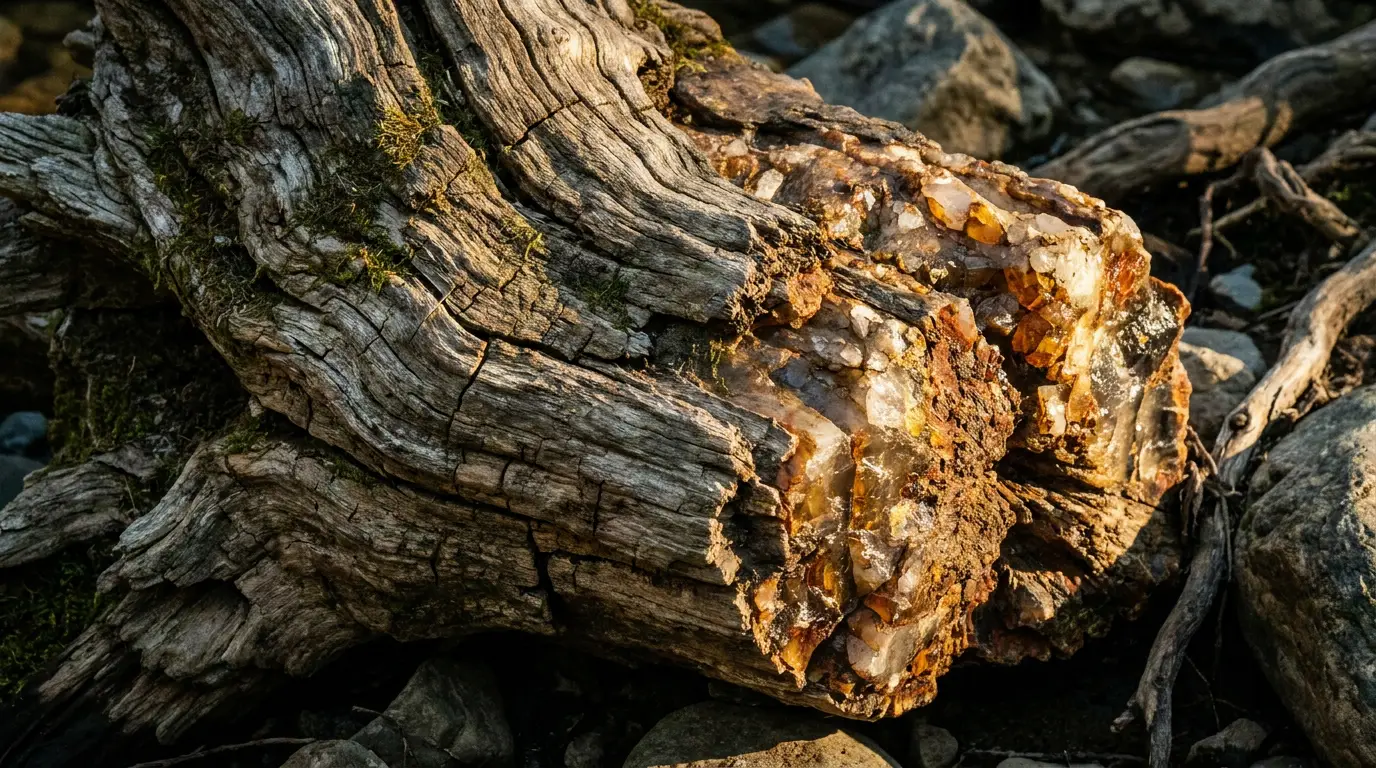
Petrified wood is not wood that has hardened over time. It is wood that has disappeared, replaced cell by cell by silica until nothing organic remains. The word "petrified" comes from the Greek petra, stone — and that is precisely what stands in your living room: not timber, but rock that remembers the shape of a tree.
The process answers a question we hear often — how does petrified wood form? The short version: a tree falls, is buried before it can rot, and groundwater carrying dissolved silica infiltrates its tissue over geological time. The long version is more interesting, and it explains why each trunk Medusa brings back from Madagascar is unique.
The Conditions That Must Align
Petrifaction is not a guaranteed outcome for a fallen tree. It requires a narrow set of conditions to occur at all, which is part of why intact fossilized trunks remain rare.
- Rapid burial — the tree must be covered by sediment, volcanic ash, or mud quickly enough to be shielded from oxygen and the organisms that cause decay.
- Mineral-rich water — groundwater must carry dissolved silica, sourced from volcanic activity or weathering rock, and circulate through the wood's porous structure.
- Time, measured in millions of years — silica deposits gradually, molecule by molecule, replacing organic material as it decomposes.
- Pressure and stability — the burial site must remain geologically undisturbed long enough for the replacement to complete without crushing or eroding the structure.
The trunks Medusa works with come from the Trias, roughly 230 million years ago, in what is now southwestern Madagascar. That region combined ancient river systems, volcanic sediment, and long tectonic stability — a rare geological coincidence that produced one of the most significant deposits of fossilized wood on Earth.
From Cellulose to Quartz: The Chemistry
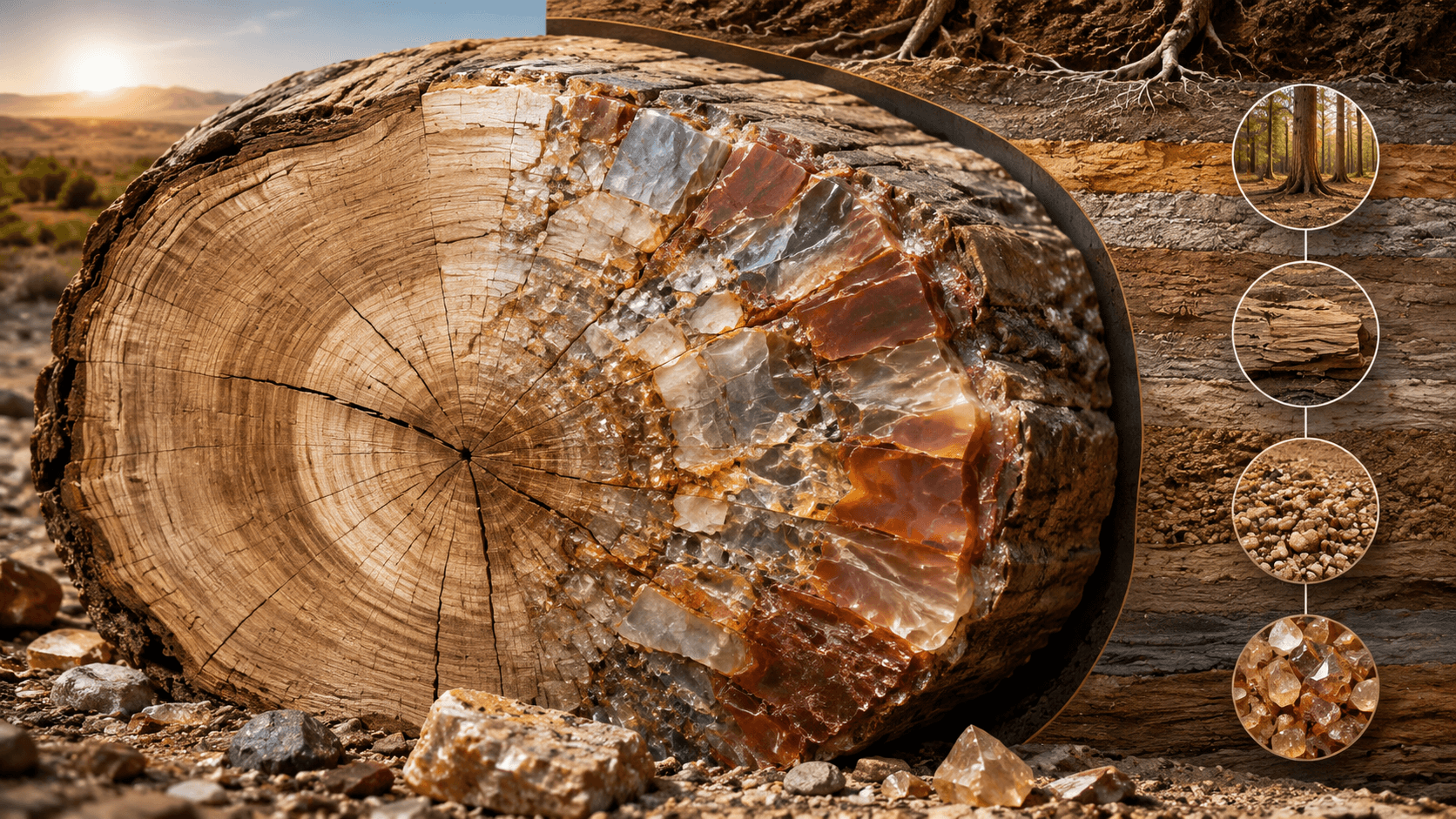
At the cellular level, petrifaction is a slow substitution. As the tree's organic tissue — cellulose and lignin — decomposes, silica-saturated water fills the resulting cavities. Over time this silica crystallizes into quartz, taking the exact form of the wood's original cell walls, growth rings, and grain.
This is why a polished cross-section still shows rings, knots, and fiber patterns with striking clarity: the stone is not an imitation of the wood's structure, it is a mineral cast of it, accurate down to the microscopic level. What began as organic matter is now, mineralogically speaking, indistinguishable from rock crystal.
The color comes from trace metals present in the water during mineralization:
- Iron produces reds, oranges, and ochres.
- Manganese produces blacks and violets.
- Chromium and cobalt produce greens and blues.
No two trunks were bathed in water carrying the exact same mineral mix, at the exact same concentration, for the exact same duration. That is why each trunk's palette cannot be repeated — a fact Medusa treats as a foundation for the way it names and presents its pieces, not a marketing detail.
Why Medusa Names Every Trunk
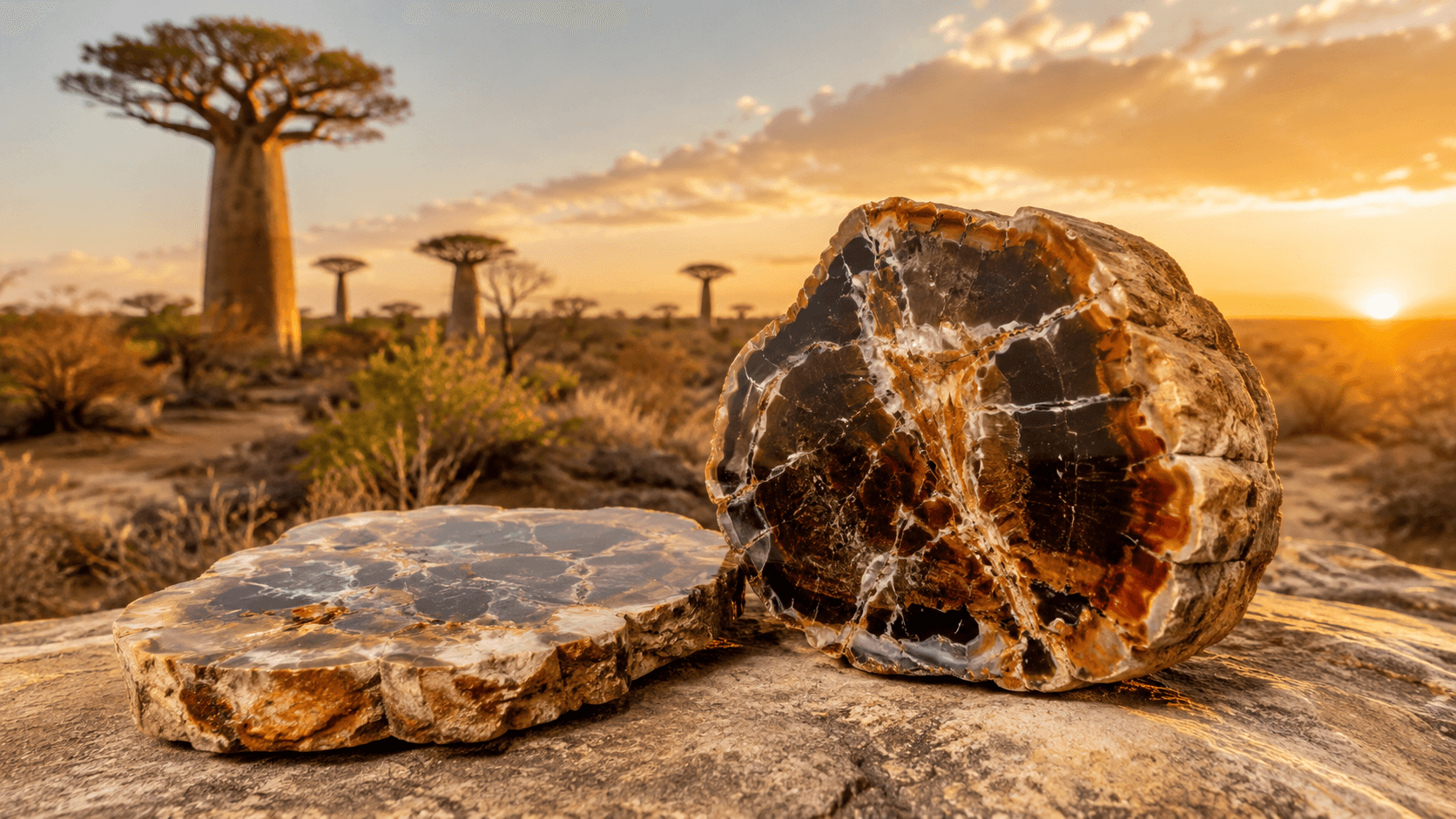
Because petrifaction is a one-time chemical event bound to a single tree, in a single location, over a single stretch of geological time, no two trunks share the same internal signature. Medusa treats each one not as raw material but as an individual: a specific tree, felled at a specific moment, mineralized by a specific water chemistry, retrieved from a specific spot in southwestern Madagascar.
That is why every trunk carries a name — Ambra for amber tones, Argentea for silvered grays, Fusca for deep browns, Umbra for near-black density, Viridis for the rare greens born of chromium and cobalt. These are not product categories. They are individual trees, and once a trunk is cut, its particular balance of color and vein is gone for good. What you place in your home is not a style choice from a catalogue — it is a specific fragment of a specific tree that no longer exists anywhere else.
A tree falls once. It is mineralized once. Cut it, and that exact color is gone forever.
How Long Does It Actually Take?
This is where the geological timeline matters more than any marketing claim ever could. Petrifaction is not fast by any human measure — it unfolds across spans that make the word "aging" feel almost comically inadequate.
The Madagascar trunks Medusa sources date to the Triassic period, around 230 million years ago. The mineralization itself — the silica replacement process — is understood to have taken place over thousands to tens of thousands of years following burial, though the exact duration varies by site, water flow, and burial depth. What is certain is the outcome: 230 million years later, the result is a stone measuring 7 on the Mohs hardness scale, structurally quartz, and entirely indifferent to water, heat, UV exposure, or frost.
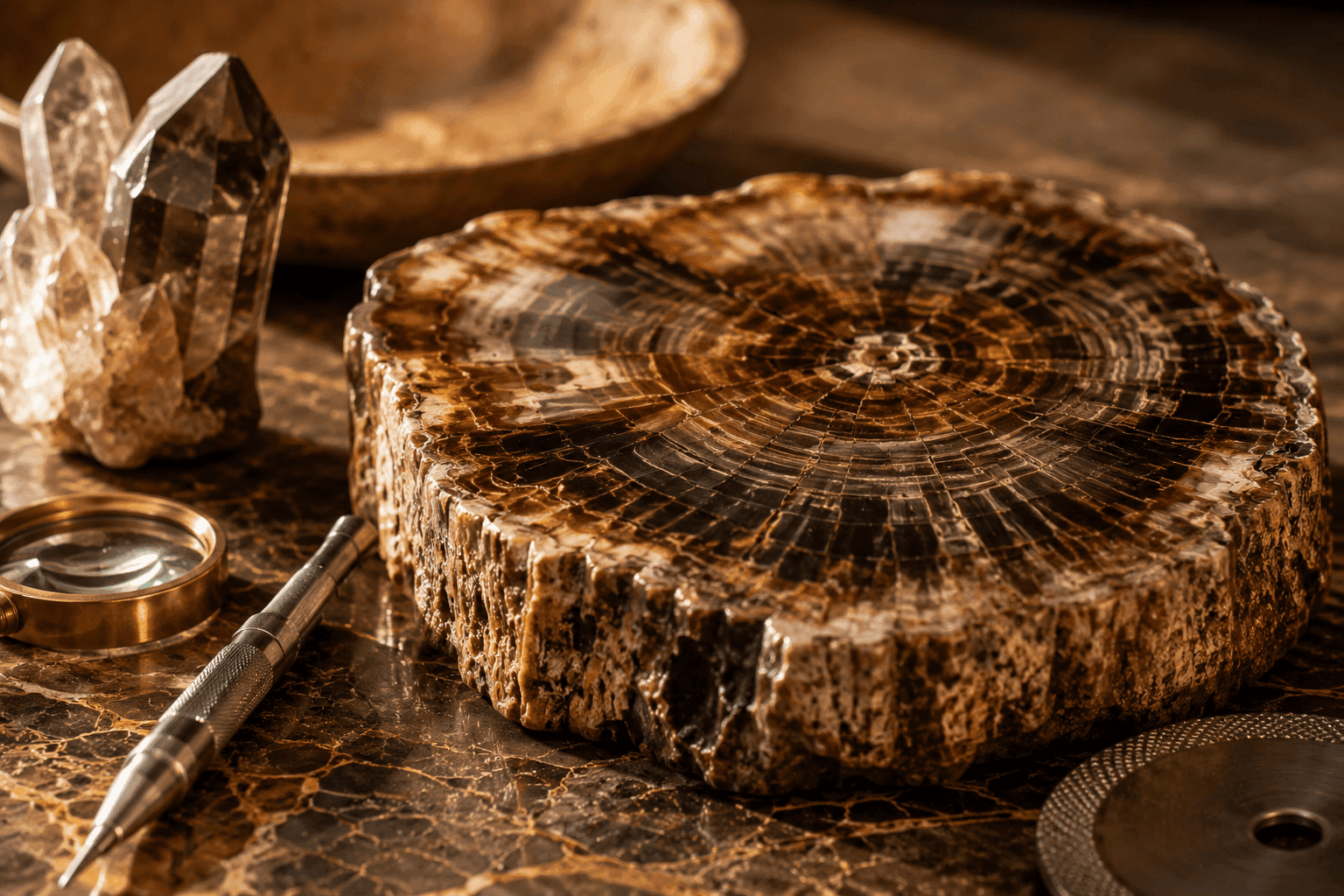
That hardness is the practical payoff of the timeline. A tabletop or basin cut from this material will not scratch under normal use, will not fade in sunlight, will not warp near a heat source, and will not be affected by standing water. It behaves, in every functional sense, like the mineral it has become.
From Fossil to Object
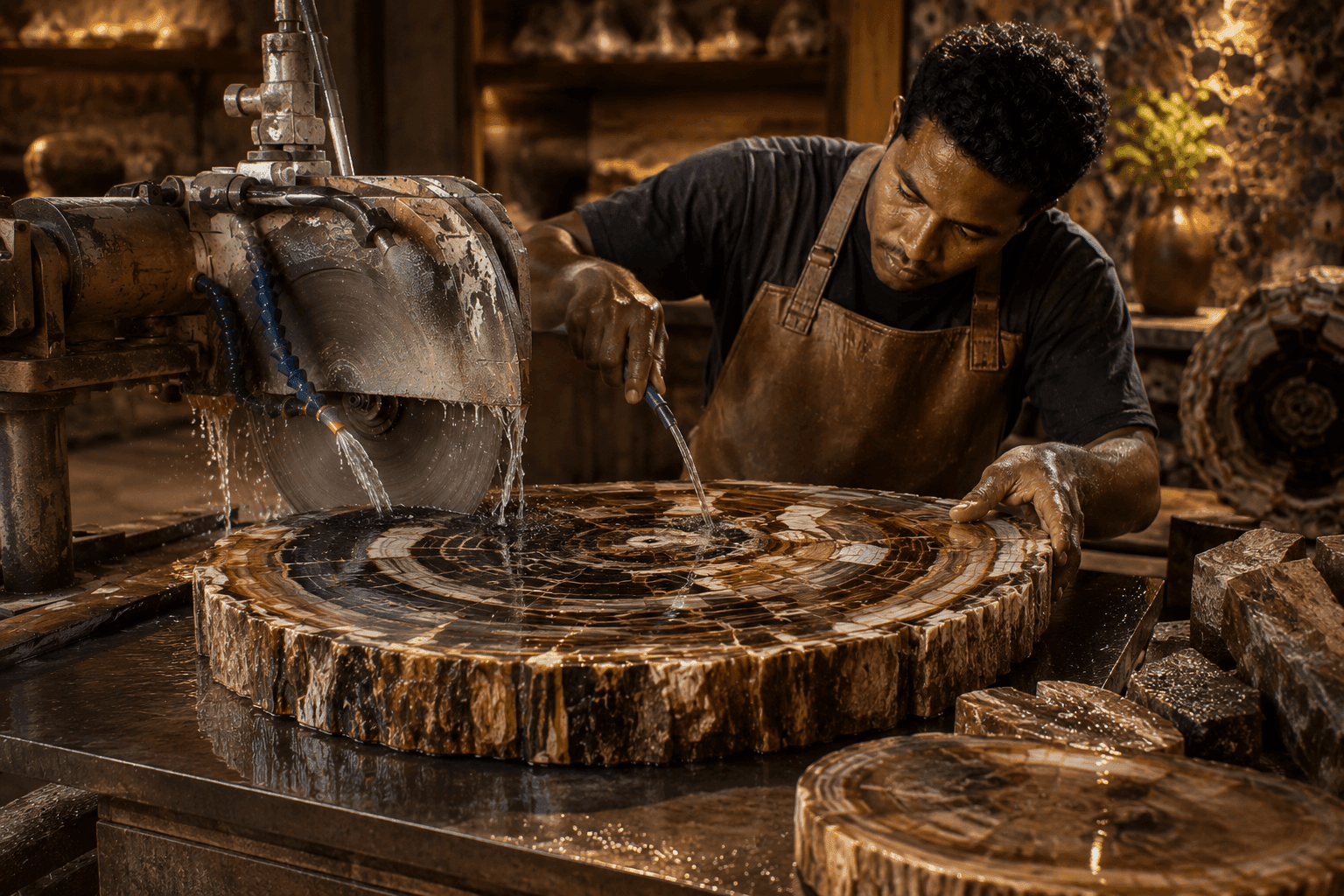
Once a trunk is retrieved, transforming it into a table, a basin, or a decorative object is a craft in itself. Because the material is quartz, standard woodworking tools are useless — cutting and polishing require diamond-tipped blades and considerable patience. Each piece is shaped to reveal, not disguise, the internal structure: the rings, the veining, the color gradients particular to that one tree.
The result sits somewhere between furniture and natural specimen. A basin carved from a Fusca trunk or a low table from an Umbra section carries the density and cool touch of stone alongside the organic silhouette of the tree it once was.
Discover the individual trunks currently available, each named and unrepeatable.
Visit the ShopFrequently Asked Questions
How does petrified wood form?
A tree is buried quickly enough to avoid decay, then silica-rich groundwater infiltrates its tissue over thousands of years, gradually replacing organic cellulose with quartz while preserving the original cellular structure, including growth rings and grain.
How long does the process take?
The mineralization itself is generally understood to unfold over thousands to tens of thousands of years, depending on burial depth and water conditions. The Madagascar trunks Medusa works with are approximately 230 million years old overall, dating to the Triassic period.
What gives petrified wood its color?
Trace metals present in the mineralizing water. Iron produces reds and ochres, manganese produces blacks and violets, and chromium or cobalt produce the rarer greens and blues.
Is petrified wood actually stone?
Yes. Once mineralization completes, the material is chemically quartz, rating 7 on the Mohs hardness scale. It is heavy, cold to the touch, and unaffected by water, heat, UV light, or frost — properties of the mineral, not the original wood.