
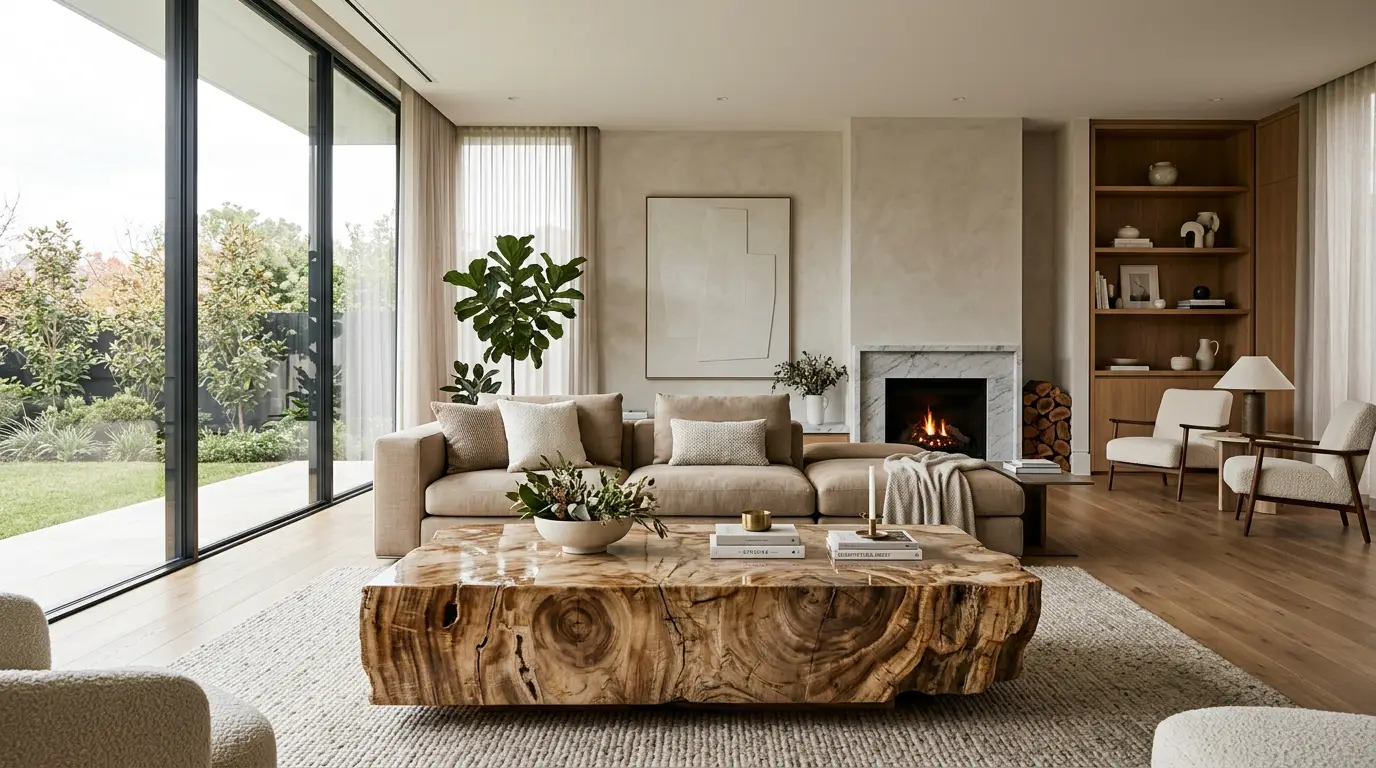
A Table Cut From a Single Tree
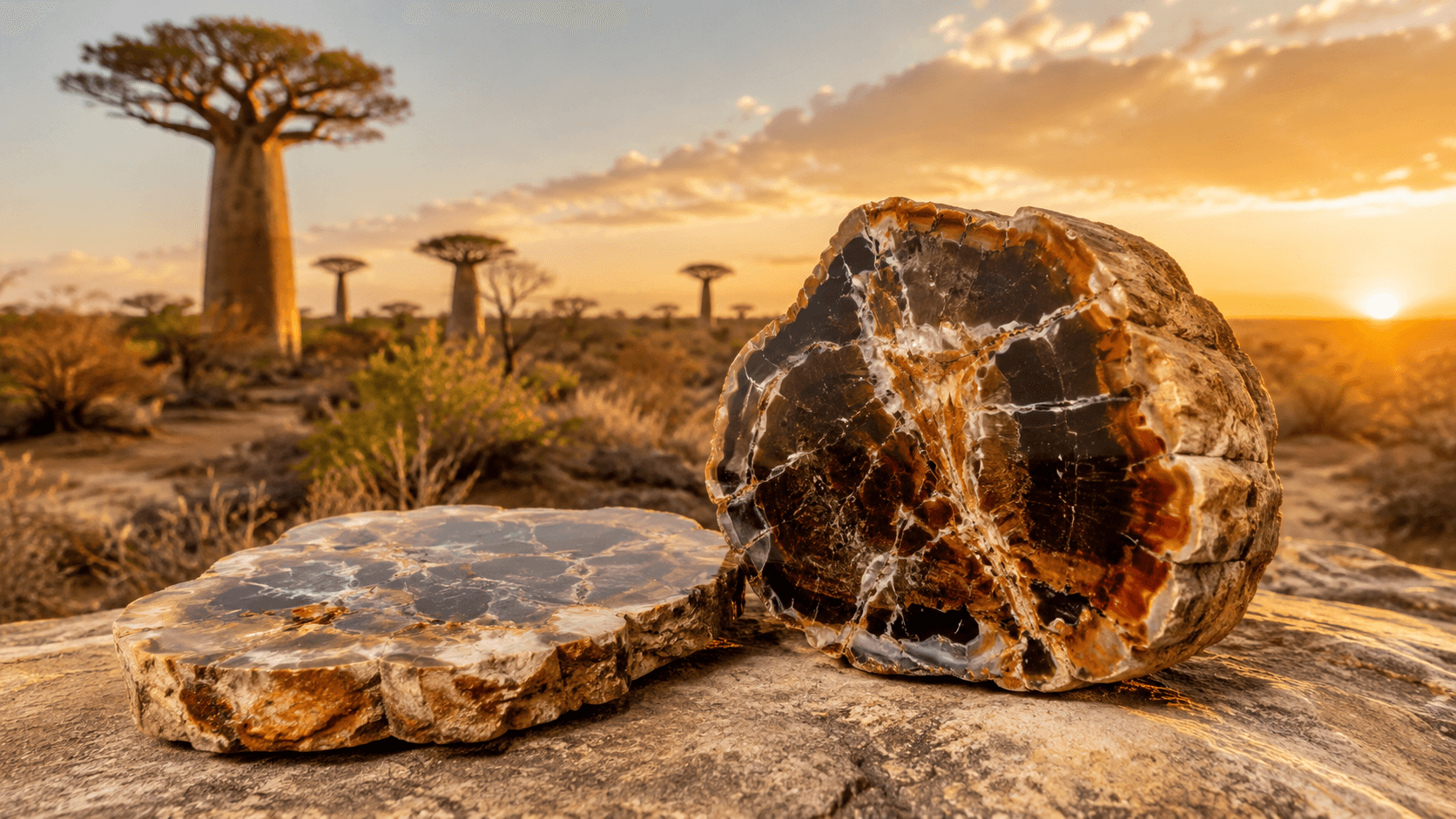
A round petrified wood table is not assembled. It is revealed. Somewhere in the sandstone of southwestern Madagascar, a single trunk lay buried for roughly 230 million years, since the Triassic period. Groundwater rich in silica infiltrated its cells, replaced its organic matter molecule by molecule, and turned living wood into solid quartz. What comes out of the ground is not a material category — it is one tree, with one history, one palette, one grain.
When we cut a cross-section from that trunk and polish it into a round table, we are not choosing a shape from a catalogue. We are following the tree's own geometry: its rings, its radial cracks, its slow decades of growth made visible in stone.
Why the Round Shape Matters
A round cut is the only one that shows the tree as it truly grew. Where a rectangular slab imposes a human shape onto the wood, the disc respects the trunk's own architecture — its concentric rings, its outward radiating fractures, sometimes its bark line still faintly traced at the edge. Nothing is hidden, nothing is forced.
This is also why no two round tables from Medusa are identical, even when they come from the same tree. A single trunk sliced into several discs will yield tables with the same base color family but different vein patterns, different densities of ring, different accents of mineral color — because each slice sits at a different height and angle through the original wood.
Each Tree Has a Name
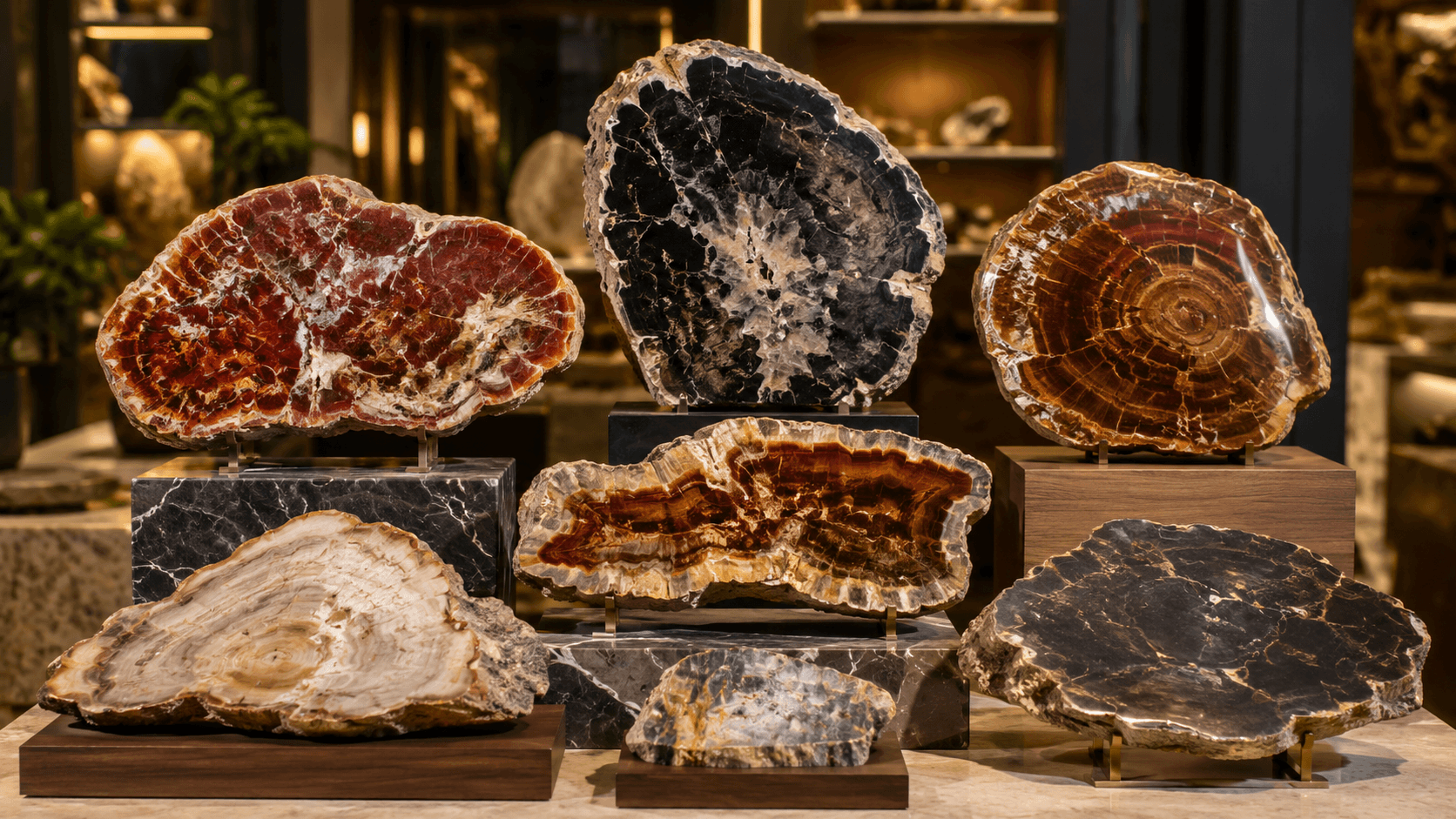
At Medusa, we do not sell "petrified wood tables" as an anonymous product line. We work trunk by trunk, and we name each one: Ambra for amber tones, Argentea for silver-grey, Fusca for deep brown, Umbra for near-black shades, Viridis for green. These are not marketing categories — they are the trees themselves, each colored by the metals that infiltrated its silica during fossilization: iron for reds and ochres, manganese for blacks and violets, chromium or cobalt for the rarer greens and blues.
Once a trunk is cut and its tables are made, that particular color signature is gone. There is no second Ambra identical to the first. This scarcity is not a sales argument — it is a geological fact we simply choose not to hide behind vague product names.
A round petrified wood table does not imitate an ancient tree. It is one.
A Stone, Not a Wood
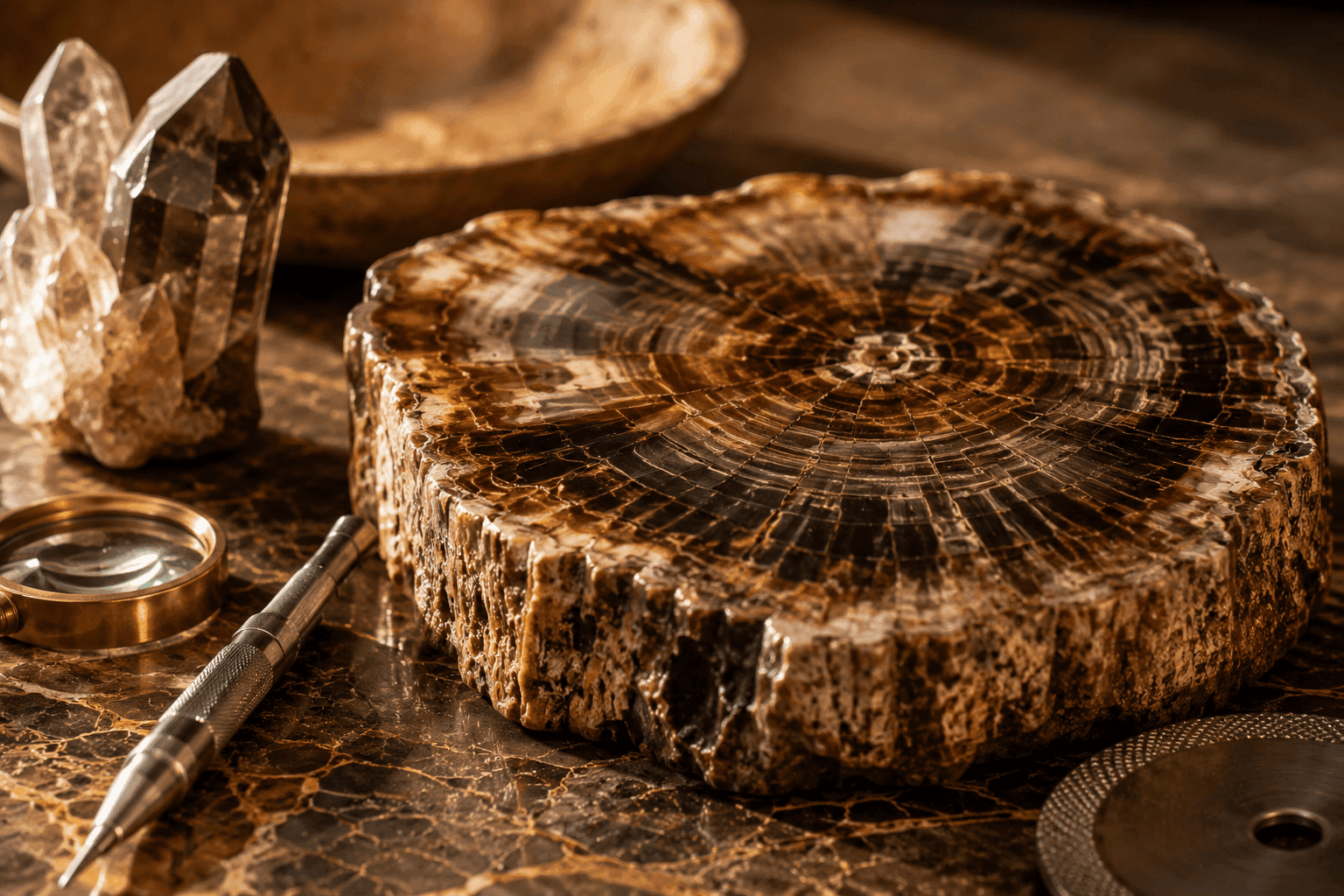
It is worth saying plainly: what you place your coffee cup on is quartz, not timber. The mineralization process has left nothing organic behind. This has direct, practical consequences for anyone considering such a table:
- Rated 7 on the Mohs hardness scale — harder than steel, resistant to scratching from daily use.
- Insensitive to water, heat, and direct sunlight — no coasters needed, no fading over years near a window.
- Unaffected by frost, which makes a round petrified wood table equally suited to a covered terrace or an entrance hall.
- Cold and dense to the touch, a sensation no wood veneer can reproduce.
None of this is decorative language. It is simply what quartz does, and has done, for 230 million years already.
From Trunk to Table
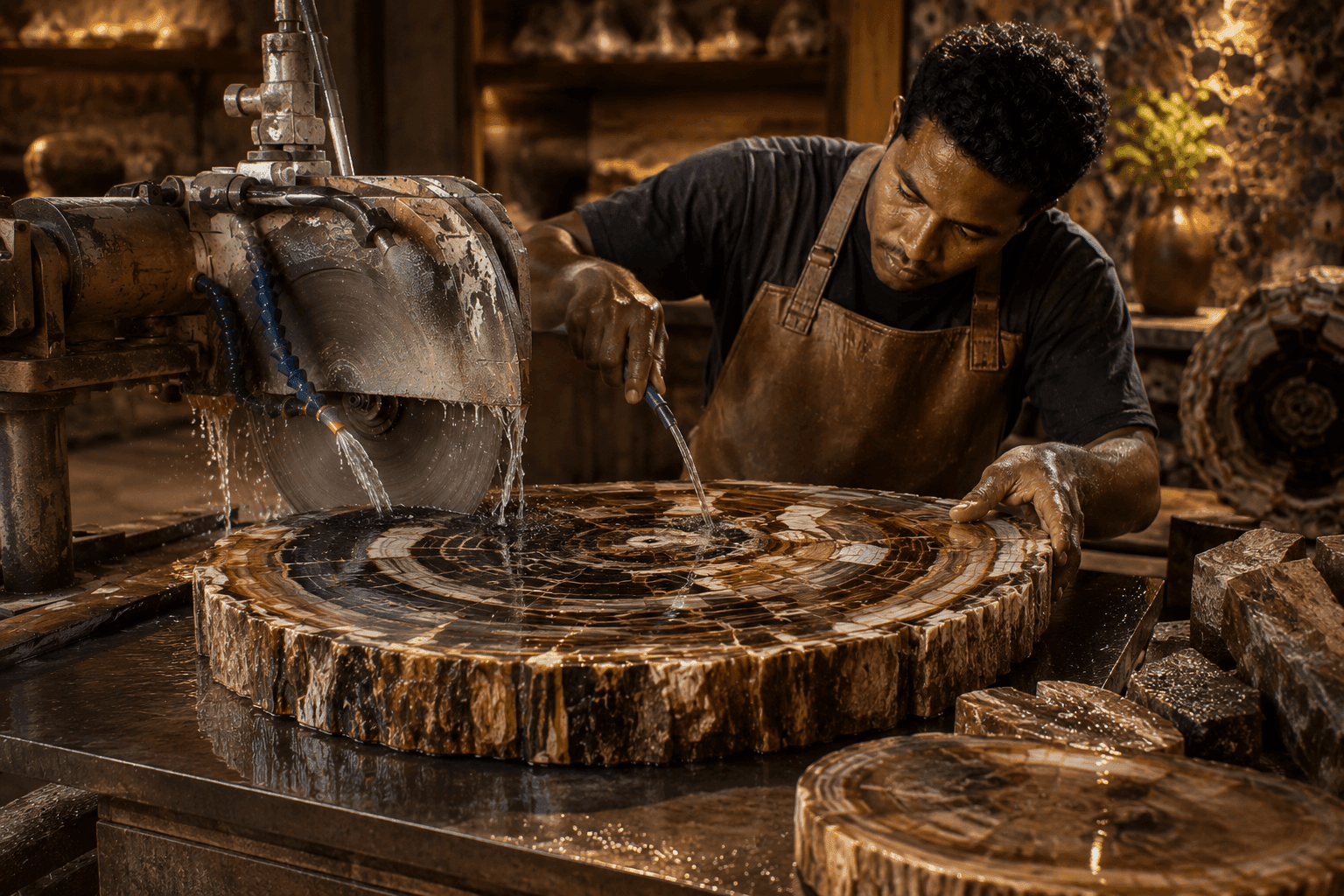
Turning a fossilized trunk into a round table is slow work. The stone is cut with diamond blades, then ground and polished in successive passes to bring out the depth of its rings without erasing the natural fractures that run through most trunks of this age. A steel or wood base is fitted to the underside, calculated for the exact weight and diameter of that particular disc — no two bases are strictly interchangeable, because no two discs weigh or balance the same.
This is also where names earn their meaning: an artisan working an Umbra trunk knows its density and its fracture pattern differ from a Viridis one. The process adapts to the tree, not the other way around.
Living With a Round Petrified Wood Table
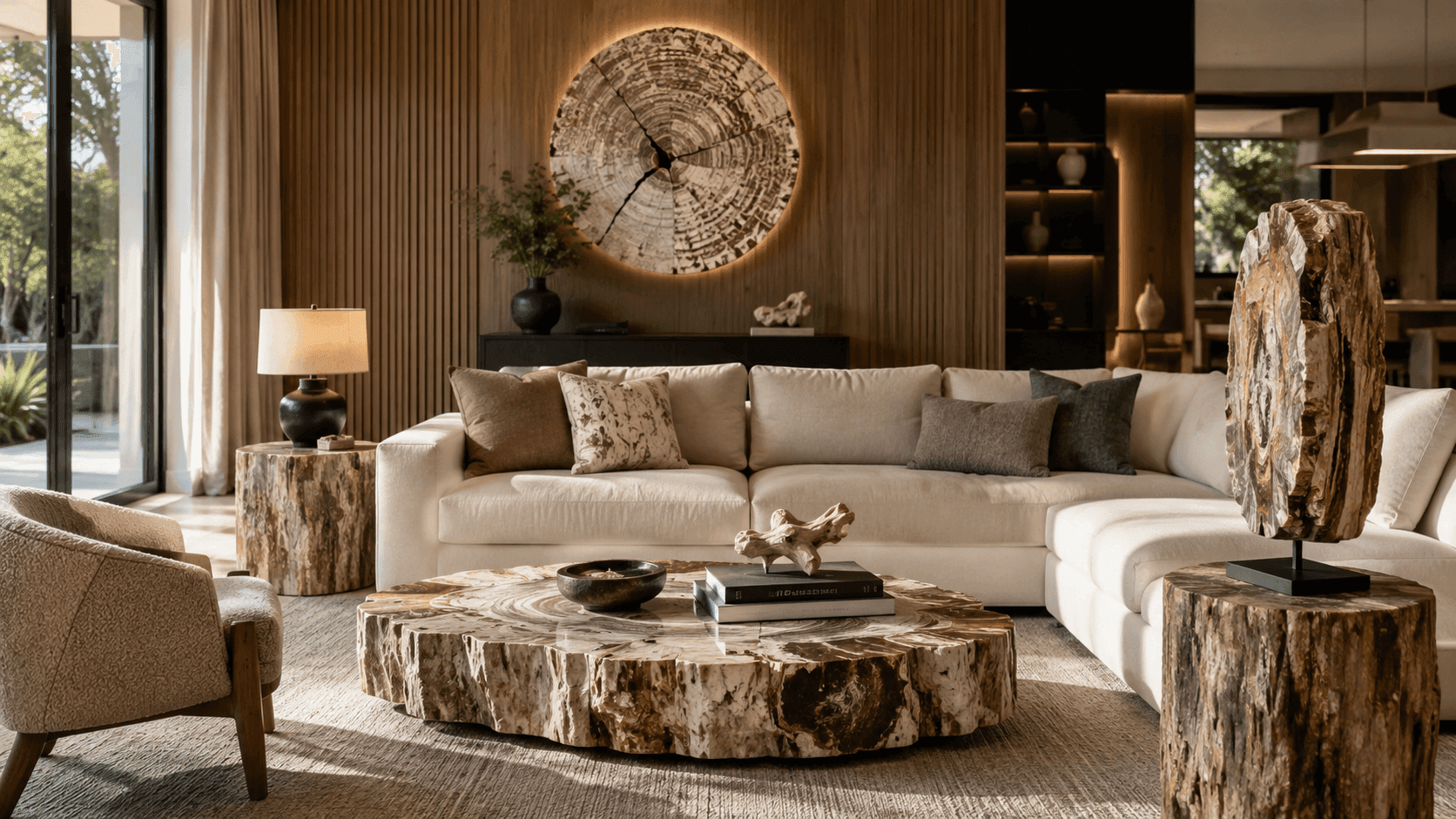
A round shape reads differently in a room than a rectangular one. It has no head, no foot, no hierarchy — which is why it works equally well as a dining centerpiece, a low table between two sofas, or a solitary entrance piece with nothing else around it. Its circular form softens a room built mostly of straight lines, and its mineral weight gives it a presence that furniture rarely has.
Because the material tolerates sun, moisture, and temperature swings, the same table can move from a shaded veranda to a living room without any change in care. There is, in practice, very little to maintain: an occasional wipe is enough.
Discover the round petrified wood tables currently available, each named after its own trunk.
View the CollectionFrequently Asked Questions
Is every round petrified wood table unique?
Yes. Each table is cut from an individual trunk with its own ring pattern, density, and mineral coloring. Once a trunk is used, its exact shade and grain cannot be reproduced.
Can a round petrified wood table be used outdoors?
The material itself withstands water, UV exposure, and frost without damage, since it is quartz rather than organic wood. The base or mount, however, should be chosen with the intended location in mind — we advise on this case by case.
How heavy is a round petrified wood table?
Weight depends on the diameter and thickness of the disc, since the material is dense quartz rather than timber. Exact weight is confirmed per piece before delivery.
Why do prices vary so much between pieces?
Each trunk differs in rarity of color, size, and condition of its natural fractures. Rather than list fixed prices, we prefer to discuss each table individually — please consult us or request a quote.