
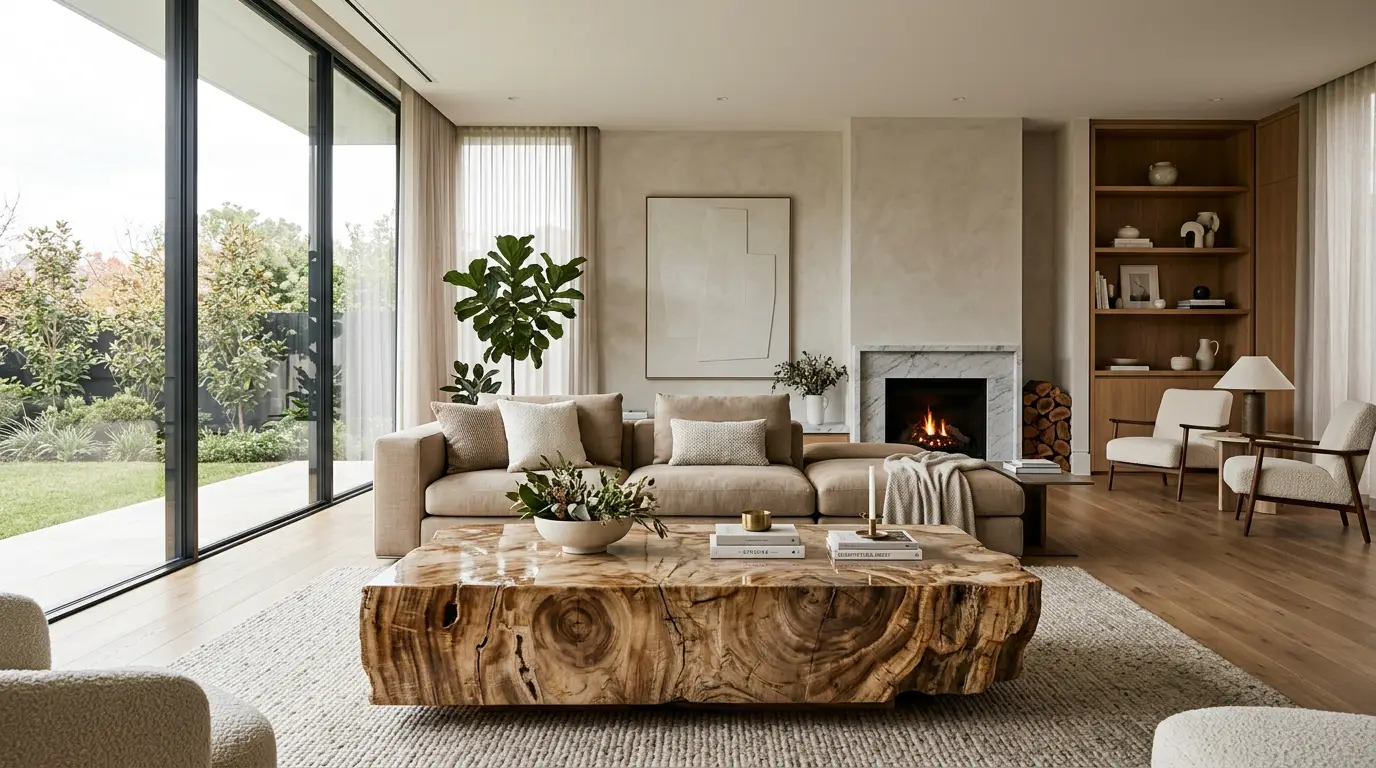
A Table Cut From a Single Tree, Not a Product Line
A petrified wood coffee table begins its life 230 million years ago, as a conifer standing in a floodplain in what is now southwestern Madagascar. Buried before it could rot, silica replaced its cell structure fibre by fibre, and the tree turned to stone without losing its shape. What you place your coffee cup on today is that same trunk — not a reproduction, not a category, but one individual tree that Medusa has named, raised, and cut once.
We don't sell "petrified wood tables." We sell Ambra, Argentea, Fusca, Umbra, Viridis — each a specific trunk with a colour that exists nowhere else, because no two trees mineralised the same way.
From Madagascar's Soil to Your Living Room
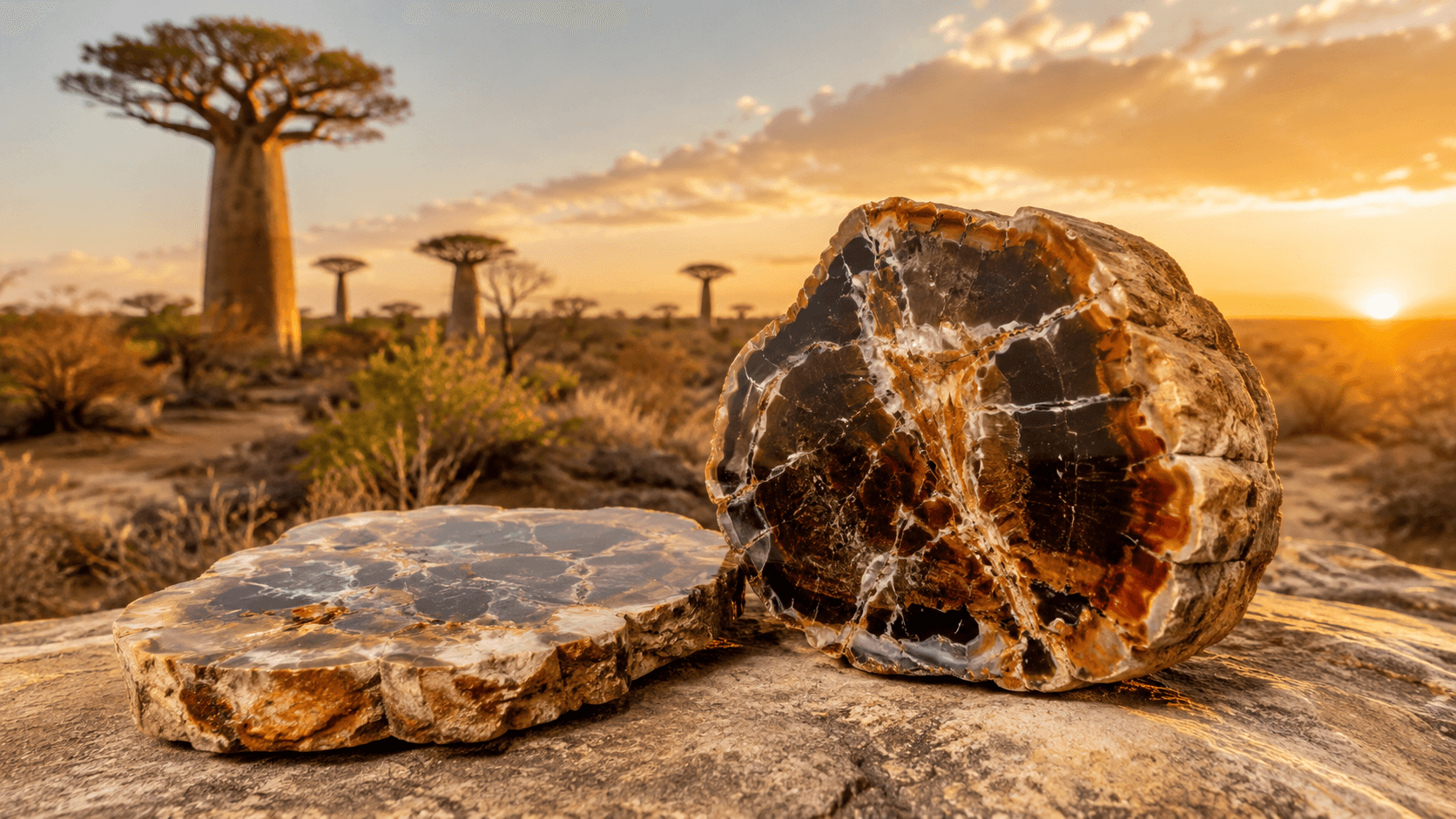
The trunks come exclusively from the southwest of Madagascar, extracted one at a time. Each block is examined before it is touched by a blade: the veining, the density of colour, the way light might travel across a future polished surface. This is the moment that decides everything, because once a trunk is cut, its particular shade is gone. There is no second Ambra.
A coffee table cut from petrified wood is therefore a decision made twice — once by geology, 230 million years ago, and once by us, standing in front of the block, choosing where the saw goes.
Why the Material Behaves Unlike Any Wood
Despite the name, there is no organic wood left in a petrified trunk. The tree's structure was fully replaced by silica — the table you own is, mineralogically, quartz. This has direct consequences for how it lives in a room:
- Hardness of 7 on the Mohs scale — resistant to scratching from keys, ceramics, or daily use.
- Insensitive to heat, water, and UV — a hot mug or a spilled drink leaves no mark; direct sunlight won't fade it.
- Cold to the touch, and dense — a coffee table of this kind carries real weight; it anchors a room rather than floating in it.
- Colour from metal, not dye — iron gives reds and ochres, manganese gives blacks and violets, chromium and cobalt give greens and blues. Nothing is pigmented; everything is mineral.
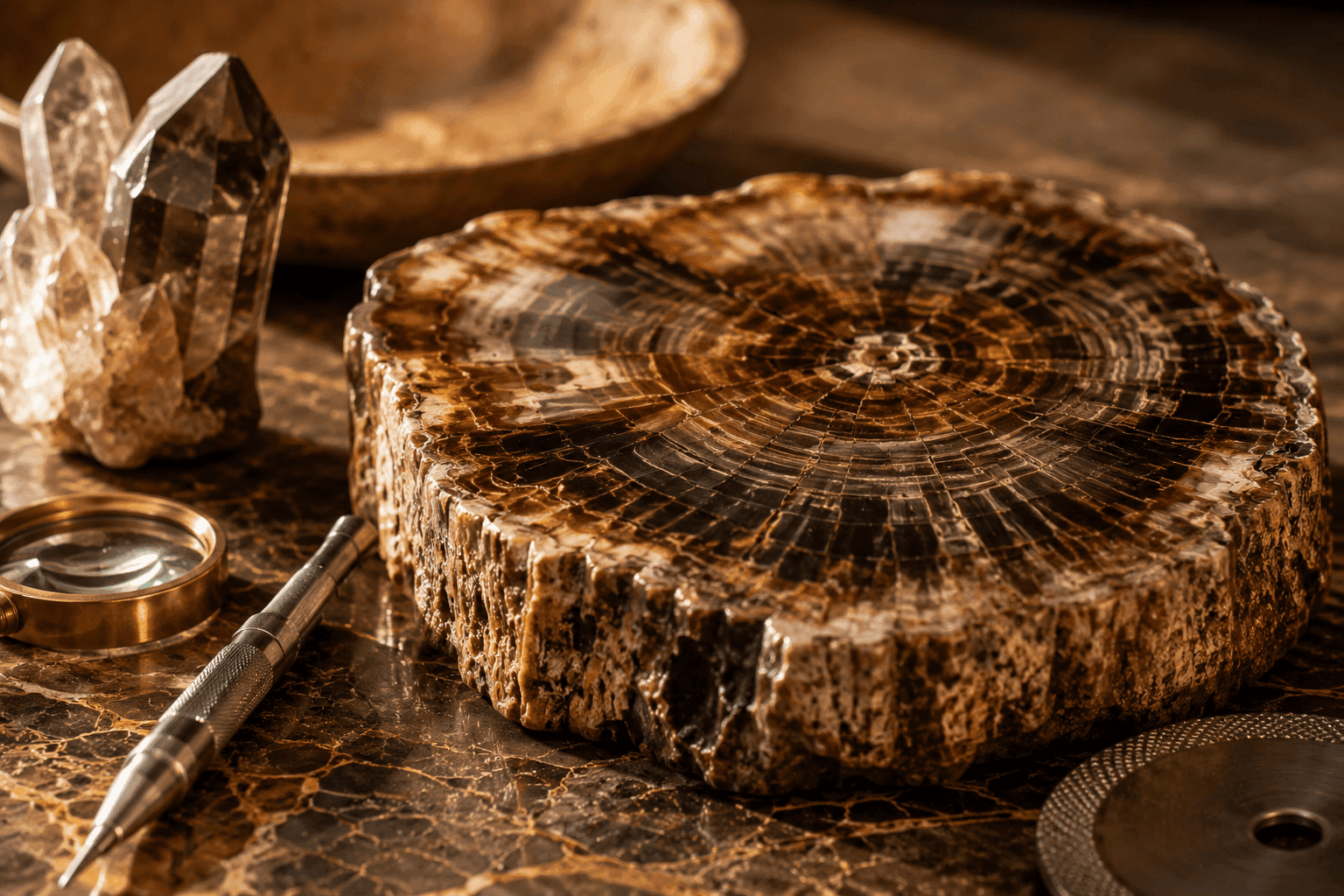
This is not a material you protect. It's a material that outlasts the furniture around it.
The Work Between the Trunk and the Table
A petrified trunk arrives as a raw, heavy mass — nothing about it suggests a coffee table yet. Cutting stone of this hardness is slow work, done with diamond blades, and every pass is a compromise between what the trunk allows and what the piece demands. Polishing follows, sometimes over days, until the internal structure — the tree's original growth rings, now frozen in mineral — comes to the surface.
A petrified wood coffee table is the only piece of furniture where the material is older than the room it stands in, older than the house, older than the idea of furniture itself.
Bases are added afterward — often blackened steel or brass, chosen to hold the slab without competing with it. The proportions of each table depend on the trunk's natural cross-section; we don't force a standard size onto material that has its own logic.
Reading the Surface: What the Colours Tell You
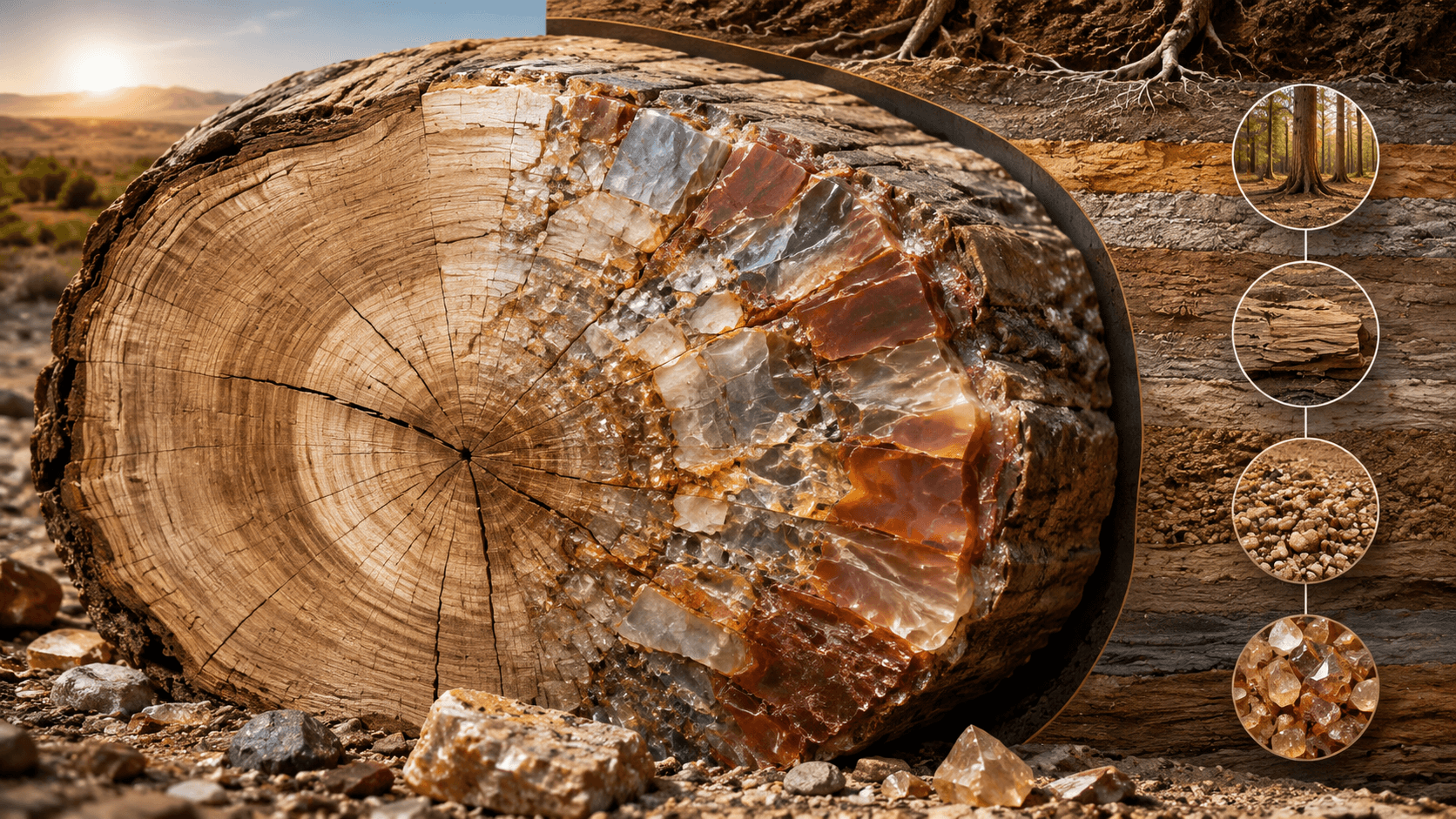
Every visible pattern on a finished tabletop is a record of the tree's original life — growth rings from wet and dry seasons, fractures filled with a different mineral, colour gradients where two metals met during fossilisation. No two slabs from the same trunk repeat exactly, and no other trunk will ever reproduce a given trunk's palette once it has been fully cut and sold.
This is why Medusa names its trunks rather than its finished tables. Ambra's honey tones, Argentea's grey-silver striations, Viridis's rare green cast — these belong to specific trees, extracted once, and once dispersed into finished pieces, unrepeatable.
Living With a Petrified Wood Coffee Table
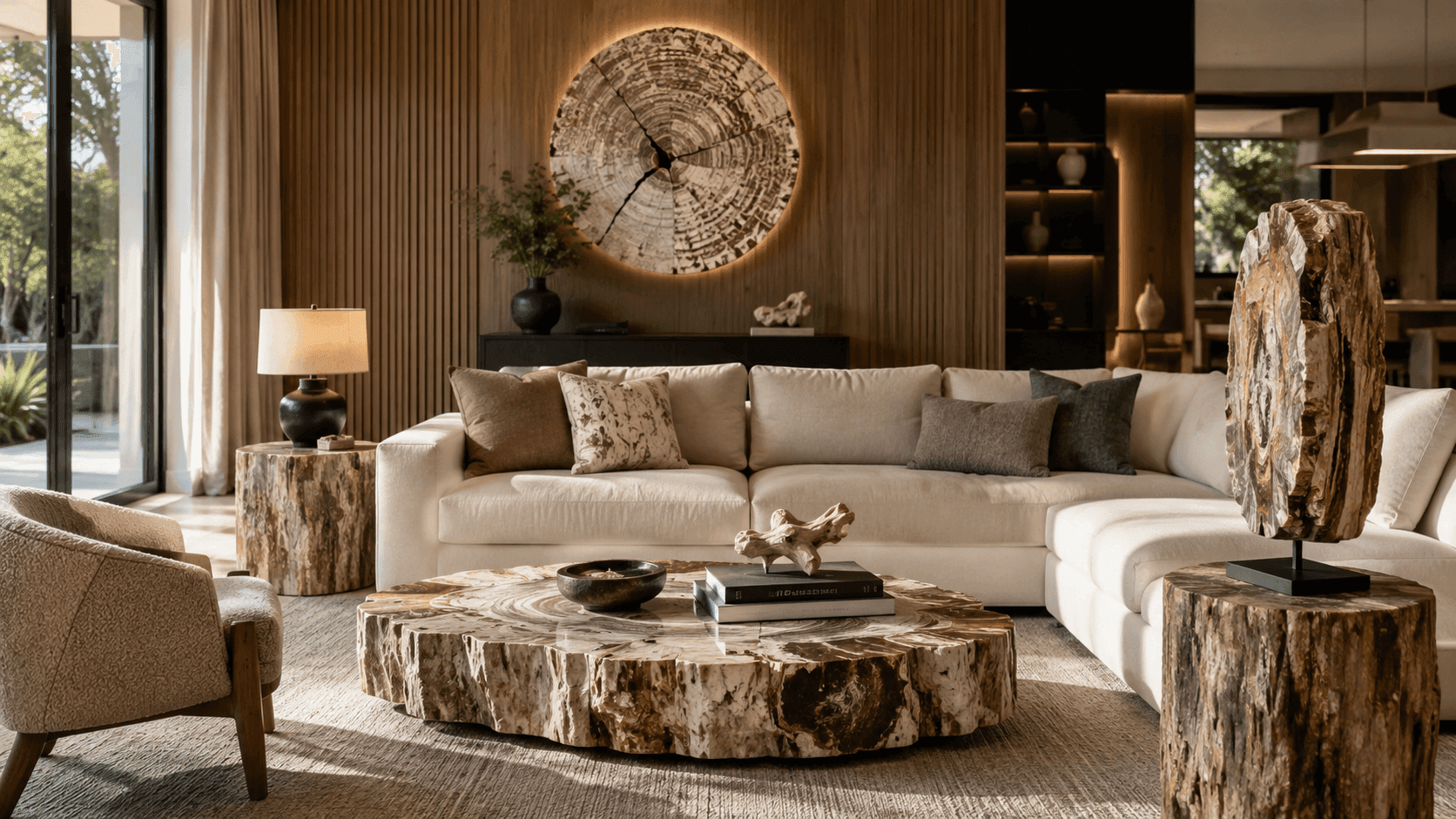
Because the material carries so much visual density, a petrified wood coffee table tends to work best as a singular statement rather than one element among many. It pairs naturally with quieter surroundings — pale walls, matte textiles, restrained metalwork — allowing the mineral surface to hold the attention it earns. Its weight also means placement is not casual: once positioned, it stays.
Maintenance is minimal by design. A damp cloth removes dust; nothing needs sealing, oiling, or protecting from the sun. The stone that has already survived 230 million years underground has little to fear from a living room.
Each trunk is available only once — see which pieces remain.
Discover the CollectionFrequently Asked Questions
Is a petrified wood coffee table actually made of wood?
No. The original wood has been entirely replaced by silica during fossilisation. What remains is quartz that preserves the tree's exact structure, including its growth rings, but chemically it is stone, not organic wood.
Can it be damaged by heat or spills?
Very unlikely. Quartz is unaffected by heat, water, and UV exposure, and rates 7 on the Mohs hardness scale, well above most household materials that might come into contact with it.
Why do Medusa's tables have names like Ambra or Viridis?
Each name refers to an individual trunk, not a product range. Every trunk has a unique colour resulting from the specific metals present during its mineralisation — once it is cut and used, that particular palette cannot be sourced again.
Where does the raw material come from?
Every trunk is extracted from the southwestern region of Madagascar, one at a time, from deposits dating back roughly 230 million years to the Triassic period.