
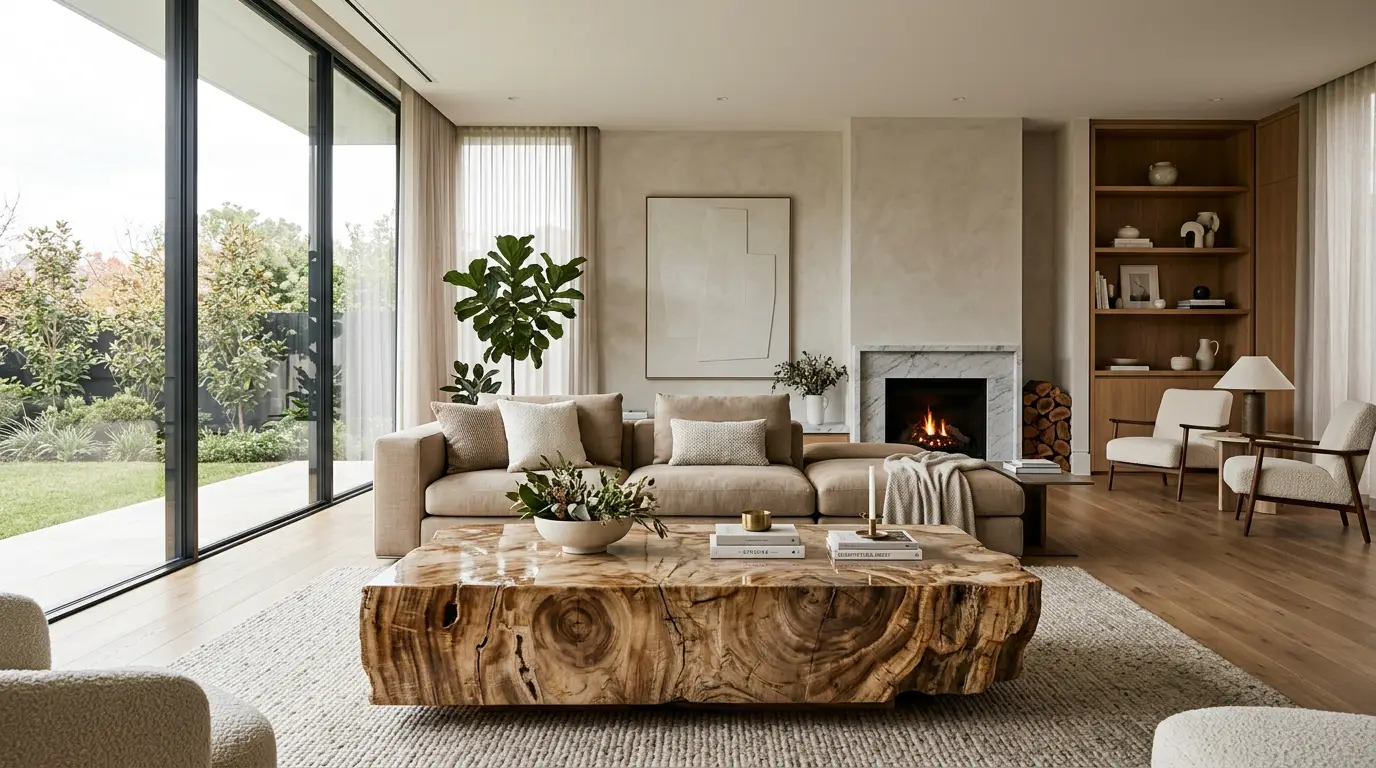
A Table That Began as a Tree, 230 Million Years Ago
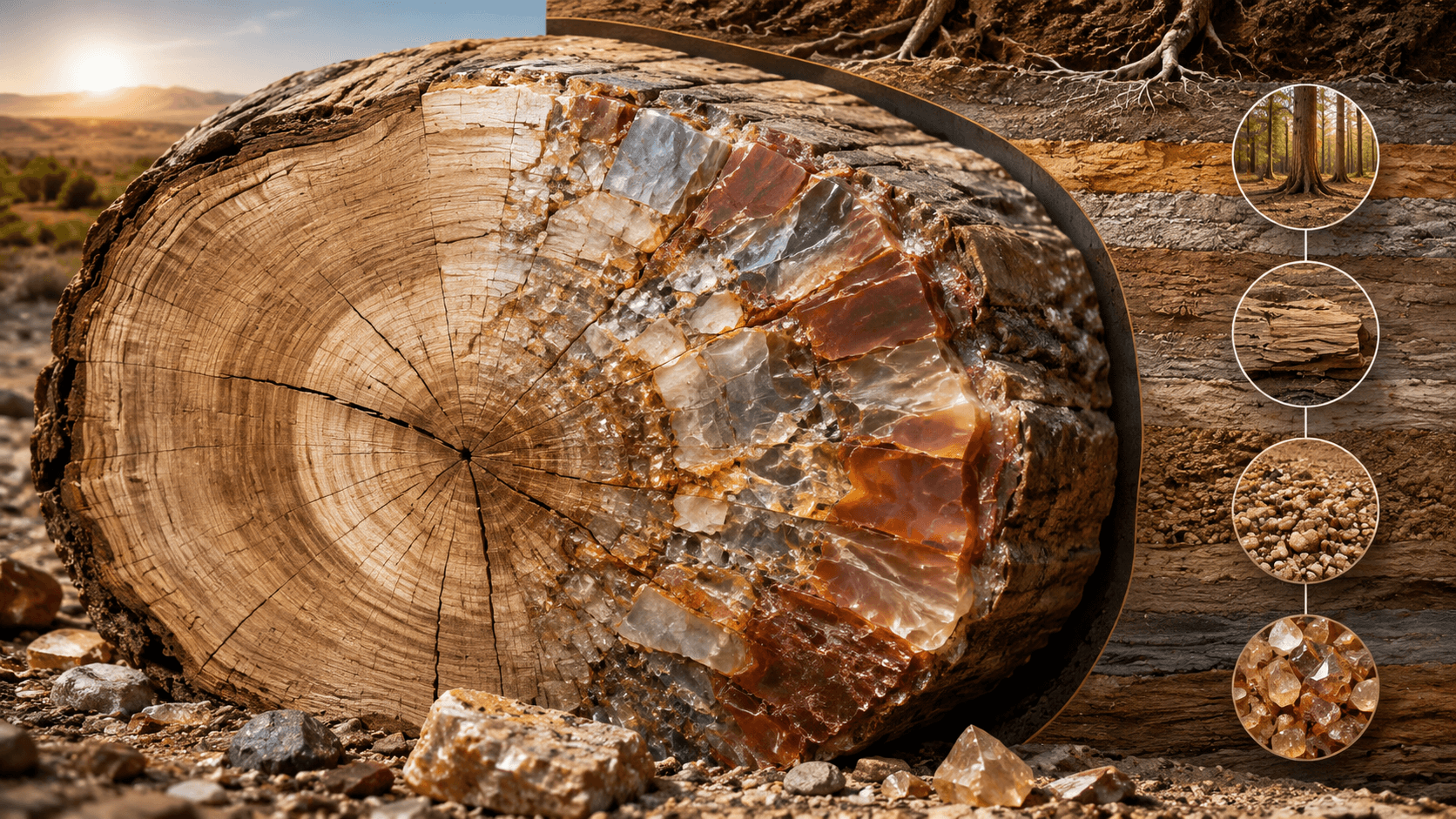
A petrified wood table is not furniture in the ordinary sense. It is the trunk of a tree that grew in the Triassic period, roughly 230 million years ago, then fell, was buried, and slowly turned to stone as mineral-rich water replaced its wood fibre cell by cell. What remains today is quartz that holds the exact shape of the original tree: its rings, its bark, its knots, its silence.
When you place one in a room, you are placing an object older than the dinosaurs at their peak, older than flowering plants, older than nearly everything we call ancient. And unlike marble cut from a quarry or a slab poured in a mould, no two tables can ever be alike — because no two trees ever were.
At Medusa, this is not a slogan. It is our entire method. We do not sell a material by the square metre. We recover trunks one by one from the south-west of Madagascar, and we give each one a name.
Every Trunk Is an Individual — and Has a Name
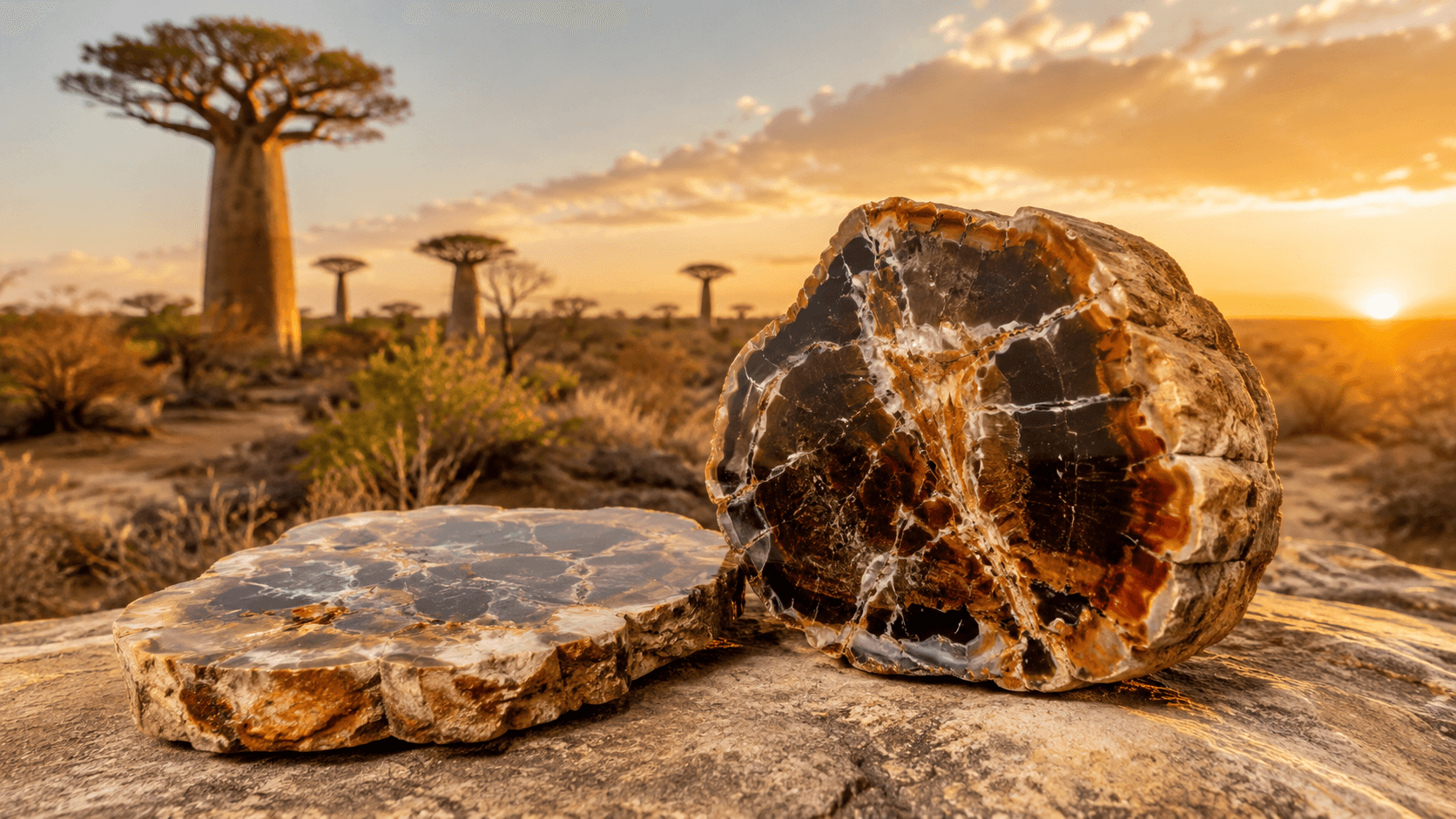
Most sellers deal in volume. They buy tonnes, cut what sells, and treat colour as a category. We do the opposite. Each tree we bring up has its own mineralisation, formed by whatever metals were dissolved in the water that petrified it. That mineral signature gives it a colour that belongs to it alone.
So we name our trunks the way you would name something you intend to know:
- Ambra — the amber, honeyed and warm.
- Argentea — the silvered, cool and pale.
- Fusca — the brown, deep and grounded.
- Umbra — the dark, close to black.
- Viridis — the green, the rarest turn of the mineral.
These are not product lines. They are trees. When we cut Ambra into a tabletop, that particular amber is gone for good — there is no reordering it, no second batch. The colour lived once, in one trunk, and now it lives in one table.
When a trunk is cut, its colour disappears forever. A Medusa table is the last and only place it survives.
That is the difference we ask you to feel before anything else. You are not choosing a finish. You are choosing which ancient tree comes to live in your home.
Why the Colours Exist
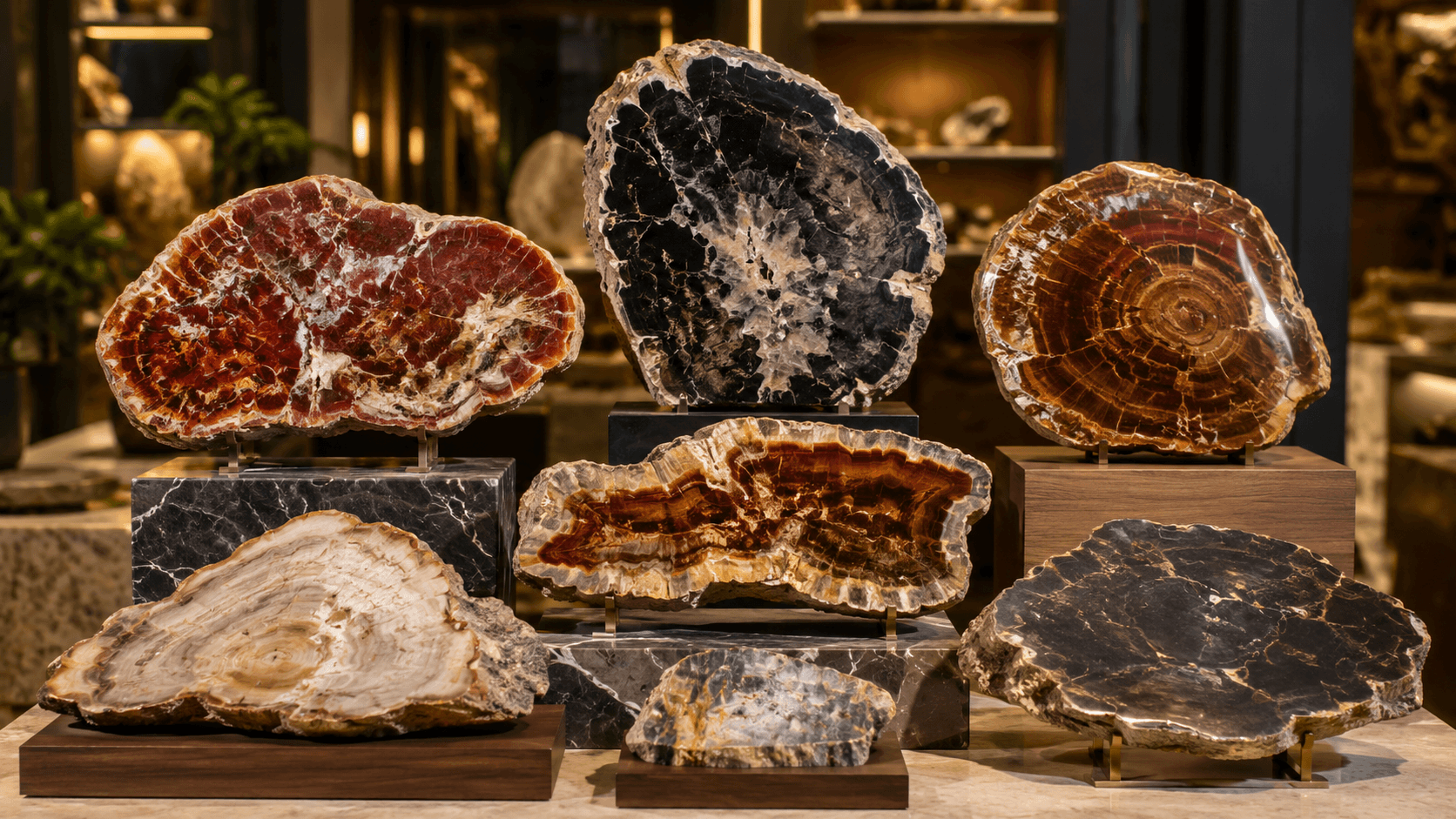
The colours are not dyes and they are not treatments. They are minerals, fixed in the quartz during fossilisation:
- Iron produces reds, ochres and warm browns.
- Manganese produces blacks and violets.
- Chromium and cobalt produce greens and blues — the scarcest tones of all.
Because the metal content varied from tree to tree and even within a single trunk, you find contrast, movement and gradients that no manufacturing process could design. A single Fusca tabletop may carry a rust-red core, a dark manganese edge and pale veins running between them. This is the record of the water that passed through the wood for millions of years, and it cannot be reproduced.
If the science of it interests you, we cover the transformation from wood to stone in more depth in our dedicated pieces on how petrified wood forms and the origin of its colours — start here, and follow the thread as far as you like.
What It Is Actually Made Of: Quartz
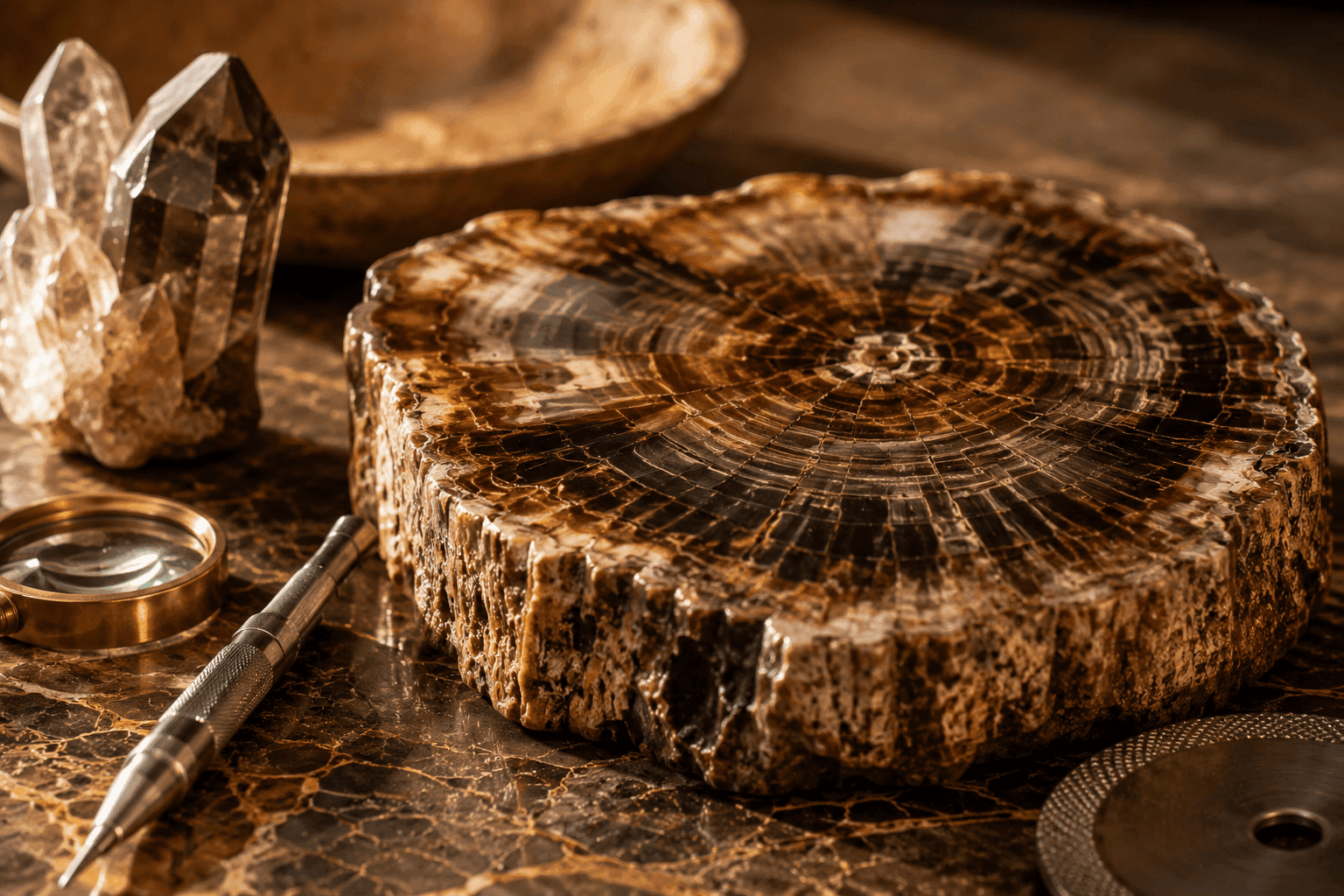
A petrified wood table looks like wood and behaves like stone, because that is precisely what it is. The organic matter is gone; what you touch is silica — quartz — with all its properties.
This has real, everyday consequences:
- Hardness of 7 on the Mohs scale. It resists scratching from almost anything you would put on a table.
- Heavy and cool to the touch, like all dense stone. A tabletop has genuine mass, and it sits with authority.
- Indifferent to water, heat, UV and frost. You can set down a hot dish or a wet glass. Sunlight will not fade the colours, because the colours are metal, not pigment. It can even live outdoors.
In other words, this is one of the most durable surfaces you can bring into a home. It asks for almost nothing and it will outlast the house around it. For the full picture, see our guide to the hardness and care of petrified wood and our practical notes on maintaining a petrified wood table.
From Trunk to Table: The Work of the Hand
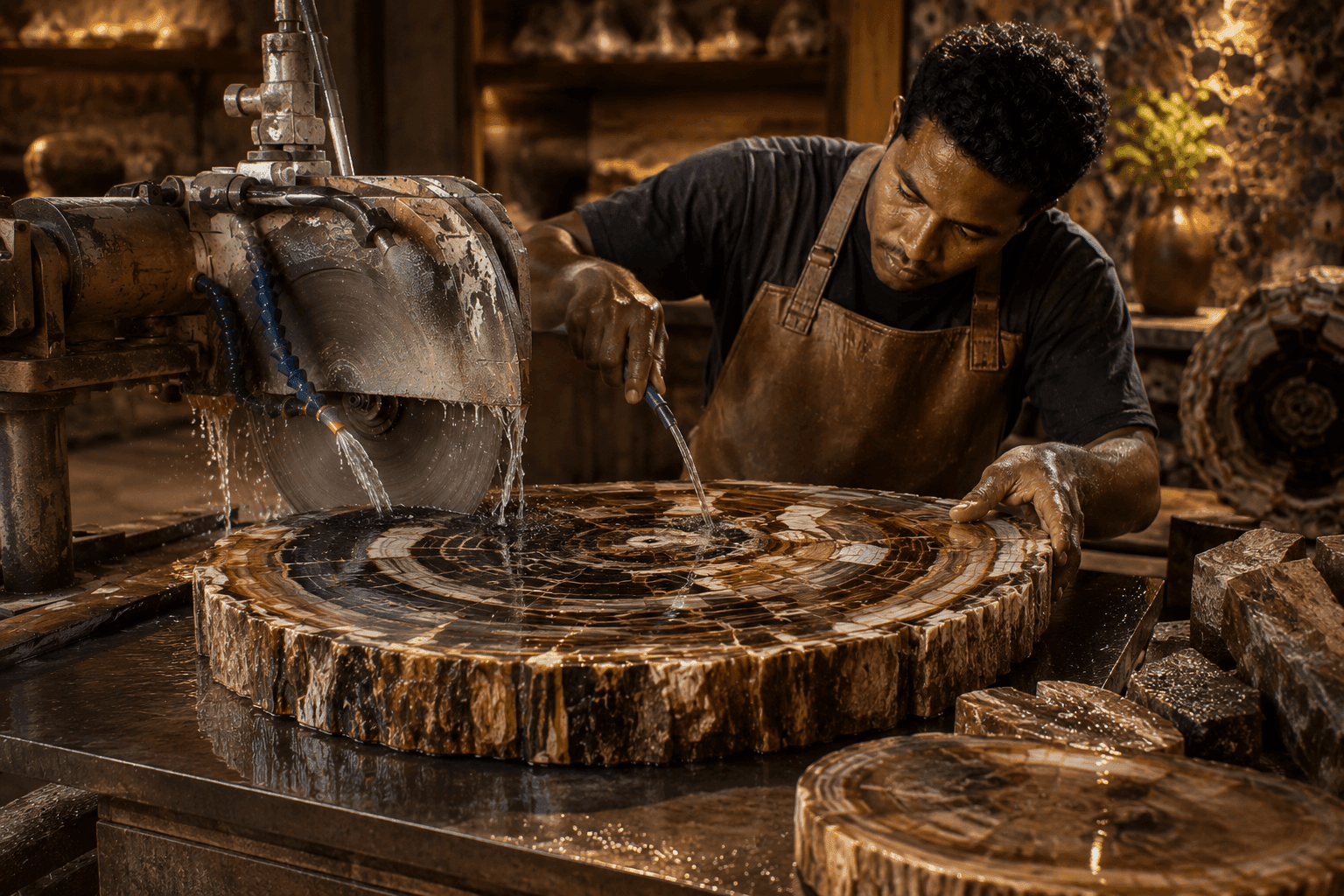
Working stone this hard is unforgiving. Every trunk is studied before a single cut is made, because the cut decides which face of the tree will be seen — and there is no undoing it. The slab is then ground and polished through successive stages until the surface reads clearly: the rings emerge, the veins sharpen, the colour deepens under the polish.
We keep the natural edge wherever the trunk allows it. A live-edge petrified wood table shows the outline of the tree itself, bark line and all, so the object never pretends to be anything other than what it is: a tree, turned to stone, brought to a table.
The results take many forms across our collection — dining tables, low and coffee tables, console and side tables, and matching pieces such as basins and decorative objects. If you are weighing formats, our overview of petrified wood table types and our piece on choosing the right table for your space will help you narrow it down before you speak to us.
Discover which trunks are available now — each one named, each one one of a kind.
Explore the collectionLiving With a Petrified Wood Table
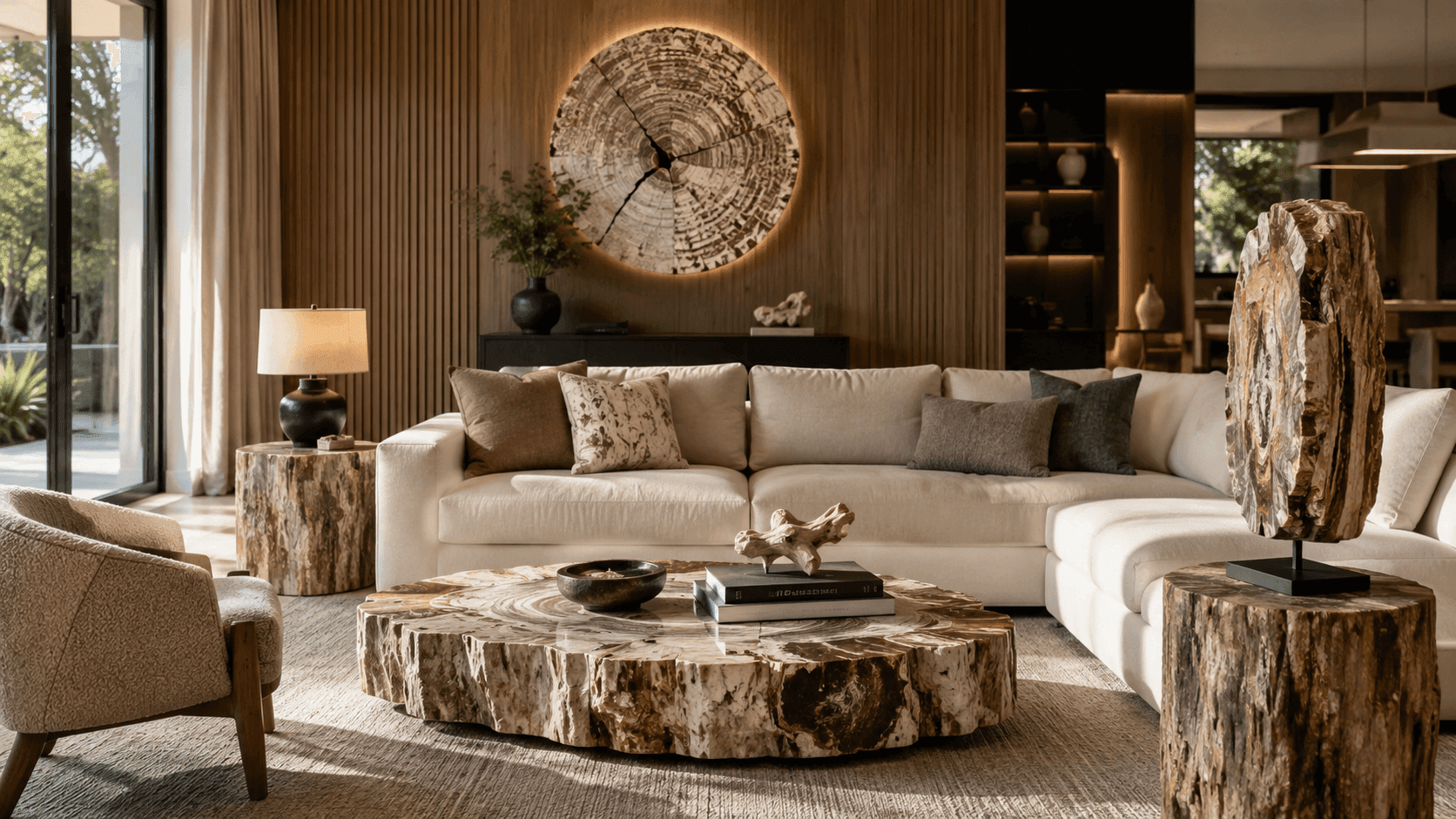
A petrified wood table does something quiet and unusual in a room: it introduces a real centre of gravity. Because it is genuinely old and genuinely singular, it does not compete with the rest of the décor — it anchors it. A minimalist interior gains warmth from an Ambra top; a darker, more textured room finds its keystone in Umbra or Fusca.
It also rewards attention. Guests lean in. They notice the rings, then the veins, then they ask how old it is — and the answer never disappoints. Few objects carry a story you can tell in a single sentence: this was a living tree before flowers existed.
Because every piece is unique, we do not publish fixed prices. The right figure depends on the trunk itself — its size, its colour, the way it was cut. The honest way to do this is a conversation. Tell us the space and the use you have in mind, and we will match you to a tree and prepare a quote for that specific piece.
Frequently Asked Questions
Is a petrified wood table really made of stone?
Yes. The original wood fibre was replaced, cell by cell, with silica — quartz. It preserves the tree's form completely, but its substance is stone, with a hardness of 7 on the Mohs scale.
Can I use it outdoors or near heat and water?
Yes. As quartz, it is unaffected by water, heat, UV light and frost. You can place hot dishes on it, and its colours will not fade in sunlight because they come from minerals, not pigment.
Why does each table have a name instead of a colour code?
Because each is a distinct tree we recovered from south-western Madagascar. Names like Ambra, Argentea, Fusca, Umbra and Viridis identify individual trunks, each with a colour created by its own mineralisation. Once a trunk is cut, that exact colour cannot be found again.
How do I get a price?
Every piece is one of a kind, so pricing depends on the trunk. Browse the collection and contact us for a quote on the specific table you have in mind — we will advise you based on your space and use.
Tell us about your project and we will match you to a trunk.
Request a quote