
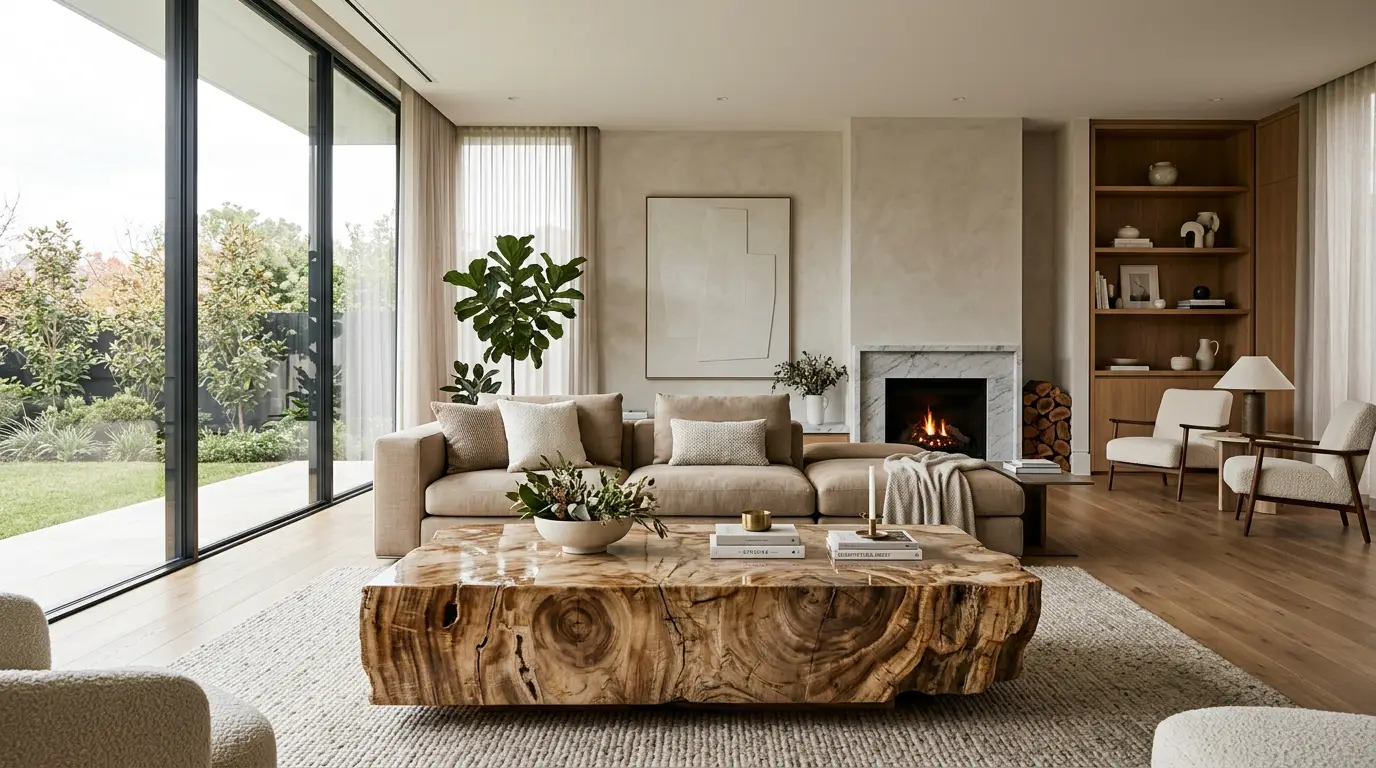
A Table Cut From a Single Tree, 230 Million Years Ago
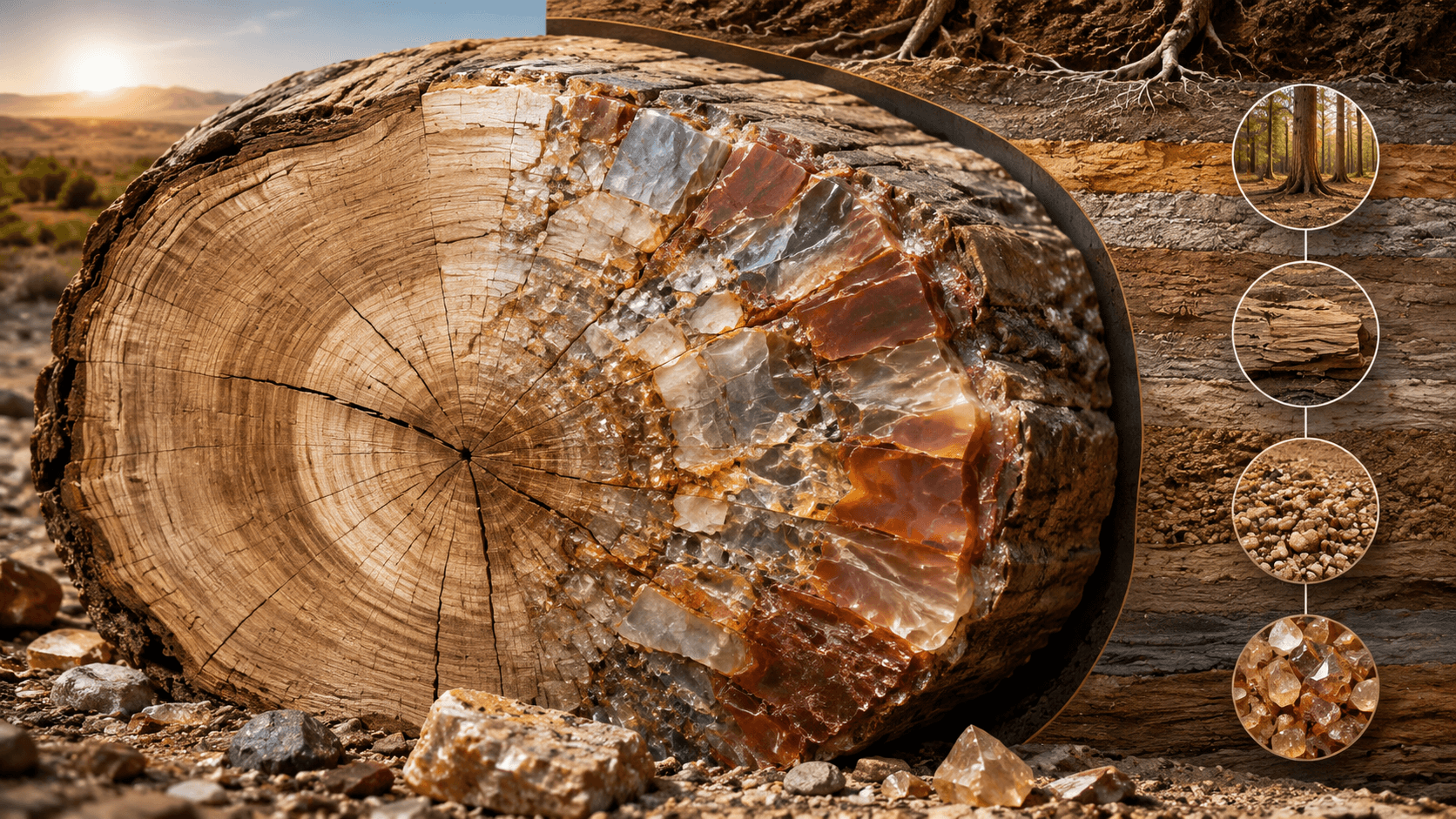
A petrified wood dining table is not a piece of furniture in the ordinary sense. It is the cross-section of a tree that grew in what is now southwestern Madagascar during the Triassic period, roughly 230 million years ago, then lay buried until groundwater rich in silica replaced its wood fibers, cell by cell, with quartz. What you sit down to each evening is that same trunk — its rings, its scars, its particular history of growth — now rendered in stone.
At Medusa, every table begins with one tree. We don't source "petrified wood" as a generic material; we bring up individual trunks from the ground, one at a time, and we name each one. Ambra for the amber-toned trunks, Argentea for the silvered greys, Fusca for the deep browns, Umbra for the darkest specimens, Viridis for the rare greens. A table built from Ambra will never be repeated, because once that trunk is cut and finished, its particular palette of iron oxides is spent. There is no second Ambra.
Where the Trunks Come From
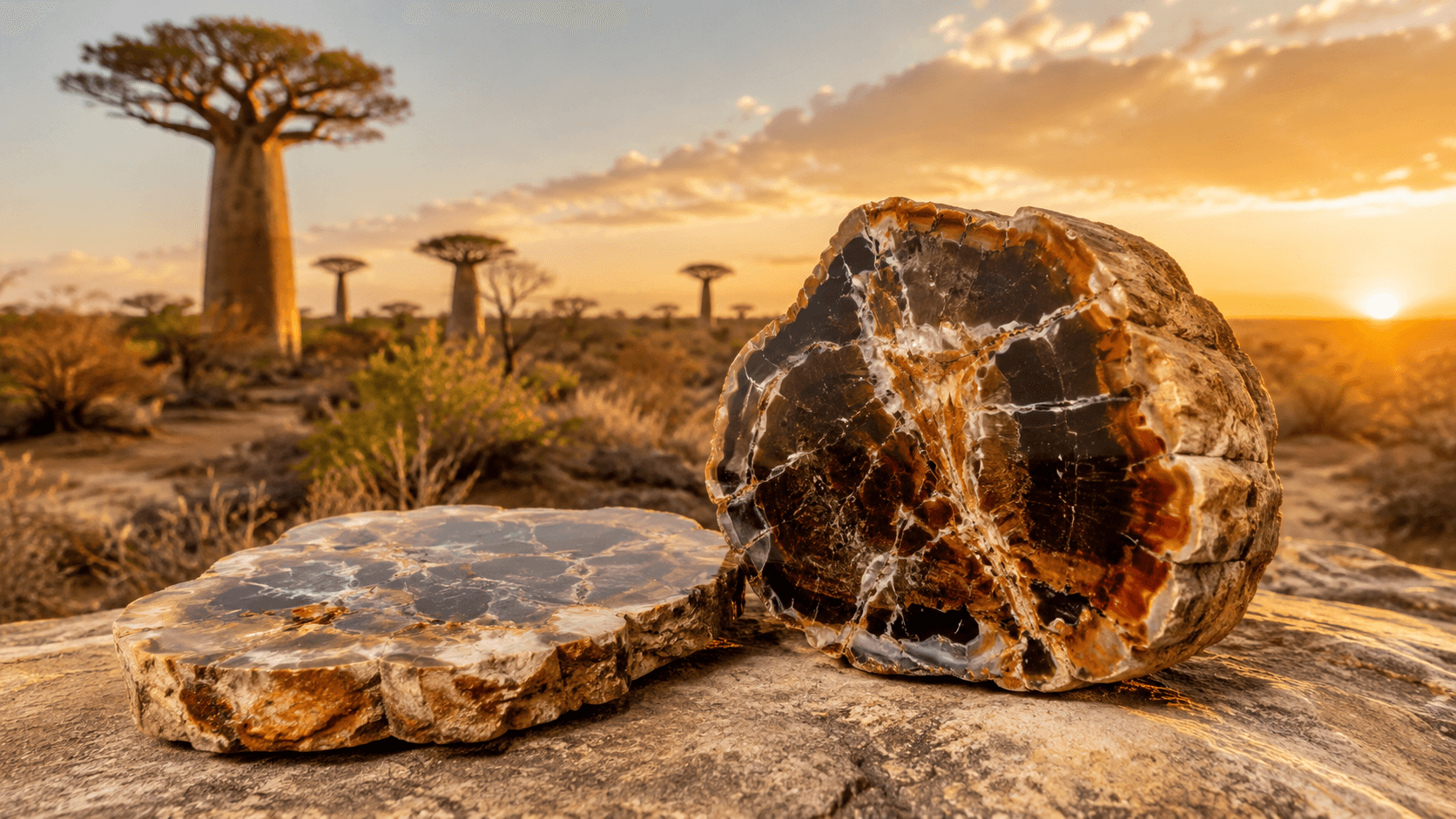
The trunks we work with are recovered from the arid southwest of Madagascar, a region where erosion has slowly exposed deposits that formed long before flowering plants existed. Each trunk tells us, through its color, what minerals surrounded it as it turned to stone:
- Iron oxides produce the reds and ochres you see running through Ambra and Fusca trunks.
- Manganese oxides darken the wood toward black and violet, characteristic of Umbra.
- Traces of chromium or cobalt, far rarer, give the green and blue-grey casts found in Viridis.
No two trunks are minerally identical, which is why no two Medusa tables are either. When we select a trunk for a dining table, we choose it as it stands — we don't blend or dye. The surface you'll eat on is the surface that formed underground, polished, not painted.
A tree does not repeat itself. Neither does the stone it becomes.
Why Quartz Makes an Exceptional Table
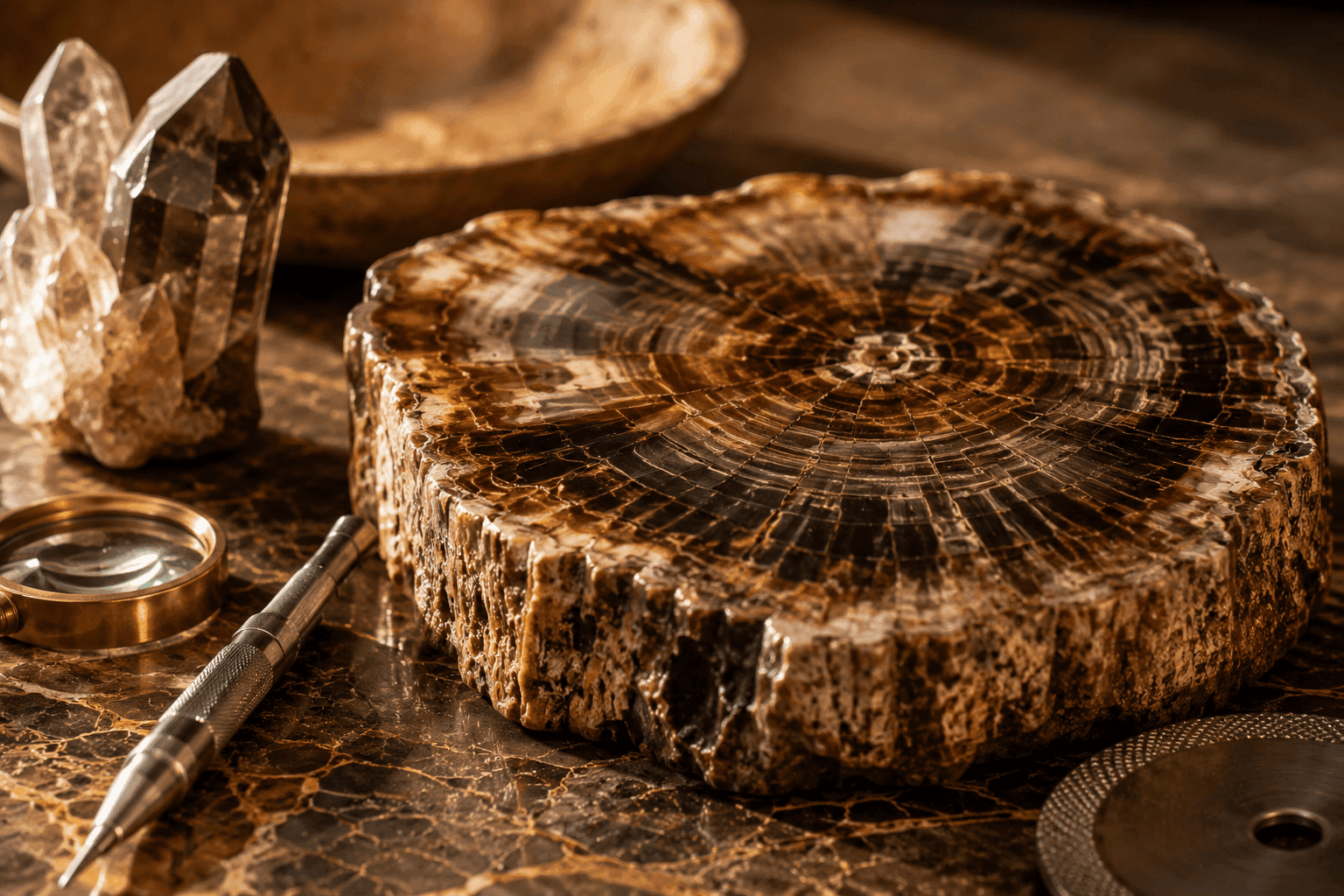
Petrified wood is, mineralogically, quartz — and it behaves like quartz. On the Mohs hardness scale it sits at 7, harder than a steel blade, harder than glass. For a dining table, this translates into properties no timber can offer:
- It will not scratch under normal use, cutlery included.
- It is entirely indifferent to heat — a hot dish leaves no mark.
- Humidity, spills, and repeated cleaning have no effect on it; it does not swell, crack, or warp.
- UV exposure does not fade its color, since the color comes from minerals fixed in the stone, not from a surface treatment.
- Even frost does not damage it, which matters for pieces used in verandas or outdoor dining spaces.
The trade-off is honest: a petrified wood table is heavy, and it is cold to the touch until the room warms it. Those who choose one are choosing permanence over convenience — a table built to outlast the people who eat at it.
From Trunk to Table: The Work Involved
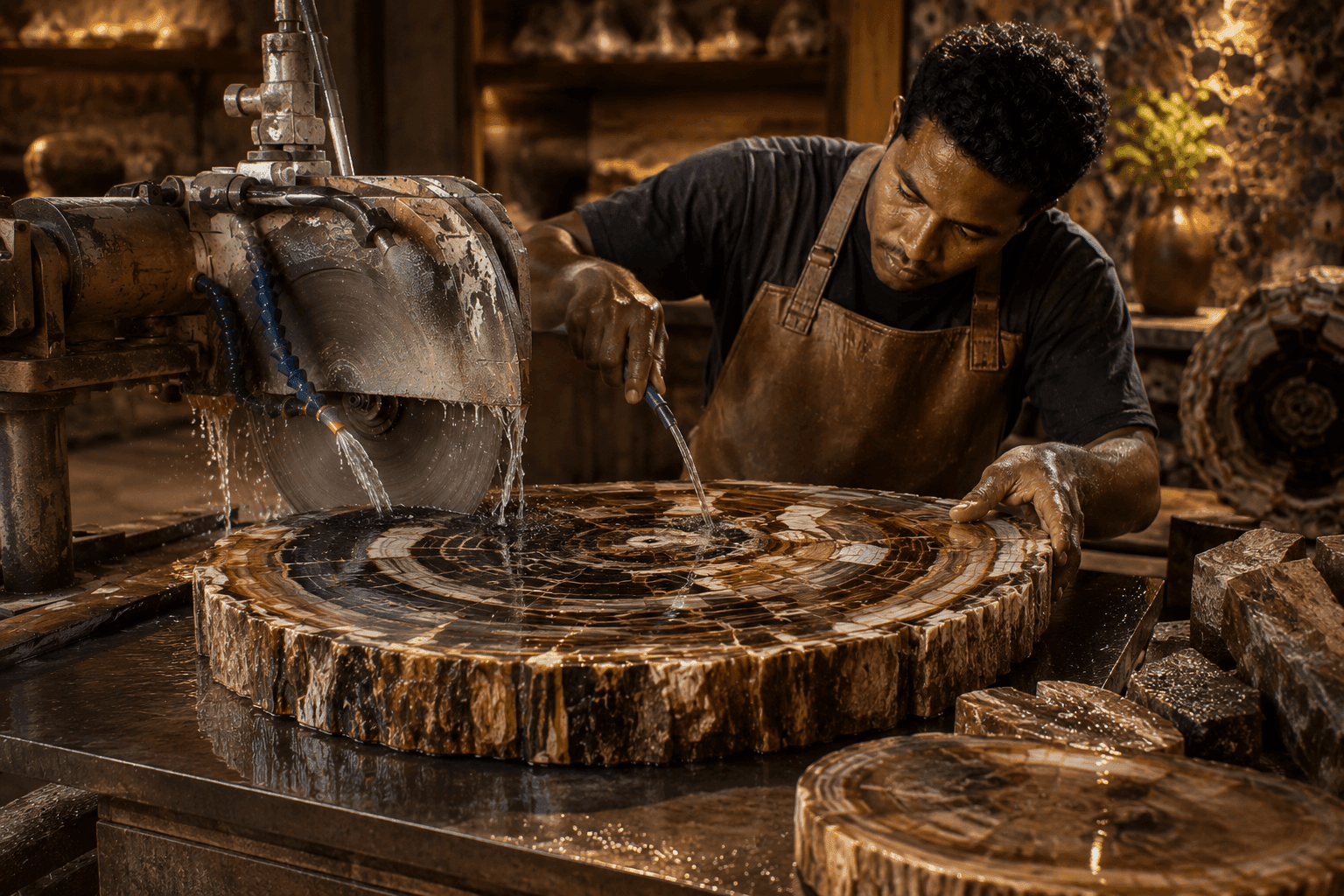
Turning a fossilized trunk into a usable dining surface is slow work by necessity. Quartz does not yield to standard woodworking tools; every cut, every leveling pass, every polish is done with diamond-tipped equipment, and each stage is dictated by the trunk itself — its cracks, its natural cavities, the angle of its rings. Some trunks reveal, once cut, a color depth that wasn't visible on the exterior; others require the base to be reinforced with a metal or wood structure to carry their considerable weight safely.
This is also where the naming becomes practical rather than poetic. A trunk named and tracked from extraction to finishing lets us tell you, when you choose a Medusa table, exactly which tree you're getting, where in Madagascar it was recovered, and what gives it its particular coloring. It is the opposite of buying from a catalog of interchangeable slabs.
Living With a Petrified Wood Table
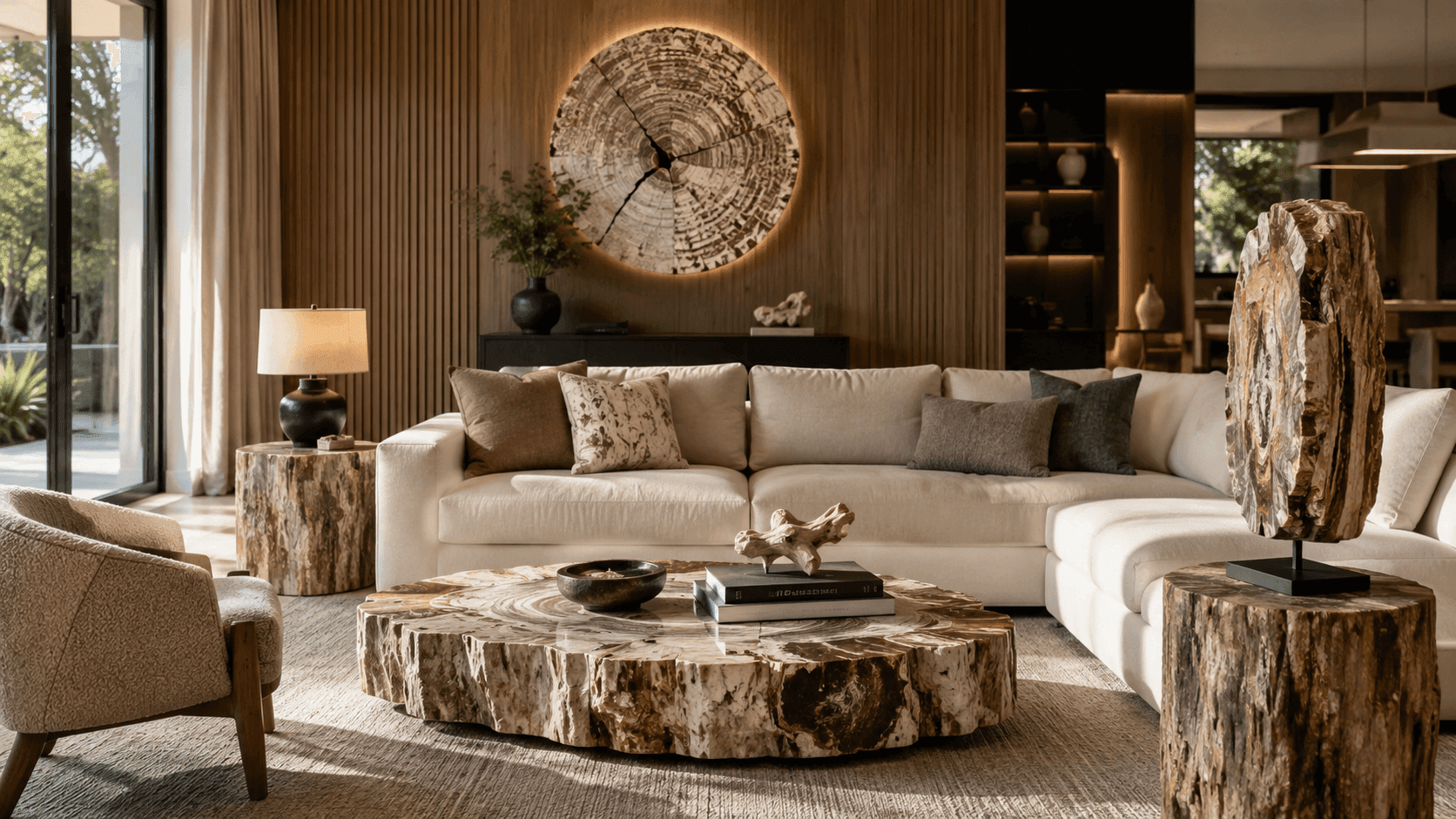
A table this dense and this old changes how a room reads. It doesn't try to match the rest of the furniture; it sets the register, and everything else adjusts around it. Designers place them as centerpieces precisely because they don't need styling — the rings, the mineral striations, the polished surface do the work.
Practically, care is minimal: a damp cloth is sufficient, no oiling, no resealing, no seasonal maintenance. This is a piece you clean, not a piece you tend.
Discover the individual trunks currently available and request a tailored quote for your dining table.
Visit the ShopFrequently Asked Questions
How much does a petrified wood dining table cost?
Pricing depends entirely on the trunk — its size, rarity of color, and the extent of finishing work required. We don't sell from a fixed price list; each table is quoted individually. Please consult us or visit the shop for a tailored estimate.
Is petrified wood actually stone, not wood?
Yes. Over millions of years, groundwater rich in silica replaced the original wood's organic material with quartz, cell by cell. The tree's structure — rings, grain, texture — is preserved, but the material itself is mineral, not organic.
Can a petrified wood table be used daily, including with hot dishes?
Yes. With a Mohs hardness of 7, it resists scratching, and being quartz, it is unaffected by heat, spills, or humidity. It requires no special care beyond regular cleaning.
Why does Medusa name each trunk instead of listing products by type?
Because each trunk is a single, once-living tree with its own mineral history — its own combination of iron, manganese, or trace chromium and cobalt. Naming them (Ambra, Argentea, Fusca, Umbra, Viridis) reflects that they are individual specimens, not a repeatable product line. Once a named trunk is cut, that particular coloring cannot be recreated.