
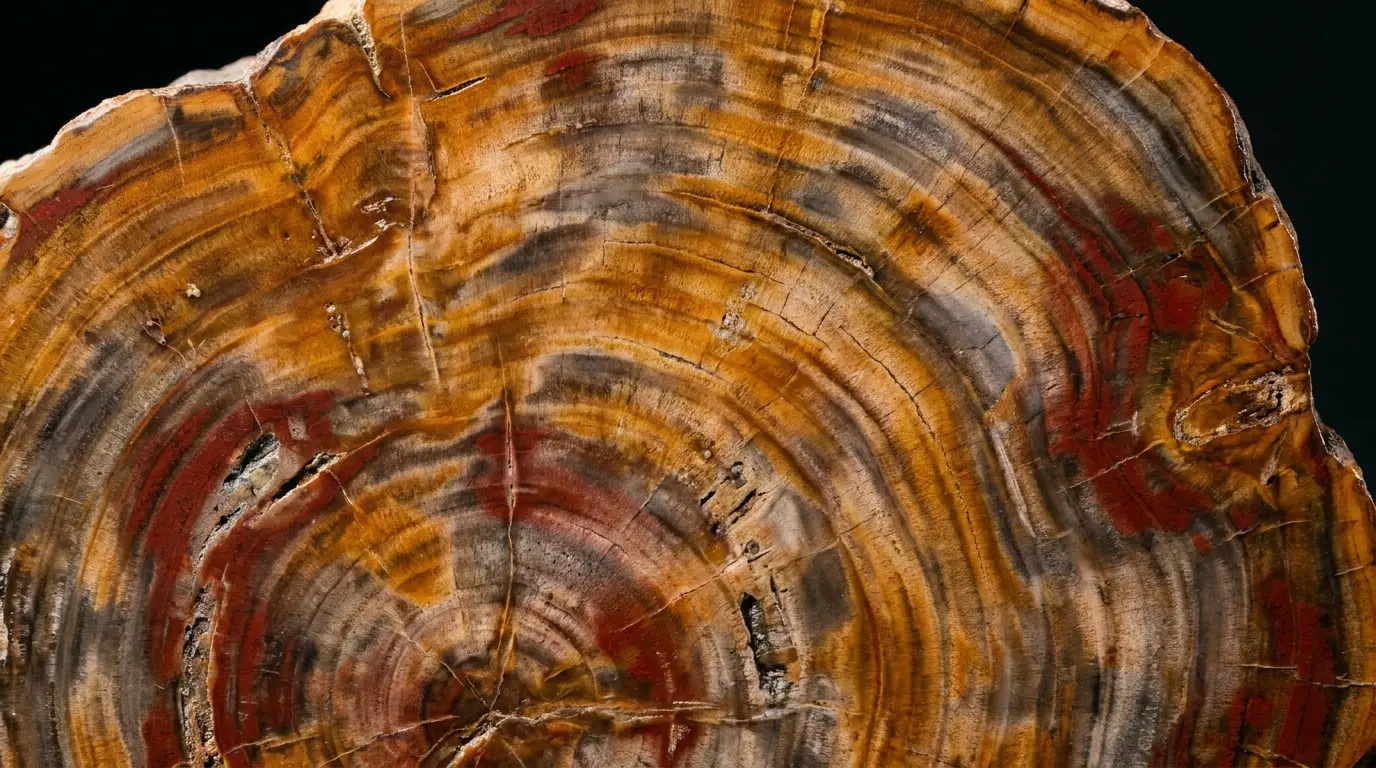
Rainbow Petrified Wood: When One Tree Holds Every Color
Among collectors and interior architects, the term "rainbow petrified wood" describes a specific and coveted phenomenon: a single trunk section displaying several colors at once — amber, ochre, plum, grey, sometimes a hint of green — arranged in bands that follow the tree's own growth pattern. It is not a decorative technique. It is a mineral event, written into the wood 230 million years ago and revealed only when the trunk is cut and polished.
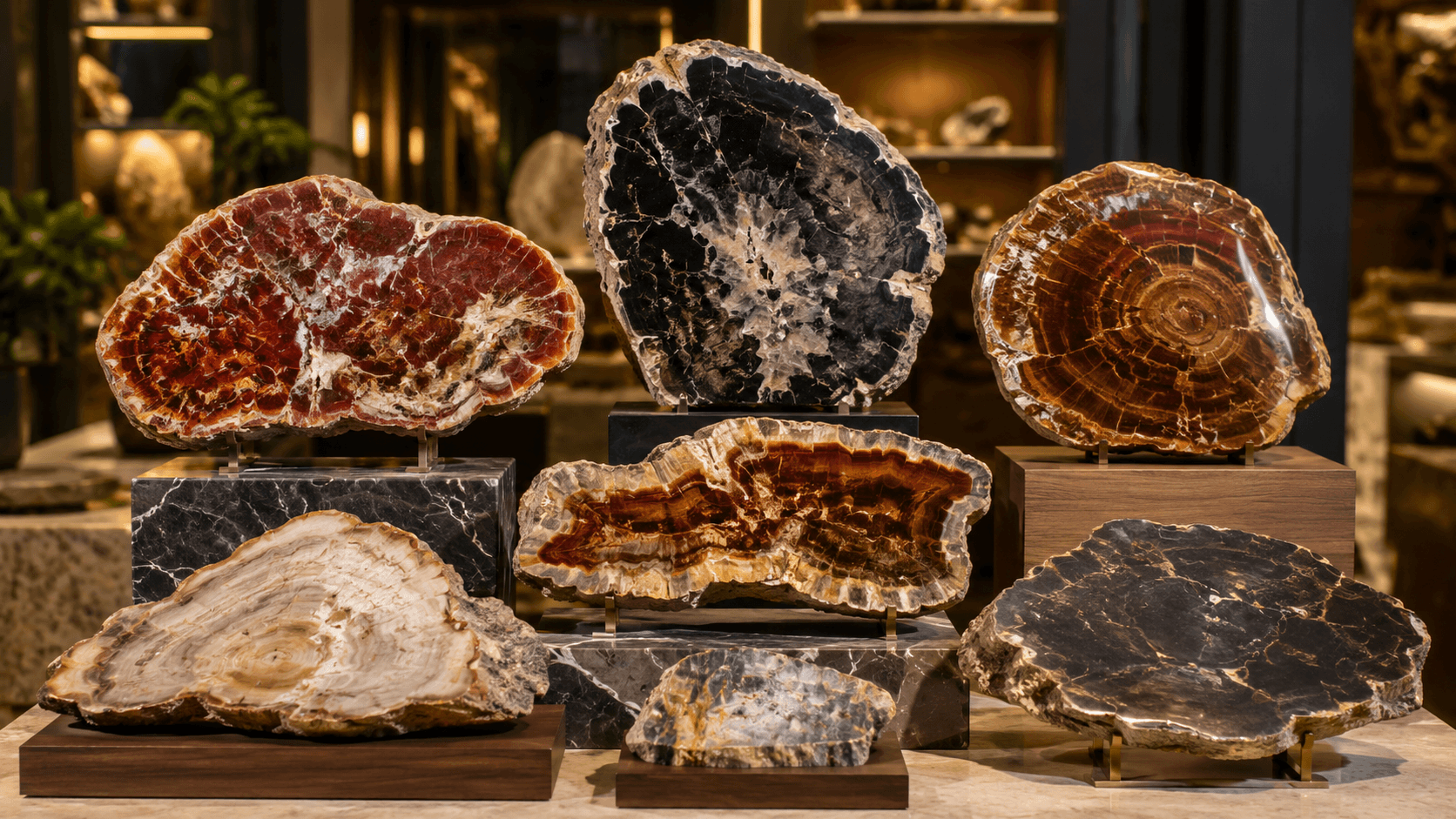
At Medusa, we do not sell "rainbow petrified wood" as a product line. We sell trunks — individual trees, each with a name, each with a palette that exists nowhere else. Some of them happen to be rainbows. Most are not. That distinction matters, and it is the reason a rainbow piece, when we find one, is treated as an event rather than an inventory item.
The Chemistry Behind the Spectrum
A polychrome trunk is, above all, a chemistry lesson. Petrified wood is fossilized cellulose replaced almost entirely by quartz — silica that infiltrated the wood's cell structure over millions of years and crystallized in place, preserving the grain down to the growth rings. The base mineral is transparent. Color arrives with trace metals carried by groundwater during that slow replacement:
- Iron produces the reds, oranges, and ochres — the most common register.
- Manganese produces blacks and violets, often in sharp, thin veining.
- Chromium and cobalt, rarer, produce greens and blues.
A rainbow trunk is simply one that was exposed, during its mineralization, to more than one of these metals — in successive layers, in pockets, or along fracture lines where mineral-rich water moved differently through the wood. No two trunks receive the same combination in the same proportions. That is why the effect cannot be reproduced, dyed, or standardized. It is geology, not decoration.
Madagascar's Southwest: Where the Rainbow Forms
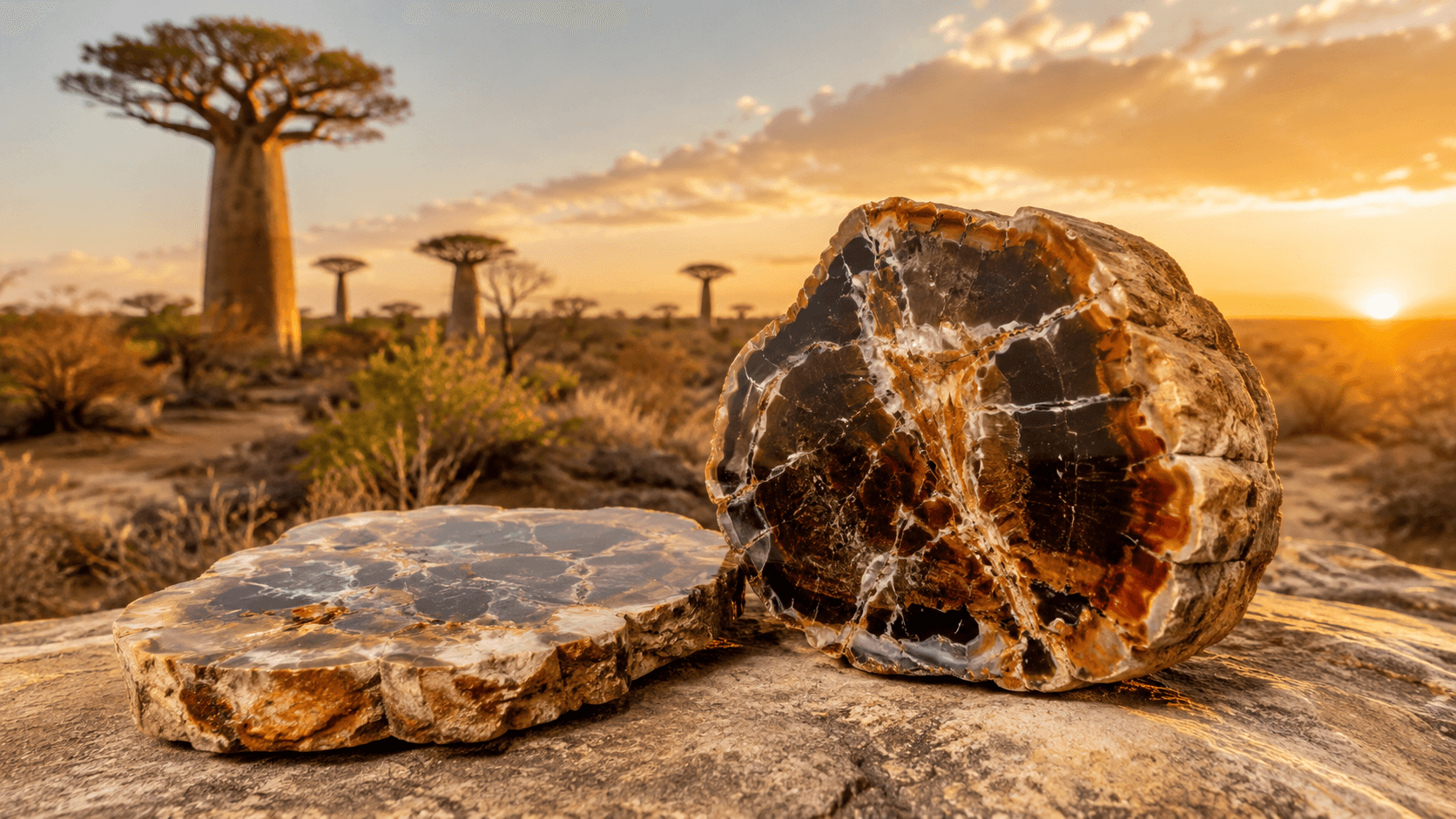
The trunks we work come exclusively from the arid southwest of Madagascar, where Triassic-era forests were buried under sediment and, over roughly 230 million years, silicified in place. The region's mineral-rich soil — its iron, its manganese, its scattered deposits of chromium — is precisely why Madagascar produces some of the most colour-diverse petrified wood in the world. Trunks pulled from the same stretch of ground can differ entirely in tone, because each one sat in its own micro-environment of minerals for millions of years before we ever touched it.
We recover each trunk individually, assess it in the raw, and only then decide what it can become — a table, a vessel, a sculptural object. A rainbow trunk, when identified, is never split for volume. It is cut to preserve the widest possible view of its own spectrum.
A rainbow trunk does not repeat itself. Cut it once, and that particular arrangement of color is gone from the earth.
Each Trunk, Its Own Palette
This is where our naming convention earns its purpose. Every trunk that enters our workshop receives a name reflecting its dominant character: Ambra for amber tones, Argentea for silvered greys, Fusca for deep browns, Umbra for near-black density, Viridis for the rare green-toned stone. A rainbow trunk sits across several of these registers at once — an Ambra vein running into an Umbra shadow, a thread of Viridis cutting through ochre.
We do not manufacture this variety; we document it. Each trunk is logged, photographed, and worked as the singular object it is. Once a section is cut and finished, that specific palette cannot be sourced again — not from a supplier, not from a future shipment. What you see in a rainbow piece is the only record of that particular tree's mineral history.
From Trunk to Object
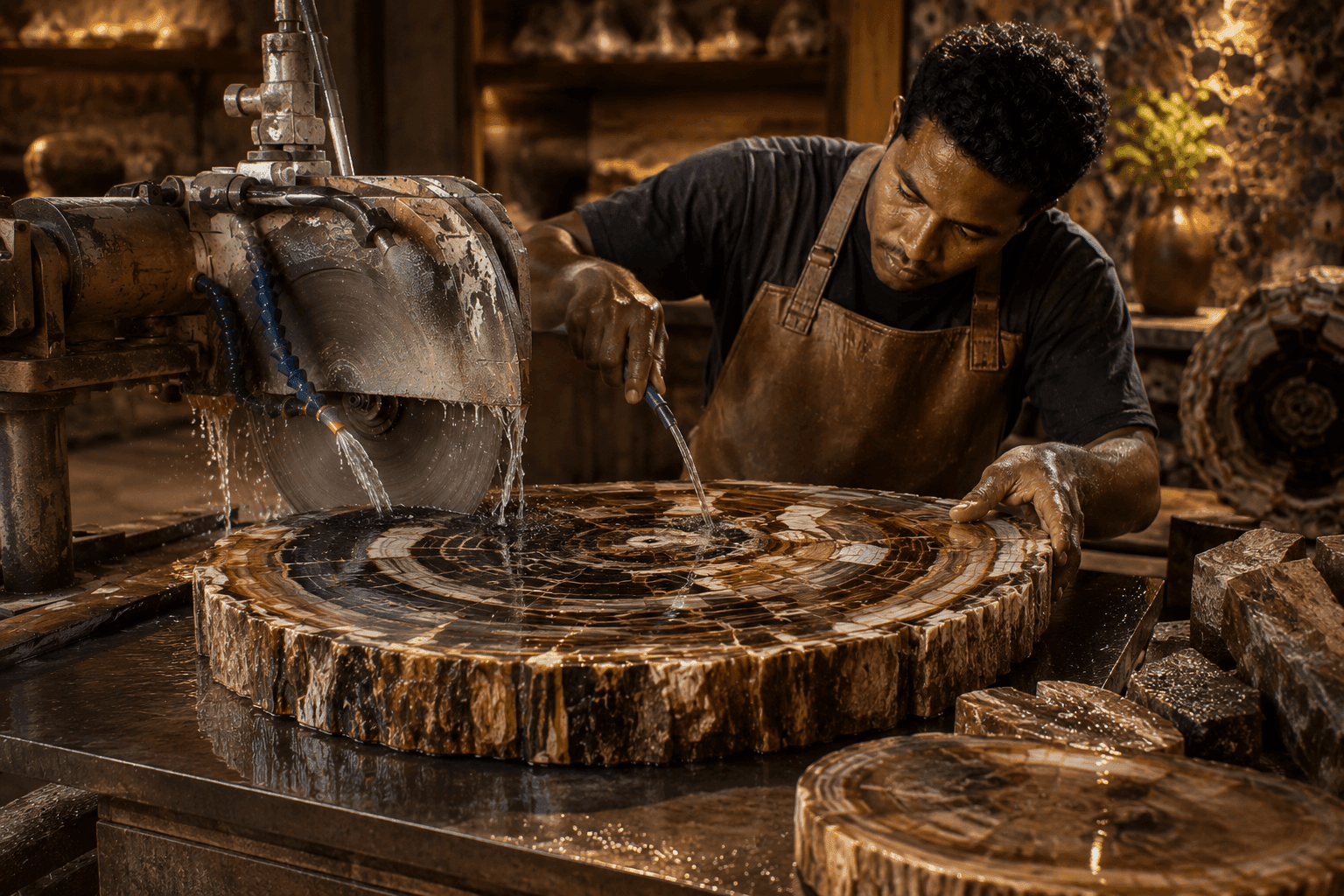
Working a polychrome trunk demands more from the artisan, not less. The cutting plane has to be chosen to expose the color bands rather than cut across them arbitrarily — a decision made by eye, trunk by trunk, since no two mineral patterns align the same way. Polishing then has to bring out contrast without flattening it: quartz takes a mirror finish, and a rainbow surface rewards patience, revealing depth that a rushed pass would erase.
The result is usually kept as a table top, a low console, or a standalone sculptural slab — forms that give the color bands room to be read as a whole. A vessel or vasque can carry a rainbow trunk too, though the effect is more contained, more intimate, closer to jewelry than architecture.
Living With Rainbow Petrified Wood
Color aside, a rainbow trunk behaves exactly like any other Medusa piece, because it is the same material: quartz, hardness 7 on the Mohs scale, indifferent to water, heat, UV light, and frost. It will not fade under a window, warp near a heat source, or dull with age. The vivid banding you see on delivery is the banding you will see in twenty years — a rare guarantee in decorative objects prized for their color.
- Wipe clean; no oiling, sealing, or conditioning required.
- Safe near heat sources, unlike wood, resin, or lacquered surfaces.
- Cold and substantial to the touch — a tactile reminder that this is stone, not timber.
Discover the rainbow trunks currently available and request a tailored quote.
Visit the BoutiqueFrequently Asked Questions
What causes the rainbow effect in petrified wood?
Multiple trace metals — typically iron, manganese, and occasionally chromium or cobalt — infiltrated the same trunk during silicification, each producing a different color band as the wood turned to quartz.
Is rainbow petrified wood rarer than single-tone pieces?
Yes. Most trunks mineralize under a fairly uniform mineral exposure, producing one dominant tone. A trunk exposed to several metals at once, in visible bands, is far less common.
Does the color fade or change over time?
No. The color is mineral, locked into quartz crystals, not a surface treatment. It is unaffected by sunlight, humidity, or temperature.
Can I get a rainbow trunk for a specific piece, like a table or a vasque?
Each rainbow trunk is unique in size and pattern, so we assess availability and suitability case by case. Contact us with your project and we will advise on what a given trunk can become, on request.