
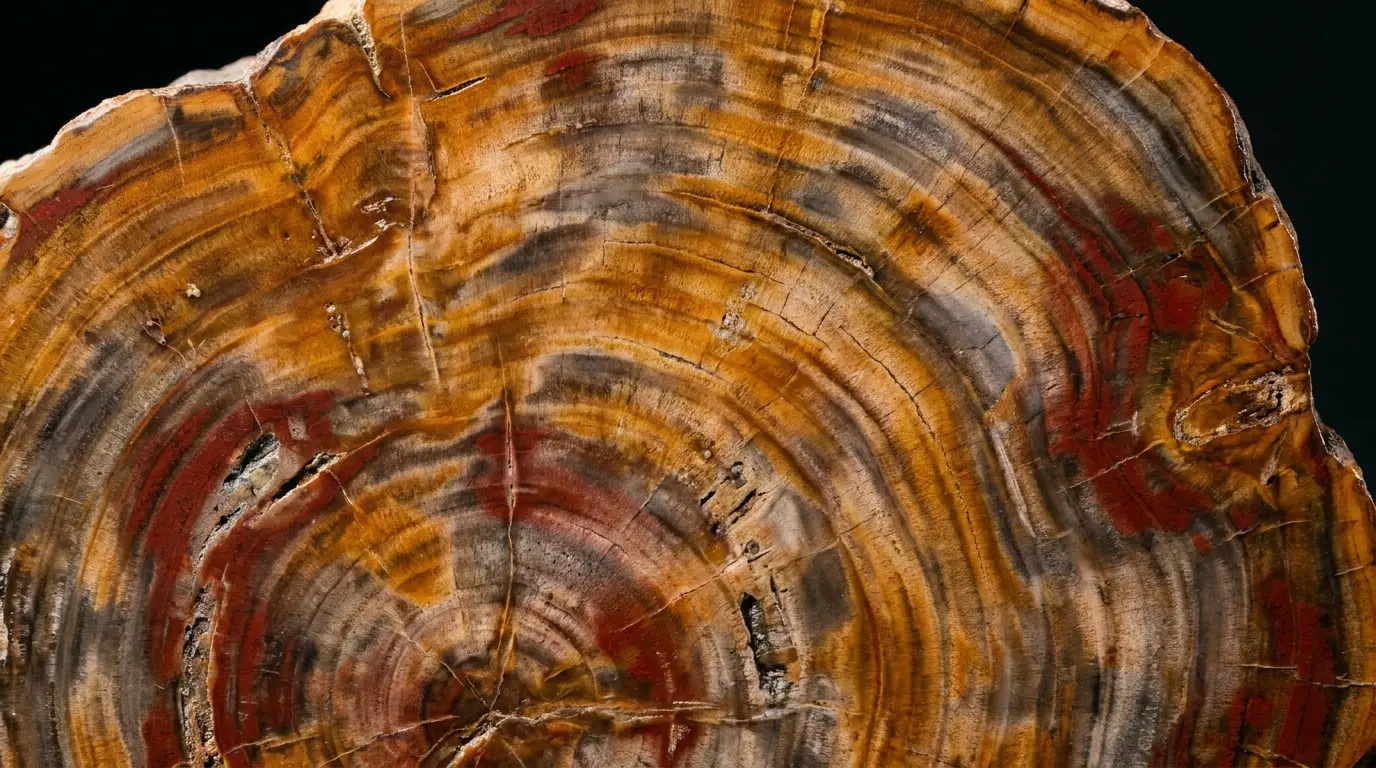
What Is Petrified Palm Wood?
Petrified palm wood is not simply another color of fossil wood — it is a different plant altogether. A palm is a monocotyledon, botanically closer to grass or bamboo than to an oak or a baobab. When one of these palms fell in the ancient wetlands of what is now southwestern Madagascar, roughly 230 million years ago, in the Triassic, the same process that fossilizes forest giants took hold of its trunk: silica-rich water infiltrated the plant tissue, cell by cell, and replaced it with quartz. The result is a stone that keeps the palm's original architecture, at a hardness of 7 on the Mohs scale — harder than steel, and entirely indifferent to water, heat, UV light or frost.
At Medusa, petrified palm wood is our second major family of material, after our classic fossil hardwoods. It has its own texture, its own logic, and — as we'll see — its own place among the named trunks that define our collection.
A Structure Unlike Any Other Tree
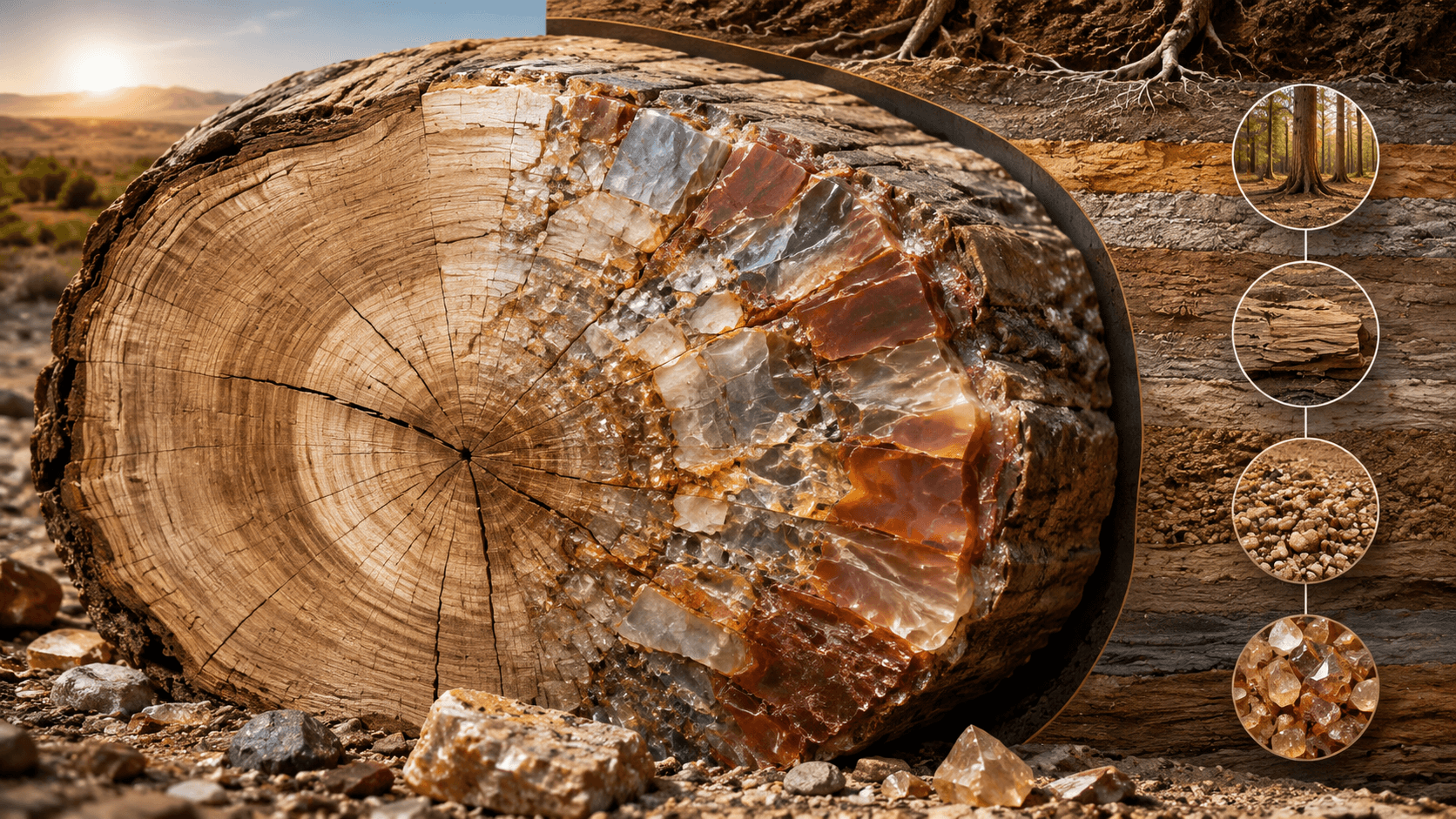
Cut a dicot tree — oak, cedar, any hardwood — and you'll find concentric rings, a yearly diary of growth. Cut a palm and you find none. Palms have no rings at all: their trunk is built from thousands of scattered fibrous bundles running the length of the stem, not from a growing outer layer. Once fossilized, these bundles appear as a dense constellation of small dots and short dashes across the polished surface — sometimes tight and fine, sometimes loose and bold, depending on the species and the individual trunk.
This is the signature of petrified palm wood: not rings, but a starfield. It reads less like wood grain and more like a mineral tapestry, which is precisely why collectors and designers seek it out as a counterpoint to the more familiar ring-patterned fossil trunks.
Madagascar Origin
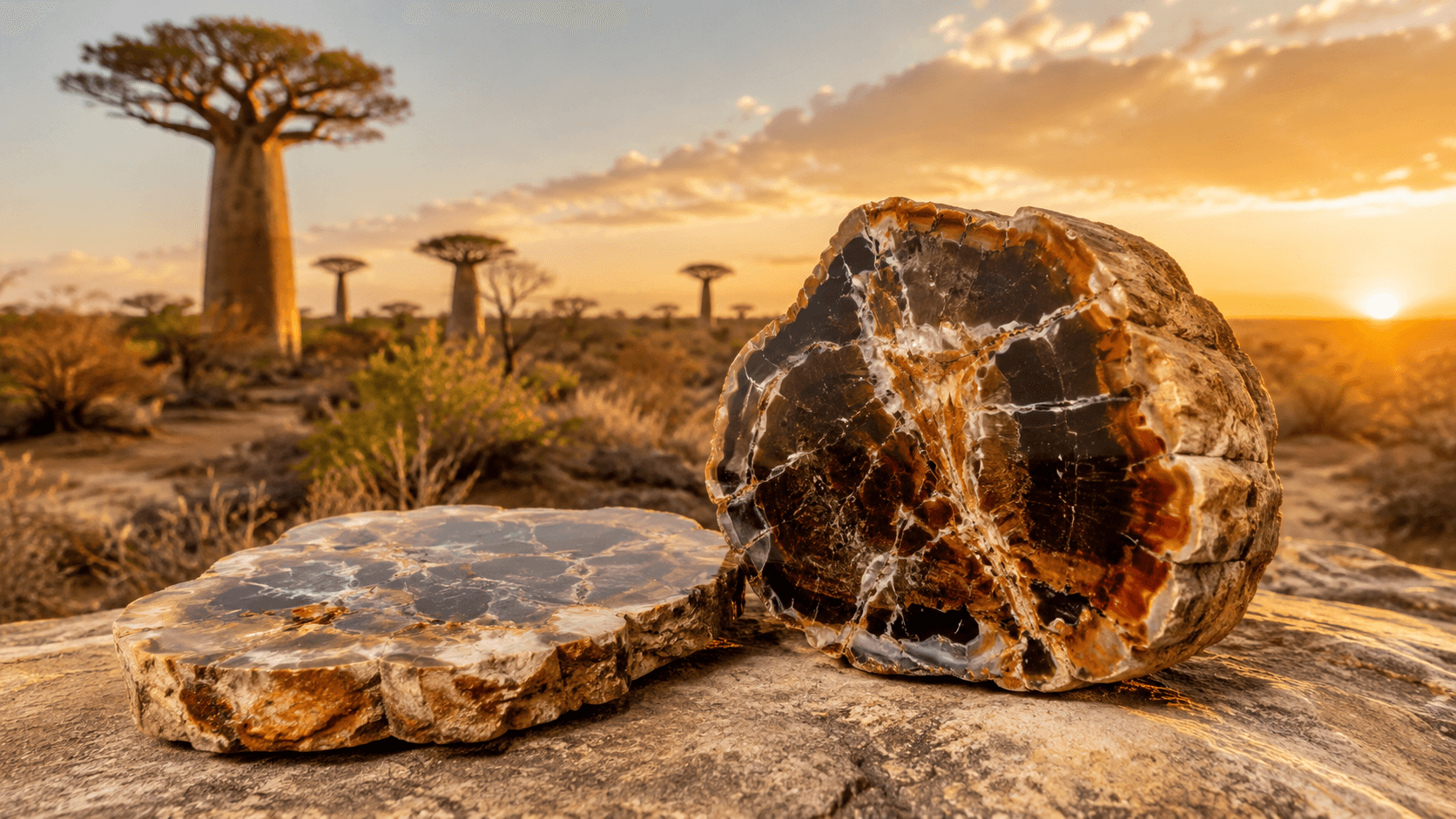
Every piece in our petrified palm wood collection is recovered from the ancient deposits of southwestern Madagascar, the same region that supplies our fossil hardwood trunks. The logs lie where they fell, buried and silicified over the same 230-million-year span, their palm structure intact beneath the surface until an artisan opens the block for the first time.
Petrified palm wood is not unique to Madagascar — comparable deposits exist elsewhere in the world, notably in parts of Texas and Louisiana in the United States, where it holds a regional significance of its own. We mention this only as context: everything Medusa sells is quarried, cut and finished from Malagasy material, and we make no claim on those other deposits.
Named Trunks, One Color at a Time
Each fossil log that reaches our workshop is treated as what it is: a single tree, not a category. We give it a name — Ambra for amber tones, Argentea for silvered grays, Fusca for deep browns, Umbra for near-black shadow, Viridis for green — according to the metal that colored its quartz. Iron oxides bring red and ochre. Manganese produces black and violet. Traces of chromium or cobalt yield the rarer greens and blues. Palm wood carries these same mineral signatures, but distributed across its dotted fiber pattern rather than across rings, giving each named trunk a distinct rhythm as well as a distinct color.
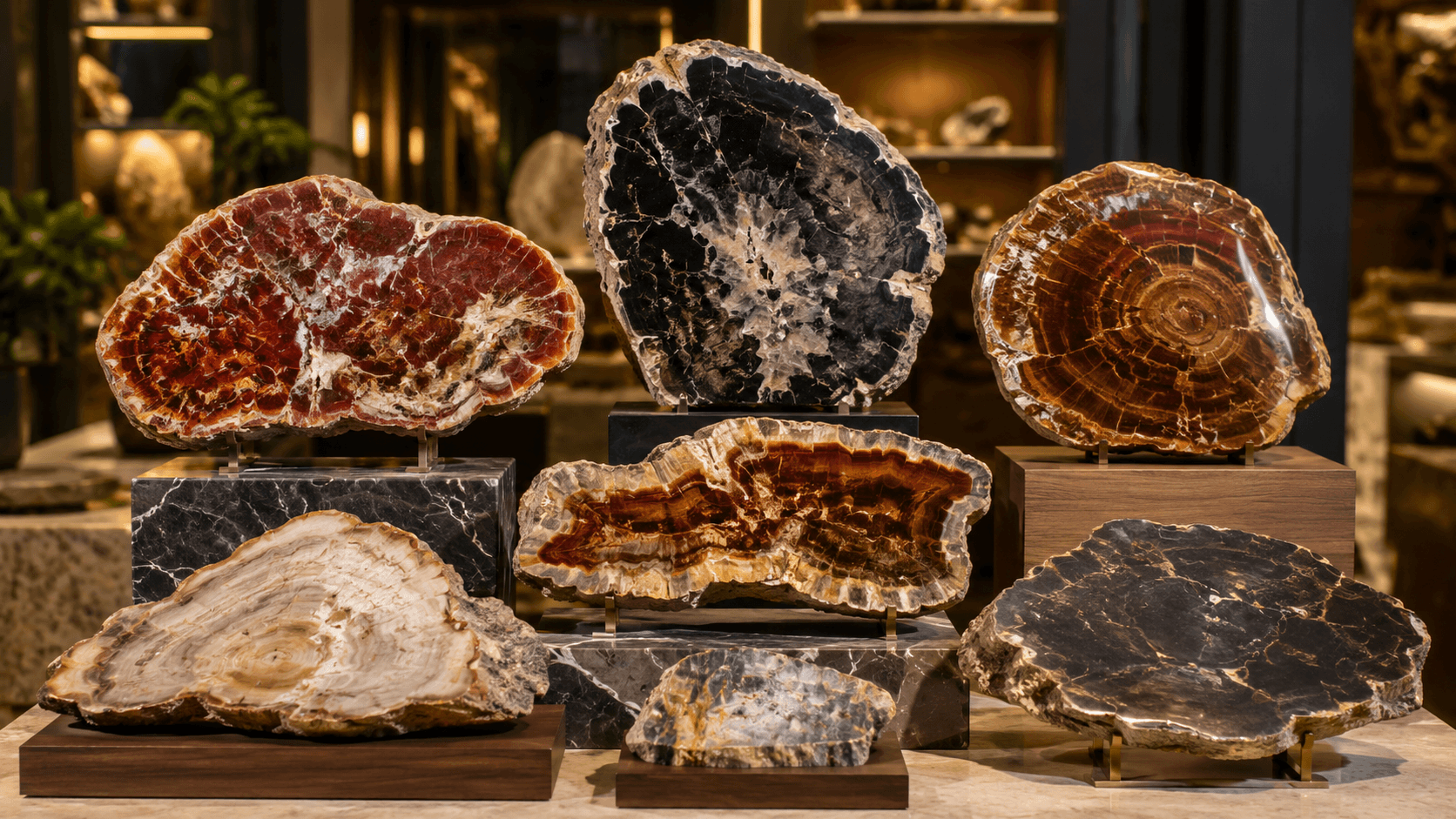
A trunk cut is a trunk gone. Its particular shade of amber, silver or green existed nowhere else, and will not exist again.
Once a log is sliced into slabs or blocks, its exact tone is spoken for. This is why we catalogue by individual trunk rather than by generic "type" — what you see in a piece is what that one tree became, over 230 million years, and nothing more can be drawn from it.
The Collection: Slabs, Spheres, and Jewelry-Scale Pieces
Palm wood's compact dot pattern makes it especially well suited to smaller, more intimate objects, alongside our larger format pieces. Our range spans several formats:
- Palm 480 — generous slabs, suited to table tops and large surface pieces where the dotted pattern reads as a continuous field.
- Palm Petrified 260 — a mid-scale format, versatile for consoles, side tables and freestanding objects.
- **