
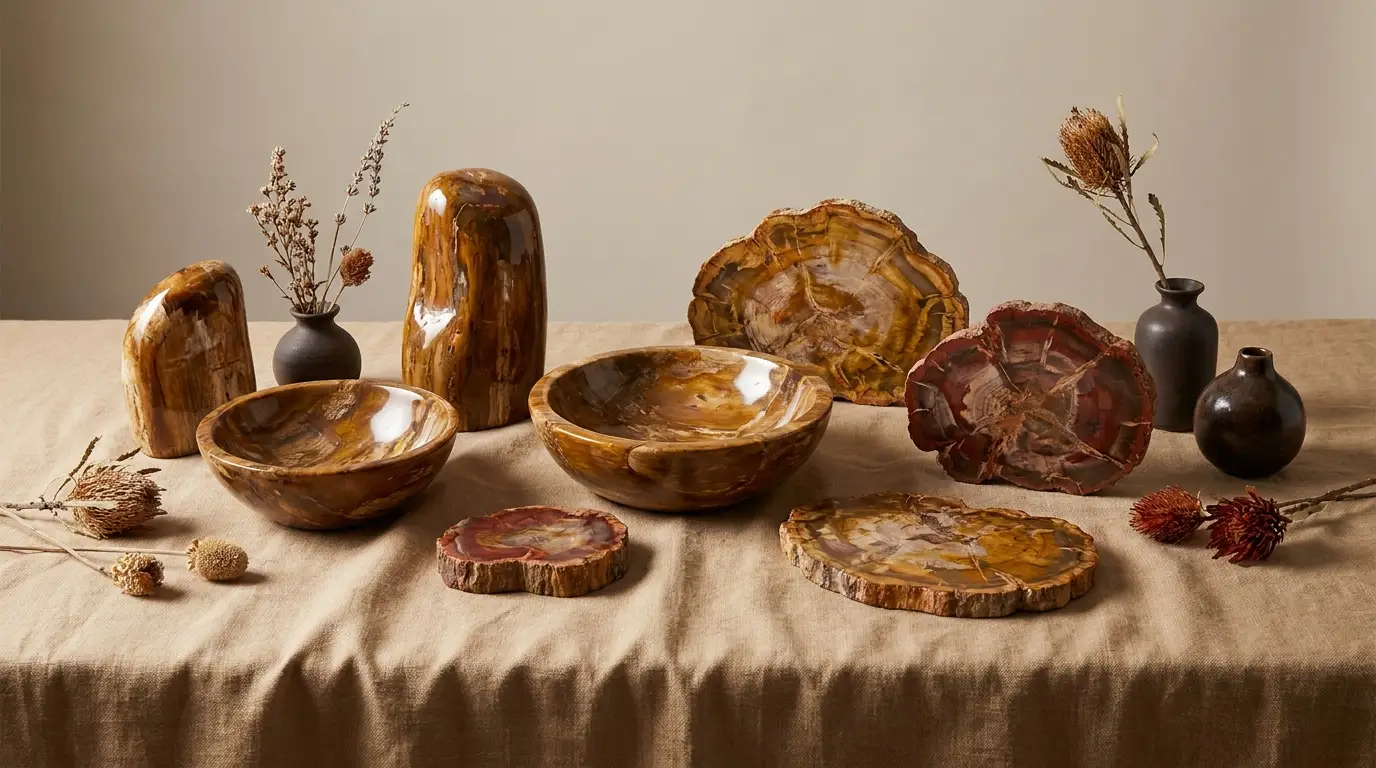
What "Opalized" Really Means
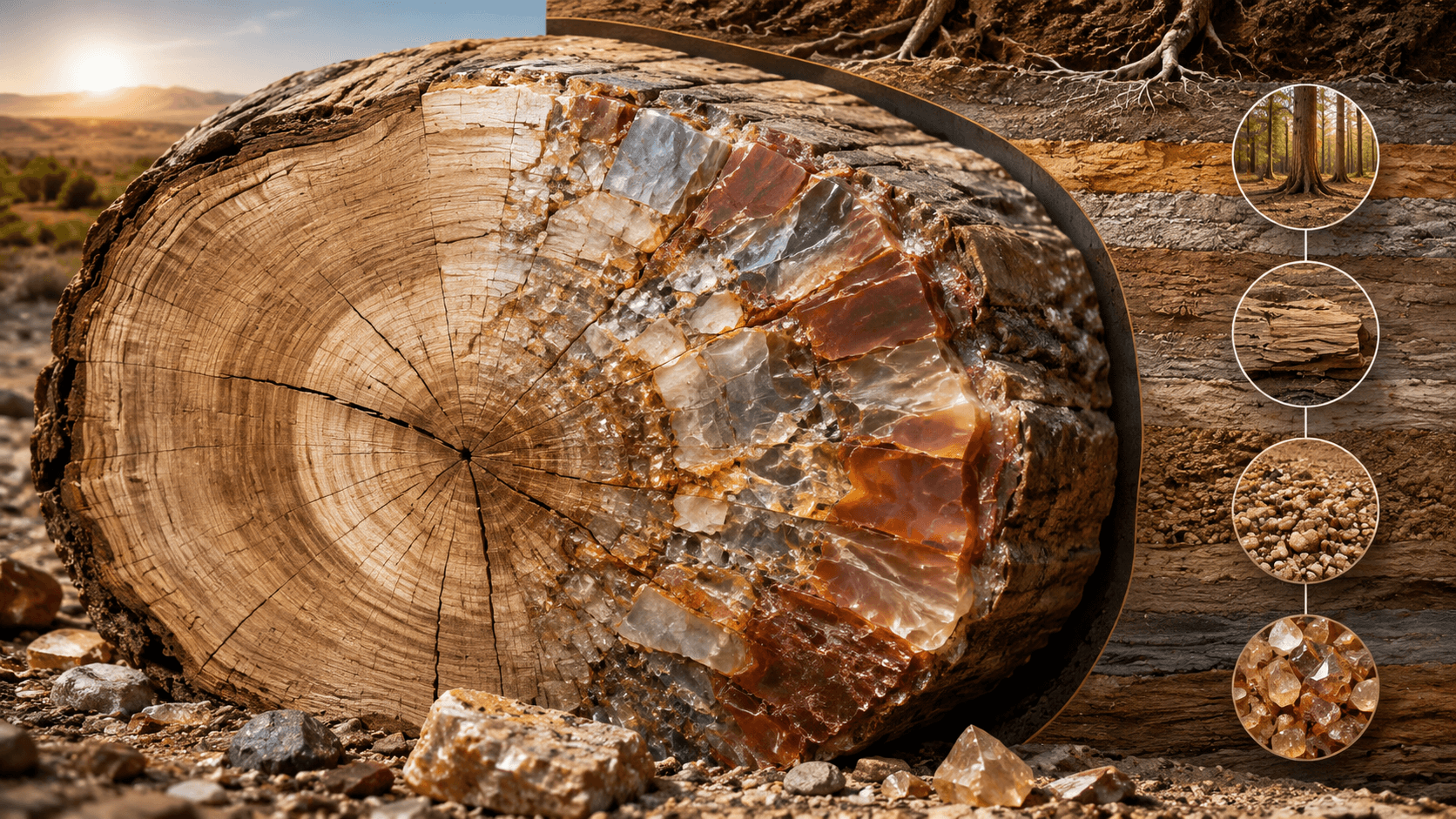
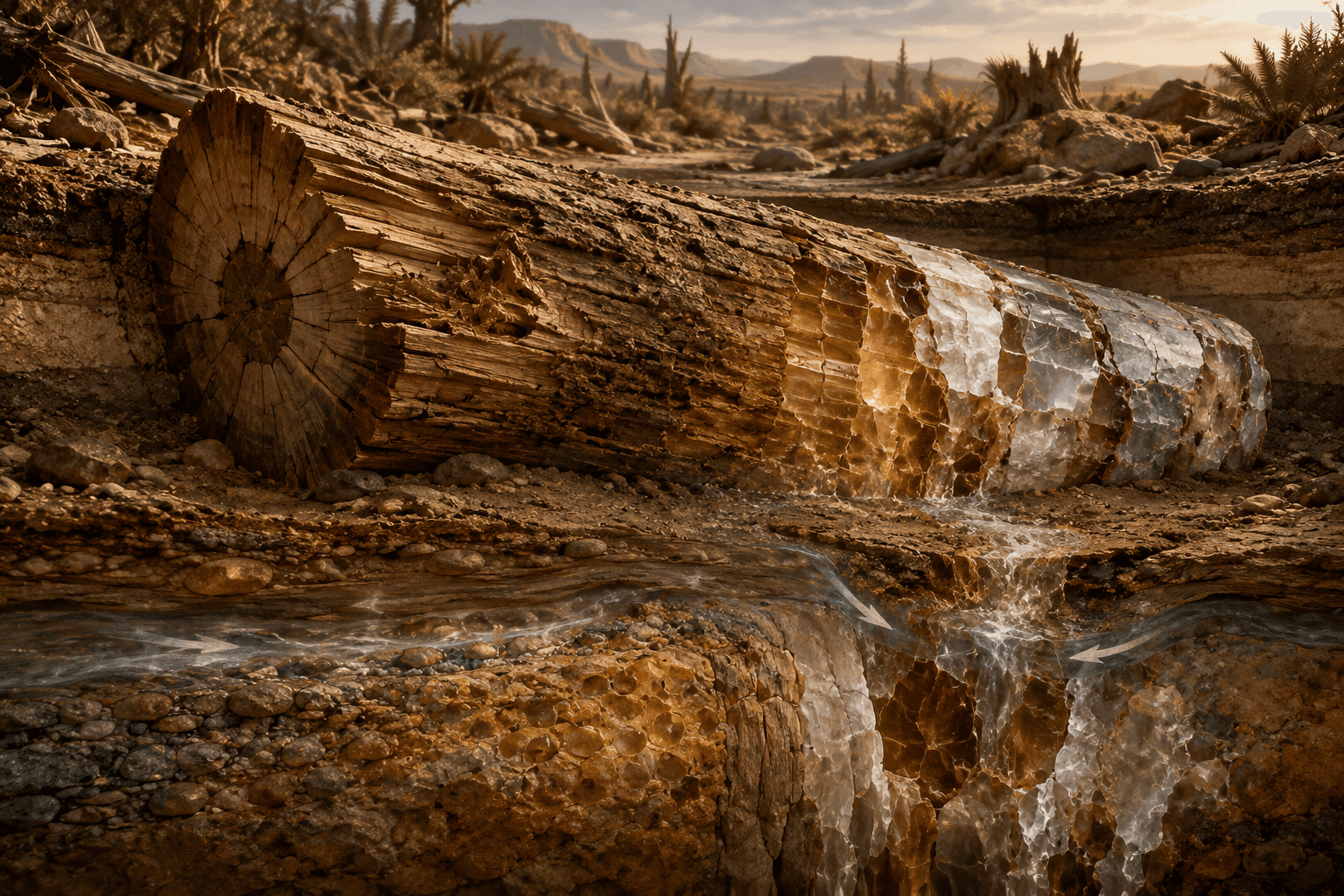
Petrification is a slow substitution. Over millions of years, groundwater loaded with dissolved minerals seeps through buried wood and replaces the organic tissue, cell by cell, with mineral matter. What remains is stone that keeps the exact shape of the tree — its rings, its bark, sometimes the scar of a broken branch.
Most petrified wood mineralizes into quartz, a crystalline form of silica. "Opalized" petrified wood refers to trunks where the silica took an amorphous form — opal — rather than crystallizing into ordered quartz. The distinction matters to collectors because opal can produce a particular translucency and, in rare cases, a play of colour.
At Medusa, the wood we raise from the ground of southwestern Madagascar is silicified quartz: dense, ordered, and hard. Understanding the difference between quartz and opal is the first step to reading any piece of fossil wood honestly — and to seeing why our trunks behave the way they do.
Quartz, Opal, and the Silica Family
Silica does not always freeze into the same architecture. The same chemical element, silicon dioxide, can settle in very different ways, and each way gives the finished stone its own character.
- Quartz — a crystalline, ordered lattice. Hard, dense, cold to the touch, and inert. This is the form our Madagascar trunks take.
- Chalcedony — microcrystalline quartz, fibrous and often waxy in appearance.
- Opal — amorphous, hydrated silica with no crystal order. It can hold water within its structure, which sometimes gives it that milky glow.
Because our wood is quartz, it registers 7 on the Mohs scale. That single number carries real consequences: it resists scratching from keys, cutlery, and everyday grit; it ignores water, heat, ultraviolet light, and frost. A trunk that survived 230 million years underground does not fear a coffee cup.
Stone this old asks nothing of you. It has already endured everything.
If you want the full breakdown of how silica varieties differ in the world of fossil wood, our companion guides in this series go deeper into each type.
How a Tree Becomes Stone
The story begins in the Triassic, roughly 230 million years ago. A forest falls. Rivers bury the trunks in sediment fast enough to cut them off from oxygen, halting the rot that would normally erase them. Then the slow work starts.
Mineral-rich water moves through the buried wood. Silica precipitates into the cellular spaces. Where the original wood held carbon, it gives way to stone — molecule by molecule — until the tree is no longer wood at all, but a mineral cast of itself, faithful down to the grain.
The colour arrives with the metals dissolved in that ancient water:
- Iron paints reds, ochres, and warm browns.
- Manganese brings blacks and violets.
- Chromium and cobalt yield the rarer greens and blues.
No two trunks drank from the same water. This is why colour, in fossil wood, is never a decision — it is a record.
Why Every Medusa Trunk Has a Name
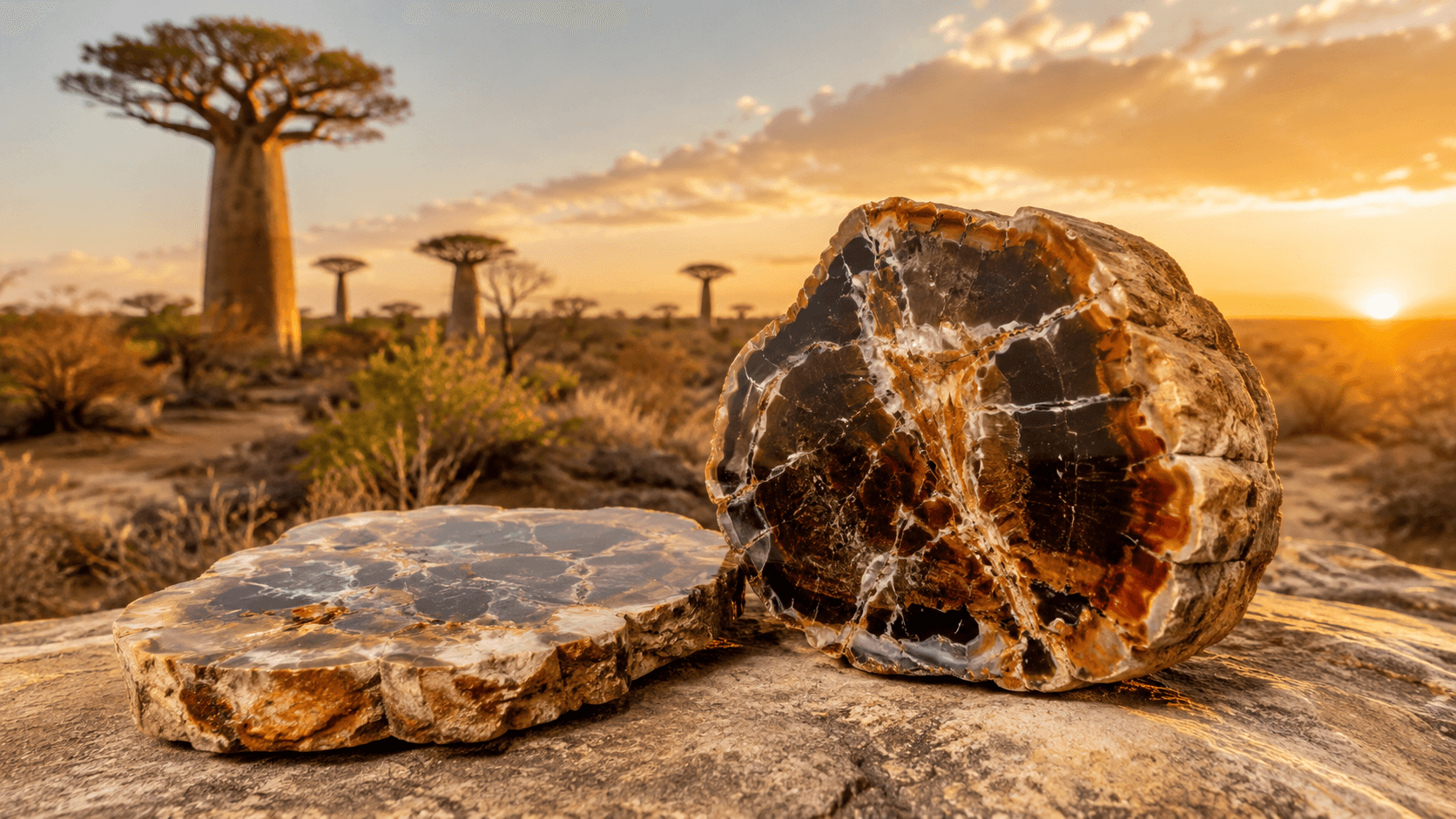
Here is where Medusa parts ways with the sellers of volume. We do not sort fossil wood into product lines. We raise each trunk from the ground one by one, from the southwest of Madagascar, and we give each one a name.
The name follows the colour that its own mineralization produced:
- Ambra — amber, warmed by iron.
- Argentea — silver, pale and quiet.
- Fusca — brown, deep and grounded.
- Umbra — dark, close to shadow.
- Viridis — green, the mark of chromium or cobalt.
These are not categories. They are individuals. When a trunk is cut, its exact tone — the precise chord struck by 230 million years of chemistry — disappears for good. There is no second batch, no restock, no equivalent. What you place in your home is the only object in the world that will ever hold that colour.
That is the whole point of naming. A name says: this one was here, it was distinct, and it will not return.
Reading Colour and Character
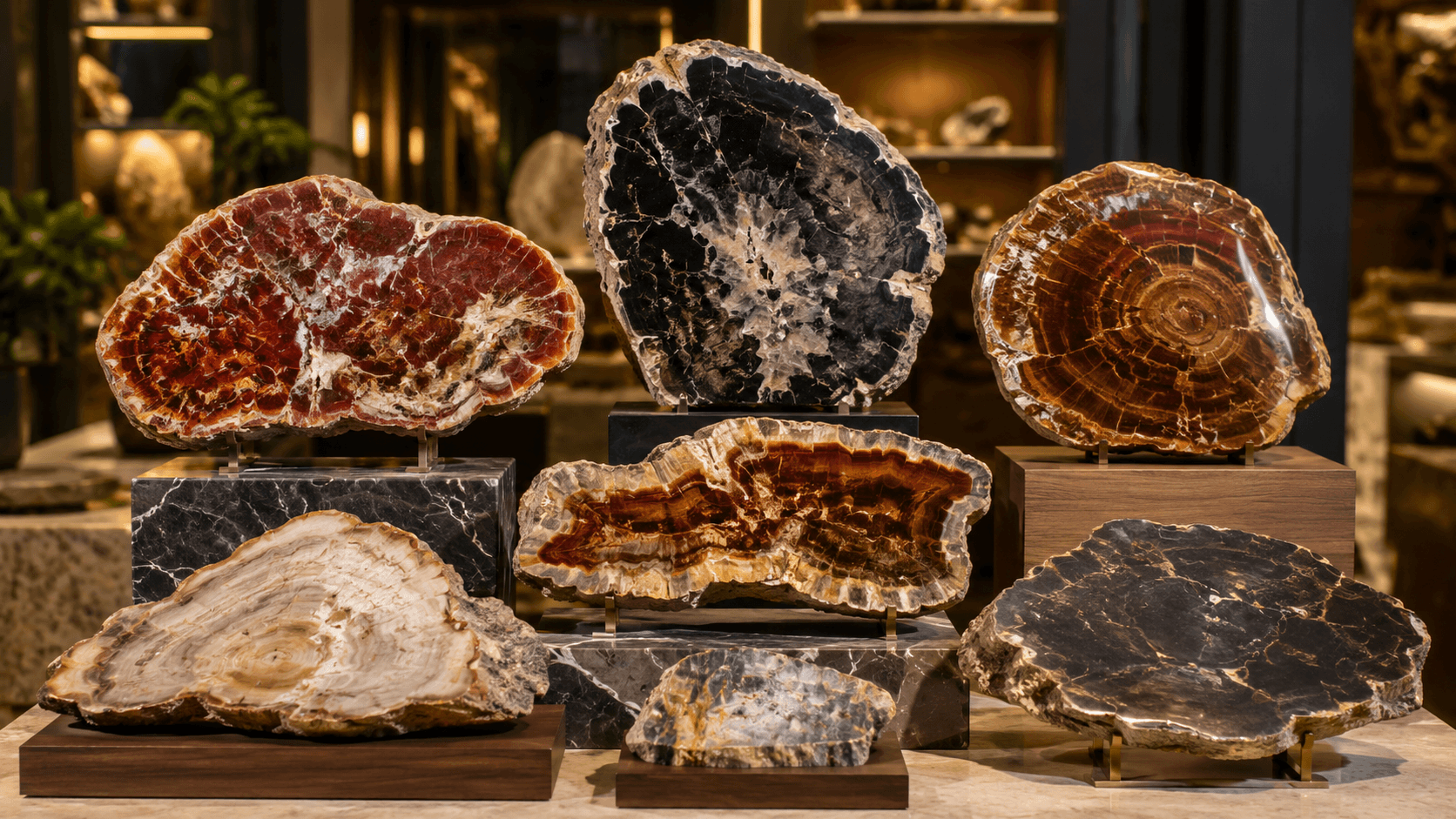
When you look closely at a polished trunk, you are reading a chronicle. The concentric rings mark the tree's seasons. The veins trace where water and metal moved. A darker halo often means manganese pooled there; a rust-coloured band means iron settled during a wetter age.
Translucency, too, tells you something. Where the silica is denser and more ordered, light stops at the surface. Where it thins, light slips a little way in before returning, and the stone seems to glow from within.
None of this is decoration in the ordinary sense. It cannot be reproduced, requested, or matched. When we finish a piece — a table, a vessel, an object — the work of the artisan is to reveal what the stone already contains, never to impose a pattern on it.
Discover the named trunks currently available and let us guide you toward the one that speaks to your space.
Explore the collectionLiving With Fossil Wood
Because the material is quartz, it asks almost nothing of you day to day.
- Water does not penetrate it, so basins and washstands are entirely at ease with daily use.
- Heat leaves it unmoved — a hot dish sets down on a fossil table without concern.
- UV light will not fade it; the colour is mineral, not pigment.
- Frost does not crack it, which is why these pieces belong outdoors as readily as in.
The one thing worth respecting is weight. This is solid stone, and a trunk carries the density of quartz. Placement is a decision to make once, with care, rather than a piece to move on a whim. Cleaning asks only a soft cloth and water; the hardness that let it survive geological time makes it indifferent to ordinary wear.
Each piece is worked by hand. The artisan follows the trunk's own logic — its rings, its fissures, its colour — and stops when the stone is revealed rather than when a shape is forced. No two finished objects are identical, because no two trunks ever were.
Choosing Your Piece
Selecting fossil wood is unlike choosing furniture. You are not picking a model; you are meeting a particular tree. Some people are drawn to the warm reds of an iron-rich Ambra, others to the near-black stillness of Umbra, others still to the rare green of Viridis.
Because each trunk is singular, we work by conversation. Tell us the room, the light, the use — a dining table, a vessel, a standalone object — and we point you toward the trunks whose character suits it. Pricing follows the piece: each is quoted individually, on request. Please contact us for a quote rather than expecting a fixed tariff, because a fixed tariff would deny what the material is.
Frequently Asked Questions
Is opalized petrified wood the same as Medusa's fossil wood?
Not exactly. "Opalized" describes wood mineralized into amorphous opal. Medusa's trunks from southwestern Madagascar are silicified into crystalline quartz — harder, denser, and rated 7 on the Mohs scale. Both are silica; the internal structure differs.
How old is this wood?
The trees fell and began fossilizing in the Triassic, approximately 230 million years ago. What you hold is a mineral record of a forest older than the dinosaurs' peak.
What creates the colours?
Metals dissolved in ancient groundwater. Iron gives reds, ochres, and browns; manganese gives blacks and violets; chromium and cobalt give the rare greens and blues. Each trunk's colour is unique and vanishes permanently once the trunk is cut.
How do I care for a fossil wood piece?
Very little is required. It resists water, heat, UV, and frost, so a soft cloth and water are enough. The main consideration is its weight — decide on placement carefully, as these are solid quartz.