
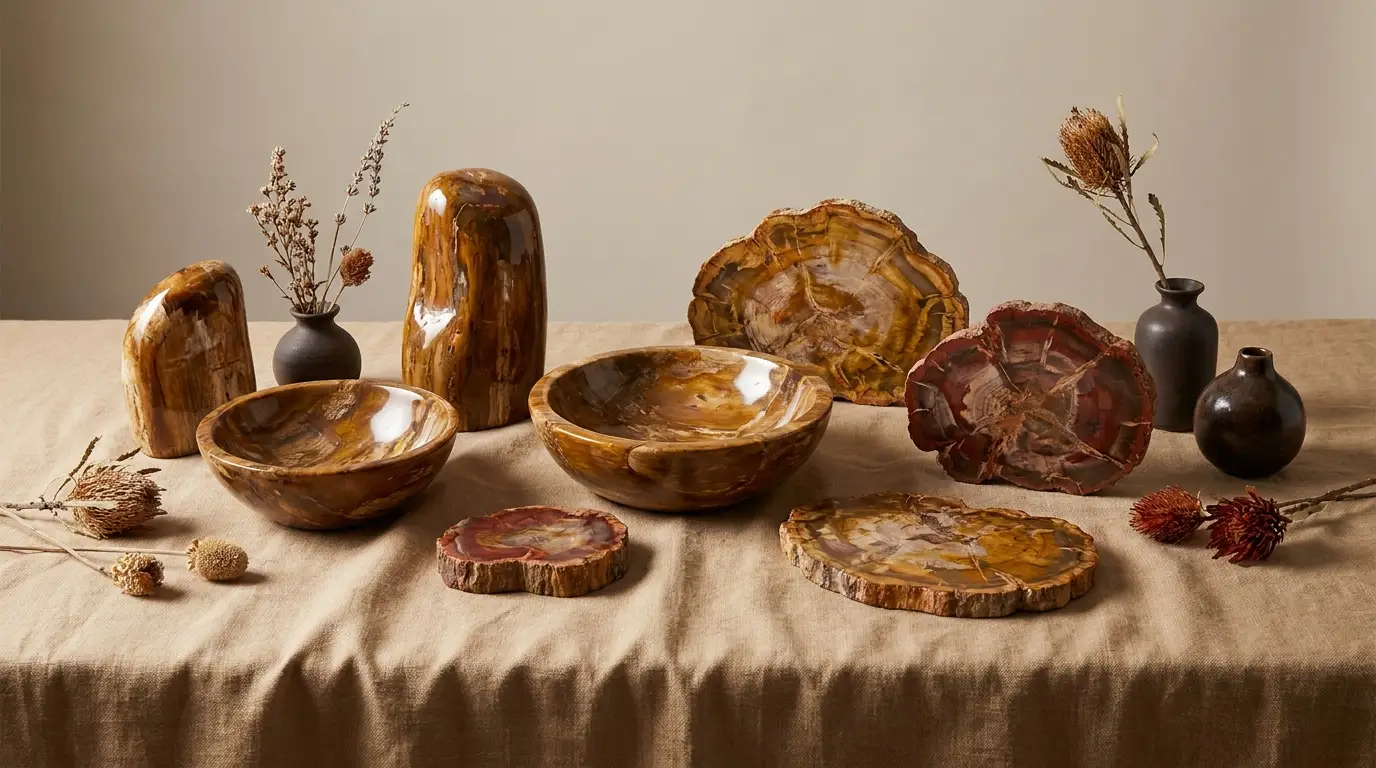
Petrified Wood Wall Decor: A Fragment of an Individual Tree
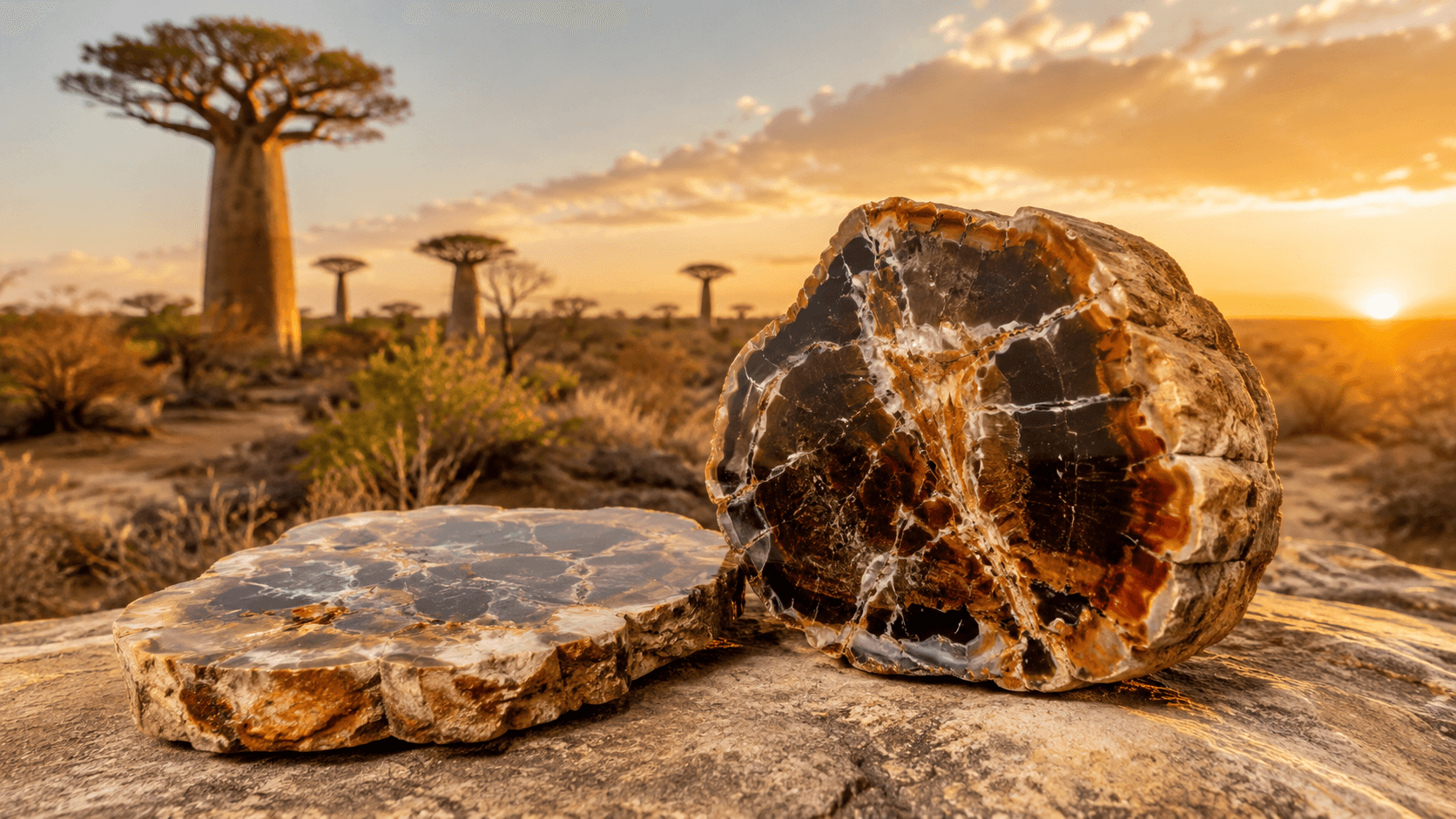
A wall panel of petrified wood is not cut from a catalogue material. It is cut from a tree — one specific trunk, raised from the ground in the southwest of Madagascar, where it has rested for roughly 230 million years. At Medusa, that trunk has a name before it ever becomes a slab: Ambra, Argentea, Fusca, Umbra, Viridis. The name marks a colour that exists nowhere else, because no two trunks mineralize the same way. Once a trunk is cut, that particular palette is gone. What hangs on your wall is not a sample of a product line; it is the last visible trace of a tree that no longer exists in that form.
This is the distinction worth understanding before choosing a piece: volume sellers offer petrified wood as a category. Medusa offers it as an individual.
Why a Wall, Not Only a Table
Petrified wood is usually imagined as a slab or a vessel — heavy, horizontal, functional. Wall decor asks something different of the material: it must read as an image as much as an object. A vertical or framed cut reveals what a tabletop often hides — the full radial structure of the trunk, the growth rings compressed by silica, the fracture lines where mineral veins cut across the grain at odd angles.
Mounted on a wall, a cross-section becomes a kind of portrait of the tree's final centuries of growth, arrested at the moment of fossilization. The piece works less like furniture and more like a framed geological event.
- Cross-sections show concentric rings, sometimes with a hollow or fractured core
- Split or "book-matched" panels reveal mirrored vein patterns from a single trunk
- Rough-edged slices keep the natural silhouette of the bark line intact
- Polished faces catch light differently through the day, unlike a static painting
Each Piece Carries a Name
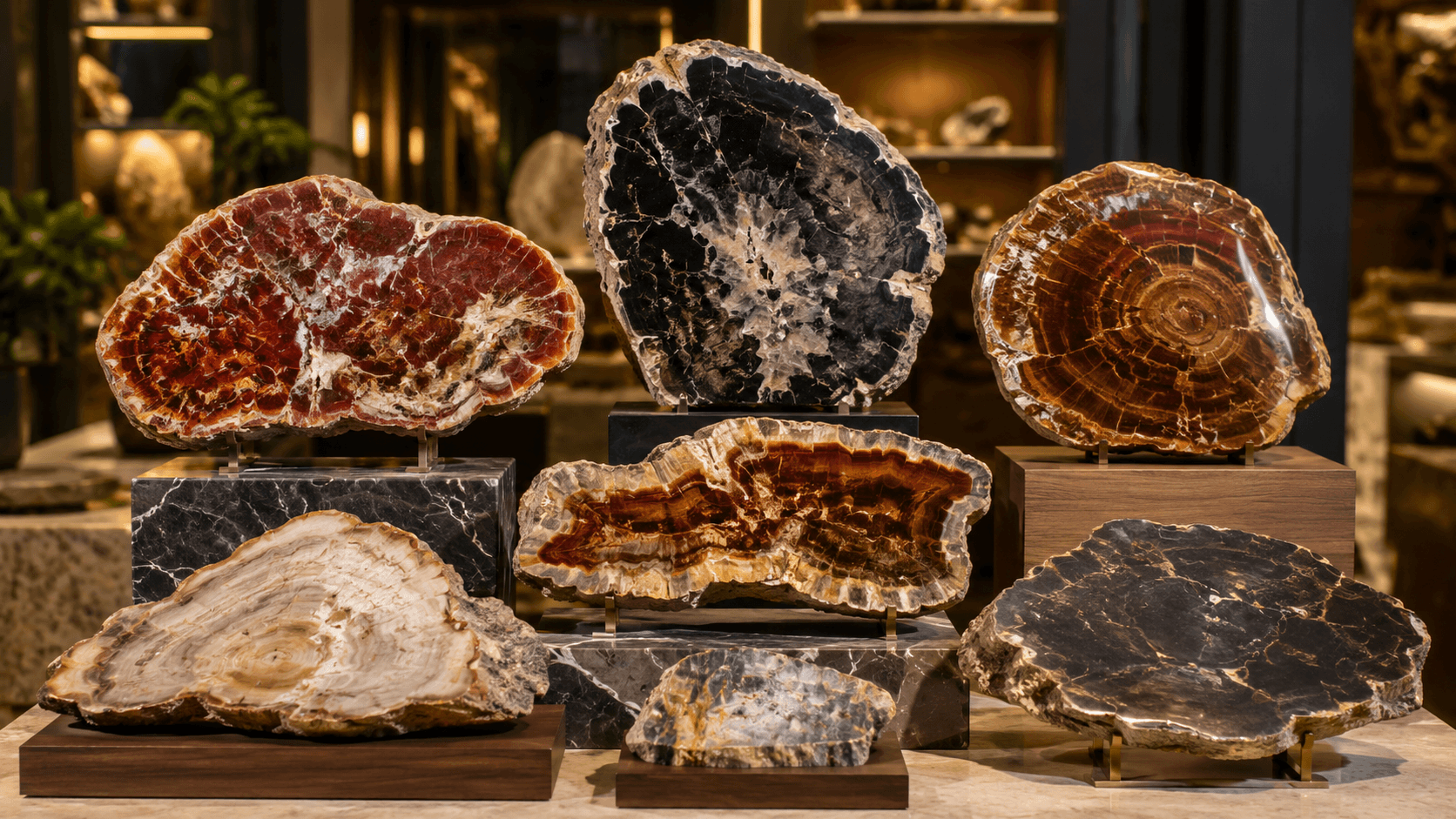
The colour of any given trunk was decided underground, long before Medusa ever recovered it. As the wood's organic tissue dissolved, groundwater carried dissolved silica into its cellular structure, along with trace metals absorbed from the surrounding rock. Iron produced the reds and ochres. Manganese produced blacks and violets. Chromium and cobalt, more rarely, produced greens and blues. The naming system at Medusa follows this logic directly:
- Ambra — amber and honey tones, dominated by iron oxides
- Argentea — pale, silvered greys with a mineral sheen
- Fusca — deep browns, dense and warm
- Umbra — near-black, shadowed tones from manganese concentration
- Viridis — the rarest, green-tinted trunks touched by chromium or cobalt
A wall piece named Umbra will never be reproduced identically once its trunk is exhausted. This is not a marketing flourish — it is a simple consequence of geology.
The Stone Behind the Wood
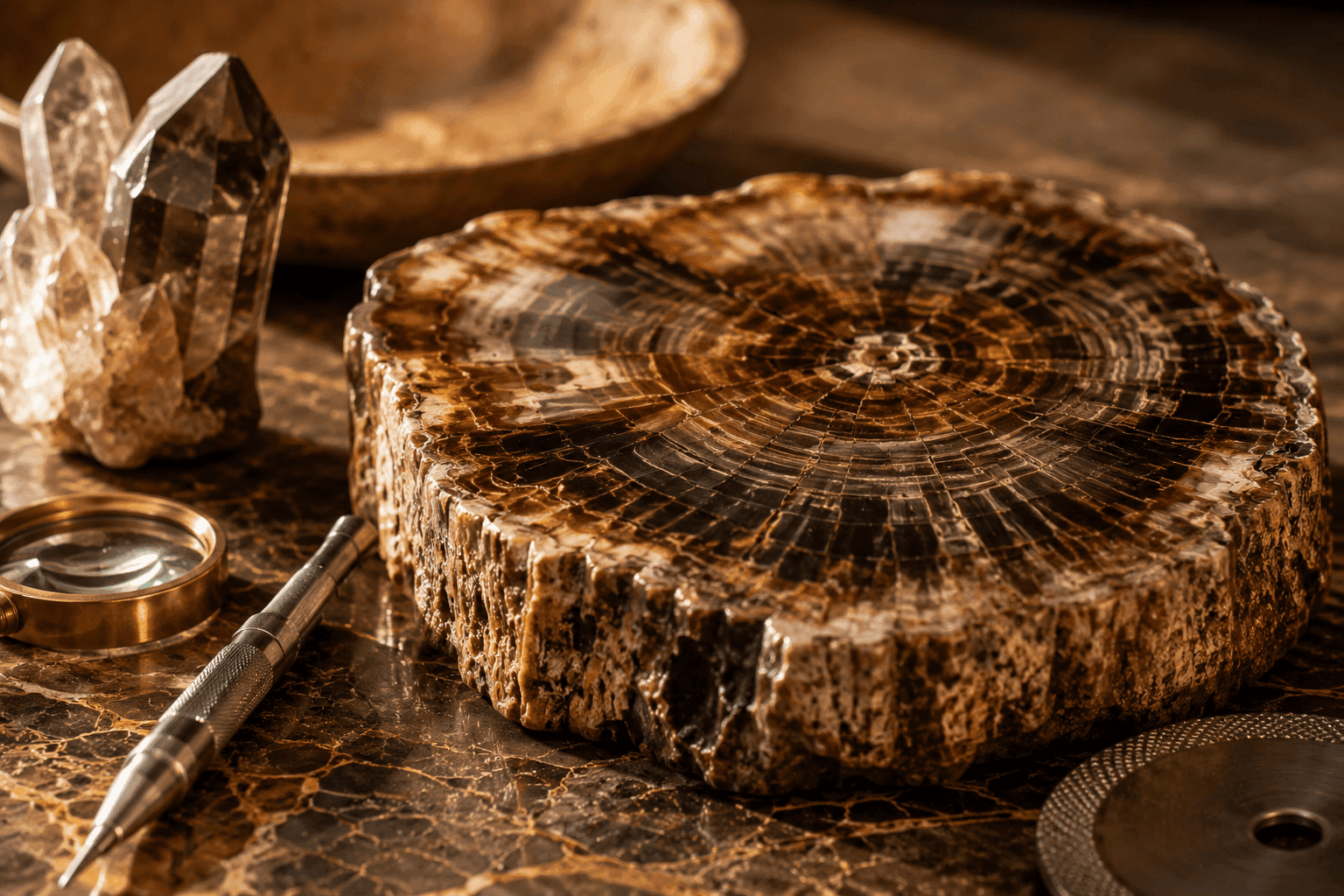
Despite its name and its visible grain, petrified wood is not wood by the time it reaches a wall. Silica replacement converted the original cellulose into quartz, cell by cell, over millions of years. What you hang is stone that remembers the shape of a tree.
This has direct consequences for wall decor:
- Hardness of 7 on the Mohs scale — resistant to scratching, chipping, and the wear that softer decorative stones suffer over decades
- Mineral stability — indifferent to humidity, temperature swings, and UV exposure, so colour does not fade near windows or under direct light
- Weight — genuinely heavy for its size, which changes how a panel must be mounted, but also explains its permanence on a wall once installed
- Cold touch — a tactile signature that distinguishes it instantly from wood, resin, or composite imitations
A tree that took three centuries to grow, and two hundred million years to become stone, does not ask to be treated as decoration. It asks to be treated as a document.
From Trunk to Wall: The Craft
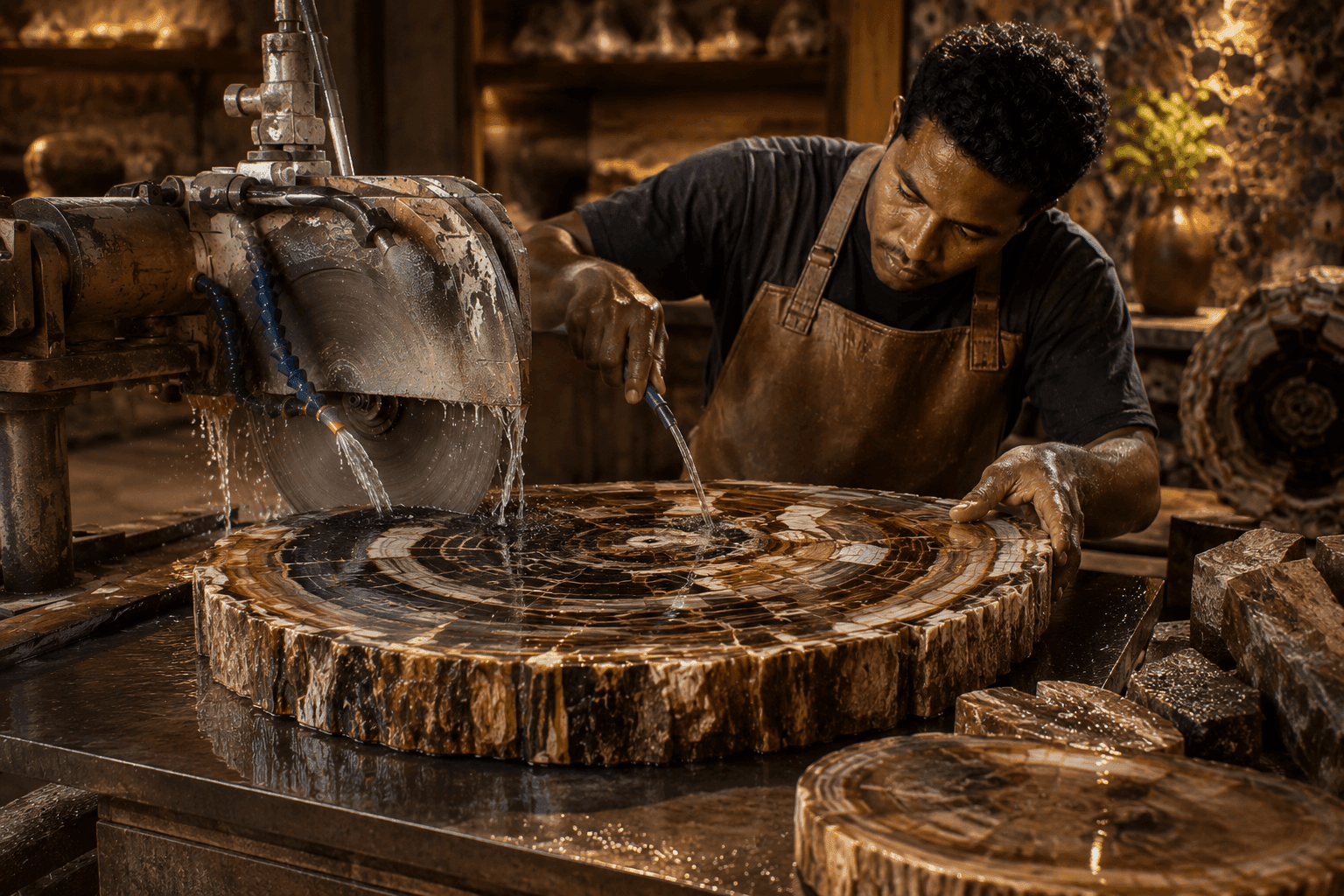
Turning a fossilized trunk into a wall panel is slower and less forgiving than working with actual timber. Diamond-tipped blades are required simply to cut quartz cleanly, and every trunk fractures differently depending on the density of its mineralization — some slice cleanly along the grain, others shatter without warning along hidden fault lines. Polishing then reveals what cutting alone cannot: the true depth of colour banding, the sharpness of the ring boundaries, the presence of small cavities filled with contrasting crystal.
At Medusa, this stage is treated as much as an act of discovery as fabrication. No amount of planning predicts exactly what a given trunk will show once opened. The artisan's role is to bring out what is already there — not to impose a shape on the stone.
Living With Petrified Wood on Your Wall
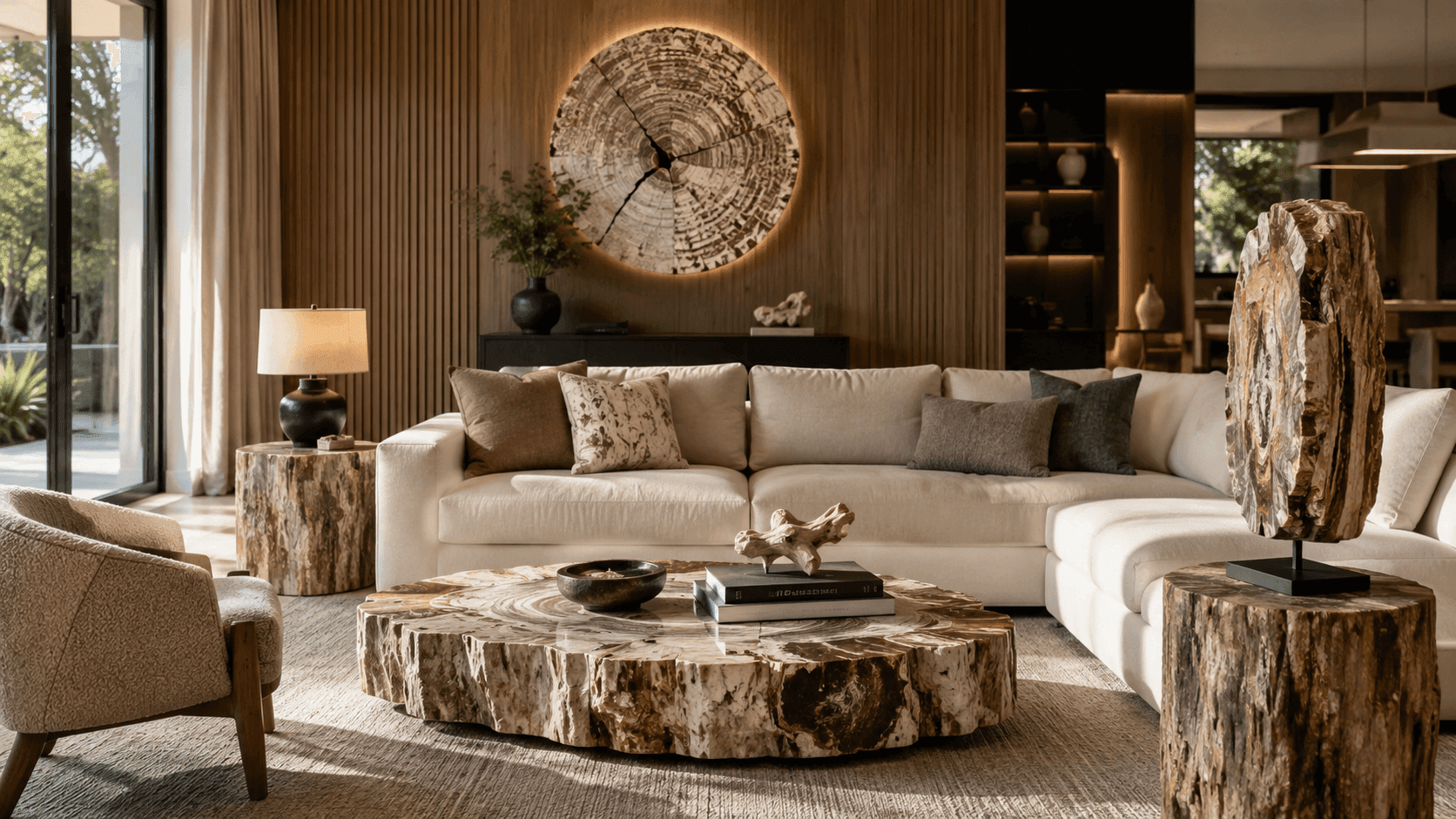
A petrified wood panel behaves differently from most wall art. It does not compete for attention the way a painting does — its presence is quieter, closer to a piece of architecture than a picture. It suits spaces where natural materials already dominate: stone floors, raw wood furniture, matte metal fixtures. Because the material never degrades, it is one of the rare wall pieces that can be considered a genuinely long-term fixture rather than a seasonal choice.
Placement matters more than most buyers expect, given the weight involved. Mounting should be planned with the piece's dimensions and thickness in mind — this is a conversation best had before the panel leaves our workshop, not after it arrives.
Discover the current selection of individually named trunks available for wall pieces.
Visit the ShopFrequently Asked Questions
Is petrified wood wall decor heavy to mount?
Yes. Because the material is fully silicified quartz, even a modest panel carries significant weight. Wall fixings should be specified for the piece's exact dimensions — this is addressed individually for each order.
Will the colour fade over time?
No. The colours come from stable mineral compounds — iron, manganese, chromium, cobalt — locked inside quartz. They are unaffected by UV exposure, humidity, or temperature change.
Can two wall panels have the same colour and pattern?
Not identically. Each trunk mineralized under unique conditions. Once a named trunk such as Ambra or Viridis is fully cut, that particular combination of colour and vein pattern cannot be sourced again.
How is petrified wood different from stained or dyed wood decor?
Stained wood is organic material with surface colour applied. Petrified wood is mineral through and through — the colour exists inside the stone itself, a result of fossilization roughly 230 million years ago, not a coating on the surface.