
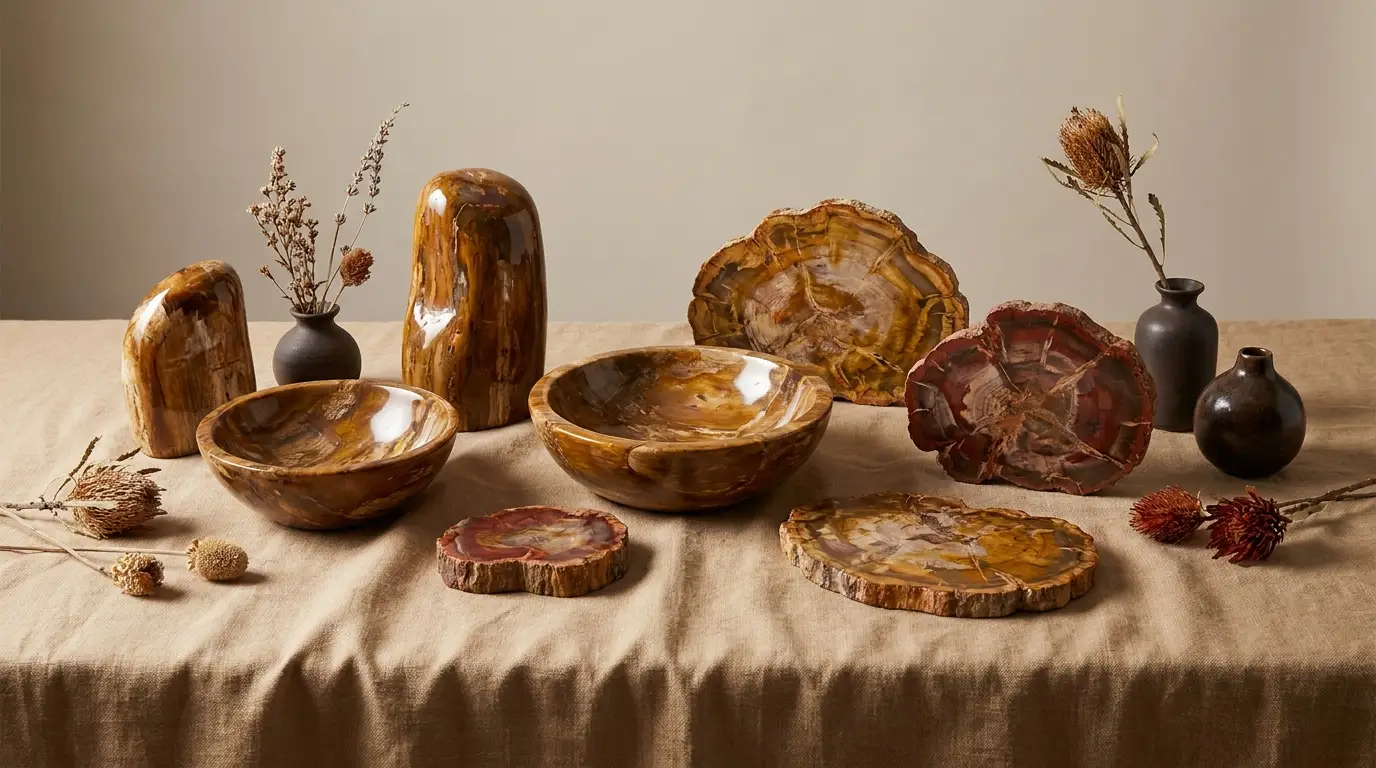
A Weight That Holds Books, and 230 Million Years Behind It
Most bookends do their job and disappear from notice. Ours don't. Each pair of Medusa petrified wood bookends is cut from a single tree that grew in the southwest of Madagascar roughly 230 million years ago, fell, and was replaced cell by cell with quartz before the Sahara existed, before the Atlantic had finished opening. What you set on your shelf is mineral, not wood — though it still remembers being a tree.
One Tree, Never Repeated
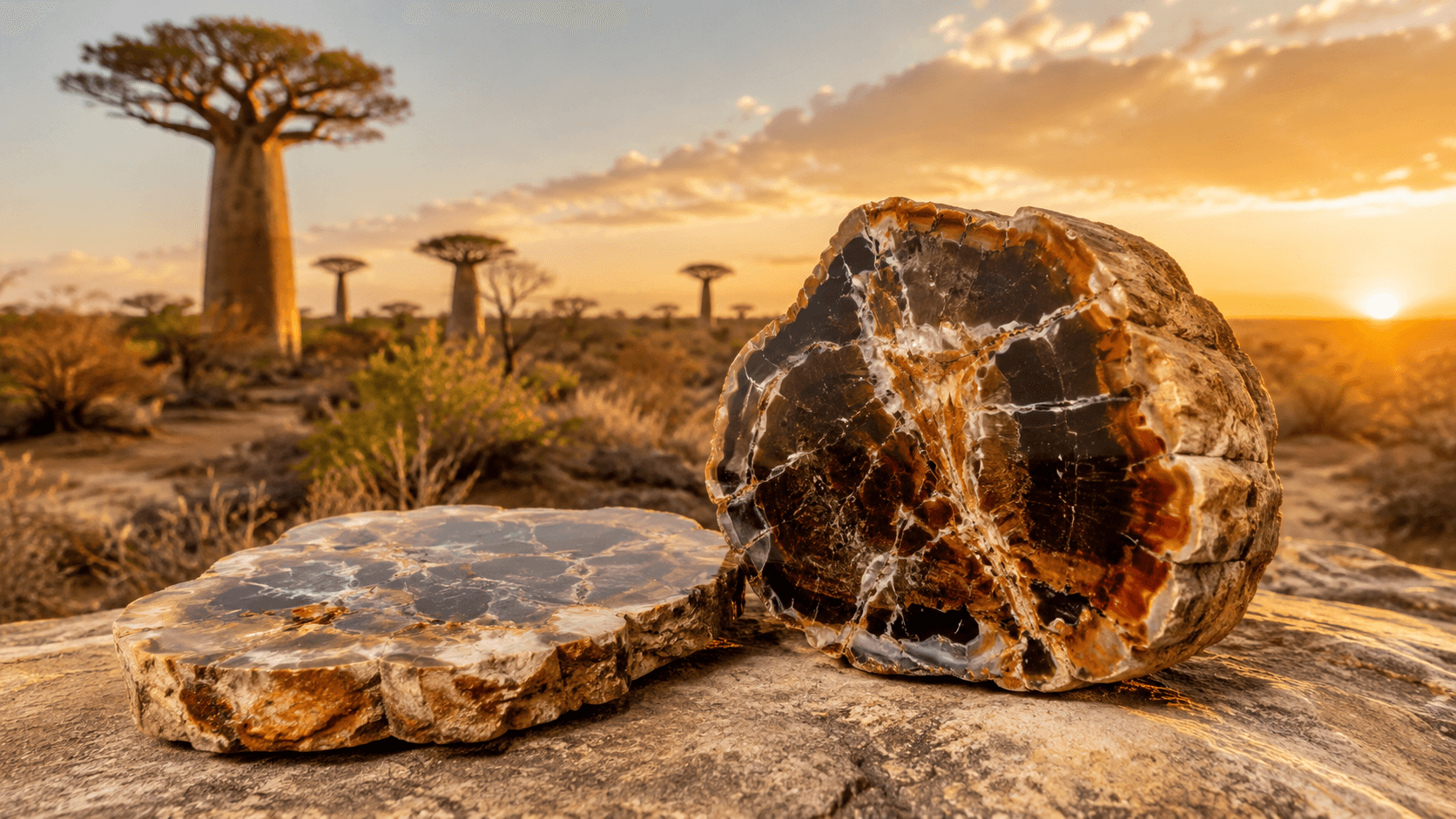
At Medusa, we don't sell "petrified wood" as a category. We bring up individual trunks, one at a time, from the sites we work in southwestern Madagascar — and we name each one. Ambra for amber tones, Argentea for silvered grey, Fusca for deep brown, Umbra for near-black, Viridis for green. A pair of bookends cut from Fusca will never exist again once that log is used up. There is no restocking a color: the tree that produced it is gone, and its mineral signature — the exact blend of iron, manganese, chrome or cobalt that colored it as it fossilized underground — cannot be reproduced from another trunk.
This is the difference between buying an object and buying a fragment of a specific, identifiable tree. Bookends are small enough that this distinction is easy to feel: you're not holding a slab, you're holding a cross-section of something that once stood.
Why Stone Makes Sense on a Shelf
Books are heavy, and cheap bookends give way under them — sliding, tipping, letting the row slump sideways. Petrified wood solves this by simple physics: it's quartz, rated 7 on the Mohs hardness scale, and dense enough that a modest pair holds its ground without needing rubber pads or hidden weights.
- Cold to the touch, always — it doesn't respond to room temperature the way wood or resin does.
- Entirely indifferent to humidity, spilled coffee, or direct sun near a window.
- Resistant to scratching from paper, leather, or metal book spines.
- Stable indefinitely: it won't warp, crack from dryness, or fade.
You are, in effect, putting a piece of geology to work as furniture. It was built to survive fossilization; a shelf of hardbacks is not a demanding second career.
What the Cut Reveals
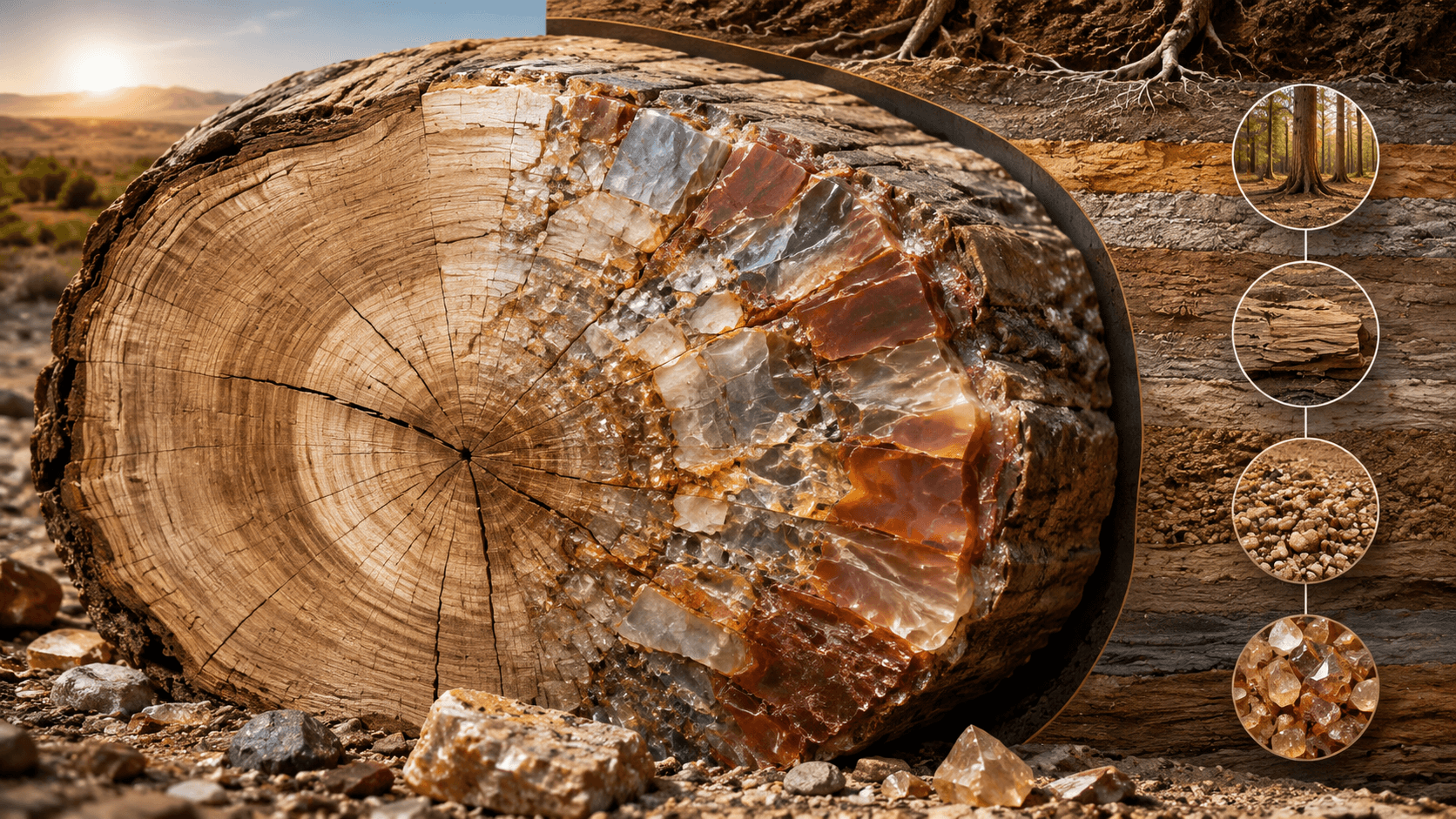
Every bookend carries the proof of its origin on its face. Growth rings, sometimes tight and regular, sometimes interrupted by a scar or a knot the tree carried for decades — all of it fixed in quartz. The color comes from trace metals absorbed during fossilization: iron produces the reds and ochres, manganese the blacks and violets, chrome and cobalt the rarer greens and blues. No dye, no stain, no finish applied afterward to "enhance" the tone. What you see is the chemical history of the ground the tree fell into.
This is also why no two bookends from Medusa are identical, even within the same named tree. A trunk is not uniform inside — the outer sapwood often differs from the heartwood, and the angle of the cut changes what pattern emerges. Buying a pair means accepting the specific piece in front of you, not a rendering of what it might look like.
From Trunk to Object
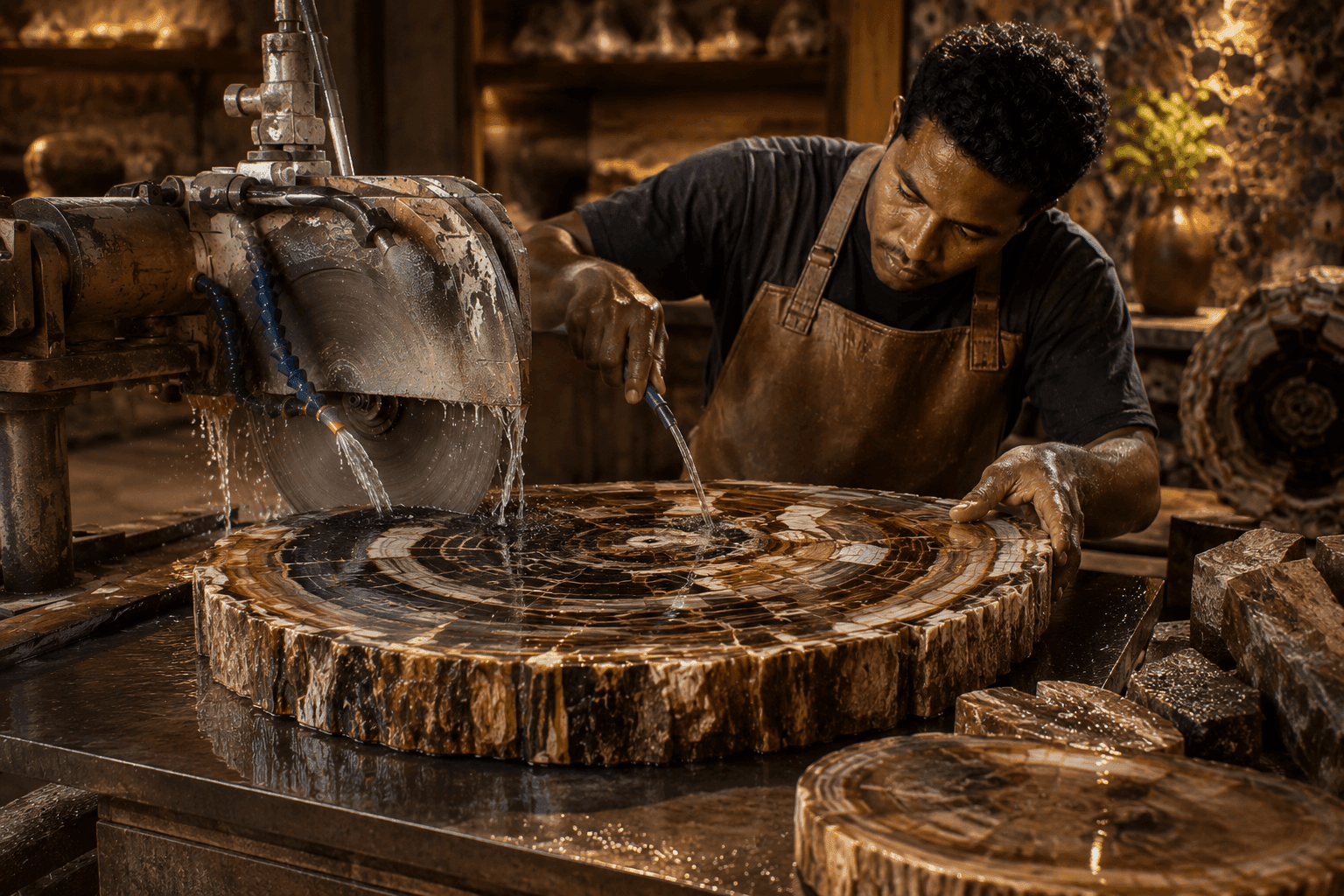
Turning a fossilized log into a pair of bookends is closer to stonework than woodwork. The trunk is cut to reveal its most telling face, then shaped and polished by hand — slowly, because quartz does not forgive impatience, and because the goal is to keep the natural contour of the piece rather than force it into a uniform block. A base is often flattened for stability; beyond that, we intervene as little as possible. The tree already did the interesting part.
A tree took two centuries to grow and two hundred million years to become this. The bookends only ask for a shelf.
Where They Belong
Petrified wood bookends read differently depending on the room. On an office shelf, they sit as a quiet counterpoint to paper and screens — something unmoved by either. In a library or reading corner, paired with leather-bound volumes, the stone's density and rings feel less like decoration and more like punctuation. They also work as a standalone object, propped without books at all, simply as a pair of grounded, weighted forms on a console or mantel.
Because each pair comes from a single named tree, we recommend choosing based on the room's existing tones rather than a fixed idea: Argentea for cooler, minimal interiors; Ambra or Fusca for wood-heavy, warmer rooms; Viridis where a room can carry a stronger note.
See the current pairs, each from a different named tree.
Browse the BoutiqueFrequently Asked Questions
Are petrified wood bookends actually wood?
No. The organic wood has been fully replaced by silica (quartz) over millions of years. The structure — rings, grain, sometimes bark texture — is preserved, but the material itself is stone.
Will the color of my bookends change over time?
No. The coloring comes from mineral inclusions fixed within the quartz during fossilization. It is not a surface treatment, so it does not fade with light or age.
Can they be used outdoors, near a window, or on a heated shelf?
Yes. Quartz is unaffected by UV exposure, humidity, or temperature swings, which makes petrified wood suitable for sunlit rooms or spaces near heat sources.
Why does each pair look different, even with the same name?
Each name designates an individual tree, but no trunk is uniform inside. The cut's position and the transition between sapwood and heartwood change the pattern and tone from one piece to the next — which is why we recommend viewing the specific pair before ordering, on request or via the boutique.