
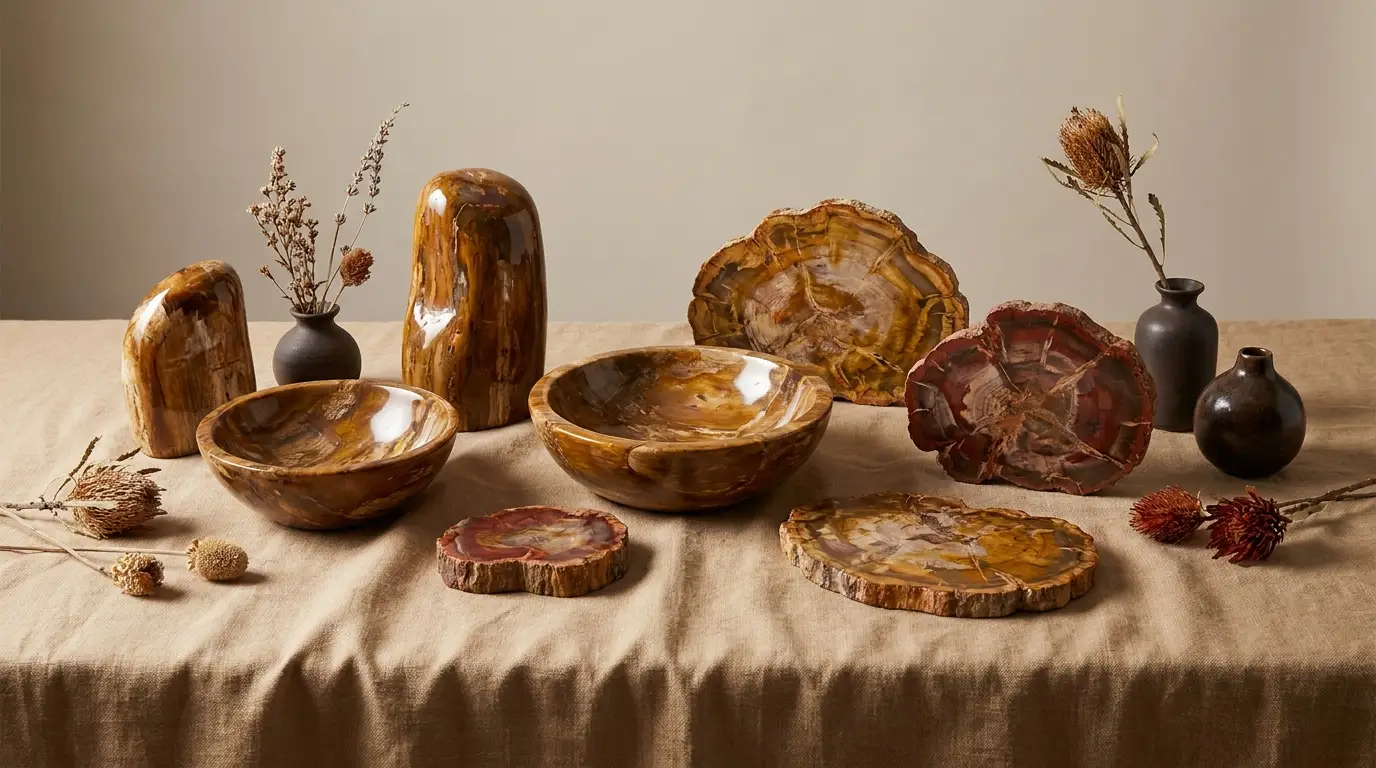
A Stone Older Than the Hand That Sets It
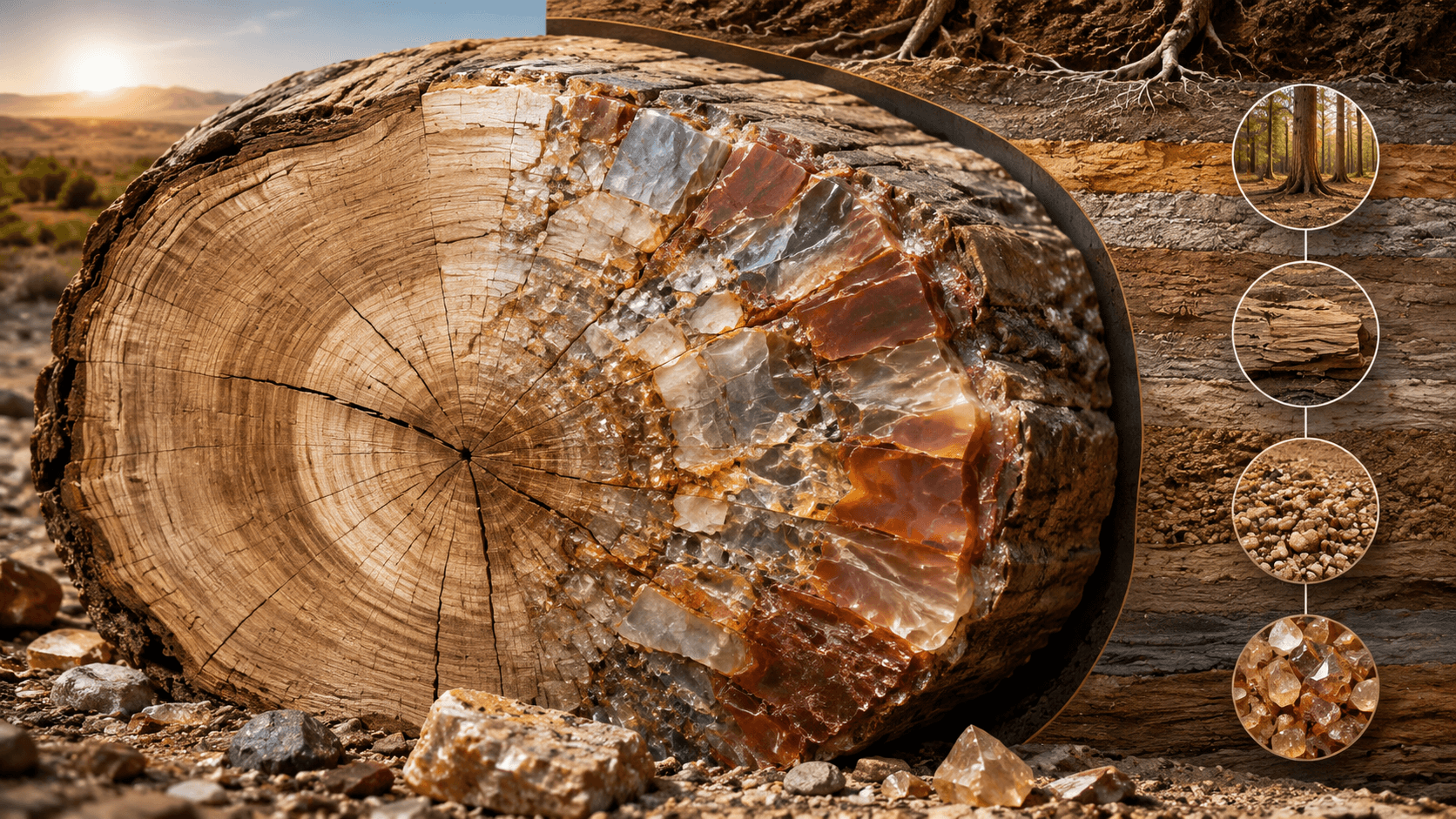
A bracelet of petrified wood does not imitate stone. It is stone — has been for roughly 230 million years, since a tree fell in what is now southwestern Madagascar and silica, dissolved in groundwater, replaced its cell structure atom by atom. What remains is quartz: hardness 7 on the Mohs scale, indifferent to water, heat, UV light, or frost. Cut thin enough to sit on a wrist or hang from a chain, that same permanence becomes intimate. You are not wearing a decorative motif. You are wearing a fragment of a specific tree, dated to a geological era, polished to reveal what its own mineralization wrote into it.
This is the premise behind our jewelry: bracelets, pendants, and beads drawn from trunks we have already identified, named, and catalogued before a single bead is cut.
Not a Southwestern Aesthetic
Petrified wood jewelry carries, in many markets, a specific visual vocabulary — turquoise-adjacent settings, Southwestern silverwork, a Native American design language tied to Arizona and New Mexico deposits. That is a legitimate tradition, but it is not ours, and we do not borrow from it.
Medusa's material comes exclusively from the arid forests of southwestern Madagascar. The trunks fell during the Triassic, long before the landmass that would become Madagascar separated from the rest of Gondwana. Their mineral signature — the specific balance of iron, manganese, chromium, and cobalt that colors each piece — belongs to that soil, that groundwater, that geological history. A red-ocher bead here and a red-ocher bead cut from an Arizona trunk are not the same object wearing different jewelry: they are different trees from different continents, colored by different minerals under different conditions. We name what we cut. We do not dress it in someone else's iconography.
Each Bead Comes From a Named Tree
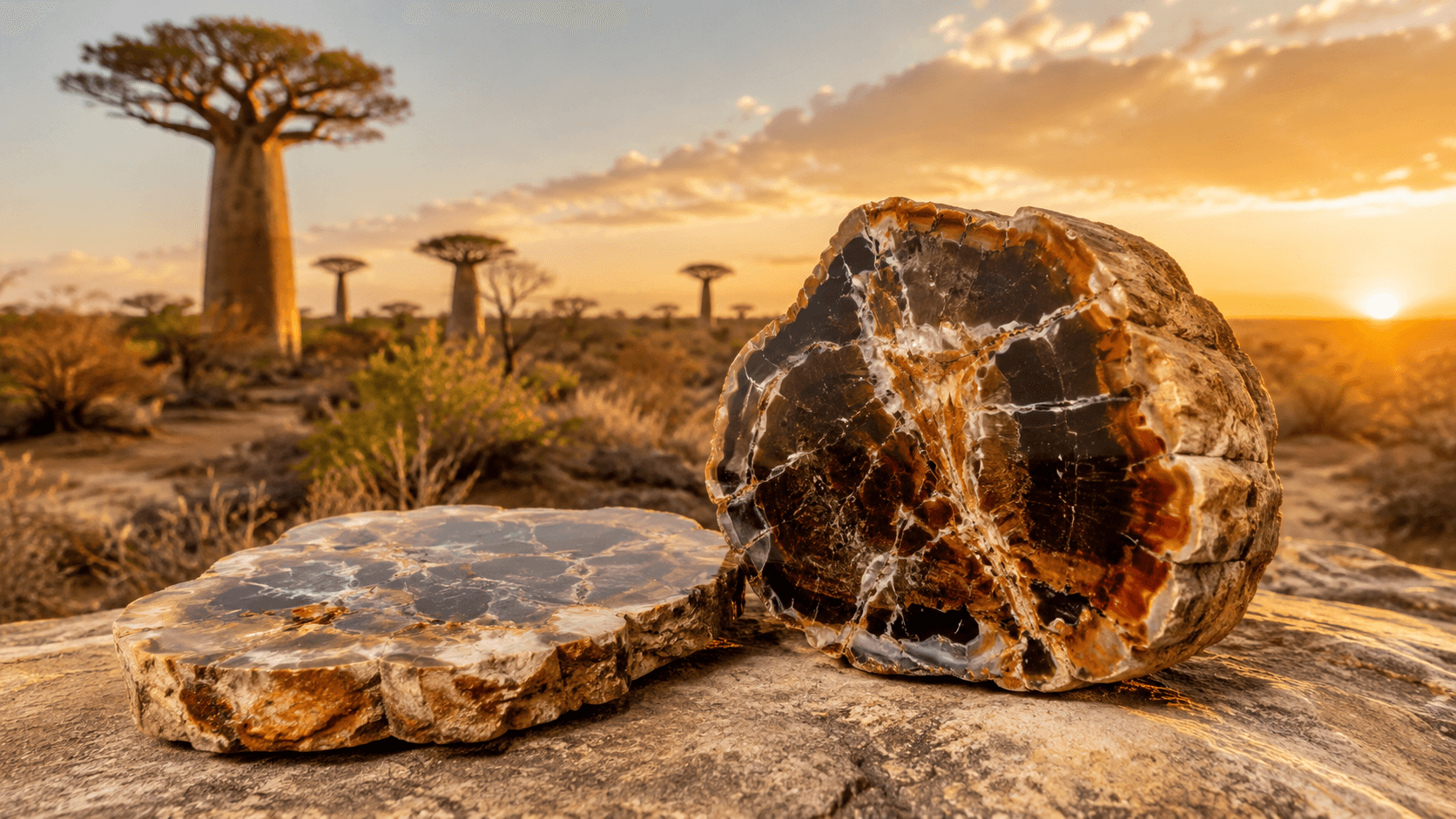
Before any trunk becomes tables, vessels, or jewelry, it has a name at Medusa: Ambra for amber tones, Argentea for silvered grays, Fusca for deep browns, Umbra for near-black density, Viridis for the rare greens born of chromium and cobalt. This is not a marketing device. Each name designates one individual tree, remounted whole from the ground, whose coloration is unrepeatable — the product of its own specific exposure to iron-rich or manganese-rich water during fossilization.
When a trunk is cut into beads or pendant slabs, its palette is fixed. There is no second harvest of an Ambra tree once it has been fully worked; the tree is finite, the color was never manufactured, and no supplier can reproduce it on request. A bracelet from a Viridis trunk is, in a strict sense, one of a limited number of objects that will ever carry that exact mineral history — because the tree that made it no longer stands to be cut again.
A tree does not fall twice. Neither does its color.
Palm Wood: A Different Structure, A Different Beauty
Not every fossilized trunk we work is a tree in the botanical sense. Petrified palms are monocotyledons — they never developed the concentric growth rings of a true tree, since they lack the secondary growth that produces annual rings. Instead, a cross-section of petrified palm shows a field of small, dark, dot-like traces: the fossilized remnants of vascular bundles, scattered rather than layered.
For jewelry, this changes the visual result entirely. Where a ringed cross-section reads as a landscape of concentric bands, a palm-wood bead or pendant reads as a constellation — dark speckles suspended in a lighter matrix, no two arrangements alike. Collectors who want the recognizable "tree-ring" look choose classic petrified wood; those drawn to a more scattered, textural pattern often prefer palm. Both are quartz. Both are roughly 230 million years old. The anatomy underneath is simply different, and it shows.
On "Opalized" Wood — and Why We Don't Sell It That Way
Some sellers market petrified wood jewelry as "opalized," implying a gem-like, opal-based mineralization. True opal is a distinct material — amorphous, hydrated silica, softer and more prone to microfracturing than crystalline quartz. It can produce striking color play, but it does not share quartz's resistance to heat, scratching, or long-term wear.
What we cut and set at Medusa is silicified wood: fully crystallized quartz, hardness 7, stable indefinitely under normal wear. Some of our trunks — particularly certain Argentea and Viridis specimens — display a luminous, almost glassy finish that visually resembles opal once polished. We are transparent about the distinction: the shine is real, the durability is quartz's, and we will not describe a piece as "opalized" if its mineral identity says otherwise.
Wearing Quartz: Weight, Cold, Permanence
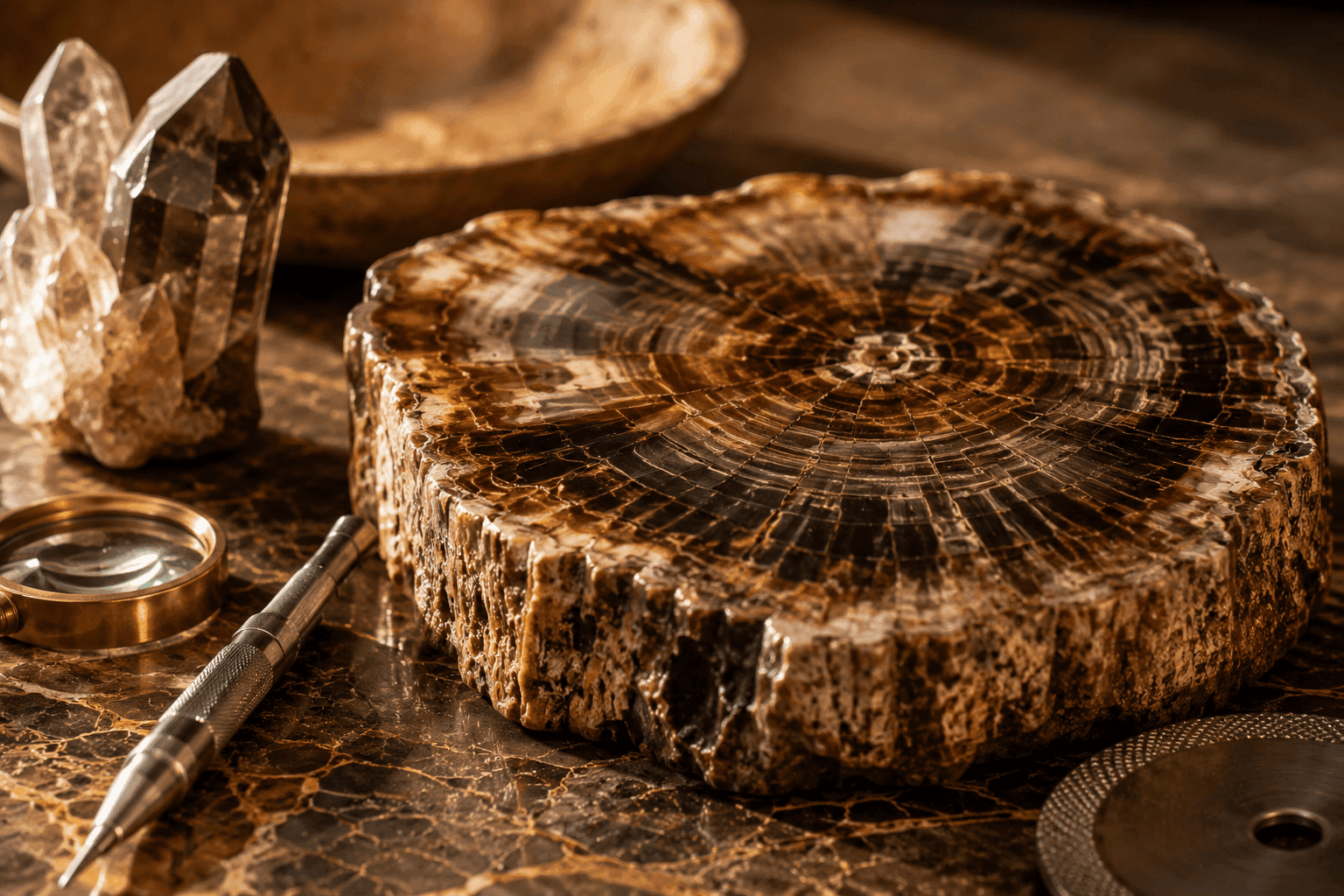
Quartz jewelry behaves differently on the body than resin, bone, or soft stone. It carries genuine weight — a bracelet of petrified wood beads sits with the same density as fine mineral jewelry, not the lightness of composite materials. It reads cold against the skin for the first moments, then warms slowly, the way stone does rather than the way metal does. And it does not degrade: no fading in sunlight, no clouding from water, no softening near heat. A pendant cut today from a named trunk will show the same grain, the same color, the same hardness in a century.
- Bracelets: beads cut from a single named trunk, matched for continuity of grain and tone.
- Pendants: slabs chosen for a specific vein pattern or color transition within one tree.
- Beads (loose or restrung): sold by trunk of origin, never blended across unrelated pieces.
See which named trunks currently have jewelry available.
Visit the ShopFrequently Asked Questions
Is petrified wood jewelry safe to wear daily, including with water?
Yes. The material is quartz, hardness 7, entirely unaffected by water, humidity, or normal skin contact. It will not swell, crack, or lose color with washing.
What makes Medusa's petrified wood different from Southwestern or Native American pieces?
Origin and process. Our trunks come exclusively from southwestern Madagascar, are identified individually before cutting, and are named according to their natural coloration rather than styled to match an existing regional design tradition.
Is palm wood the same as regular petrified wood?
Both are fossilized and both are quartz, but palms are monocotyledons without growth rings. Their cross-sections show scattered dot-like vascular traces instead of concentric bands, giving jewelry a speckled rather than ringed appearance.
Do you sell true opalized wood?
No.