
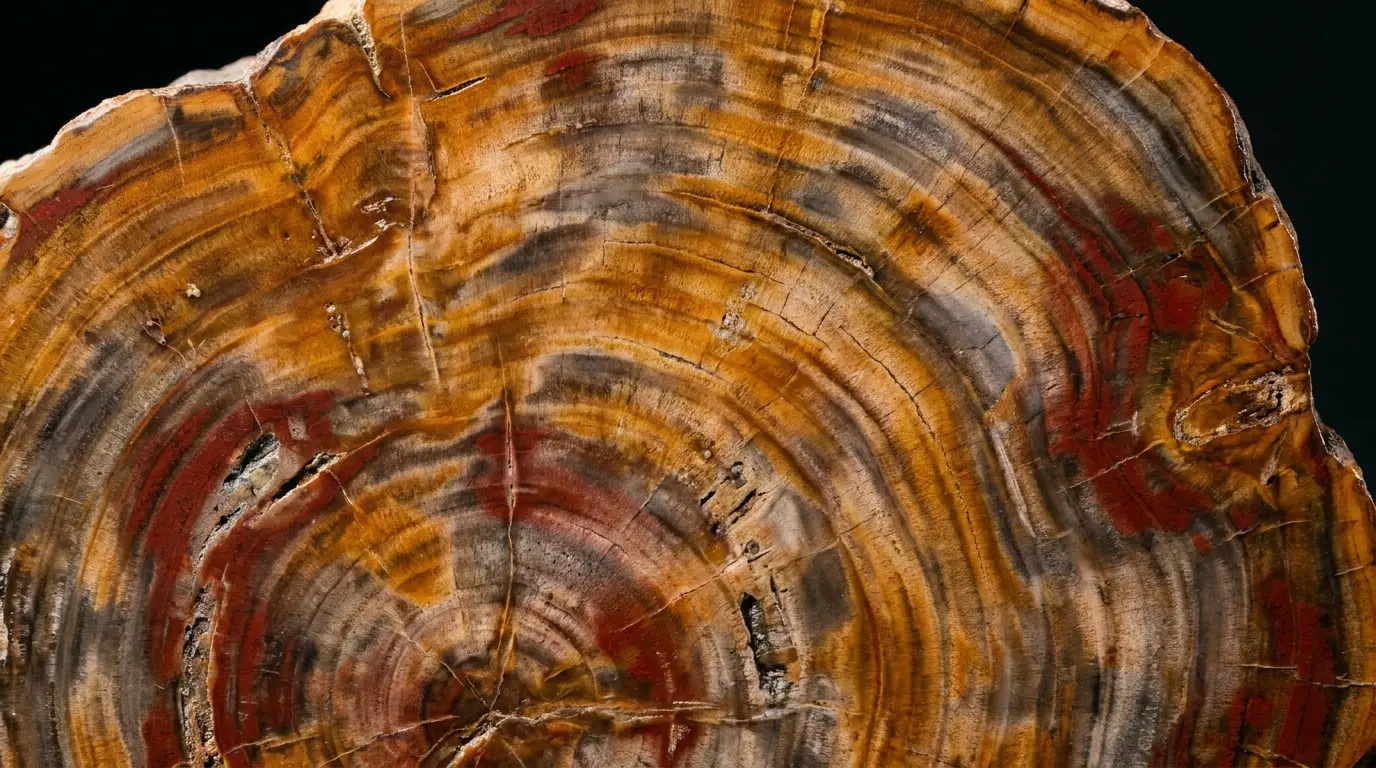
Petrified Wood vs Granite: What Actually Separates These Two Stones
Granite is the reference point for hard, durable stone surfaces — and rightly so. But petrified wood, though it looks like timber, is mineralogically closer to granite's quartz cousins than to wood at all. Comparing the two isn't a matter of taste versus performance. Both perform. The difference lies in what each surface is, where it comes from, and what it tells you once it's polished.
Same Hardness, Different Story
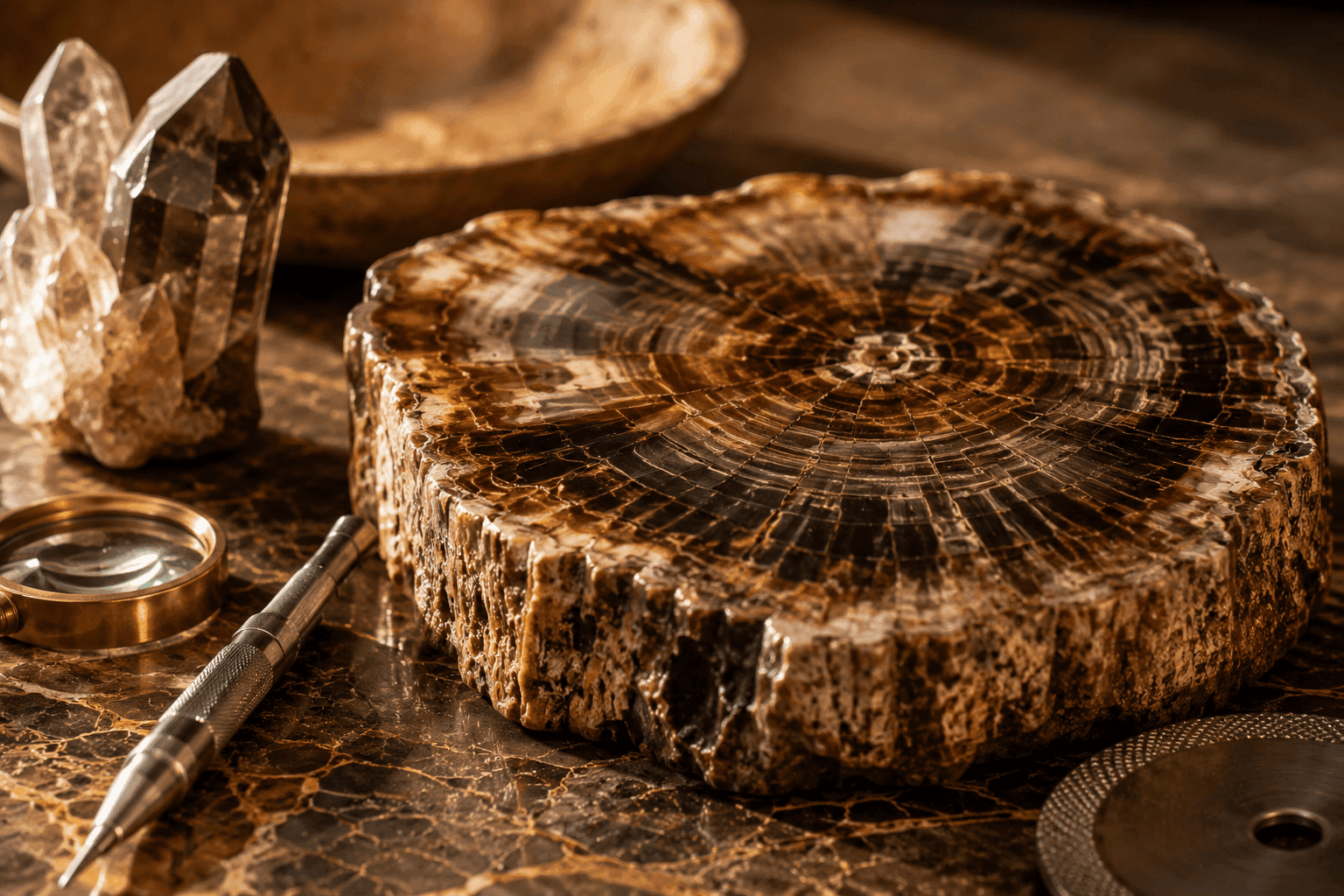
Granite typically sits between 6 and 7 on the Mohs scale, depending on its mineral composition. Petrified wood from Madagascar sits firmly at 7 — it is, after all, crystallized quartz. On paper, the two are near-equals: scratch-resistant, heat-tolerant, indifferent to daily wear.
The real divergence is structural. Granite is an igneous rock, formed from cooled magma, with a mineral grain that's essentially random. Petrified wood carries something granite never can: the anatomy of a living tree. Each polished slab reveals growth rings, mineral veining that follows what were once vascular channels, sometimes even traces of bark or knots. Granite shows geology. Petrified wood shows biology fossilized into geology — a tree that stood roughly 230 million years ago, during the Triassic, before it was buried, saturated with mineral-rich water, and replaced cell by cell with silica.
Where the Material Comes From
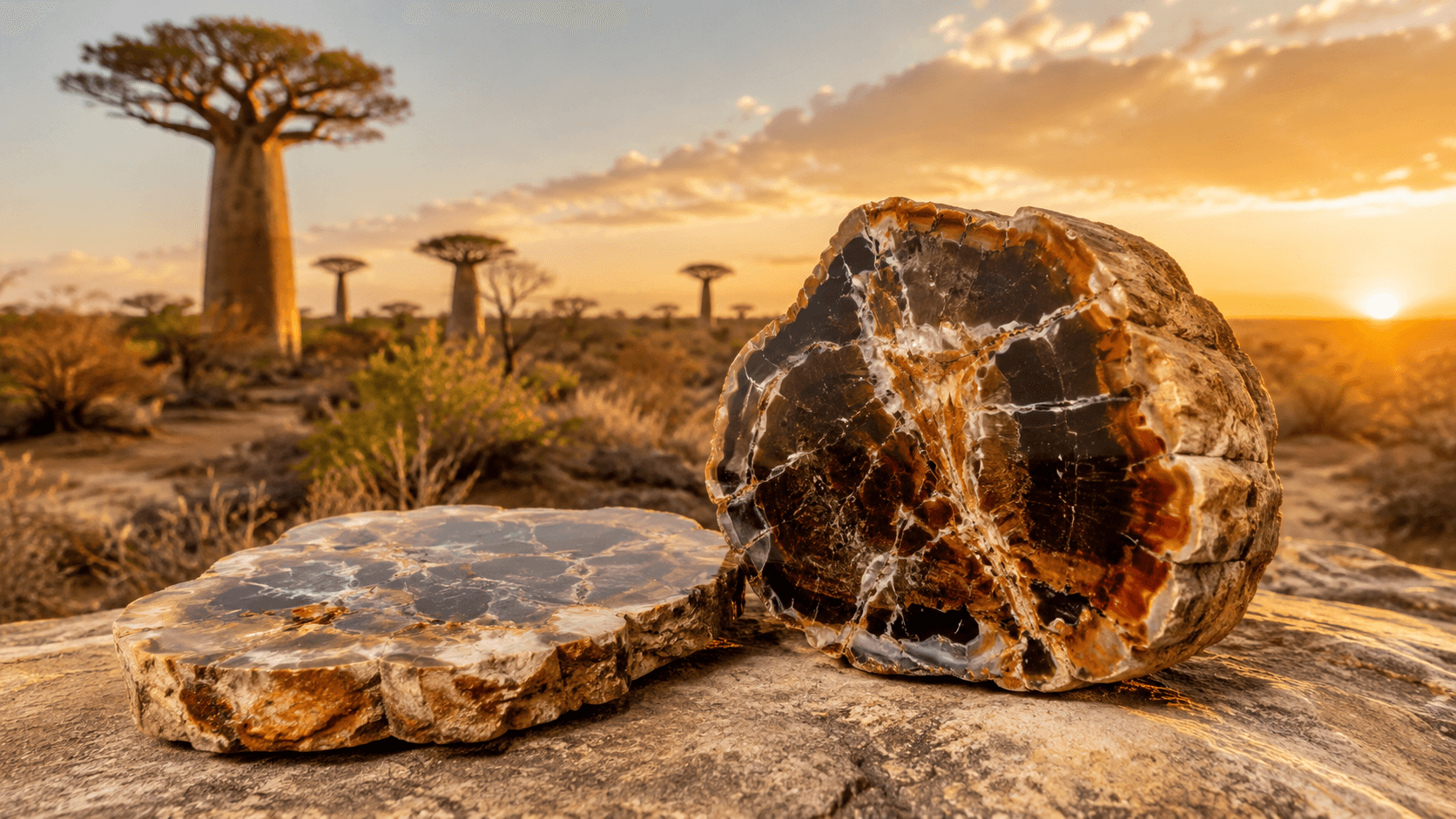
Commercial granite is quarried worldwide — Brazil, India, China, Scandinavia — in slabs cut from continuous rock beds. Supply is, for practical purposes, unlimited: a quarry face yields the same stone indefinitely.
Petrified wood works differently. Every piece Medusa sources comes from a single fallen trunk unearthed in southwest Madagascar, a region where fossilization conditions of the Triassic period were exceptional. Each trunk is an individual tree, extracted once. There is no seam to reopen, no vein to re-quarry. When a trunk is fully worked, that particular pattern, that particular mineral signature, is gone.
This is why Medusa names each trunk rather than categorizing it as a product line — Ambra, Argentea, Fusca, Umbra, Viridis. A name for an amber trunk, one for silvered grey, one for deep brown, one for near-black, one for the rare green. These aren't finishes or collections. They're identities tied to the specific minerals — iron for reds and ochres, manganese for blacks and violets, chromium or cobalt for the scarce greens and blues — that infiltrated that one tree, in that one place, over those millions of years.
A granite slab can be re-ordered. A petrified wood trunk cannot be repeated — only replaced by another tree, with another story.
Working the Material: Cutting vs Quarrying
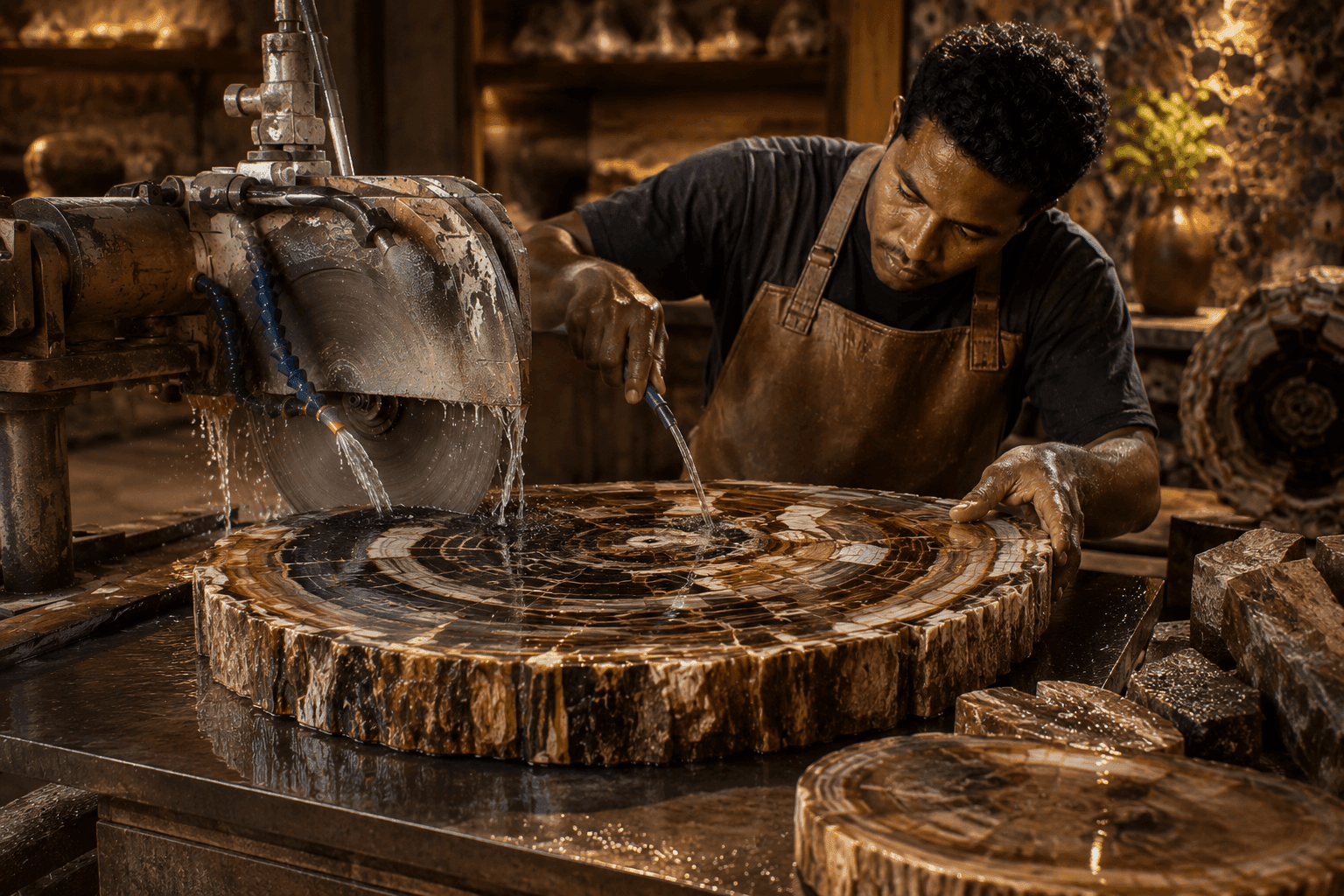
Granite fabrication is industrialized and fast: diamond saws cut slabs to standard dimensions, edges are profiled by machine, and finish is largely uniform across a batch. It's a system built for volume and predictability — which is exactly what a granite countertop promises.
Petrified wood asks for the opposite rhythm. Because the material is already 230 million years old, cutting isn't preparation — it's revelation. Each cut through a trunk exposes a cross-section that didn't exist visibly before; there's no way to know exactly what pattern will emerge until the saw passes through. Polishing then has to follow the grain the tree actually grew with, not an arbitrary axis. This is closer to lapidary work than to stone fabrication, and it's why Medusa treats each trunk as a singular project rather than a cutting list.
Where Each Material Belongs
Both surfaces are viable for kitchen counters, vanity tops, and statement furniture. But they answer different intentions.
- Granite suits large, continuous runs — kitchen islands, multiple matching counters — where uniformity across the surface matters more than individual character.
- Petrified wood suits singular pieces: a vanity basin, a console, a dining table where the slab itself is the focal object, not a background surface.
- Granite is chosen for consistency across a project.
- Petrified wood is chosen when the piece needs to be unrepeatable — when the room is built around it, not the other way around.
If you've already read our comparison of petrified wood against marble, the pattern holds here too: petrified wood competes with premium stone not on hardness alone, but on the fact that no two pieces — and in this case, no two trees — are alike.
Living With It: Maintenance and Longevity
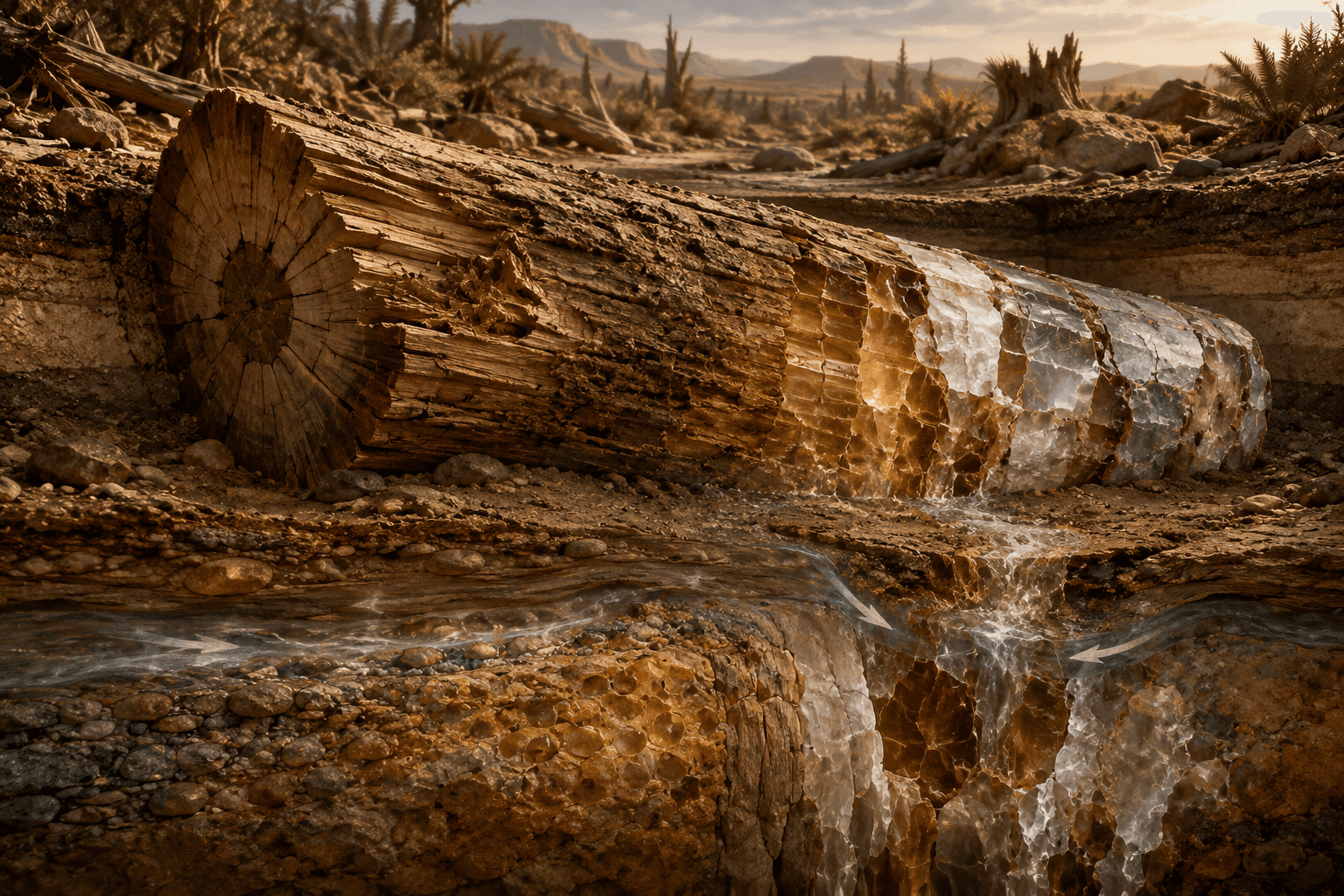
Because petrified wood is silicified — quartz, not organic timber — it shares granite's practical resilience: unaffected by water, indifferent to heat, stable under UV exposure, unbothered by frost. Sealing routines that matter for porous stones are largely irrelevant here; the material was already mineralized before it ever reached a workshop.
Care, in both cases, is straightforward: clean surfaces, avoid abrasive scouring on polished finish, and let the stone do what it's done for 230 million years — endure.
Placing It in a Room
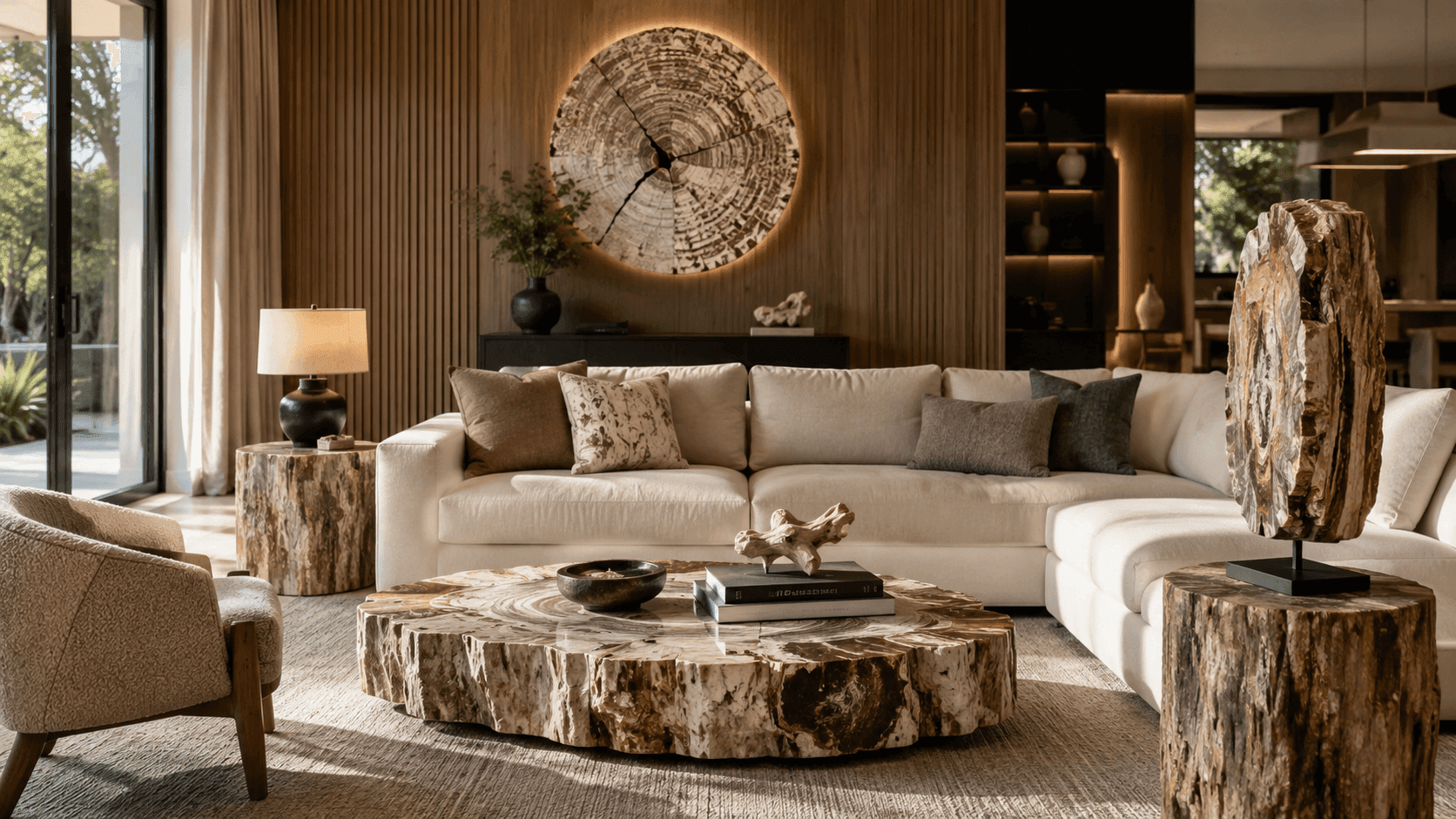
Granite tends to recede into function — a dependable, handsome backdrop. Petrified wood tends to anchor a space: a table that draws the eye before anything else in the room, a basin that guests stop to look at twice. Choosing between them is really choosing what role you want the surface to play.
Considering petrified wood for your next project? Explore available trunks and request a tailored quote.
Visit the ShopFrequently Asked Questions
Is petrified wood as durable as granite for daily use?
Yes. At 7 on the Mohs scale, petrified wood matches or exceeds most granites in hardness, and as fossilized quartz it resists water, heat, UV, and frost without special treatment.
Why is petrified wood more expensive per piece than granite?
Each trunk is a single tree extracted once from southwest Madagascar; there's no ongoing quarry to replenish an exact pattern. Pricing depends on the piece — please consult us for a quote.
Can I get two matching petrified wood pieces, like granite slabs from the same quarry?
Not identically. Two pieces can share tonal character if cut from the same trunk, but each cross-section is unique. This is inherent to the material, not a limitation of supply.
How is the color of petrified wood determined?
By the minerals present during fossilization — iron produces reds and ochres, manganese gives blacks and violets, and chromium or cobalt account for the rarer greens and blues. No two trunks mineralize identically.