
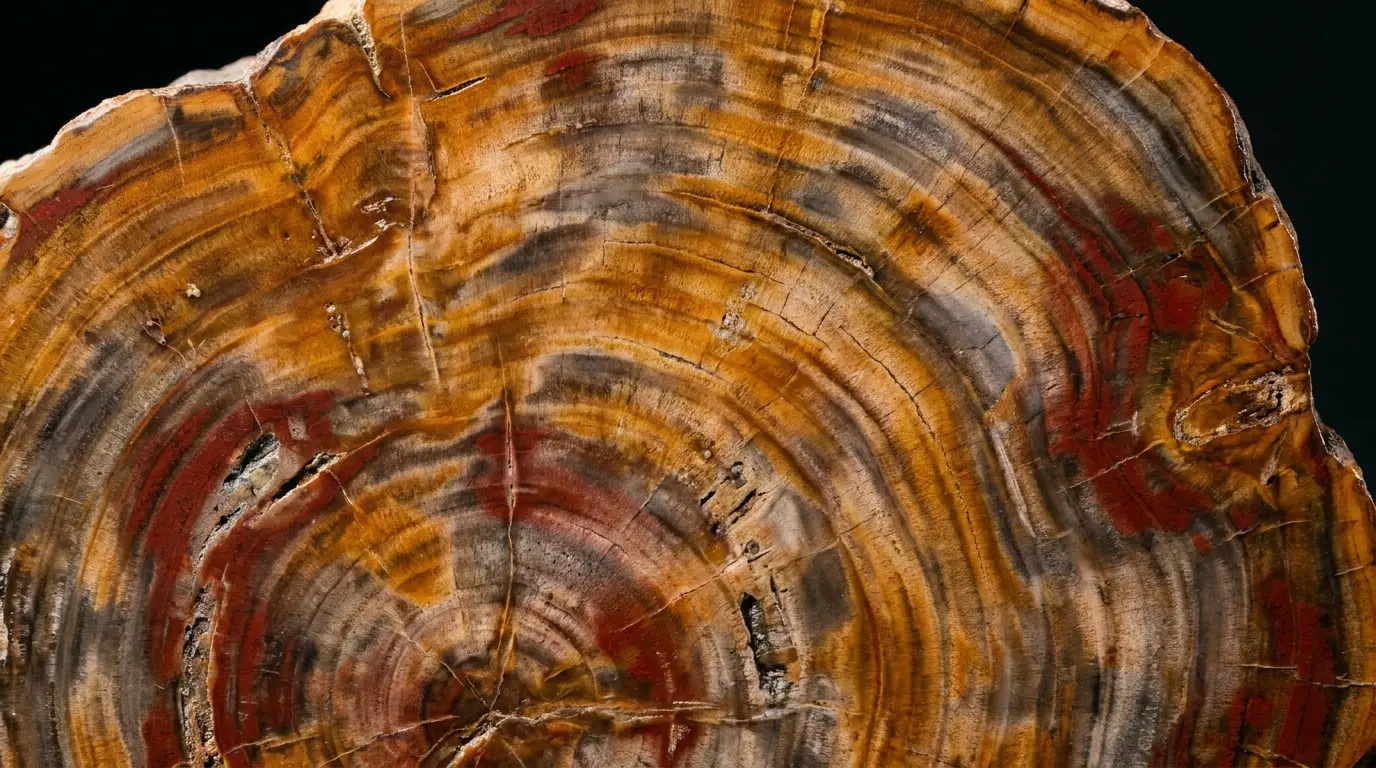
What Actually Determines Petrified Wood Value
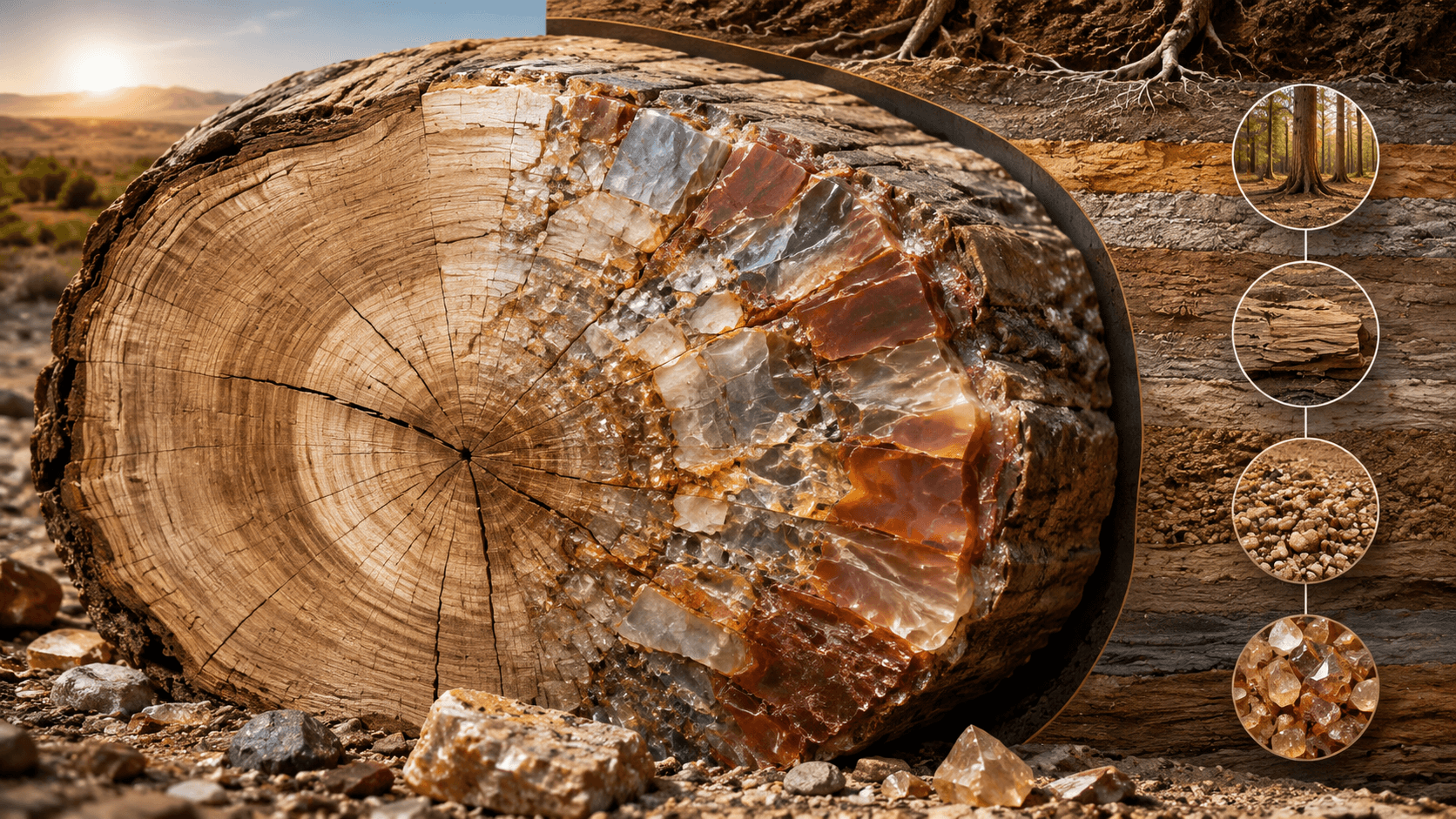
Ask "how much is petrified wood worth" and you'll find wildly different answers online — because the question itself is incomplete. A polished paperweight and a two-meter table cut from a single trunk are not the same object, even if both are technically petrified wood. Value here isn't set by weight or by a generic material price. It's set by the tree itself: its size, the rarity of its coloration, how it was cut, and whether it still carries the visible history of the organism it once was.
At Medusa, every trunk that leaves the ground in southwestern Madagascar is treated as an individual — not a batch of raw material. That distinction is the starting point for understanding cost, because it explains why two pieces of the same species and the same region can carry entirely different worth.
The Age and Rarity Behind the Cost
Petrified wood from Madagascar formed around 230 million years ago, during the Triassic. Fallen trees were buried before decay could take hold, and over an immense span of time, groundwater rich in dissolved minerals replaced the organic cellulose cell by cell with silica. The result is quartz — technically a fossil, but structurally a stone, holding a hardness of 7 on the Mohs scale.
This process is not reproducible on demand, and the supply is finite. Each trunk represents a fixed quantity of material that existed once and will not exist again once it is fully worked. That scarcity underlies every conversation about cost:
- Age: roughly 230 million years, verified by geological context, not estimated per piece.
- Hardness: quartz-level density, resistant to scratching, heat, and moisture.
- Coloration: derived from trace metals absorbed during mineralization — iron for reds and ochres, manganese for blacks and violets, chromium or cobalt for greens and blues.
- Availability: extraction is slow and irregular; no two shipments are identical.
None of these factors are marketing flourishes — they're the physical reasons a trunk is worth what it's worth, and why pricing is always assessed piece by piece rather than by a fixed rate.
Why Each Named Tree Carries Its Own Worth
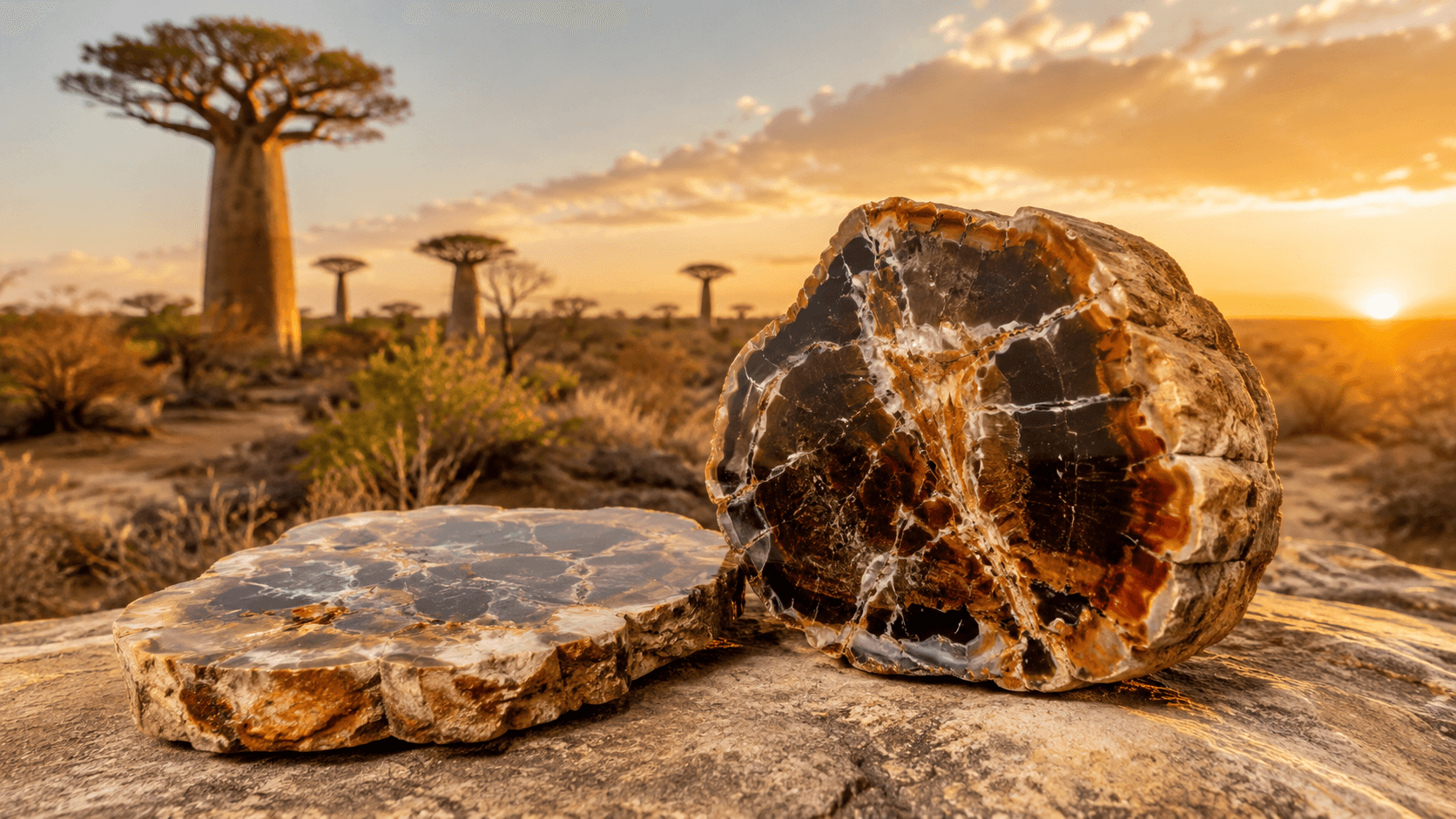
Most sellers of petrified wood treat it as a commodity — sold by the kilogram, indistinguishable lot to lot. Medusa works differently. Each trunk we bring up is given a name: Ambra for amber tones, Argentea for silvered grays, Fusca for deep browns, Umbra for near-black density, Viridis for green-toned mineralization. These aren't product categories. They are individual trees, each colored by its own specific mineral history, each finite.
This matters directly for value. When a trunk named Viridis is cut into a table top, a vessel, and a set of smaller objects, that particular shade of green — produced by a unique concentration of chromium or cobalt absorbed underground — is distributed across those pieces and then gone. There is no restocking a color. The next trunk extracted will have its own chemistry and its own name.
A tree cut once cannot be cut again — its color leaves the ground with it.
Understanding this is the real answer to "how much is it worth": you are not paying for stone by volume, you are paying for a specific, non-repeatable slice of a specific organism.
From Raw Trunk to Finished Piece: Where Cost Comes From
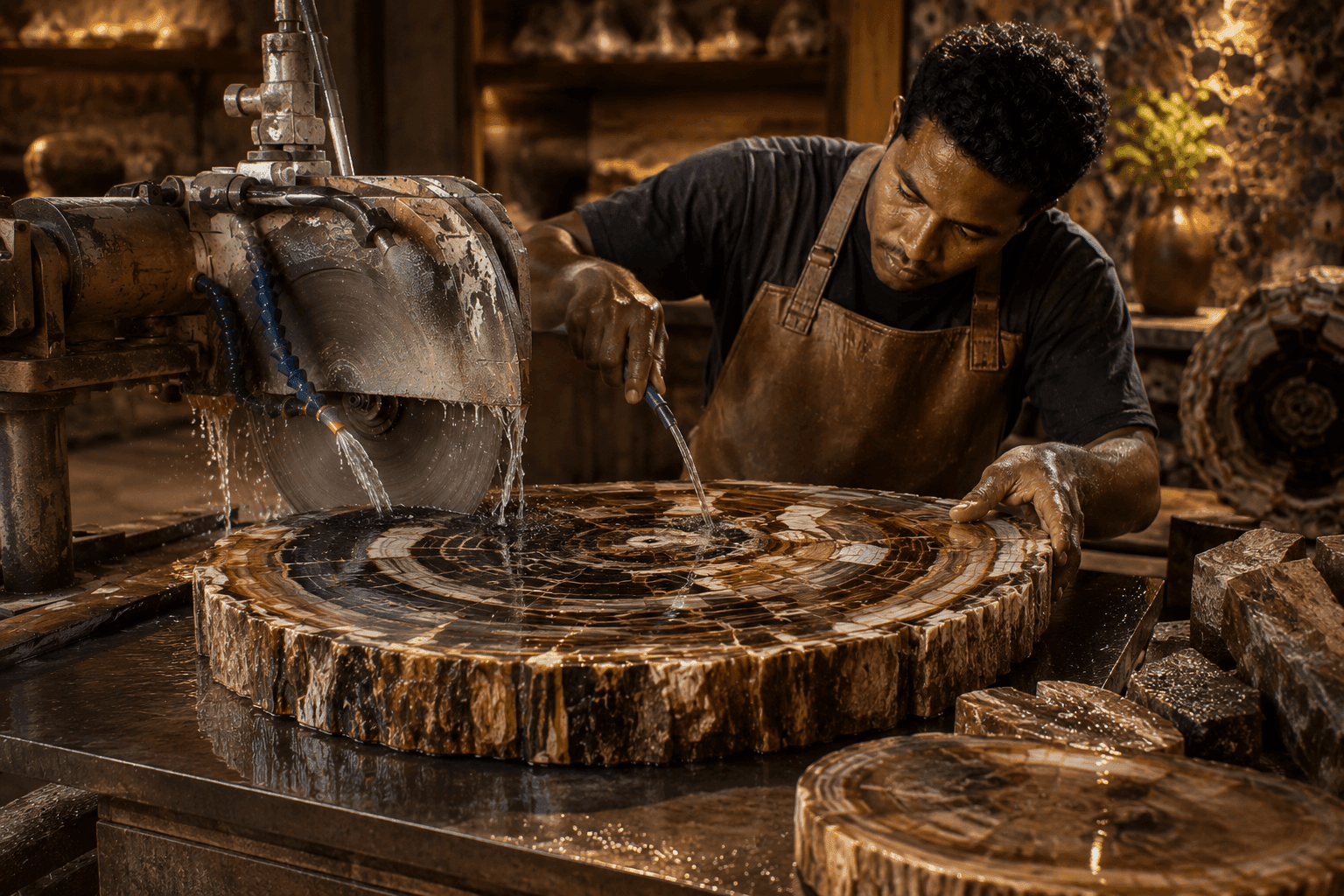
The worth of a finished table, vasin, or decorative object also reflects the labor required to shape a material that behaves like stone. Cutting a Mohs 7 mineral is slow. Standard woodworking tools do not apply; diamond-tipped blades and patient, incremental polishing do. Every pass has to respect the internal structure of the trunk — its cracks, its density variations, its natural cavities — or the piece is lost.
Several factors compound into the final cost of a workshop piece:
- Extraction and transport of a trunk that can weigh a great deal for its size, given its mineral density.
- Selective cutting to preserve the most visually striking sections — bark line, growth rings, color transitions.
- Extended polishing time to bring out the internal grain without damaging fragile zones.
- Finishing work specific to the intended use: a vasque needs different treatment than a tabletop or a standalone sculpture.
None of this is quoted as a flat rate. Because each trunk is unique, cost is always assessed against the specific piece — its size, its condition, its coloration — rather than against a published price list.
Living With It: Why the Value Holds Over Time
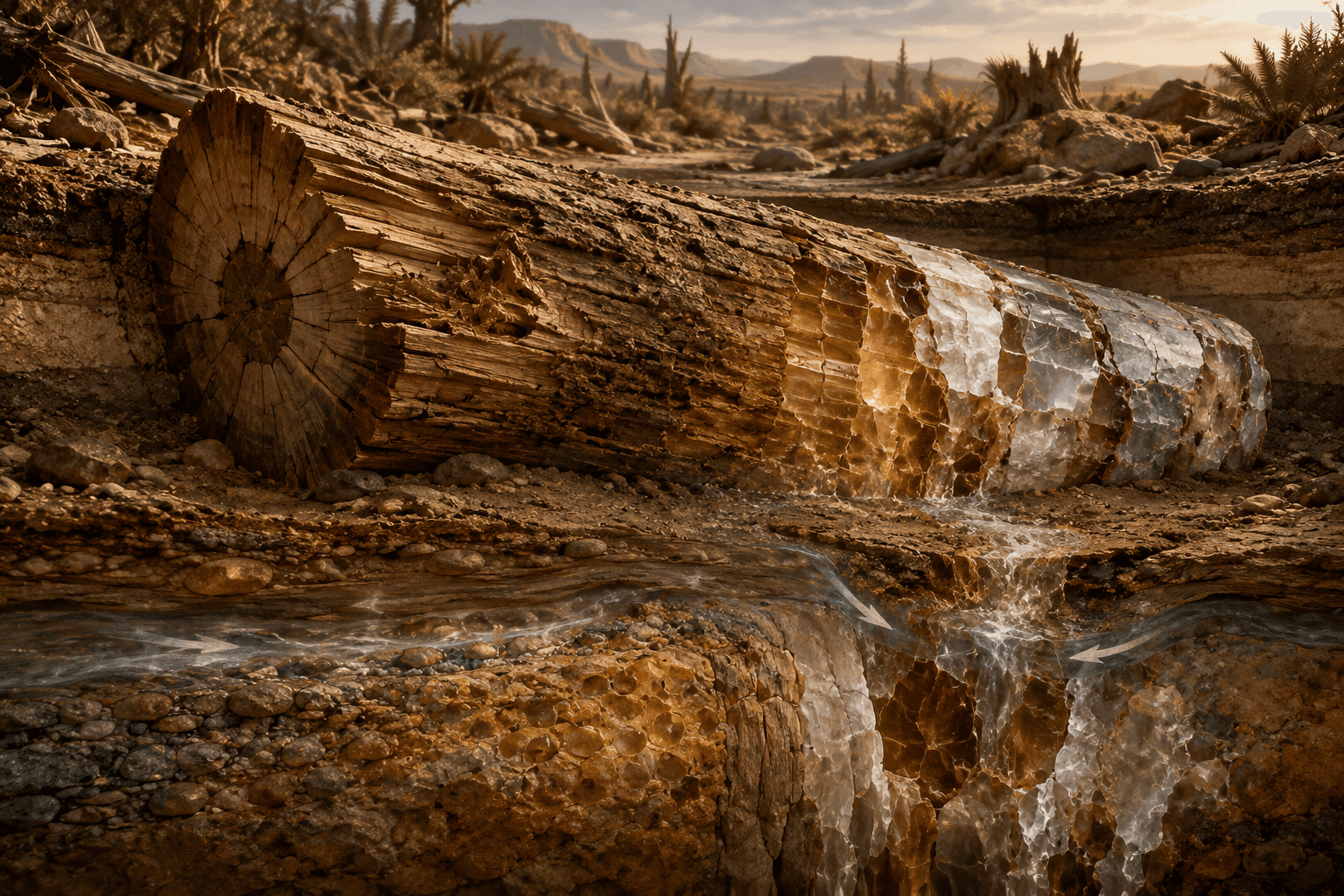
Part of what petrified wood is worth comes from what it doesn't need. Because it is quartz rather than wood, it is unaffected by humidity, indifferent to direct heat, unbothered by UV exposure, and stable through freezing temperatures. A vasque placed outdoors or a tabletop set near a window will not warp, fade, or crack from the conditions that would compromise timber or many other natural stones.
This durability is a quiet part of the value equation. A piece bought today is not a piece that depreciates through use — it is handled, touched, and lived with in the same condition decades on. That permanence is difficult to price on a spreadsheet, but it's precisely why petrified wood behaves less like furniture and more like a long-term acquisition.
Getting an Accurate Estimate for Your Piece
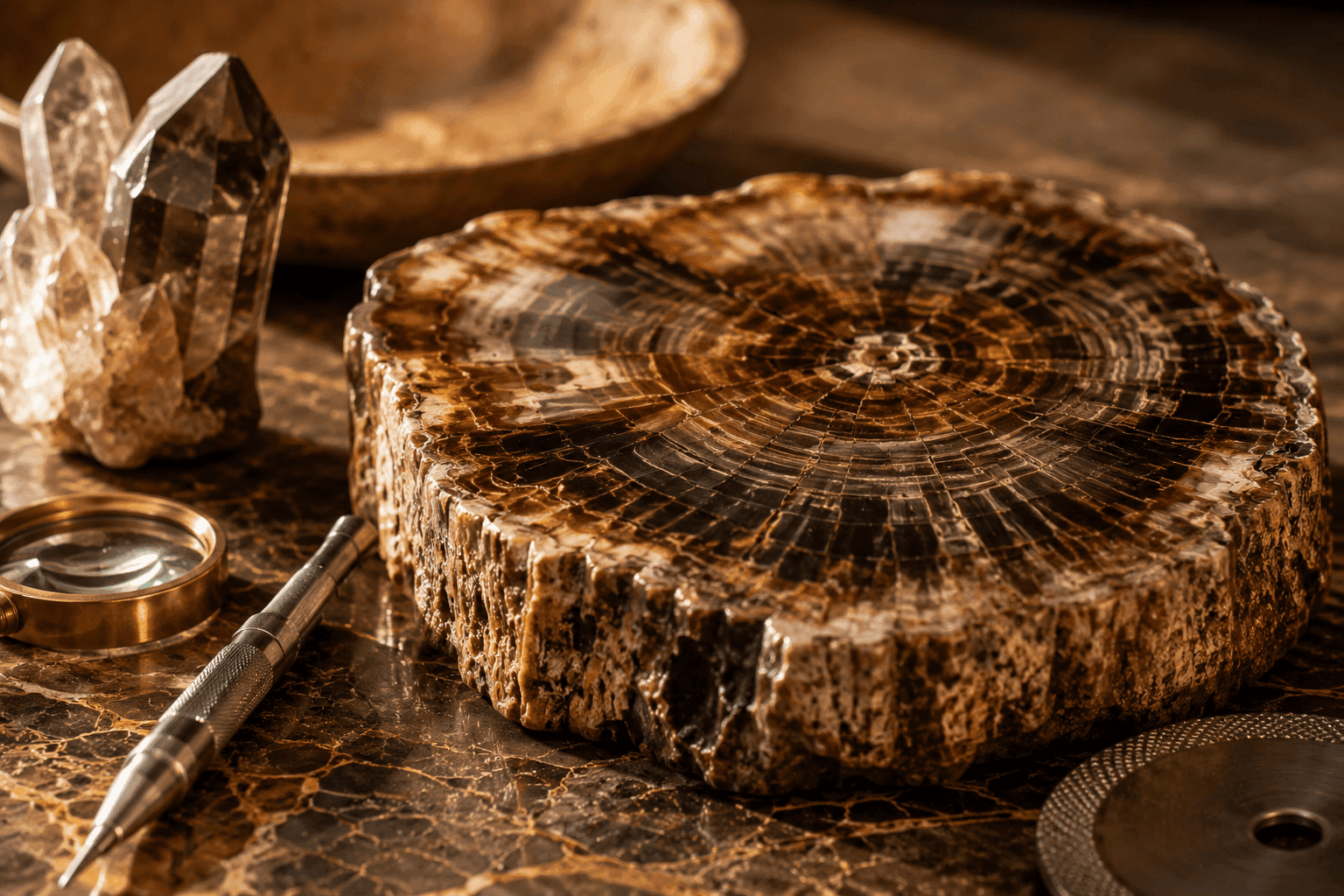
Because no two trunks are identical, there is no meaningful universal number to answer "how much does petrified wood cost." Size, coloration, condition, and the complexity of the cut all shift the assessment. The only reliable way to know the worth of a specific piece — a Fusca console, an Ambra bowl, an Umbra sculpture — is to have it evaluated directly, against the trunk it came from and the work it required.
Discover the current trunks available and request a tailored quote for your piece.
Visit the ShopFrequently Asked Questions
How much is petrified wood worth per piece?
There is no fixed rate. Worth depends on the trunk's size, its coloration, the complexity of the cutting, and the intended use of the finished piece. Each item is assessed individually — please contact us for a quote.
Why is Madagascar petrified wood considered more valuable than other origins?
Trunks from southwestern Madagascar date to roughly 230 million years ago and often display strong, well-preserved coloration from iron, manganese, chromium, or cobalt. Combined with a hardness of 7 on the Mohs scale, this produces material that is both visually distinctive and structurally durable.
Does the value of petrified wood increase over time?
The material itself does not degrade — its quartz composition resists moisture, heat, UV light, and cold — so a piece does not lose condition with normal use. Market worth for finished pieces is assessed at the time of quotation rather than tracked as an appreciating index.
Can I get an exact cost for a custom piece before ordering?
Yes. Because every trunk is unique, we evaluate each piece individually — its coloration, dimensions, and finishing requirements — and provide a specific quote rather than a catalog price.