
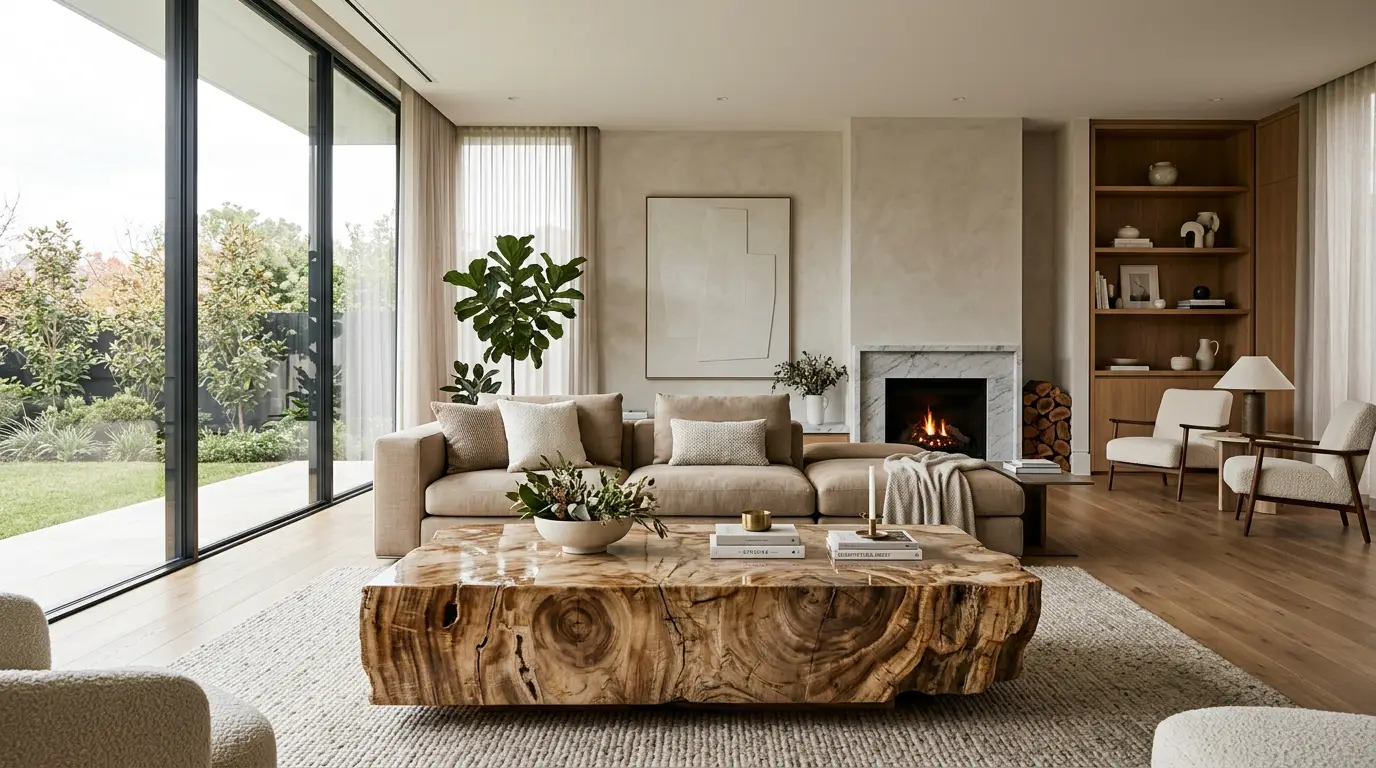
An Accent Table Cut From a Single Ancient Tree
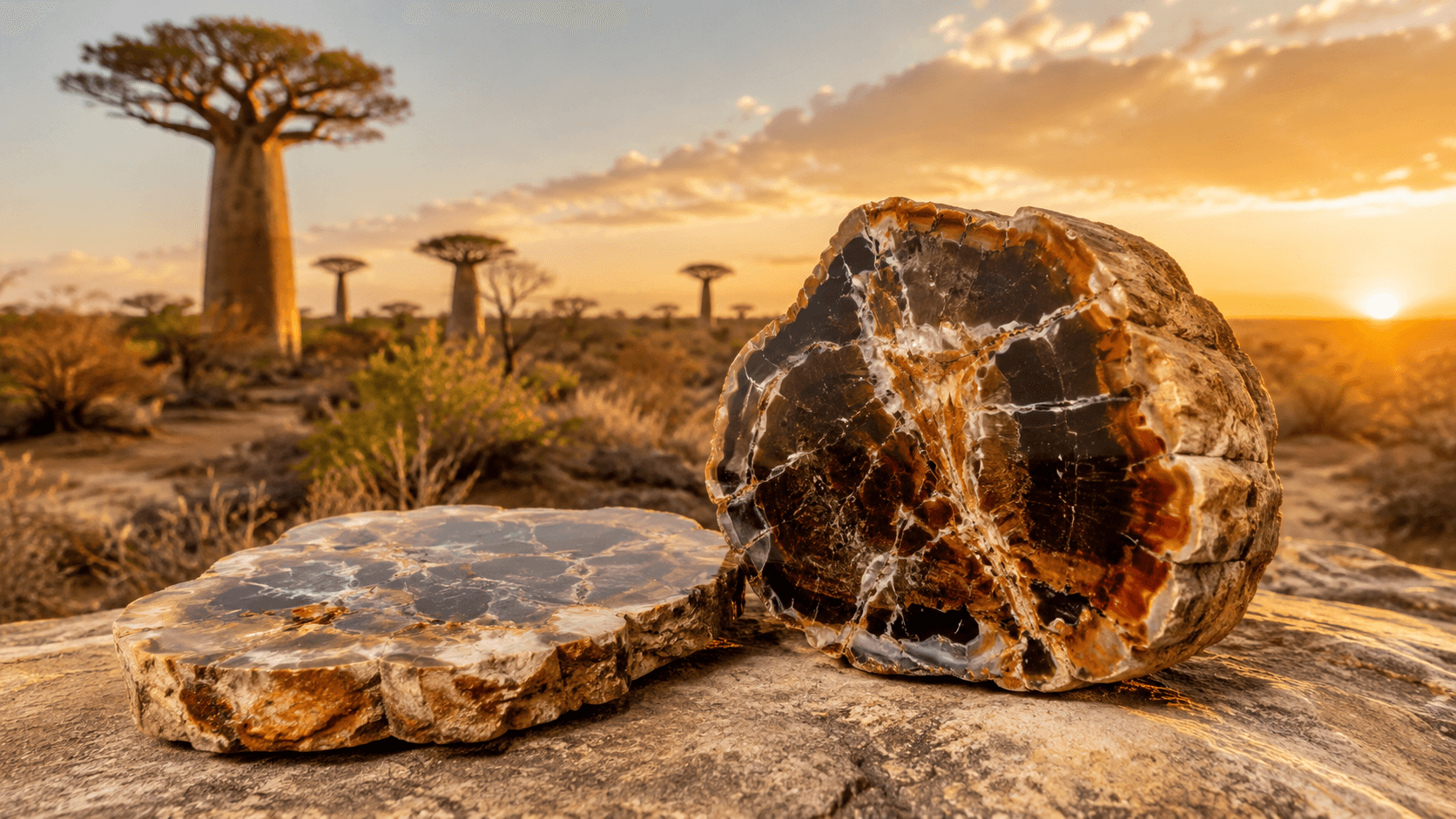
A petrified wood accent table is not a piece of furniture in the ordinary sense. It is a cross-section of a tree that stood in the southwest of Madagascar some 230 million years ago, long before it was stone. What you place beside your sofa or armchair once had bark, rings, and roots. Mineralization replaced the wood cell by cell, and time did the rest.
At Medusa, we don't sell "petrified wood tables" as a catalogue item. We sell trunks — each one raised individually from the ground, each one given a name. An accent table is simply one chapter cut from that trunk's life. Understanding this changes how you look at the object on your side table.
Each Trunk Has a Name — And a Story
Every trunk that reaches our workshop carries its own mineral signature, and we name it accordingly: Ambra for amber tones, Argentea for silvered greys, Fusca for deep browns, Umbra for near-black density, Viridis for the rare greens. These are not product lines. They are individuals.
- No two trunks share the same internal color map.
- Once a trunk is fully cut into tables, vessels, and objects, that particular palette is gone for good.
- An accent table from Umbra will never be replicated from Ambra, and vice versa.
This is the core difference between Medusa and volume sellers of "stone furniture": we work trunk by trunk, not batch by batch.
A tree does not repeat itself twice. Neither does its stone.
The Stone That Was Once Wood
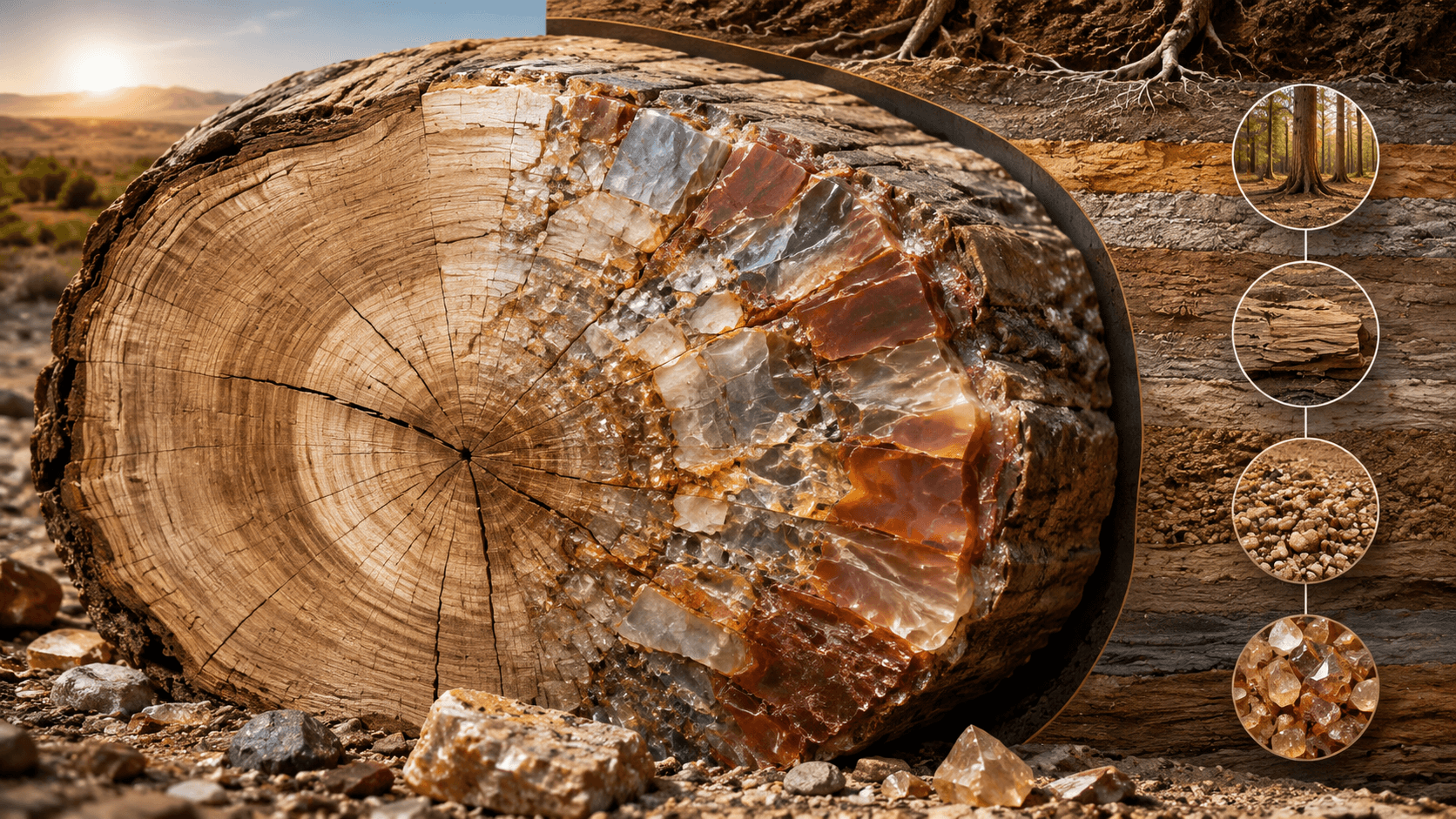
Petrified wood is, mineralogically, quartz — silica that infiltrated the organic tissue and crystallized in its place while the tree lay buried, sealed away from oxygen. This origin explains everything about how the material behaves as furniture:
- Hardness: rated 7 on the Mohs scale, on par with most quartz — it resists scratching from daily use far better than hardwood or marble.
- Weight: dense and substantial; an accent table in petrified wood grounds a room rather than filling it.
- Indifference to water, heat, and UV: unlike timber, it doesn't warp, fade, or crack under a hot cup or a sunlit window.
- Color: the palette comes entirely from trace metals present during mineralization — iron for reds and ochres, manganese for blacks and violets, chromium or cobalt for the rarer greens and blues.
None of this is decorative language. It is the physical reason an accent table cut from a 230-million-year-old trunk in Madagascar will outlast the room it sits in.
Living With Petrified Wood
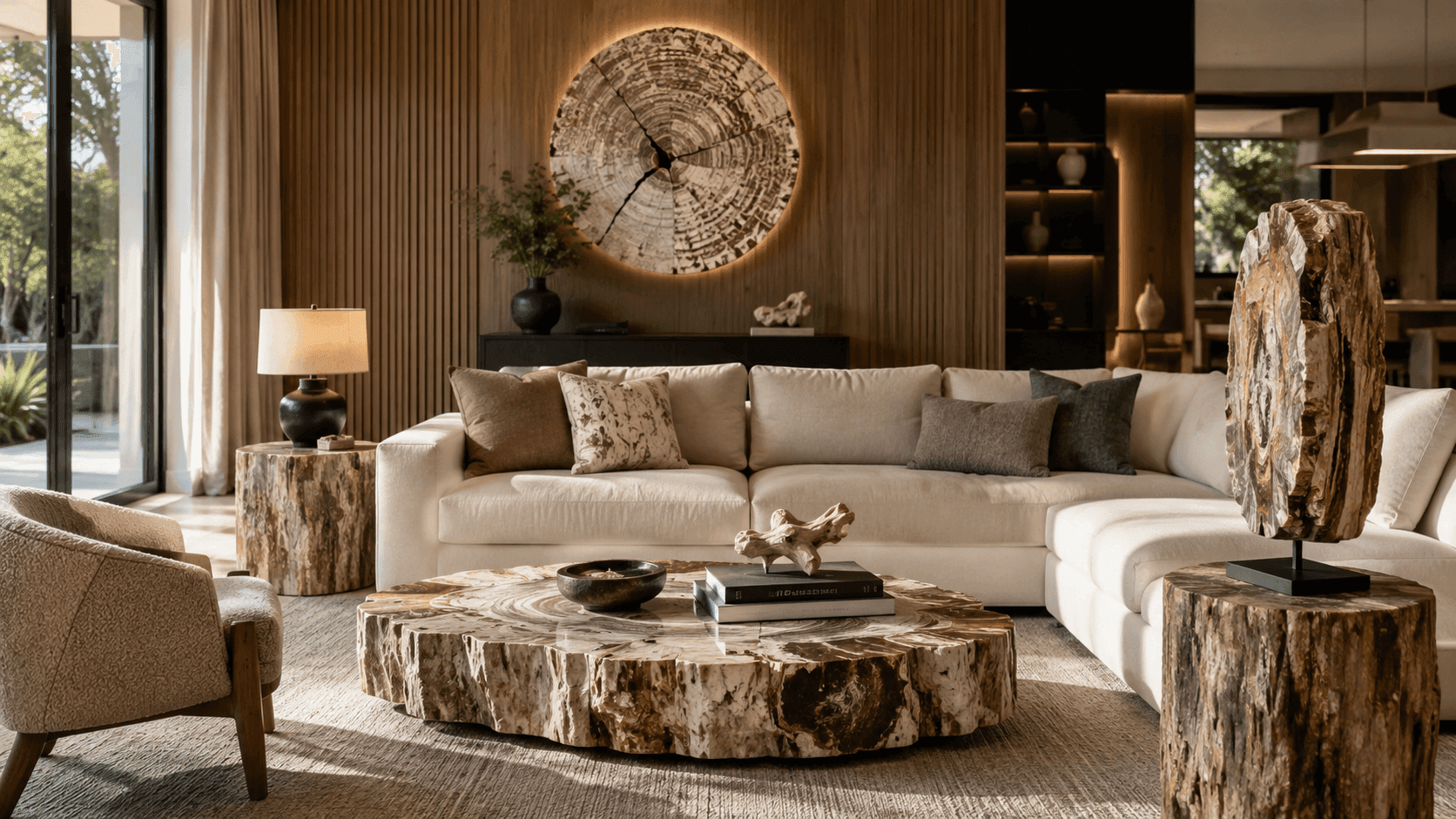
An accent table is, by definition, a supporting piece — yet petrified wood rarely stays in the background. Its density, its polished surface, its slow gradient of color pull the eye even in a room built around other materials.
It pairs well with:
- Raw materials — linen, brushed brass, unlacquered oak — that don't compete with its mineral finish.
- Neutral or dark walls, where the trunk's inner colors read as a focal point rather than an accessory.
- Spaces where a single object needs to do the work of a whole composition: an entryway, the side of a reading chair, the foot of a bed.
Because the surface is cold to the touch and entirely inert, it also works where wood furniture struggles — near a fireplace, on a sunlit terrace, beside a bathtub.
From Trunk to Table: The Craft
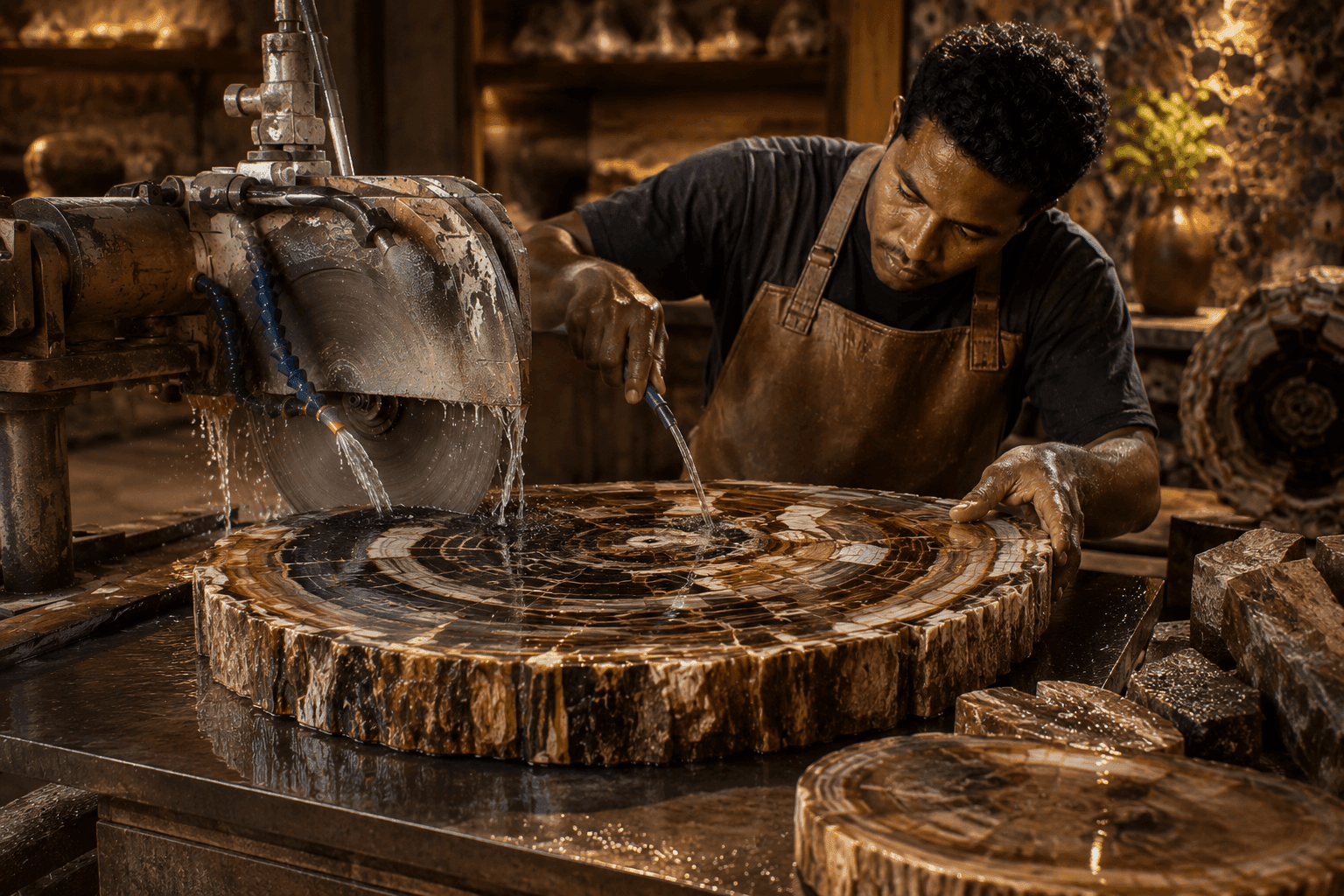
Turning a fossilized trunk into an accent table is slow, deliberate work. Quartz doesn't forgive a rushed cut. Each slice is selected for the pattern it reveals, then ground and polished in stages to expose the color without erasing the texture of the original wood grain — the very thing that proves this was once a living organism.
- The base is often left raw or lightly finished, so the table still reads as a trunk, not a manufactured slab.
- The top surface is polished to a level that lets light travel slightly into the stone, giving depth to the color bands.
- No two tables from the same trunk are polished to produce an identical face — the internal veining decides the final look, not the artisan's preference.
This is why lead times and finishes are discussed individually for each piece — a petrified wood accent table is fitted to the trunk it came from, not the other way around.
Discover the trunks currently available and find the accent table that matches your space.
Visit the ShopQuestions fréquentes
Is a petrified wood accent table heavy?
Yes. Because the material is solid quartz, even a modestly sized accent table is considerably heavier than an equivalent piece in wood or resin. We can advise on handling and placement for your specific piece — consult us for the exact weight of a given table.
Can I use it outdoors or near water?
Petrified wood is insensitive to water, humidity, UV exposure, and temperature changes, which makes it suitable for covered terraces, bathrooms, or spaces near a pool. Extreme, sudden impacts should still be avoided, as with any quartz surface.
Why is each table described as coming from a "named" trunk?
Every trunk Medusa sources from southwest Madagascar has its own mineral composition and therefore its own unique coloring. We name each trunk — Ambra, Argentea, Fusca, Umbra, Viridis — to reflect that these are individual origins, not repeatable product categories. Once a trunk is fully worked, its specific palette cannot be reproduced.
How old is the material, really?
The petrified wood we work with dates to the Triassic period, roughly 230 million years ago. The wood was buried, sealed from oxygen, and gradually replaced by silica, which is why it now behaves as stone rather than timber.