
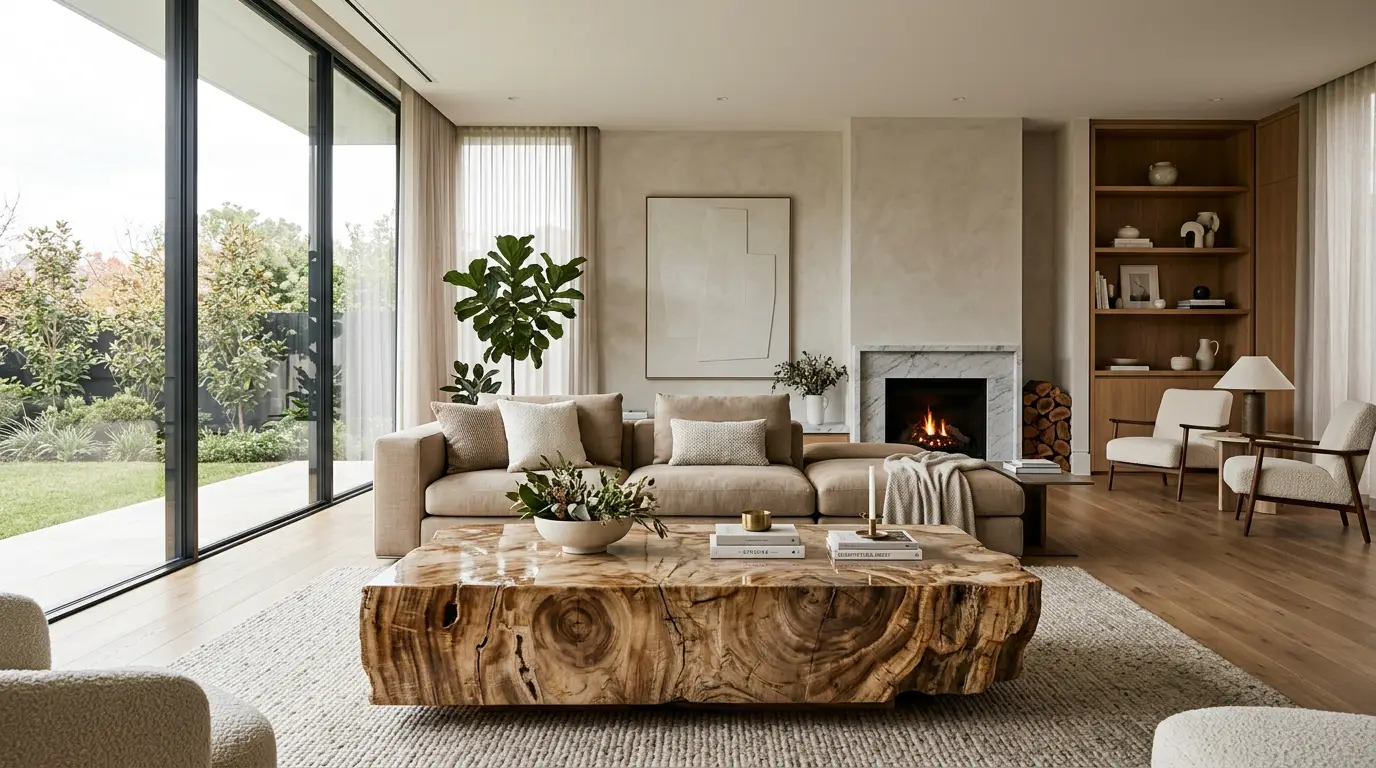
The River Table, Reinvented in Stone
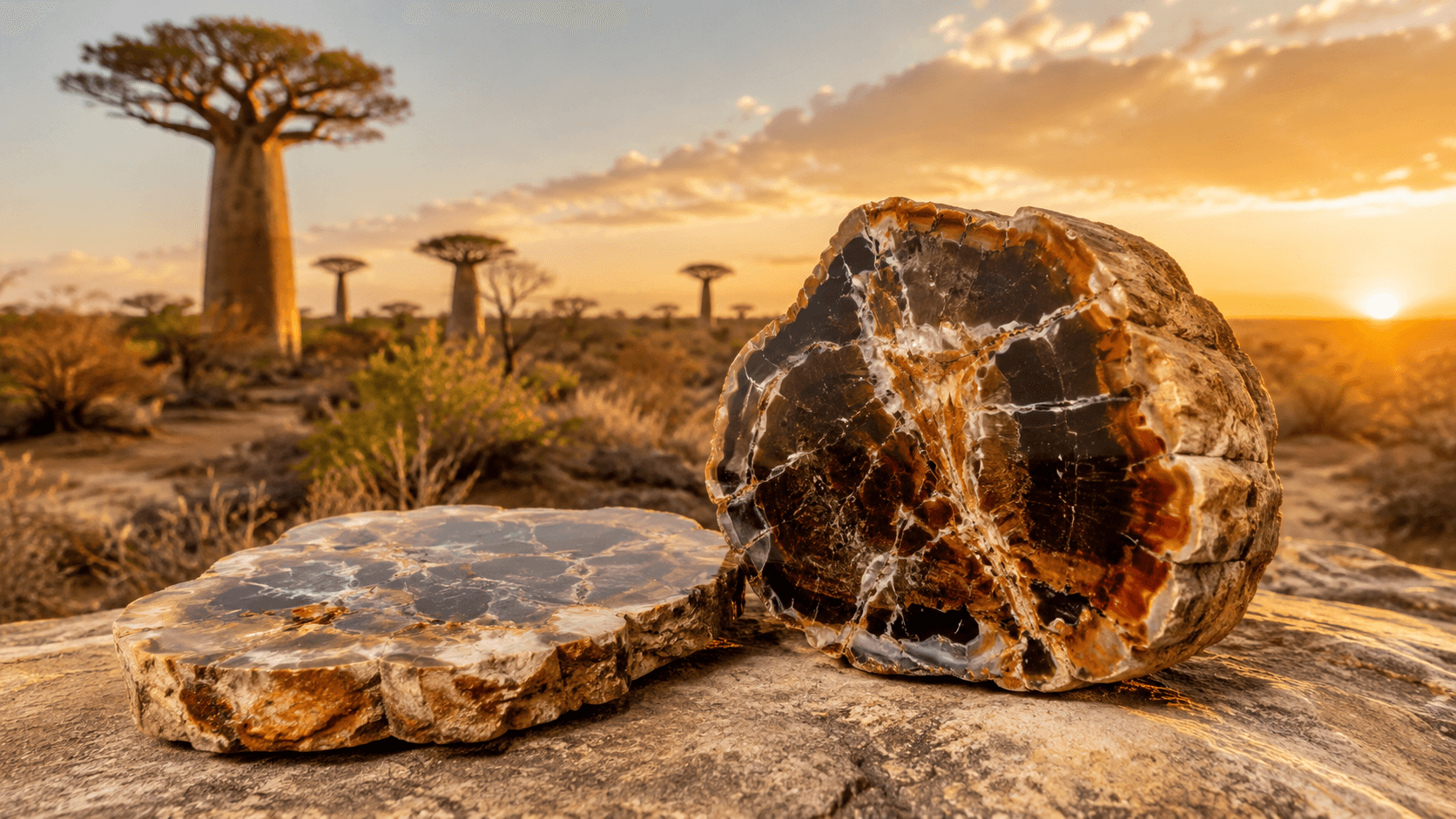
A river table is usually a slab of wood split by a poured band of resin, mimicking a waterway cutting through a landscape. Ours needs no resin. The river is already there, written into the stone by 230 million years of mineral replacement. Every petrified wood river table we build follows the trunk's own fracture lines, its natural fault, its color break — not a mold, not a pour. What looks like a river is the exact boundary where one mineral phase gave way to another, inside a tree that grew in the Triassic and turned to quartz in the soils of southwestern Madagascar.
This is not a variation on the resin-river trend. It is what that trend was imitating, minus the imitation.
One Tree, One Name, One Table
Each trunk we bring up from the ground is logged, photographed and given a name before it is ever touched by a blade: Ambra for amber tones, Argentea for silvered grey, Fusca for deep brown, Umbra for near-black, Viridis for the rare greens. These are not product lines. They are individual trees, each with a mineral history that will never repeat itself.
A river table depends entirely on this individuality. The width of the "river," the density of the grain on either bank, the way ochre bleeds into grey at the fracture — all of it comes from the specific trunk chosen for that specific table. Once a trunk is cut, its palette is gone. There is no second Fusca table with the same river.
A river table cut from petrified wood doesn't imitate a landscape. It preserves one, fixed at the exact moment the tree stopped being wood.
What the Stone Actually Is
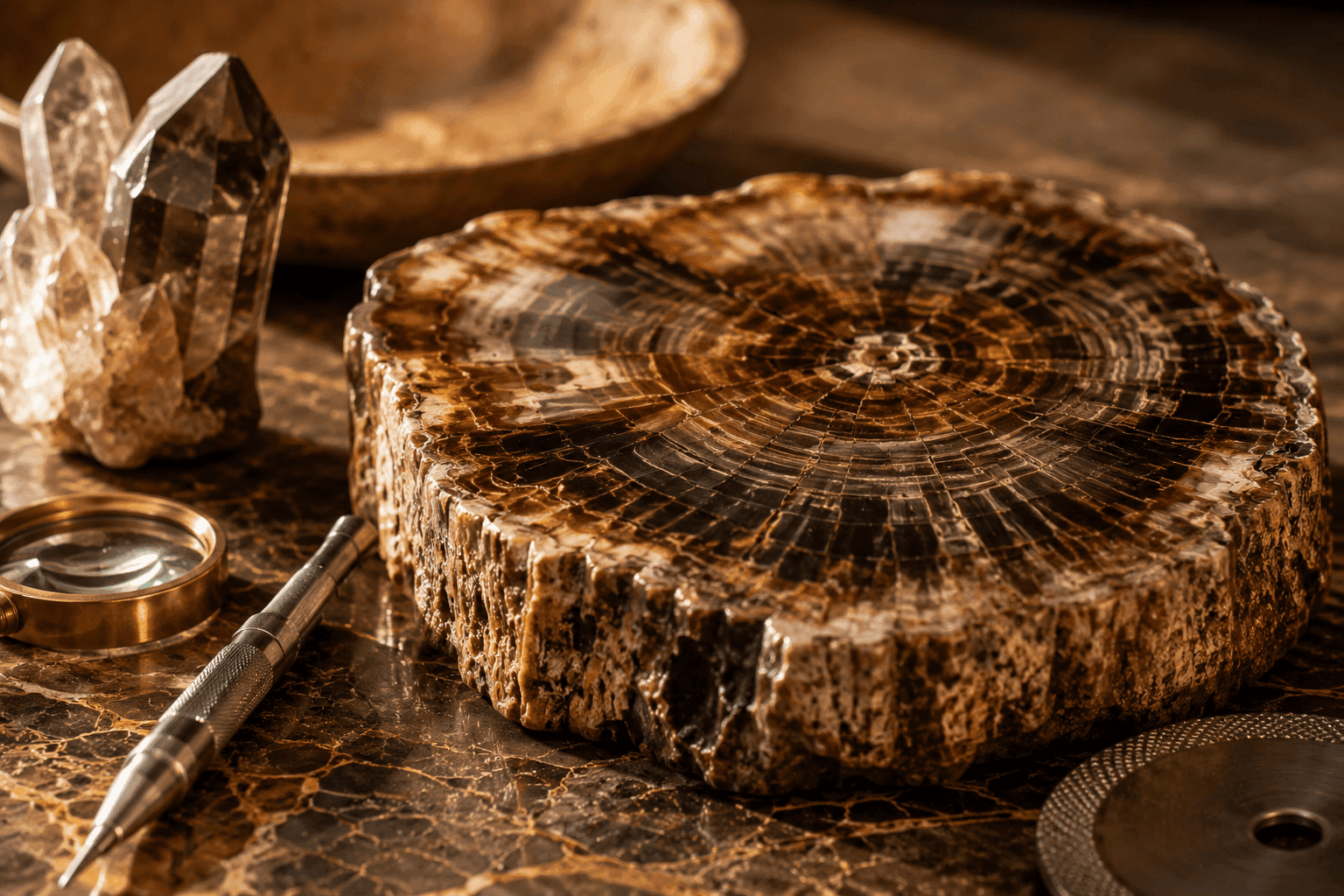
Petrified wood is not treated timber, and a river table cut from it behaves nothing like one cut from oak or walnut. Over roughly 230 million years, silica dissolved in groundwater replaced the tree's organic tissue, cell by cell, while the original structure — the grain, the rings, the cracks — stayed intact. The result is chemically quartz, rated 7 on the Mohs scale.
That single fact governs everything about how the table lives in a room:
- It is unaffected by water, so no coaster ritual, no ring stains.
- It tolerates heat and direct sun without warping, fading or drying out.
- It is cold and dense to the touch — a tabletop with real physical weight.
- Its colors come from trace metals locked in during fossilization: iron for reds and ochres, manganese for blacks and violets, chromium or cobalt for the rarer greens and blues.
A wooden river table is furniture that ages. A petrified wood river table is geology that furnishes a room.
From Trunk to Tabletop
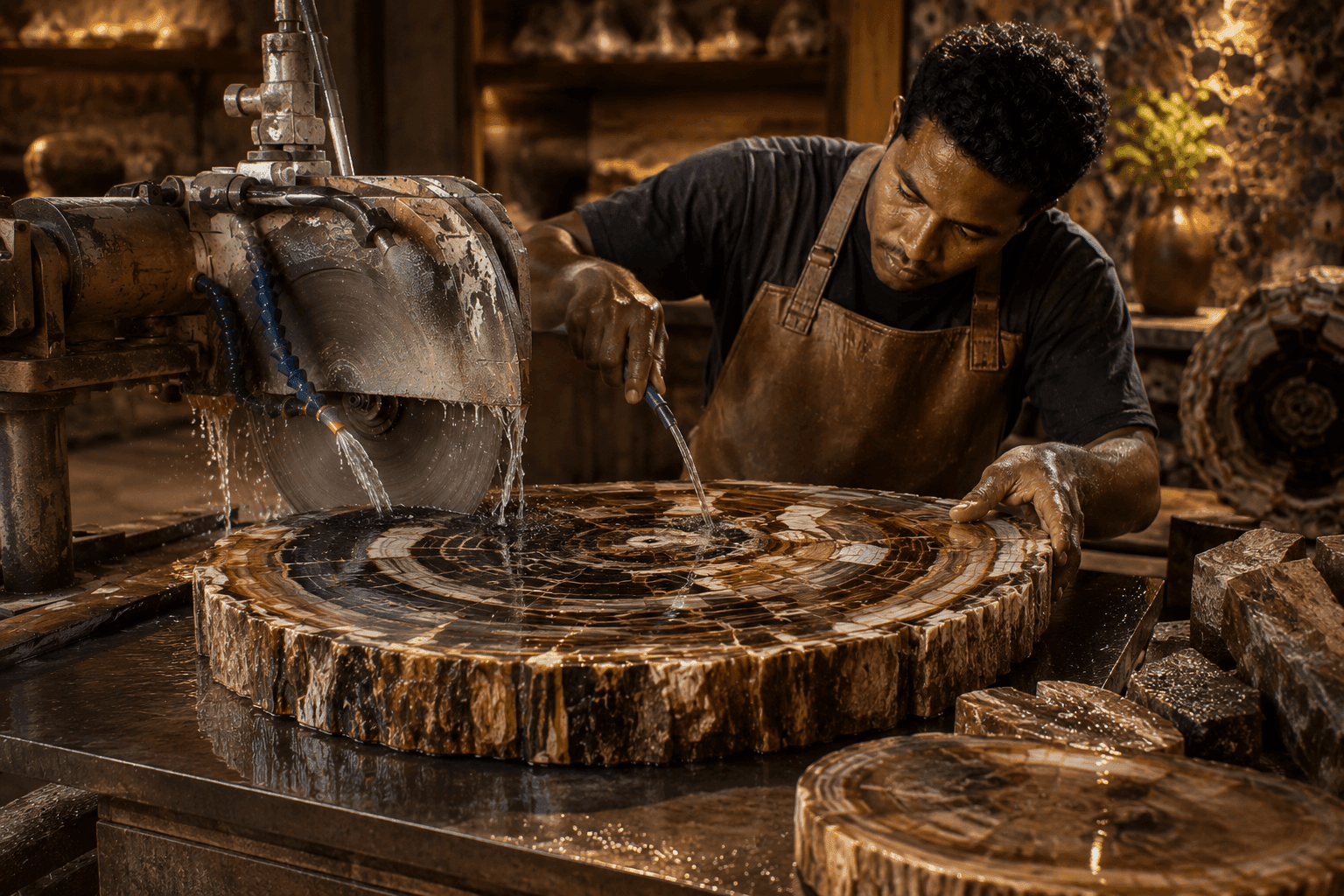
Because no two trunks fracture the same way, no two river tables are drawn from a plan. Our craftsmen study each trunk before cutting: where the natural break runs, where the color shifts, where the density changes. The "river" is chosen, not designed — it is the widest, cleanest fault already present in the stone.
The process is slow by necessity. Quartz does not forgive haste:
- Sectioning follows the trunk's existing planes to preserve the widest usable span.
- Progressive polishing brings out the cross-section's rings without over-flattening the surface texture.
- Edges are finished by hand to keep the trunk's original silhouette visible at the border of the table.
- A base — usually blackened steel or solid wood — is built to the exact footprint of that one slab, not to a standard size.
Every table is therefore made to measure, sized and shaped around the one piece of stone it comes from, rather than the stone being cut to fit a standard tabletop.
Living With a River of Stone
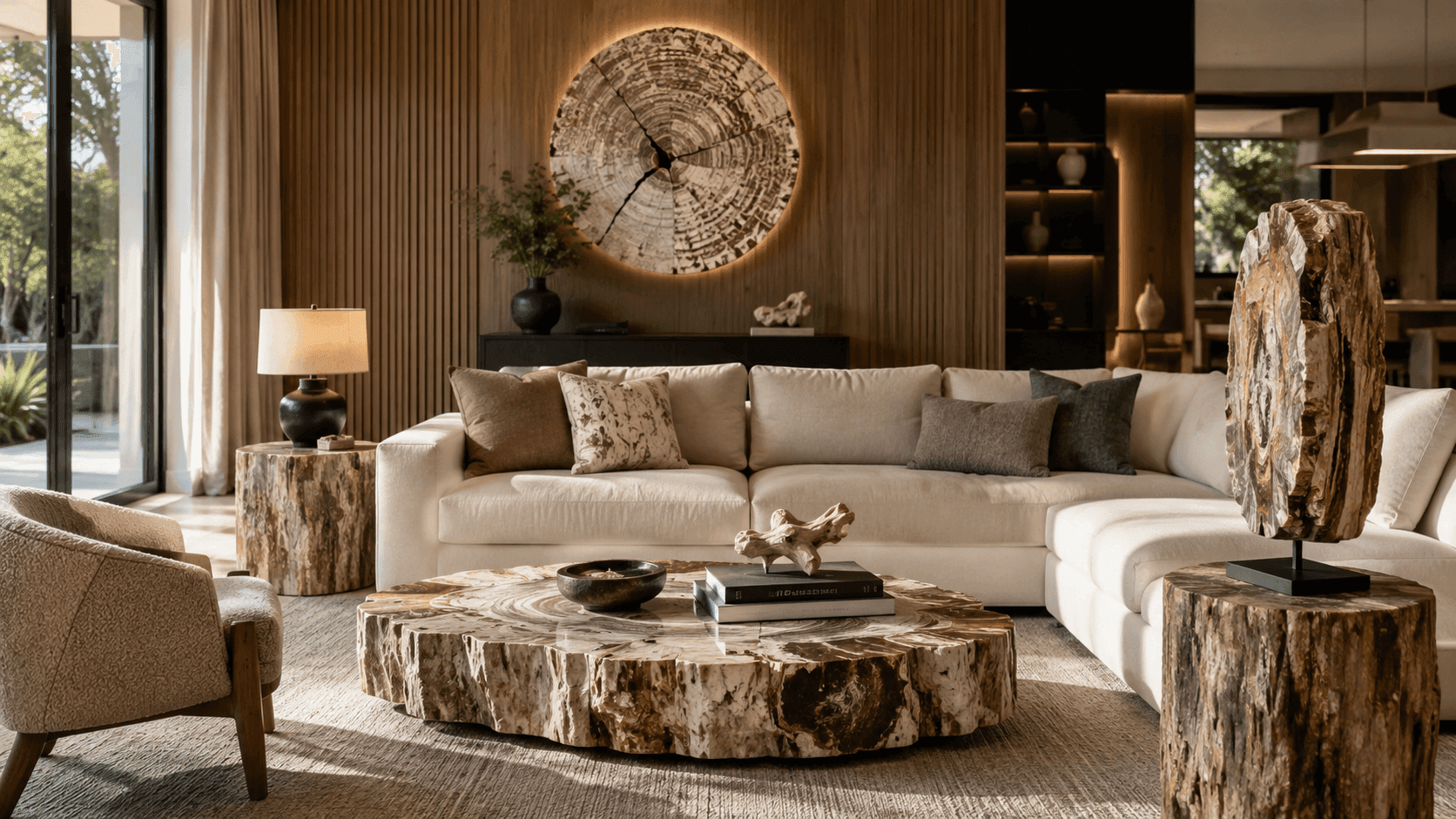
A river table in petrified wood is not a neutral surface. It is the object a room is arranged around — a dining table that holds its own against bare concrete or pale oak floors, a console that reads as sculpture as much as furniture. Because the material is inert, it fits equally in a sunlit conservatory, near a fireplace, or outdoors under cover, without the maintenance schedule that timber demands.
Placement matters more than with ordinary furniture, precisely because the river pattern is unrepeatable. We generally recommend positioning the table where the fracture line runs with the room's main sightline — from the entrance, from a staircase, from the kitchen — since that line is the one detail no other table in the world will share.
See the available trunks and request a quote for your own river table.
Visit the ShopFrequently Asked Questions
Is the "river" pattern natural, or is resin used?
Fully natural. The line running through the table follows the trunk's own internal fracture, formed during fossilization — no resin, dye or filler is added.
Where does the wood come from, and how old is it?
Every trunk is sourced in southwestern Madagascar and dates from the Triassic period, roughly 230 million years ago.
Can a river table go outdoors or near a heat source?
Yes. Being quartz (7 on the Mohs scale), it resists water, UV, frost and heat without degrading — one of the few tabletop materials suited to both indoor and covered outdoor use.
How is pricing handled, since no two tables are alike?
Each river table is priced individually, based on the trunk's size, color and complexity of cutting. Contact us directly for a quote tailored to the piece you're interested in.