
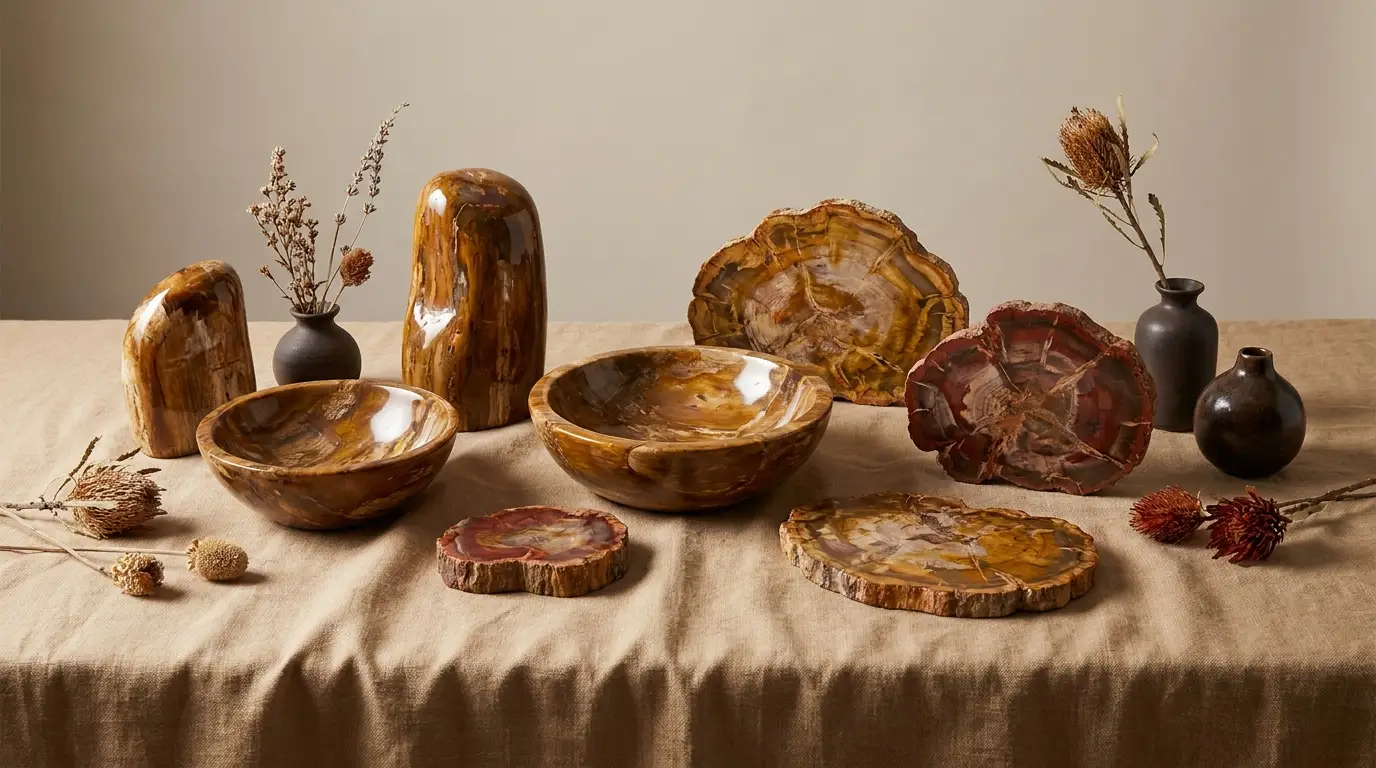
A Piece of Deep Time on Your Desk
A paperweight rarely deserves a second look. It holds papers down, gathers dust, gets replaced without regret. The Medusa petrified wood paperweight asks something different of you: pick it up, feel its cold density, notice the growth rings frozen mid-sentence by silica. This is not an object that pretends to be useful — it is useful, and it happens to be 230 million years old.
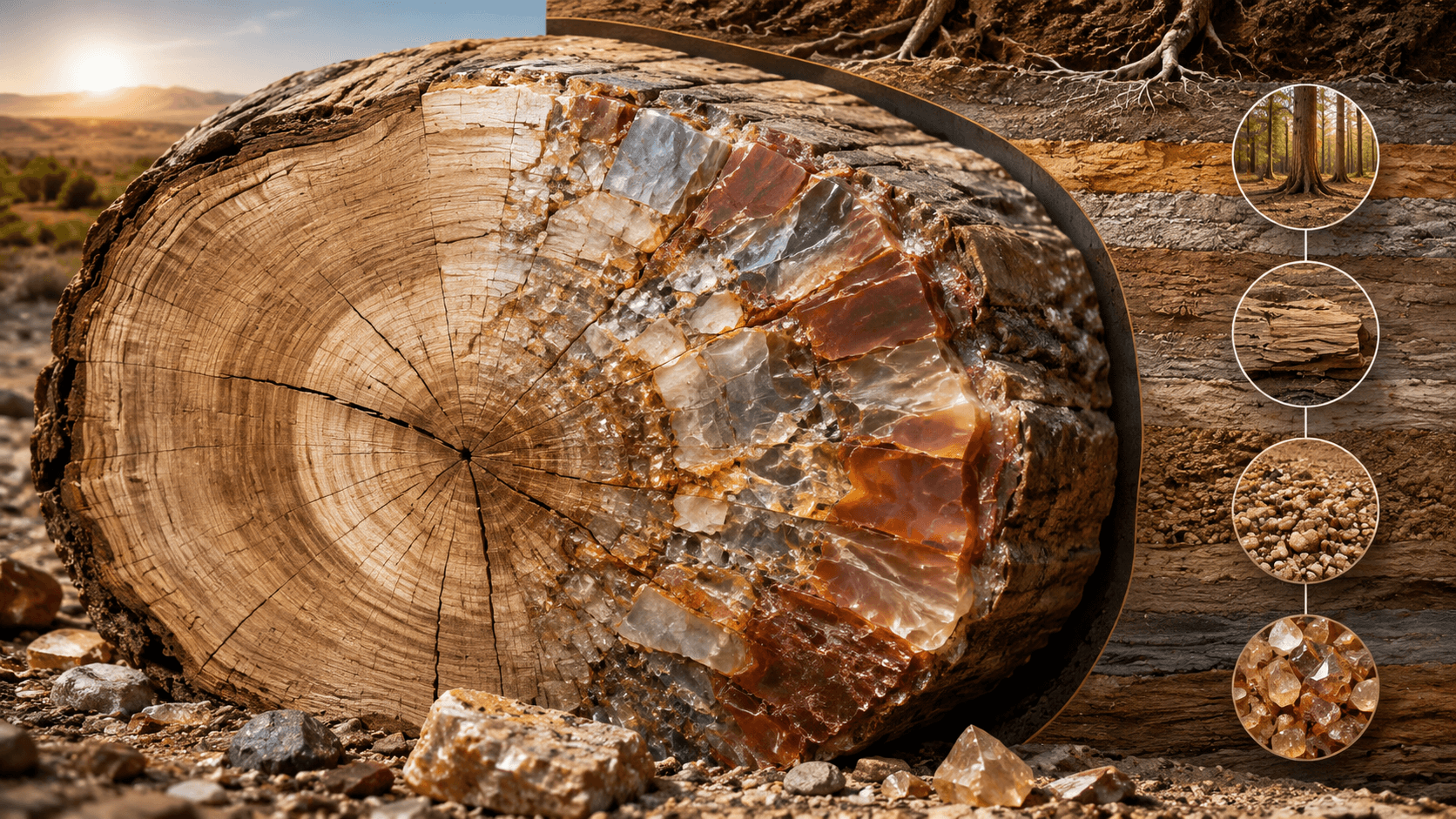
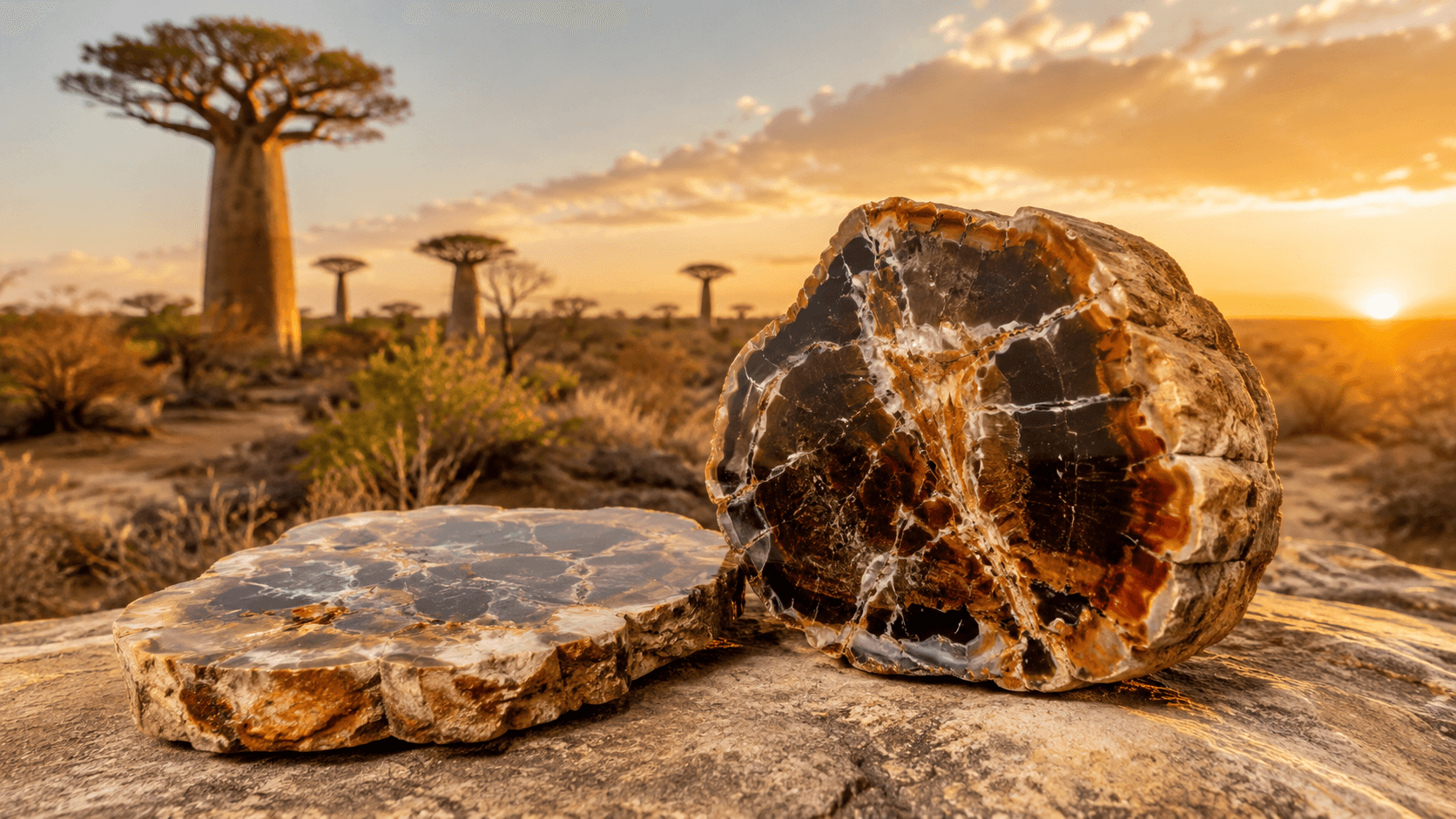
Each piece is cut from a fossilized tree trunk that once stood in the forests of southwestern Madagascar during the Triassic period. Buried, then slowly replaced by silica-rich water over millions of years, the wood's cellular structure survived — its rings, its grain, its quiet architecture — while its substance became quartz. What you hold is not wood anymore. It is stone that remembers being wood.
An Individual Tree, Not a Product Line
At Medusa, no two paperweights come from the same story. Every trunk we recover is named — Ambra for amber tones, Argentea for silver-grey, Fusca for deep brown, Umbra for near-black, Viridis for green — because each one mineralized differently underground, absorbing different trace metals as it turned to stone. Iron gave some trunks their red and ochre; manganese produced blacks and violets; chromium and cobalt, rarer, left traces of green and blue.
When a trunk is cut, that particular colour signature is gone. There is no reordering the same shade once the log is spent. A paperweight cut from Ambra will never be replaced by an identical one — only by a different tree, with its own palette.
- Each trunk is extracted individually, not mined in bulk
- Colour comes from mineral content, not dye or treatment
- Once a trunk is fully cut, its exact tone disappears from the collection
Why It Makes an Exceptional Gift
Desk gifts tend to be forgettable — a pen, a mug, something branded. A petrified wood paperweight sits in a different category entirely. It is small enough to give without ceremony, but substantial enough to matter. It has no expiry, no batteries, no assembly. It simply sits on a desk and slowly becomes part of someone's daily ritual — the object their hand reaches for while thinking.
It suits a retirement, a promotion, an anniversary at a firm, a housewarming for someone who already has too many candles. It works for a geologist and for someone who has never thought about rocks in their life, because the story carries itself: a tree older than most mountain ranges, now holding down an invoice.
A paperweight that has outlasted continents doesn't need an explanation — it needs a place on the desk.
Weight, Cold, and Permanence
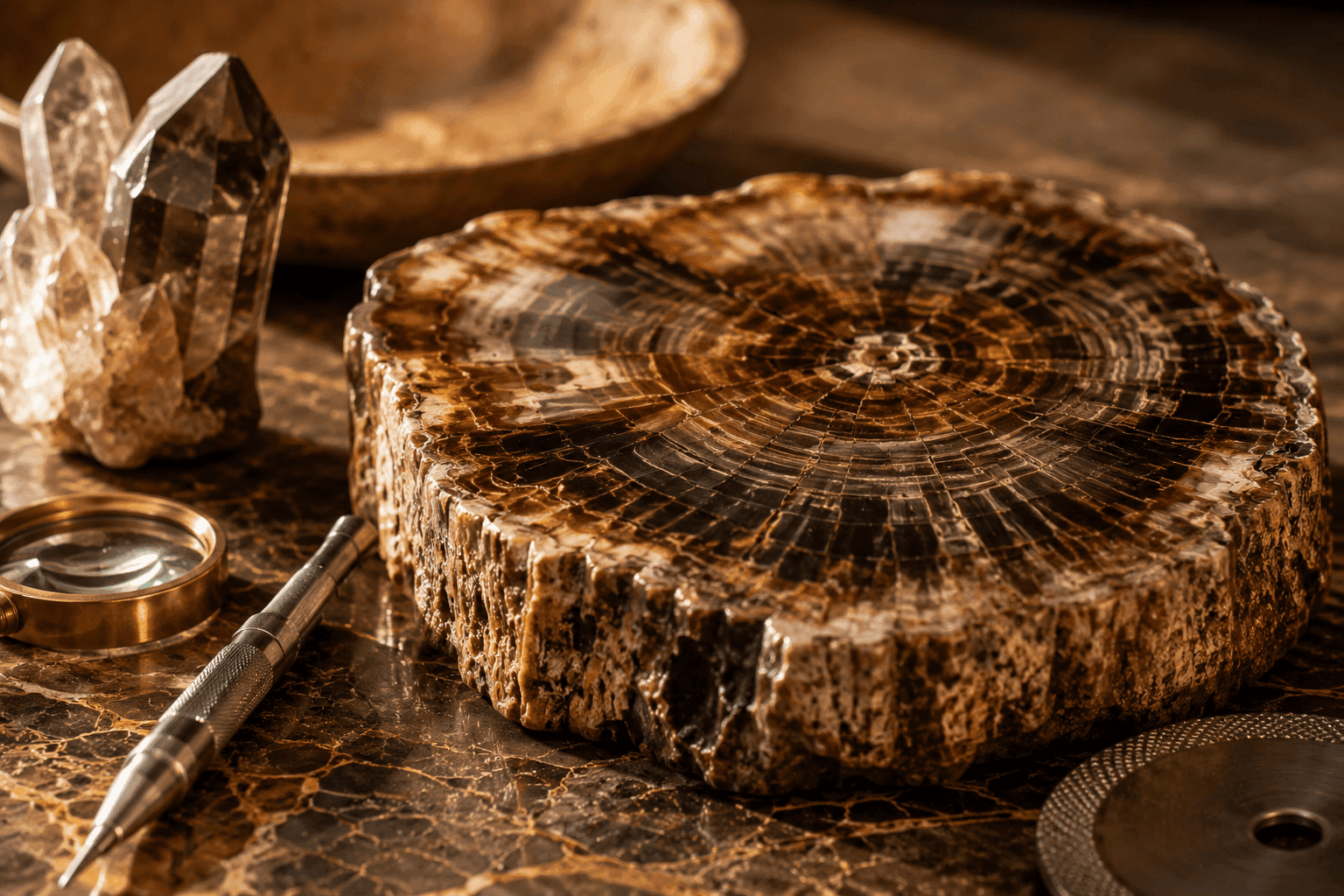
Petrified wood is quartz, full stop — which means it behaves nothing like the tree it once was. It rates 7 on the Mohs hardness scale, harder than steel, and it carries genuine heft in the hand, far beyond what its size suggests. That density is part of the pleasure of it: a good paperweight should feel deliberate, almost stubborn, against a gust from an open window.
Being quartz also means it is entirely indifferent to the things that damage ordinary wood or stone. It does not fear water, does not react to heat or cold, does not fade under sunlight, does not crack in frost. A desk gift, in other words, that asks nothing of the person who receives it — no polishing, no coasters, no care instructions. It simply endures.
Colour and Grain, Preserved Exactly as Formed
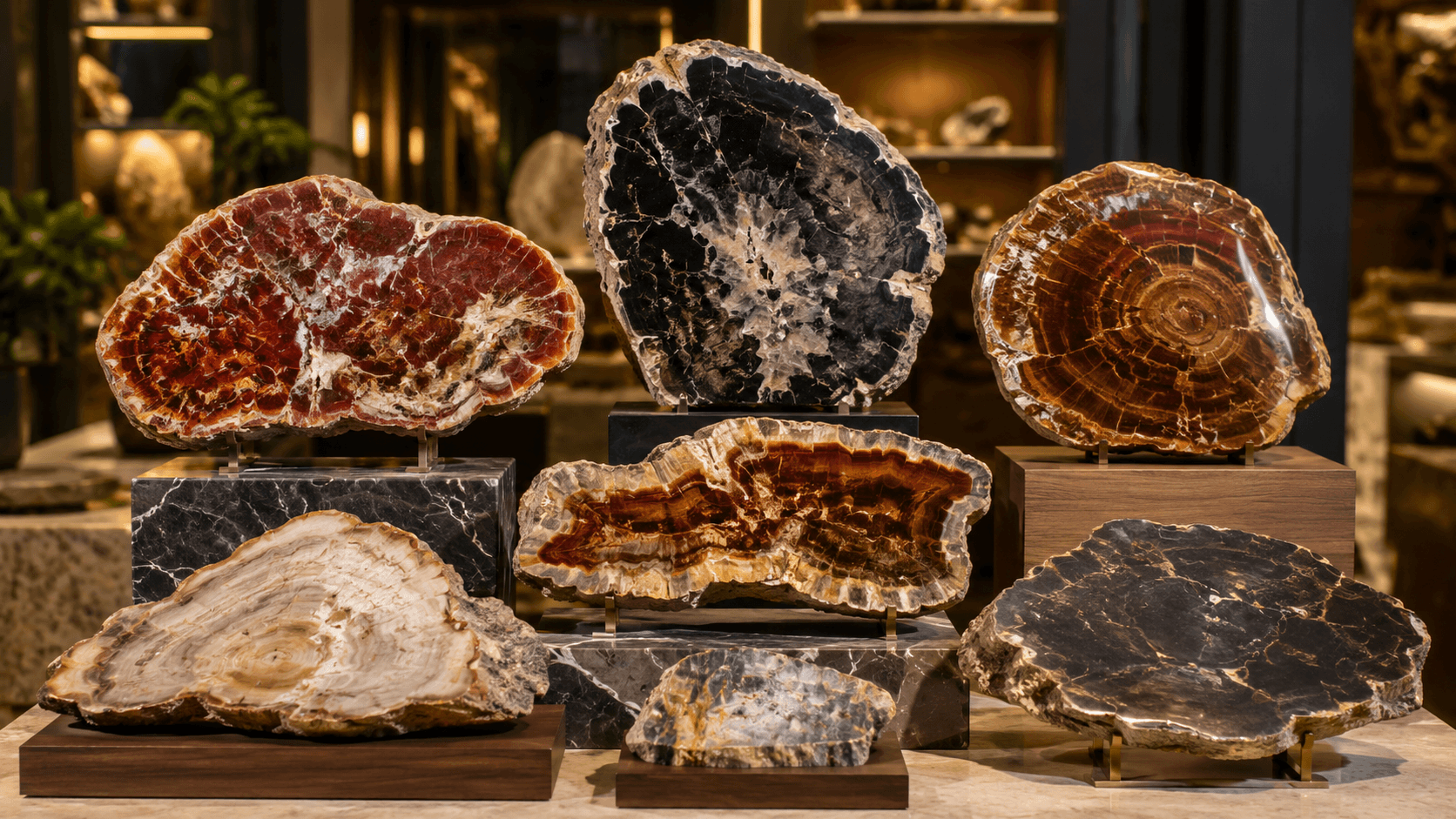
Look closely at a polished face and you'll find the anatomy of a living tree rendered in stone: concentric rings, radial fractures, sometimes a knot or a fissure that tells you where a branch once grew. None of it is added. None of it is carved. The pattern is exactly what silica found and fixed in place, one mineral molecule at a time, underground.
This is why every paperweight looks slightly different even within the same trunk — a slice near the bark shows different rings than one near the heartwood. Buyers looking for a specific tone should expect variation as a feature, not a flaw. It is the clearest sign that nothing here was manufactured to match a catalogue photo.
A Small Object, Carefully Finished
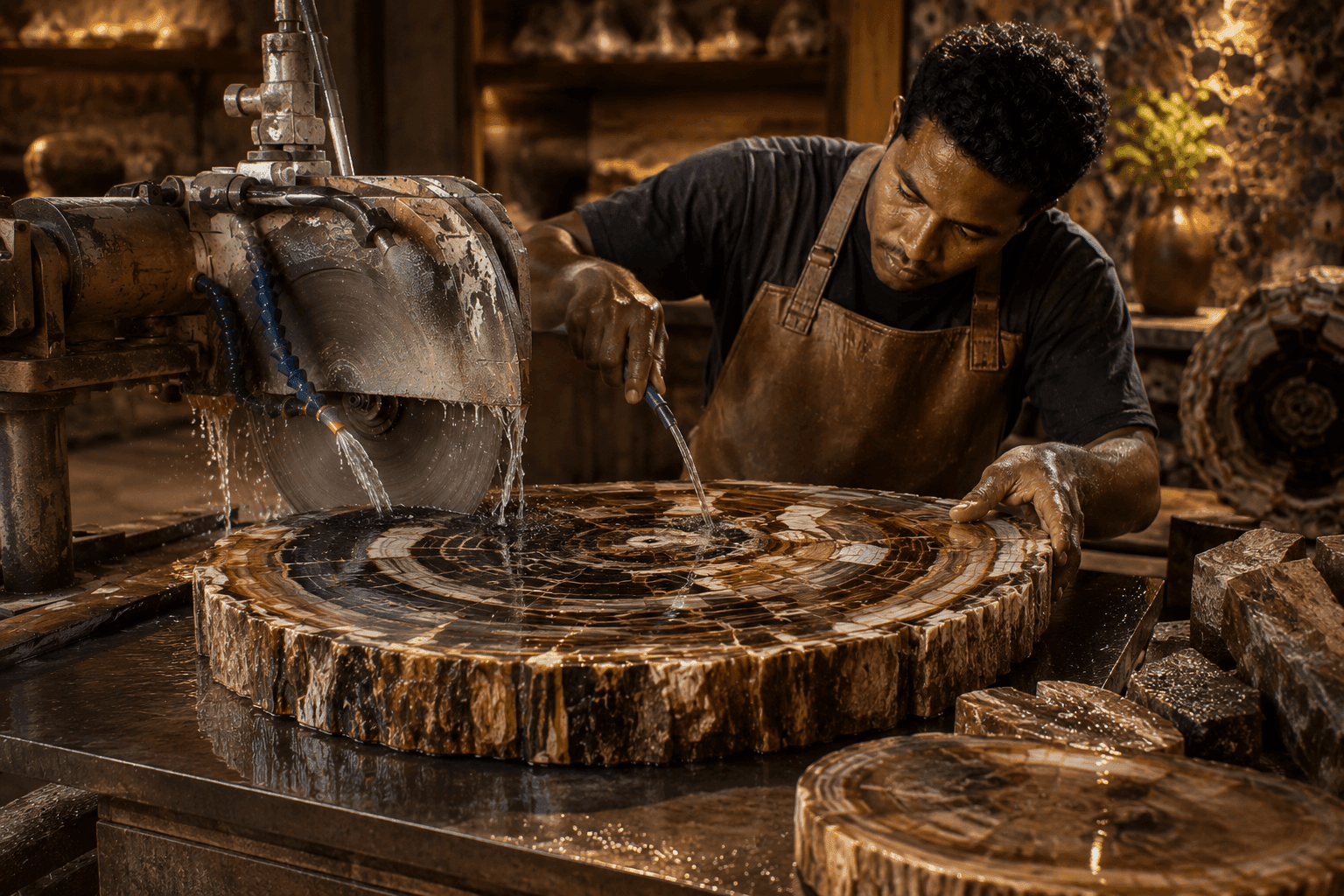
Turning a rough fragment into a paperweight is slower work than it looks. Each piece is cut, shaped, and polished by hand to bring out the natural contrast between rings and matrix, without disguising the irregularities that make the material what it is. The final polish is not a coating — it's the mineral itself, brought to a shine through abrasion alone.
The result sits somewhere between a geological specimen and a design object: refined enough for a minimalist desk, raw enough to remind you where it came from.
Discover paperweights cut from named, individually recovered trunks.
Shop the CollectionFrequently Asked Questions
Is every petrified wood paperweight unique?
Yes. Each piece comes from an individually named trunk with its own mineral history, so colour, grain, and pattern vary from one paperweight to the next — even within the same tree.
How old is the material, exactly?
The wood originates from trees that grew roughly 230 million years ago, during the Triassic period, in what is now southwestern Madagascar.
Does it need any special care?
No. Because the material is fossilized quartz, it is unaffected by water, heat, cold, or sunlight. A simple wipe is enough to keep it clean.
Why do the colours vary so much between pieces?
Colour comes from trace metals absorbed during fossilization — iron for reds and ochres, manganese for blacks and violets, chromium or cobalt for the rarer greens and blues. No dye or treatment is involved.