
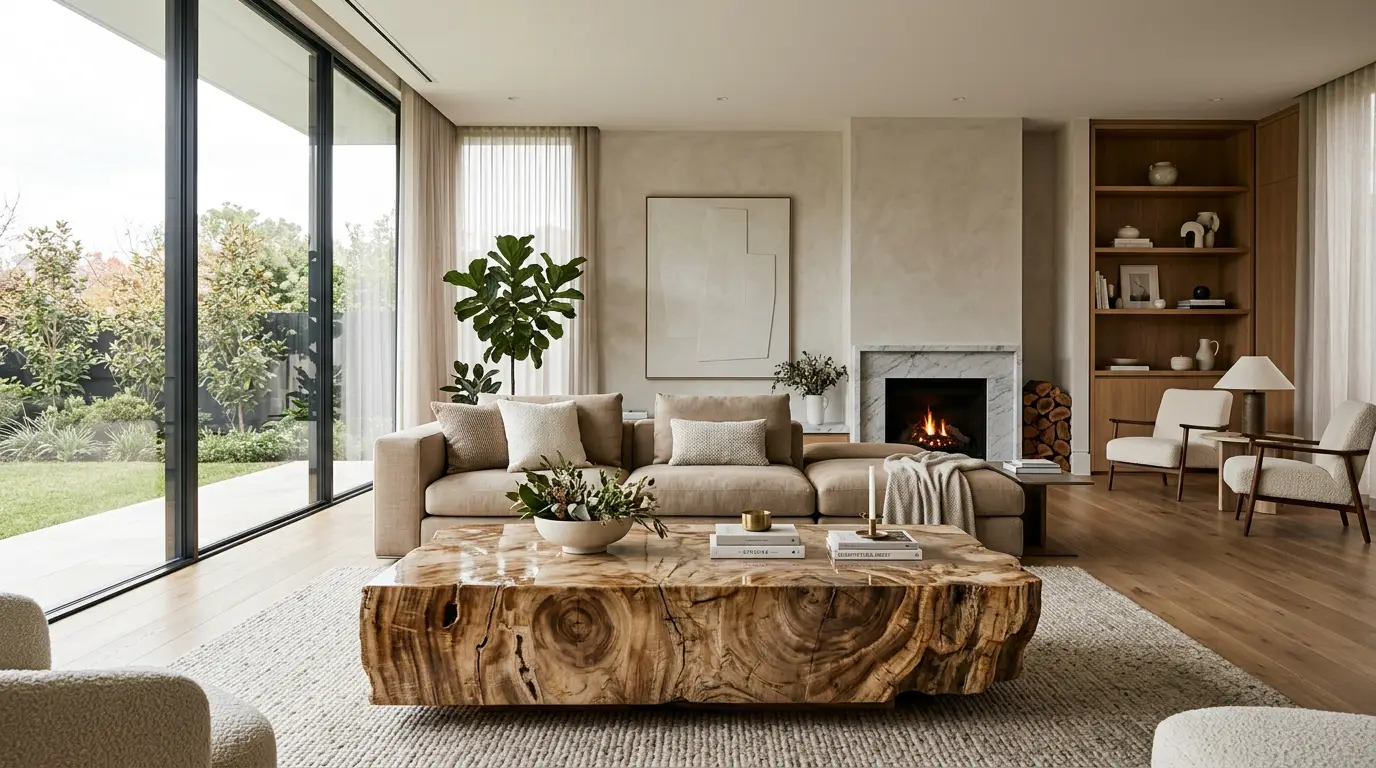
A Stone That Once Was Wood, Now Standing By Your Bed
A nightstand is a strange piece of furniture. It sits closer to us than almost anything else we own — closer than the dining table, closer than the sofa. We reach for it half asleep, set a glass of water on it, rest a hand on its edge in the dark. Most nightstands are forgettable because they ask so little of themselves. A petrified wood nightstand asks something different: that this small, intimate surface be cut from a tree that stood in a Triassic forest some 230 million years ago, in what is now southwestern Madagascar, before slowly turning to stone.
At Medusa, that tree has a name.
One Tree, One Name, One Nightstand
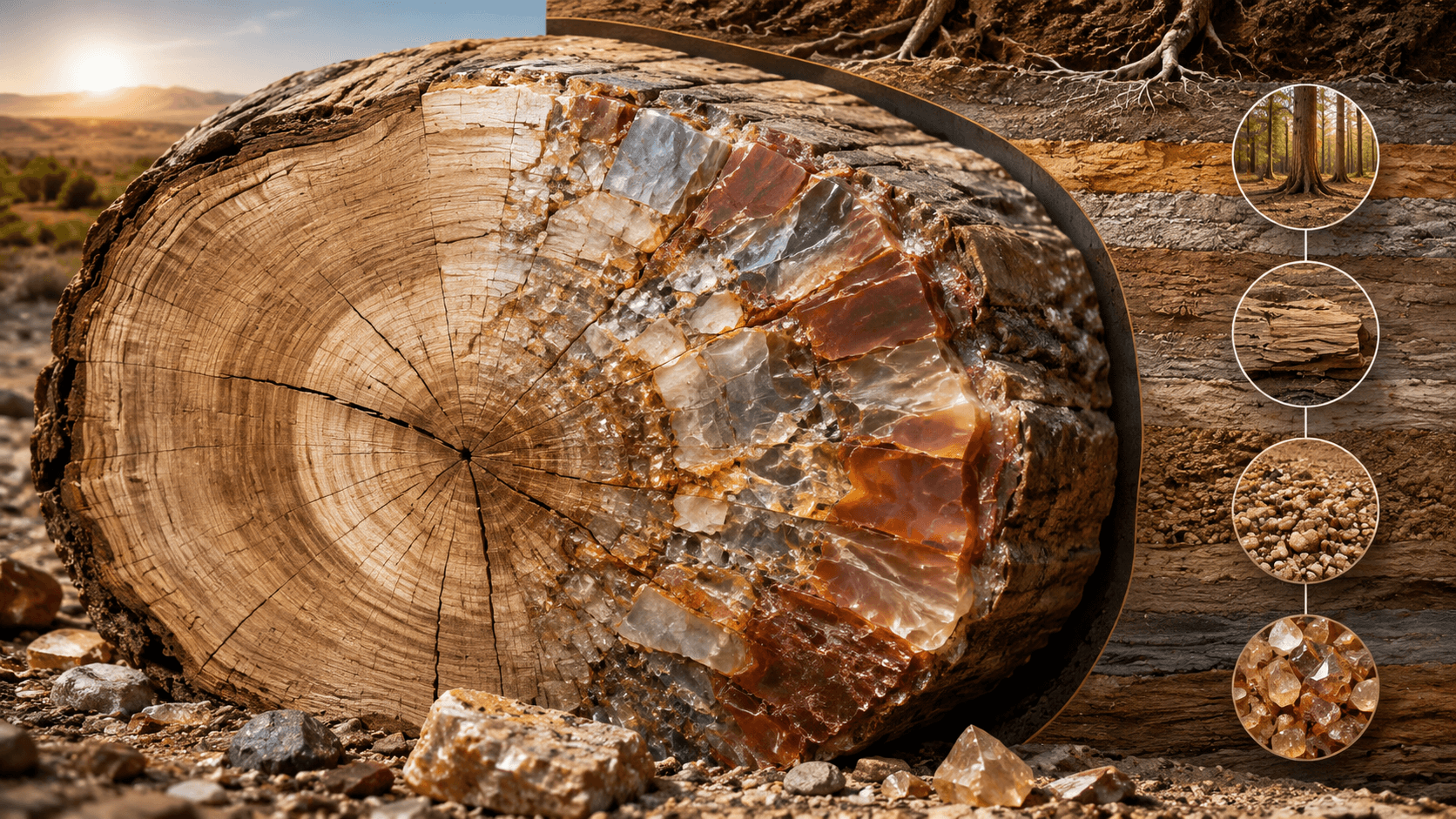
We don't sell "petrified wood furniture" as a category. We recover individual trunks, one at a time, from the sud-ouest of Madagascar, and we give each one a name: Ambra for the amber-toned trunks, Argentea for the silvery ones, Fusca for the deep browns, Umbra for the darkest, near-black stone, Viridis for the rare greens. Each name marks a single tree and its own mineral history — the particular mix of iron, manganese, chromium or cobalt that seeped into its cells while it lay buried and turned, molecule by molecule, into quartz.
A nightstand cut from Ambra will never look like one cut from Umbra. And once a trunk is fully worked, its exact palette is gone. There is no second batch, no reorder in the same shade — only the next tree, with its own name and its own colour.
Why Stone Beside the Bed
It might seem an odd place for something so ancient and so heavy. But the nightstand is precisely where petrified wood's nature makes the most sense.
- It is quartz, rated 7 on the Mohs hardness scale — a glass of water left overnight, a dropped ring, a hot mug: none of it marks the surface.
- It is entirely indifferent to humidity, so a bedroom with poor ventilation or a bathroom-adjacent alcove poses no risk.
- It carries genuine weight and cold-to-the-touch density, the opposite sensation of the veneered wood or MDF nightstands most bedrooms hold.
- Its surface shows the tree's original structure — growth rings, sometimes bark texture — fixed permanently rather than sanded into uniformity.
A nightstand in petrified wood does not age. It was already old when it arrived.
From Trunk to Bedside
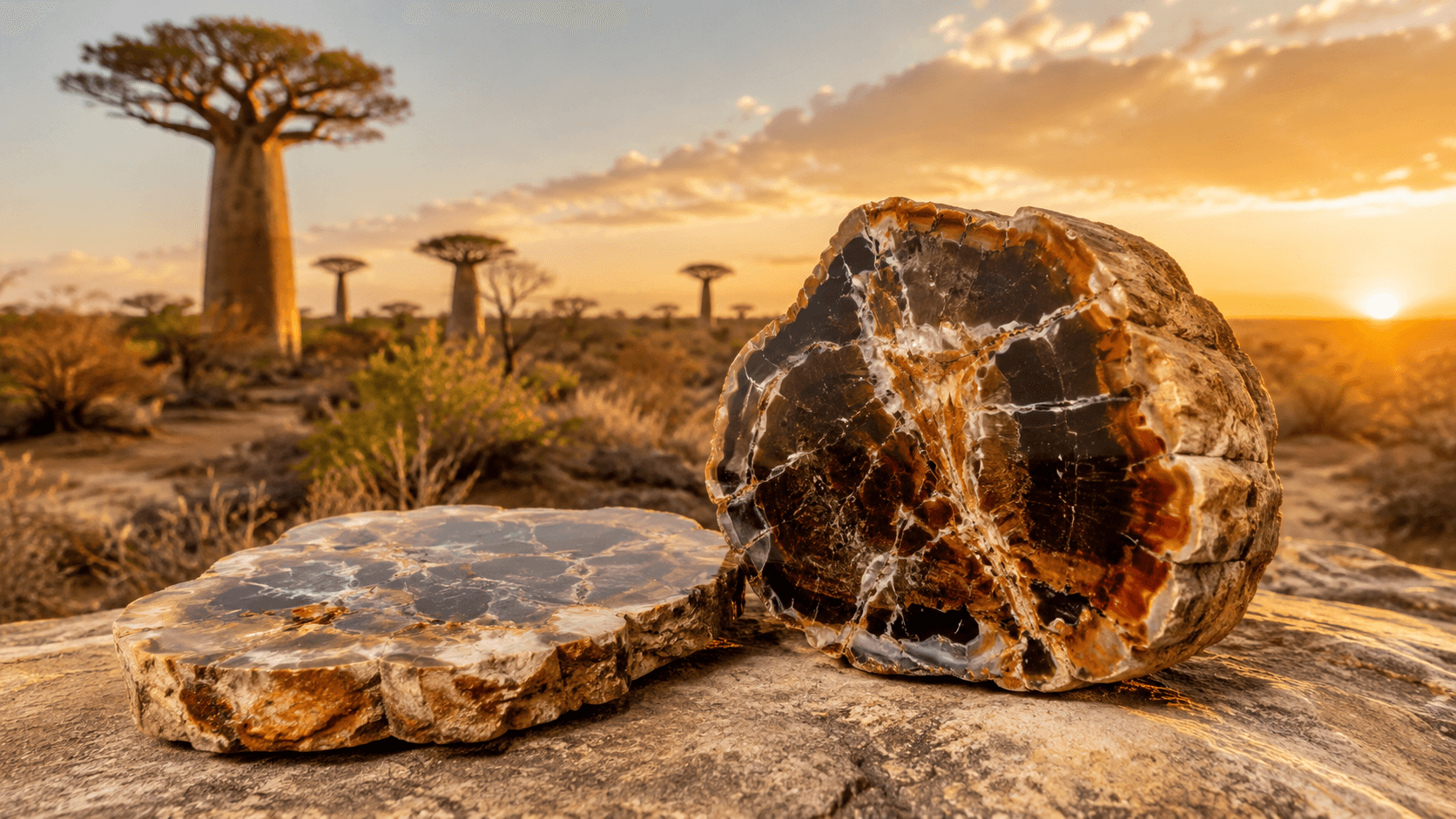
Each nightstand begins as a section cut from a larger trunk, chosen for its diameter, its colour, and the way its internal veining runs — decisions made by eye, block by block, since no two sections behave the same way under the blade. What follows is slow, deliberate work: cutting, polishing, sometimes hollowing a small recess for a drawer or a shelf, always respecting the stone's natural contours rather than forcing them into a uniform box shape.
This is why we build nightstands to order rather than from stock. A client's bedroom dictates the height, the diameter, the base — solid stone plinth, blackened steel legs, or a raw, unpolished underside. The stone dictates everything else.
The Hand Behind the Stone
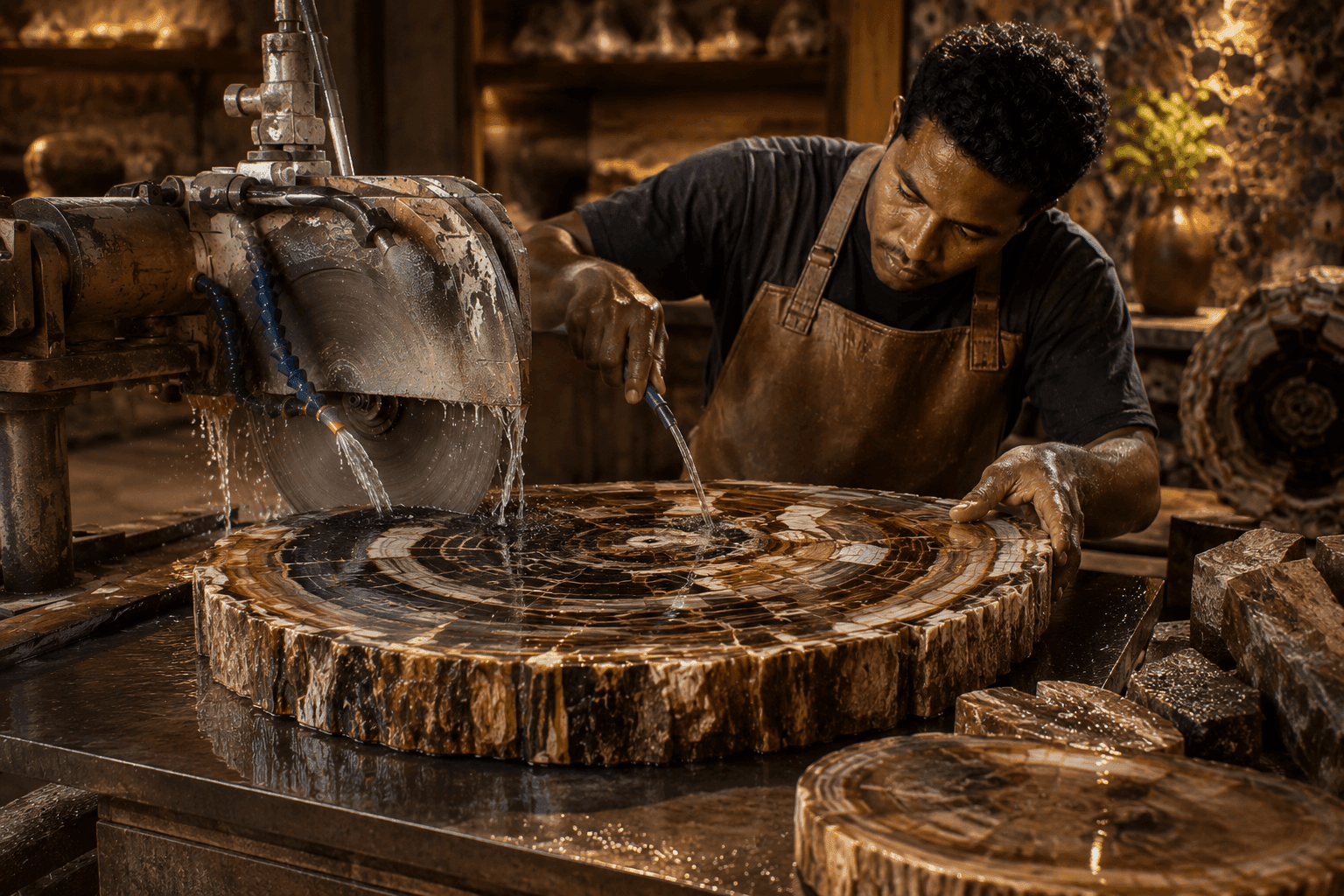
Quartz does not forgive haste. Each nightstand passes through hours of grinding and polishing by hand, since machine passes alone leave the surface flat and lifeless, blind to the trunk's actual grain. The artisan works with the stone's history in mind — following a vein rather than cutting across it, letting a knot or a fracture line remain visible instead of masking it. The result is a surface that reads as geology as much as furniture: matte in places, glassy in others, the record of both a fossilised tree and a human hand.
Living With It
A petrified wood nightstand does not try to blend in. Placed beside a plain bed frame and pale linens, it becomes the room's single mineral note — something a lacquered wood or laminate piece could never offer. It pairs naturally with brass, dark bronze, aged leather. It holds its own beside a marble lamp base or a cast concrete wall.
Because each trunk name (Ambra, Argentea, Fusca, Umbra, Viridis) carries its own tone, the piece can be selected to match — or deliberately contrast with — the rest of a bedroom's palette. A cool Argentea nightstand against warm oak flooring; a deep Umbra piece beside pale stone walls. The decision is made once, at the point of choosing which trunk to work from, and it cannot be repeated once that trunk is gone.
Discuss your bedroom's proportions and the trunk that would suit it.
Request a QuoteFrequently Asked Questions
Is every petrified wood nightstand really one of a kind?
Yes. Each nightstand is cut from an individually named trunk with its own mineral colouring. Once that trunk is used, its exact grain and shade cannot be reproduced.
Can it withstand a glass of water or a hot cup left overnight?
Yes. Petrified wood is fossilised quartz, rated 7 on the Mohs scale, and entirely unaffected by water, heat, or humidity — conditions that would damage lacquered or veneered furniture.
How heavy is a petrified wood nightstand?
It is considerably heavier than a wood or laminate equivalent, since the material is solid quartz rather than organic wood. Exact weight depends on the dimensions and base chosen; we discuss this directly when scoping a piece.
Can I choose the colour of my nightstand?
You can choose among available named trunks — Ambra, Argentea, Fusca, Umbra, Viridis — each with a distinct tone shaped by its own mineral history. Availability depends on current stock, since each trunk is finite.