
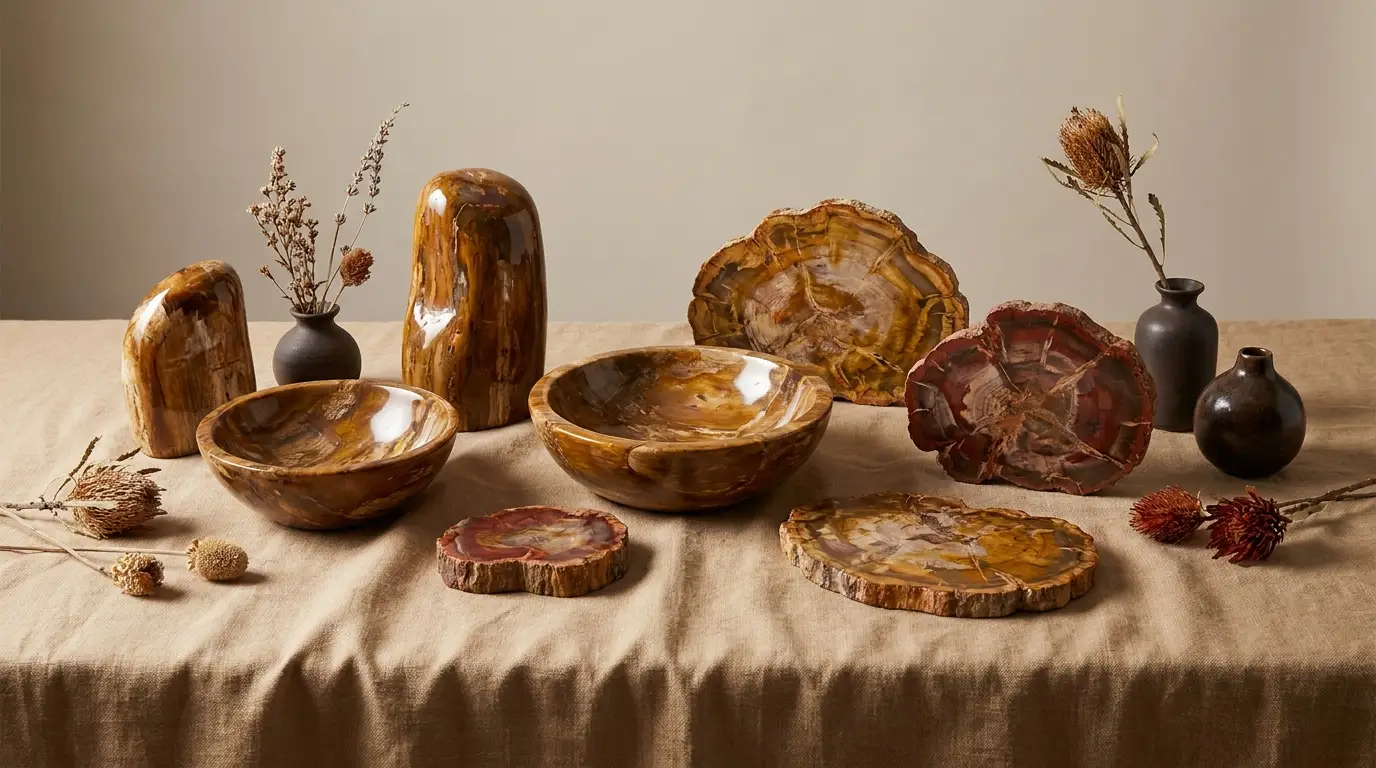
A Light That Rests on Stone Older Than Trees Themselves
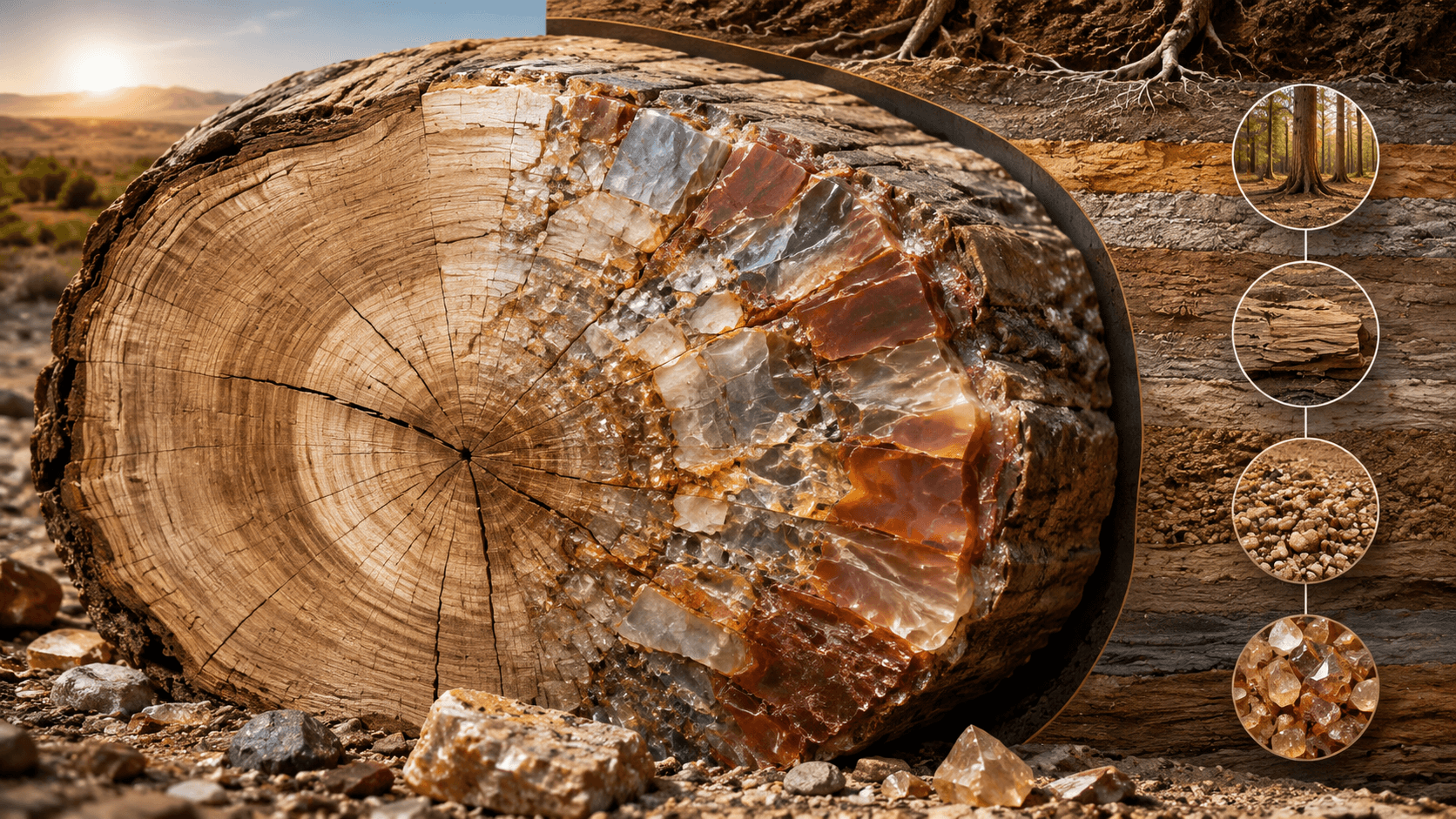
A lamp built on a petrified wood base is an odd kind of paradox: light, modern and electric, resting on a mass that has not changed in 230 million years. At Medusa, each lamp base begins as a section of a single fossilized tree, pulled from the sandy soils of southwestern Madagascar, where entire Triassic forests were buried, flooded with mineral-rich water, and turned to quartz cell by cell. What was once wood is now stone — and what was once a living trunk now anchors a light fixture in a living room.
We don't manufacture these bases. We select them, tree by tree, from trunks that have already been named.
One Tree, One Name, One Base
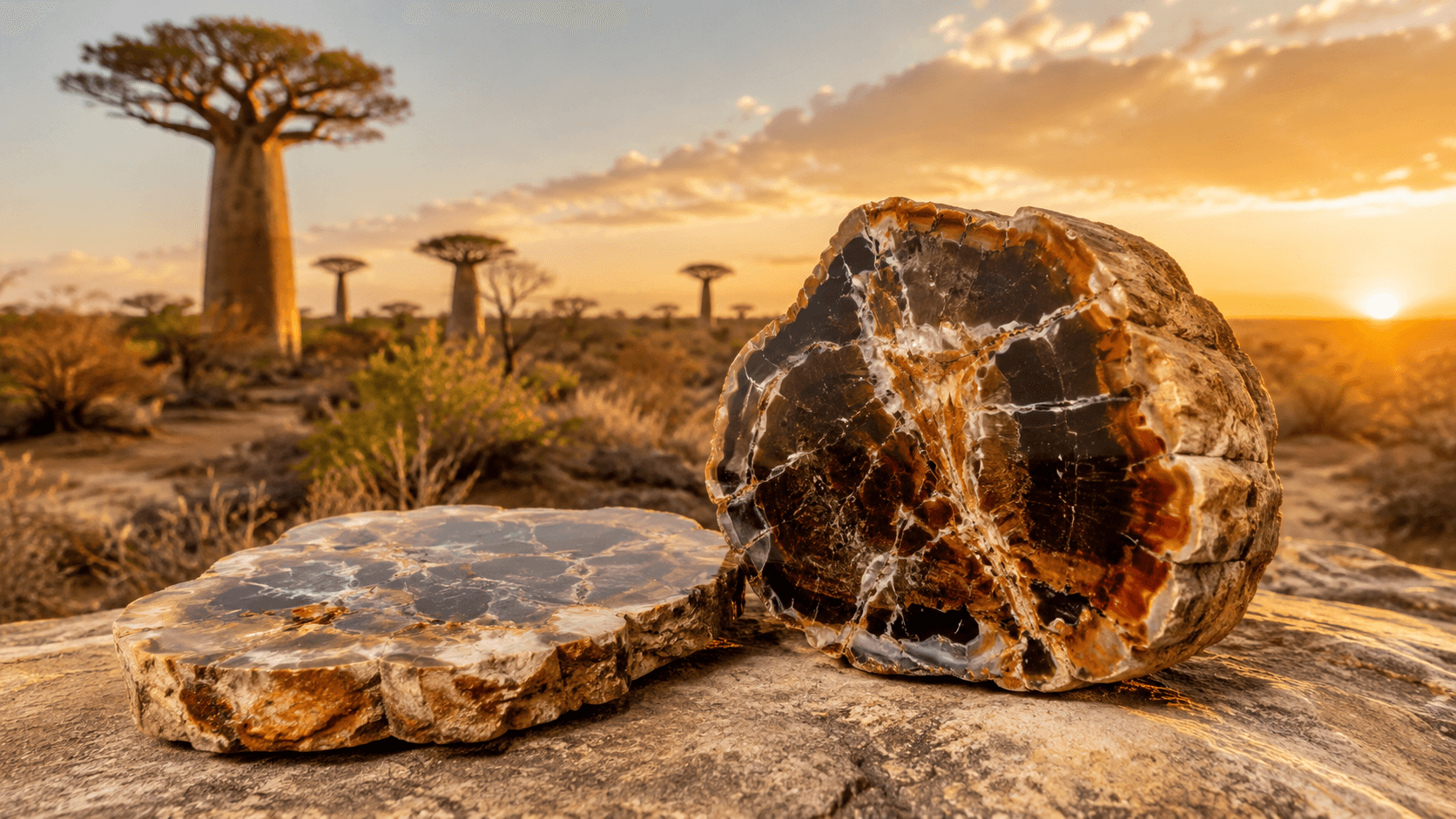
Every trunk that arrives at our workshop carries a name — Ambra, Argentea, Fusca, Umbra, Viridis — not as a product line, but as an identity. These are not categories we invented to organize a catalogue. They describe five distinct mineral destinies: the same species of ancient conifer, buried in different pockets of ground, exposed to different concentrations of iron, manganese, chromium or cobalt during silicification. Ambra trunks absorbed iron and oxidized toward amber and ochre. Umbra trunks took on manganese and darkened toward near-black and violet. Viridis is rarer still — trace chromium or cobalt shifting the stone toward green or blue.
A lamp base cut from an Ambra trunk will never look like one cut from an Umbra trunk. And once a trunk is fully worked, its particular palette is gone. There is no second batch.
- Ambra — amber, ochre, warm iron tones
- Argentea — silvery, pale grey striations
- Fusca — deep brown, dense grain
- Umbra — near-black, occasional violet
- Viridis — green-blue, the rarest mineral signature
From Trunk to Light Fixture
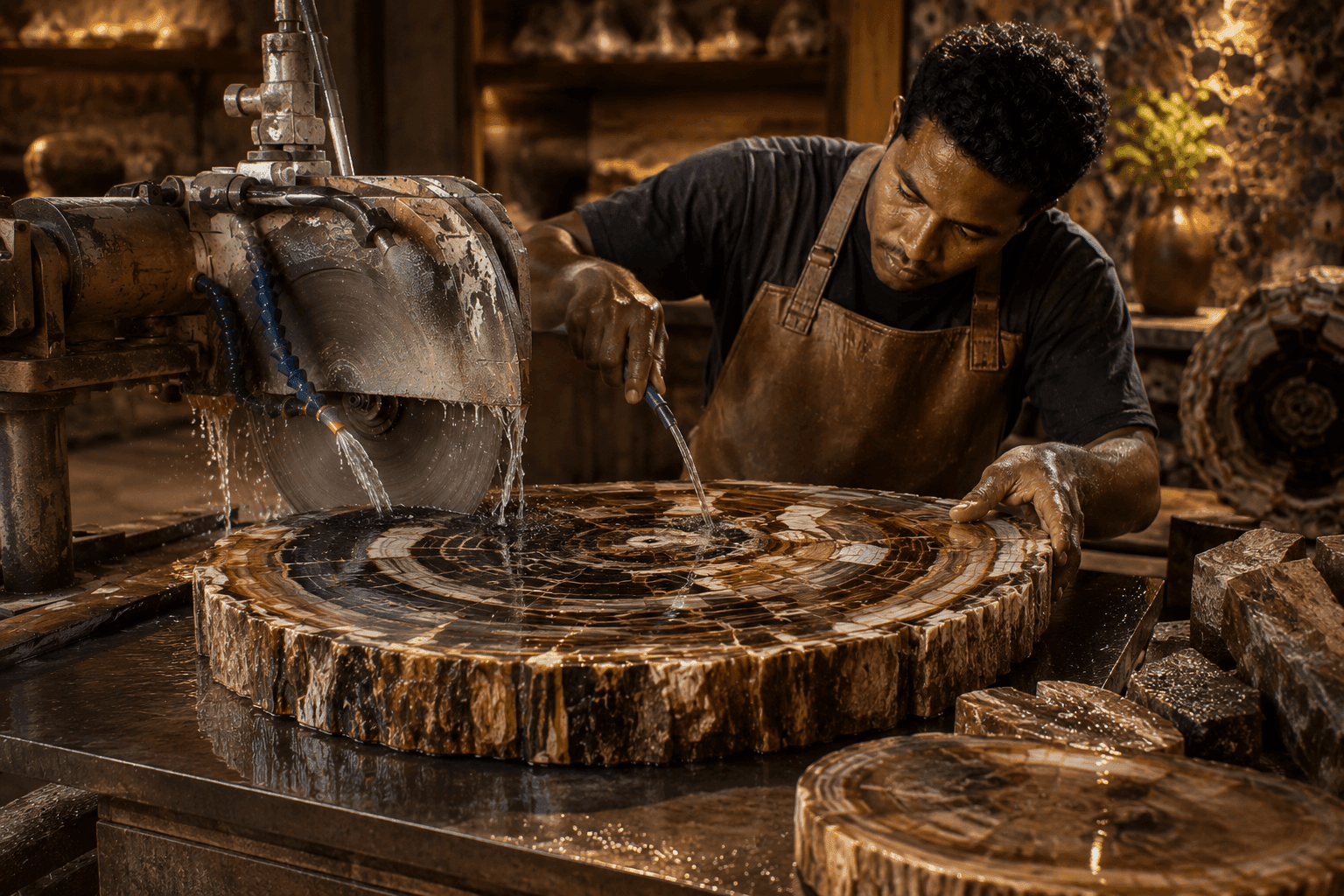
Turning a fossilized trunk into a lamp base is not a woodworking job — it's lapidary work. The trunk is cut, then the base is shaped, polished, and drilled to house the electrical column, all without altering the mineral's natural contours or its cross-grain pattern. Because the material is quartz rated 7 on the Mohs scale, this takes patience: diamond tooling, slow passes, and a craftsman who knows how to read the stone's fracture lines before committing a cut.
The result keeps what mattered from the tree — its rings, its knots, its silhouette — while gaining the properties of stone: cold to the touch, indifferent to humidity, immune to heat and to the fading effect of direct sun. A petrified wood lamp base does not warp, does not dry out, does not need oiling. It simply sits, as it has for two hundred and thirty million years, and now holds a source of light instead of a canopy of leaves.
A trunk does not become a lamp. It becomes the only object in the room that was already ancient before the room existed.
Why the Base Changes the Room
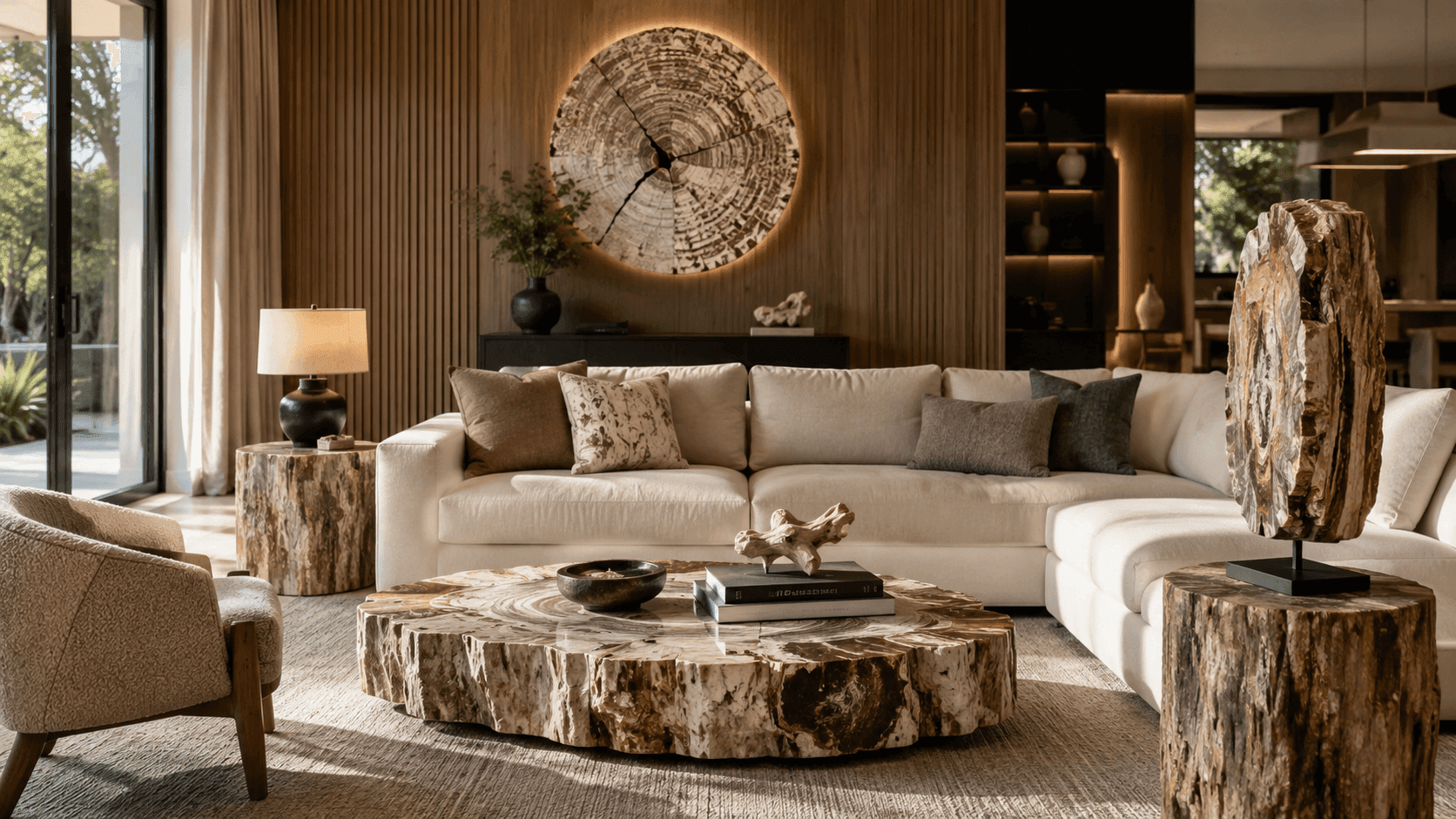
A lamp is usually the most forgettable object in a room — a fixture chosen for its shade, rarely for its foot. A petrified wood base reverses that logic. Its mass, its grain, its color pull attention downward, toward the material itself. Placed beside a sofa, on a console, or as a singular reading lamp in a study, it behaves less like lighting hardware and more like a mineral sculpture that happens to hold a bulb.
Because no two trunks weather identically, no two lamp bases are interchangeable. A client choosing an Umbra base is choosing a specific dark, faintly violet mineral — not a finish that can be reordered once the trunk it came from has been fully used.
Durability Without Maintenance
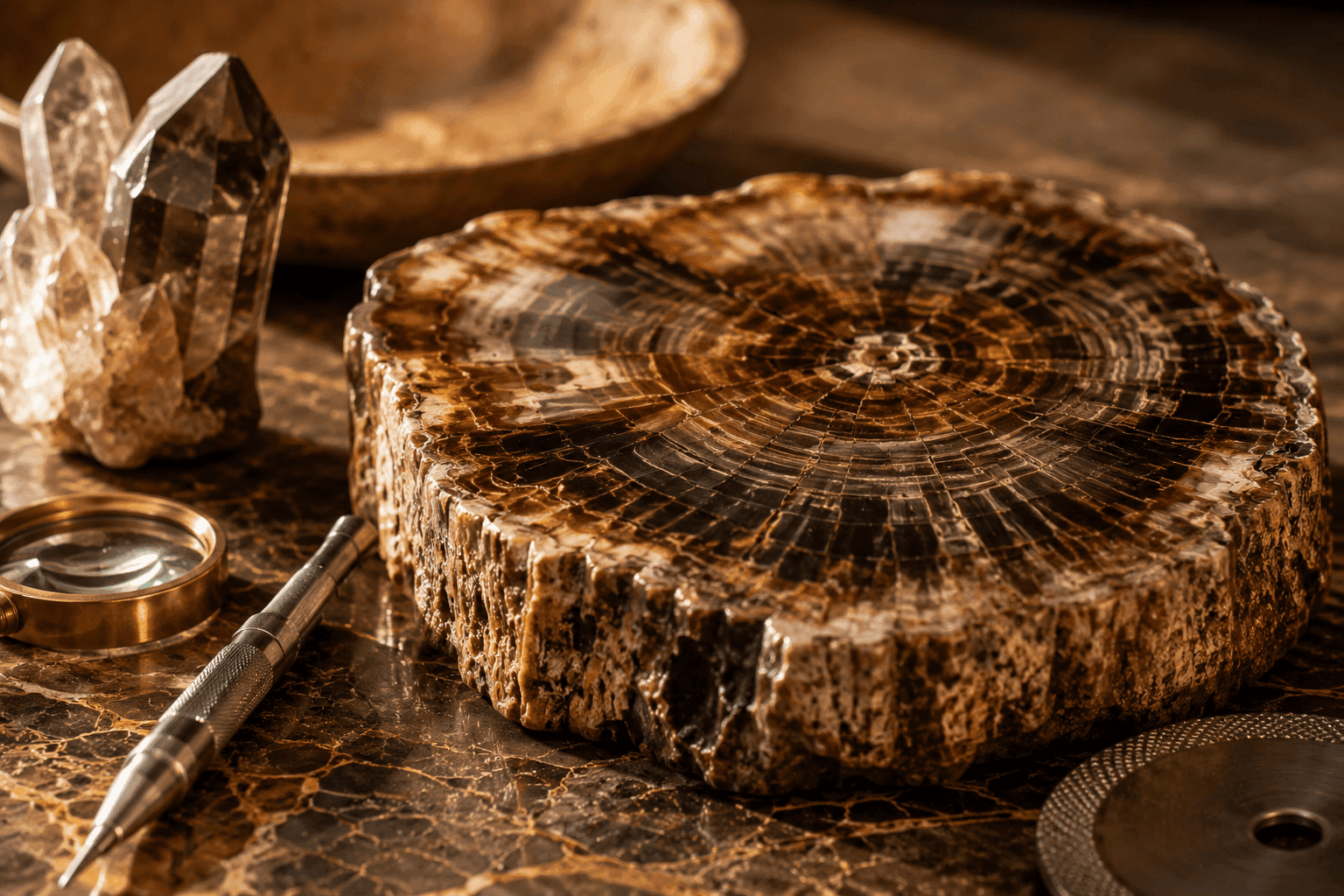
Quartz at Mohs 7 is harder than a steel blade. Practically, this means a petrified wood lamp base tolerates decades of daily handling — resting glasses beside it, dusting it, moving it from room to room — without scratching, without dulling, without the surface concerns that come with lacquered wood or metal. It won't react to spilled water, won't crack under the heat of an incandescent bulb resting nearby, and won't fade under a sunlit window.
This is a piece meant to outlast the lamp fitting itself. If the shade wears out or tastes change, the base remains — a fixed point of stone in an otherwise replaceable object.
Discover the petrified wood lamps and bases currently available.
View the CollectionFrequently Asked Questions
Is the base heavy?
Yes. Petrified wood is fossilized quartz, considerably denser than the original timber. A lamp base will feel substantial in the hand — this weight is part of its stability and its authenticity.
Can I place it near a heat source or in direct sunlight?
Yes, without concern. As quartz, the material is unaffected by heat, humidity, or UV exposure, unlike lacquered or varnished wood.
Why do the colors vary so much between pieces?
Color comes from the trace metals present during fossilization — iron for reds and ochres, manganese for blacks and violets, chromium or cobalt for greens and blues. Each trunk mineralized differently, which is why every named tree yields its own distinct palette.
Is electrical wiring integrated safely into the stone?
Yes. The base is drilled to house the wiring column following standard safety norms, without compromising the structural integrity of the fossilized wood.