
# A Gift That Was Already 230 Million Years in the Making
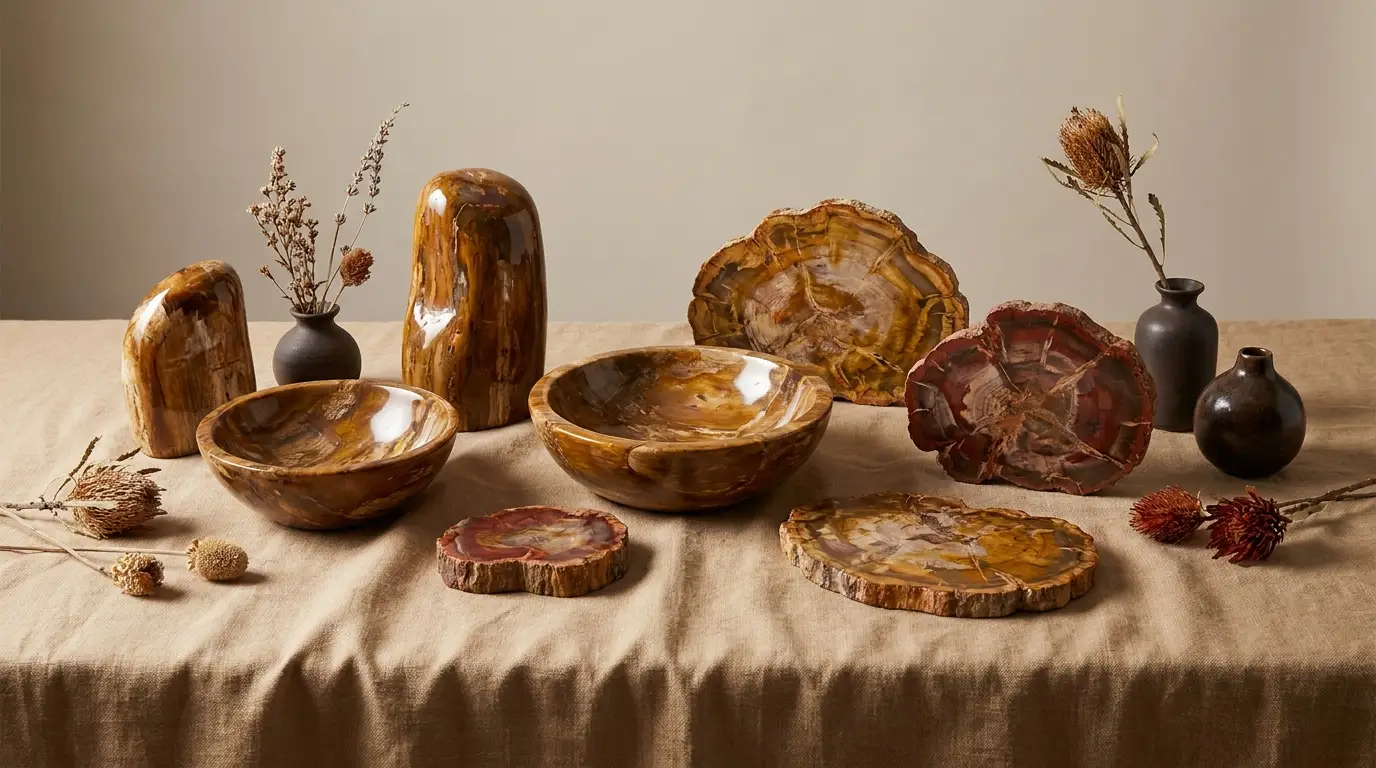
Most gifts are chosen. This one was found. Long before it reached a jeweller's bench or a shelf in someone's study, the stone inside it was a tree — standing in a forest in what is now southwestern Madagascar, some 230 million years ago. It fell, it was buried, and over unthinkable spans of time, silica replaced its wood cell by cell until nothing organic remained. What's left is quartz: hard, cold to the touch, and coloured by the minerals it absorbed underground.
Giving a piece of petrified wood means giving something that owes nothing to fashion or trend. It was finished being made long before anyone thought to make it into a gift.
Every Piece Comes From a Named Tree
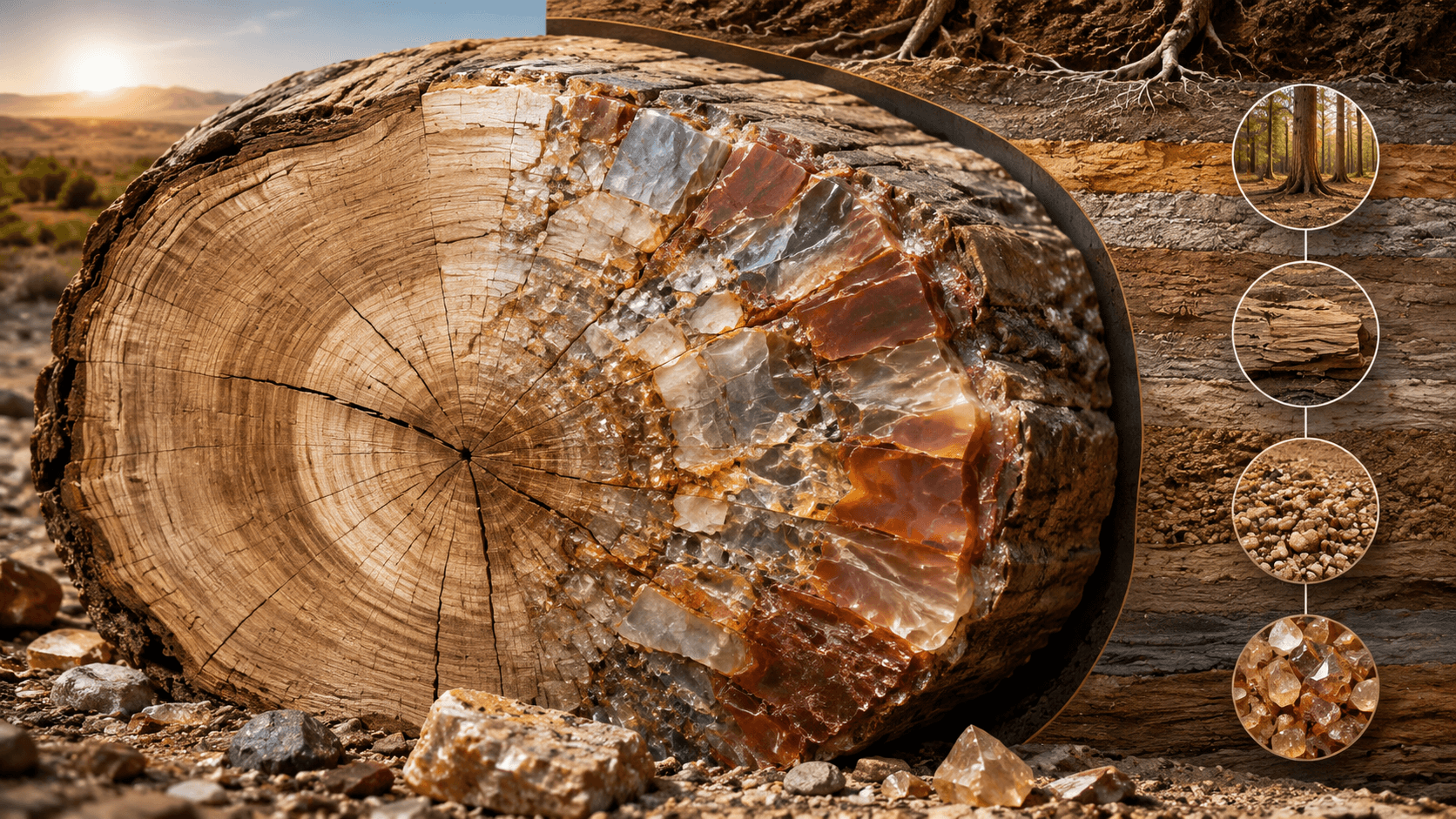
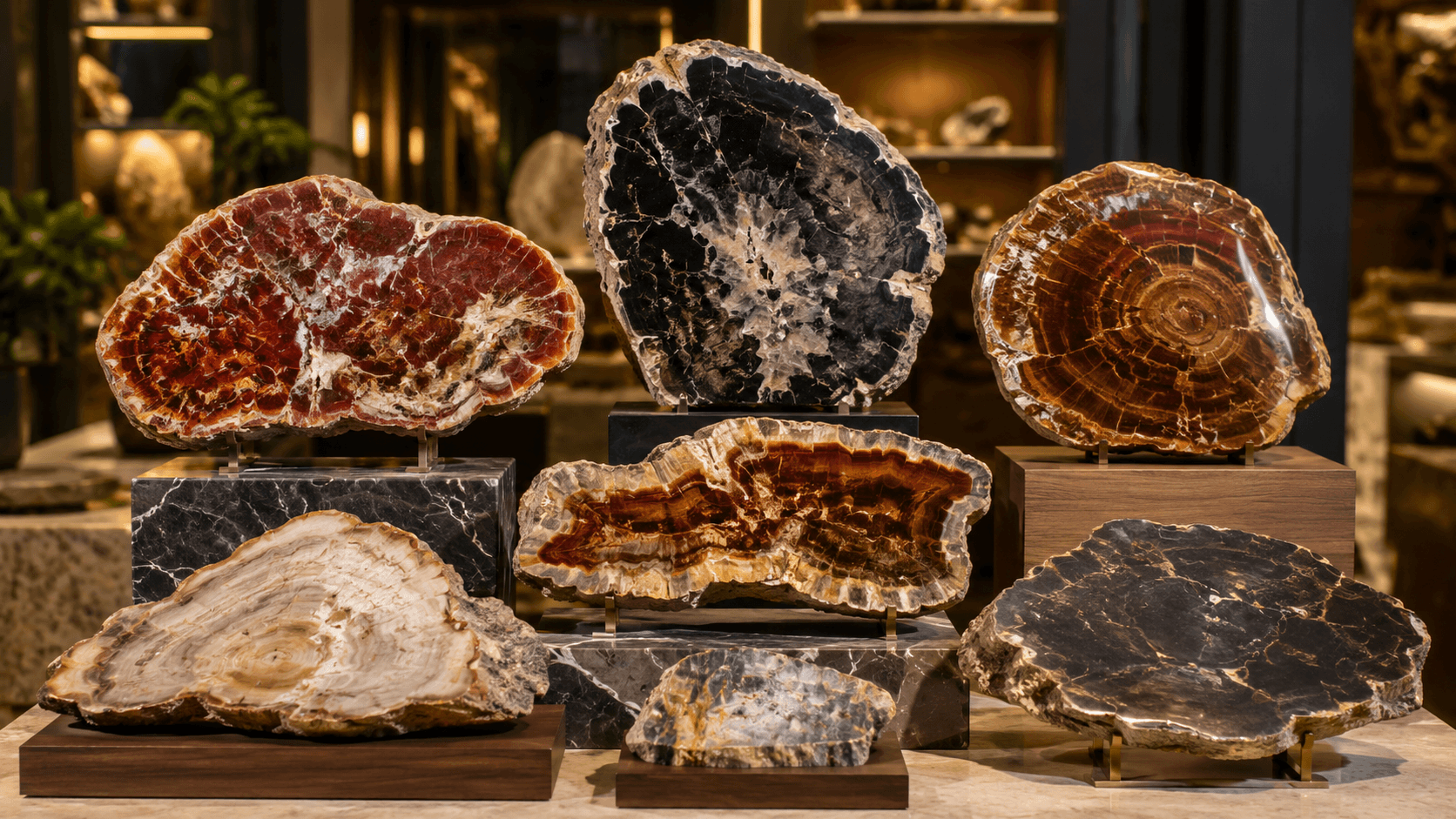
At Medusa, we don't sell "petrified wood" as an anonymous material cut to size. Each trunk we bring up from the ground in southwestern Madagascar is a single tree, and we give it a name: Ambra for the amber tones, Argentea for the silver-grey, Fusca for deep browns, Umbra for the darkest pieces, Viridis for the rare greens. These aren't product categories — they're individuals. No two trunks share the same mineral history, so no two trunks share the same colour.
This matters for gifts more than almost any other object. A pendant cut from Argentea, a coaster set from Fusca — once that trunk is fully worked, its particular shade is gone. What you give someone is not a sample of a range. It's a fragment of one tree that will never be duplicated.
Small Formats, Same Material
A dining table or a vasque is a statement piece. A gift, by nature, is smaller — but the material doesn't change scale of importance. The stone in a pendant is the same quartz, the same 7 on the Mohs hardness scale, the same resistance to water, heat, and time as the stone in a two-metre console. Petrified wood simply doesn't behave differently at a small size. It just asks for a different kind of craftsmanship.
Formats we consider well suited to gifting:
- Jewellery — pendants, cufflinks, rings set with thin polished slices, chosen for colour and vein pattern rather than mass.
- Coasters — single pieces or matched sets, cut from the same trunk so the grain and tone stay coherent across a table.
- Paperweights and small sculptural pieces — raw or partially polished, kept close to their natural form.
- Bookends — a pair split from the same slab, mirroring each other's pattern.
- Small trays and dishes — for a desk, an entryway, a bathroom counter.
None of these compete with the larger furniture pieces. They're an entry point to the same material, sized for a hand rather than a room.
Why It Works as a Gift
A gift usually says something about the moment it was given. This one says something about the three hundred million years before that moment existed.
Petrified wood resists the usual objection to decorative gifts — that they'll be outgrown, or go out of style, or need replacing. Quartz doesn't fade under UV light. It isn't marked by heat from a cup or a splash of water. It doesn't require the kind of care that turns a gift into a chore. Given once, a piece like this is meant to stay exactly as it was received, indefinitely.
There's also the matter of origin. Each piece can be traced to a specific trunk, recovered from a specific site in Madagascar. For a gift meant to mark something — an anniversary, a retirement, a move into a new home — that traceability gives the object a story to tell, rather than a generic label to wear.
Working the Stone by Hand
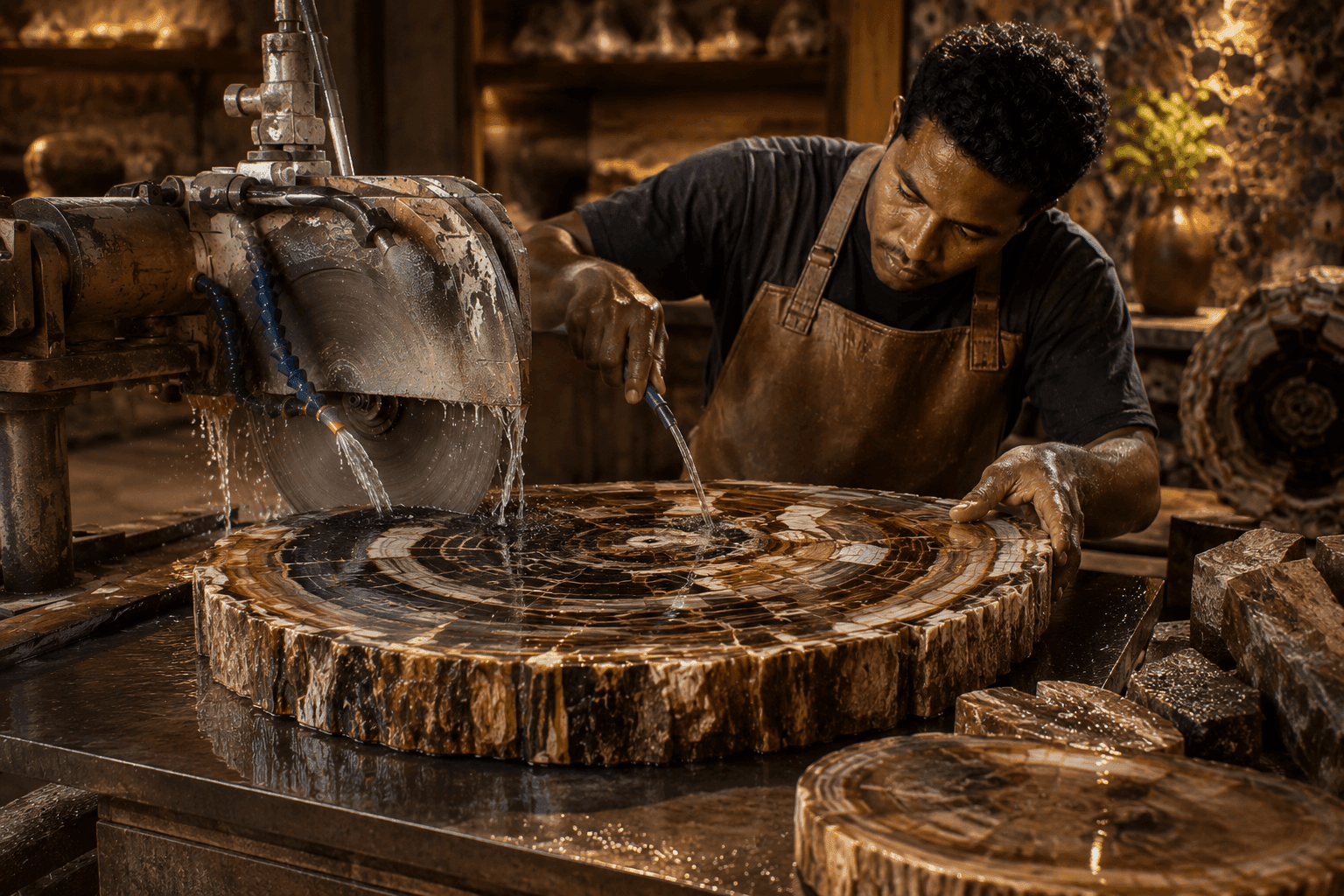
Small pieces are, in some ways, harder to make than large ones. A tabletop can absorb minor irregularities across its surface; a pendant or a coaster has nowhere to hide them. Cutting quartz at hardness 7 means working slowly, with the right tools, respecting the direction of the original grain before it was ever stone. Our artisans select the section of trunk for each small piece the way a jeweller selects a stone for a setting — for the vein, the contrast, the way light will sit on the polished face.
This is also where colour choice becomes personal. Someone drawn to warm ochres and reds — the mark of iron in the mineralisation — will gravitate toward Ambra or Fusca pieces. Someone who prefers cooler, quieter tones might choose Argentea or Umbra, where manganese has pulled the stone toward grey, black, or violet. The rare greens and blues of Viridis, coloured by chromium or cobalt, are harder to find and correspondingly more sought after as gifts meant to stand out.
Placing a Small Piece at Home
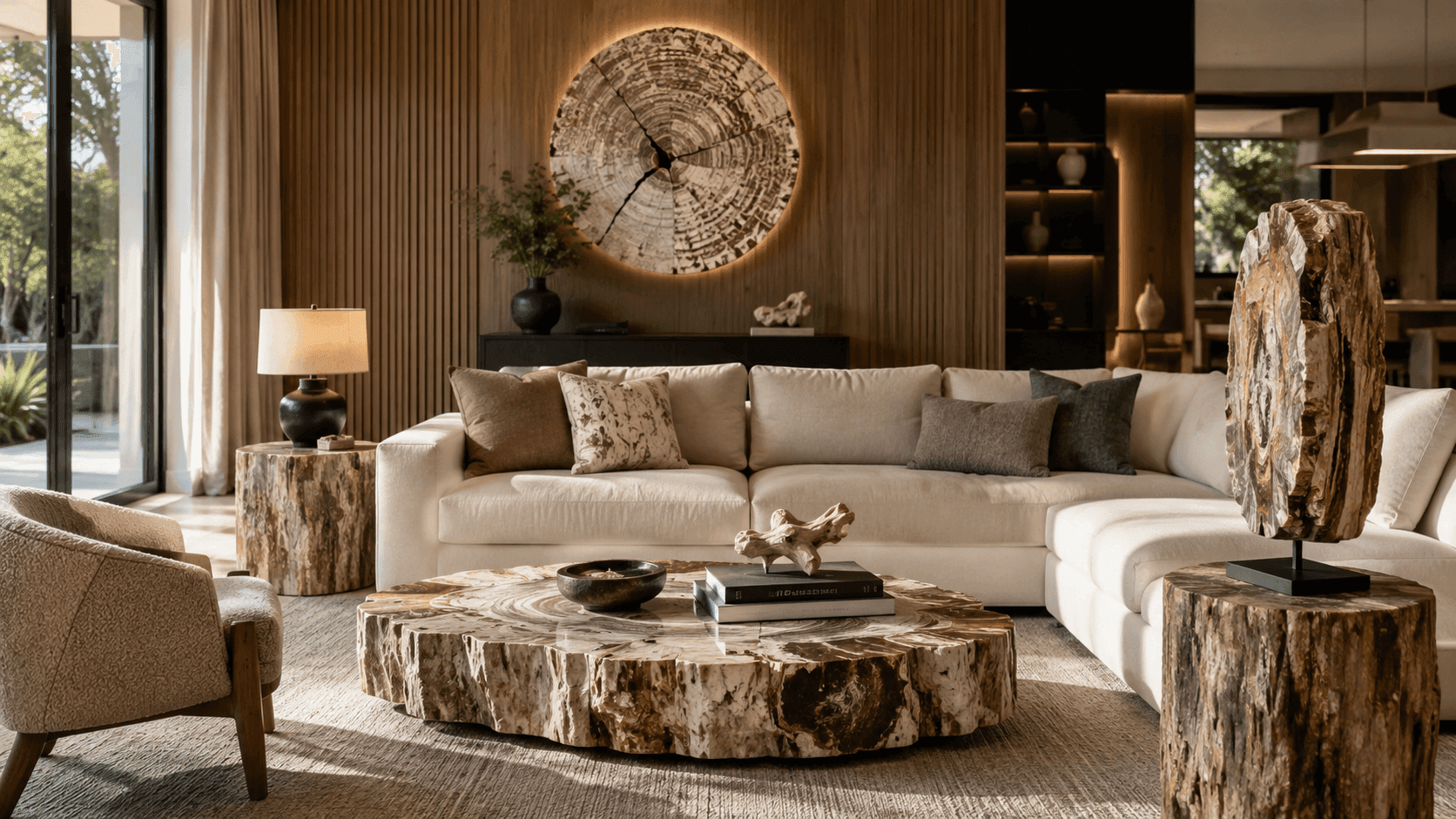
Unlike most decorative gifts, small petrified wood pieces don't need to be arranged around. A single coaster or paperweight left on a desk holds its own — the density of the stone gives it a presence that has little to do with size. It doesn't ask for a matching set or a themed shelf. It simply sits where it's placed, cold to the touch, indifferent to the room around it.
That quality makes it as suited to a considered, personal gift as to something chosen for a client or a colleague — understated enough not to need explanation, specific enough to reward one.
Browse individual pieces, ready to gift or made to order.
Visit the ShopFrequently Asked Questions
Is petrified wood fragile, given how old it is?
No. Once mineralisation is complete, the wood has become quartz — rated 7 on the Mohs hardness scale. It is dense, heavy, and considerably harder to damage than most decorative stone or wood objects.
Will a small piece fade or change colour over time?
No. The colours come from metallic minerals (iron, manganese, chromium, cobalt) locked into the quartz structure. They are not surface pigments, so they don't fade with light, heat, or age.
Can I request a specific colour, like green or deep black?
Yes, within availability. Since each colour comes from a specific named trunk (Ambra, Argentea, Fusca, Umbra, Viridis) rather than a standard catalogue, availability depends on what remains from that particular tree. Contact us or check current stock in the shop.
Do you offer custom-made gift pieces?
Yes, on request. We can discuss format, finish, and material selection for a specific occasion — get in touch and we'll advise on what's possible for a given quote.