
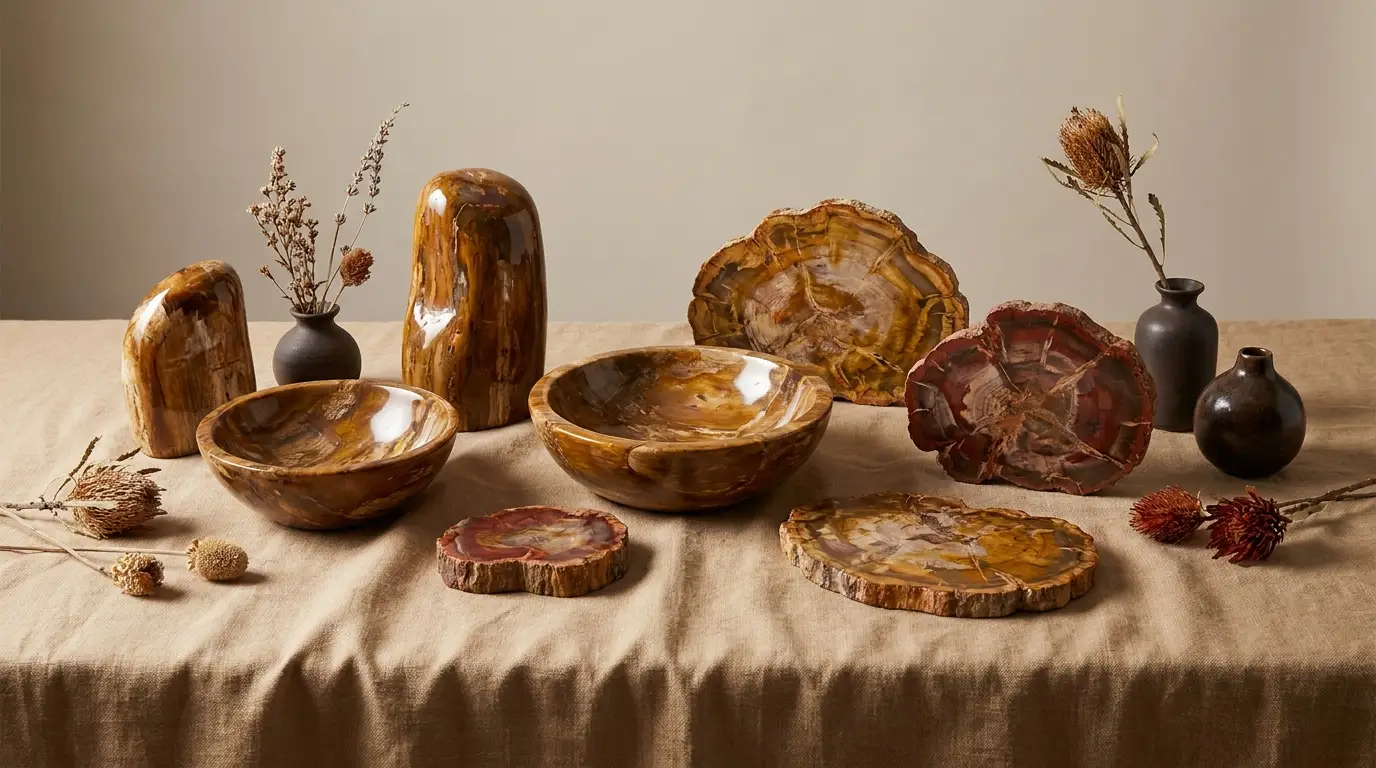
A Clock Cut From an Individual Tree
A petrified wood clock is not a category of object. It is a slice of a single tree, felled some 230 million years ago in what is now southwestern Madagascar, silica-replaced atom by atom until every cell of its structure turned to quartz. At Medusa, that tree has a name — Ambra, Argentea, Fusca, Umbra, or Viridis — and the slice you hang on your wall carries its specific mineral signature, never to be repeated once the trunk is fully worked.
Reading time on a wall clock is incidental. What matters is what sits behind the hands: growth rings laid down over centuries, arrested mid-motion by silica, now telling a second kind of time — geological, not domestic.
From Trunk to Timepiece
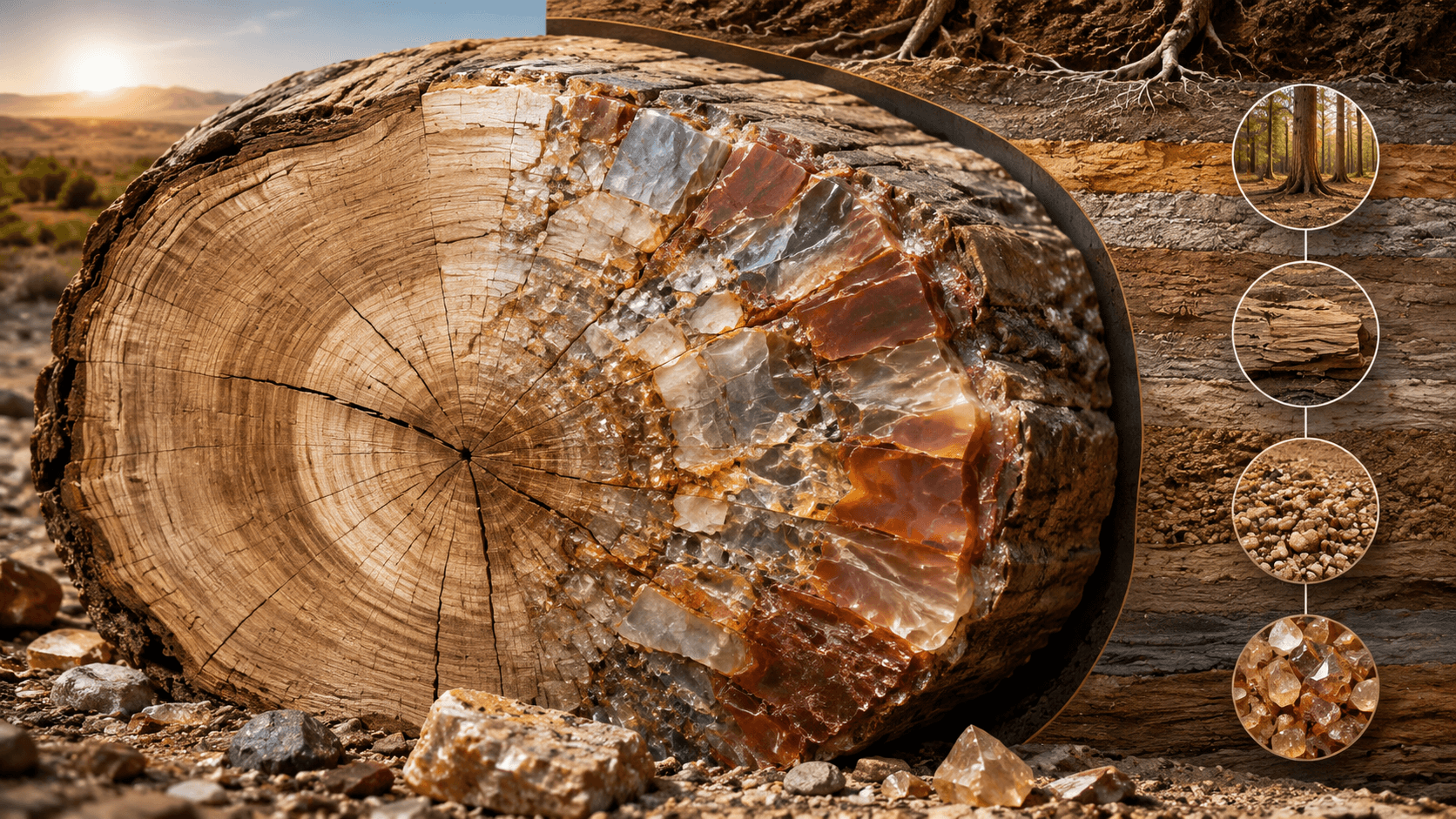
Each trunk is raised individually from the Malagasy soil, never mined in bulk. Once above ground, it is assessed for its internal pattern — the rings, the color zoning, the density of veining — before a single cut is made. A clock face is cut where the trunk speaks most clearly: where rings are tightest, where color shifts are sharpest, where the story is most legible.
- The trunk is selected and named before any cutting begins.
- A cross-section is chosen for clarity of rings and color contrast.
- The face is polished to reveal, not to disguise, the original structure.
- A quartz movement is fitted last, discreetly, so the wood remains the subject.
Because the tree determines the pattern, no two clock faces are interchangeable. Order one from Ambra and one from Viridis, and you own two entirely different objects — not two units of the same product.
Color Is Chemistry, Not Choice
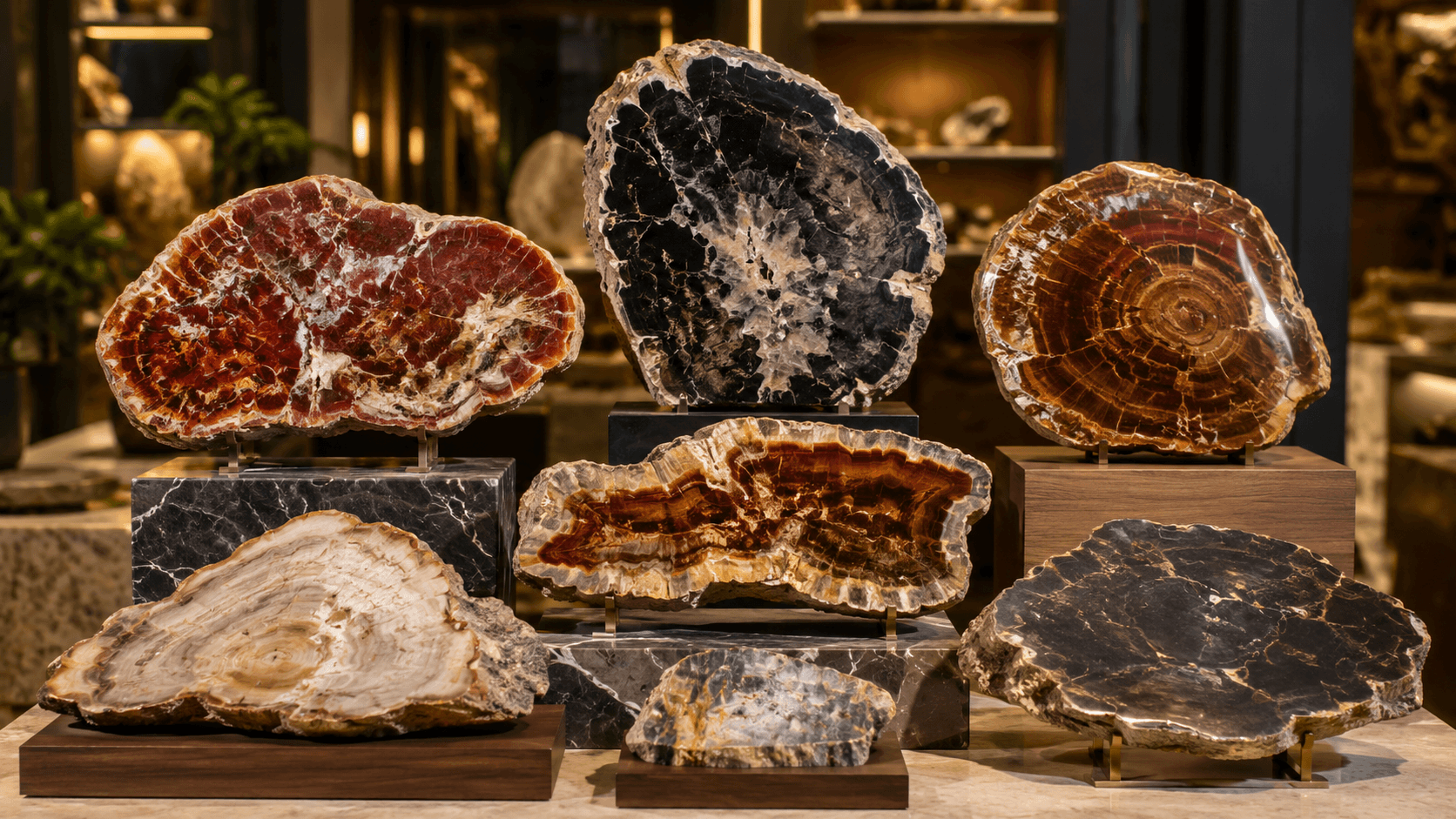
The palette of each trunk was set during fossilization, not during finishing. Iron oxidizes into reds and ochres. Manganese produces blacks and violets. Traces of chromium or cobalt shift the stone toward green or blue. Ambra's honeyed tones, Argentea's pale greys, Umbra's near-black depth — these are not dyes or treatments. They are the chemical fingerprint of the ground each tree stood in for 230 million years.
This is why Medusa never promises to "match" a clock to a sample. The trunk dictates the tone. Once it is cut through, that particular gradation of color is gone.
A clock face cut from petrified wood does not decorate a wall. It closes a chapter that began in the Triassic.
A Material That Resists Time Twice Over
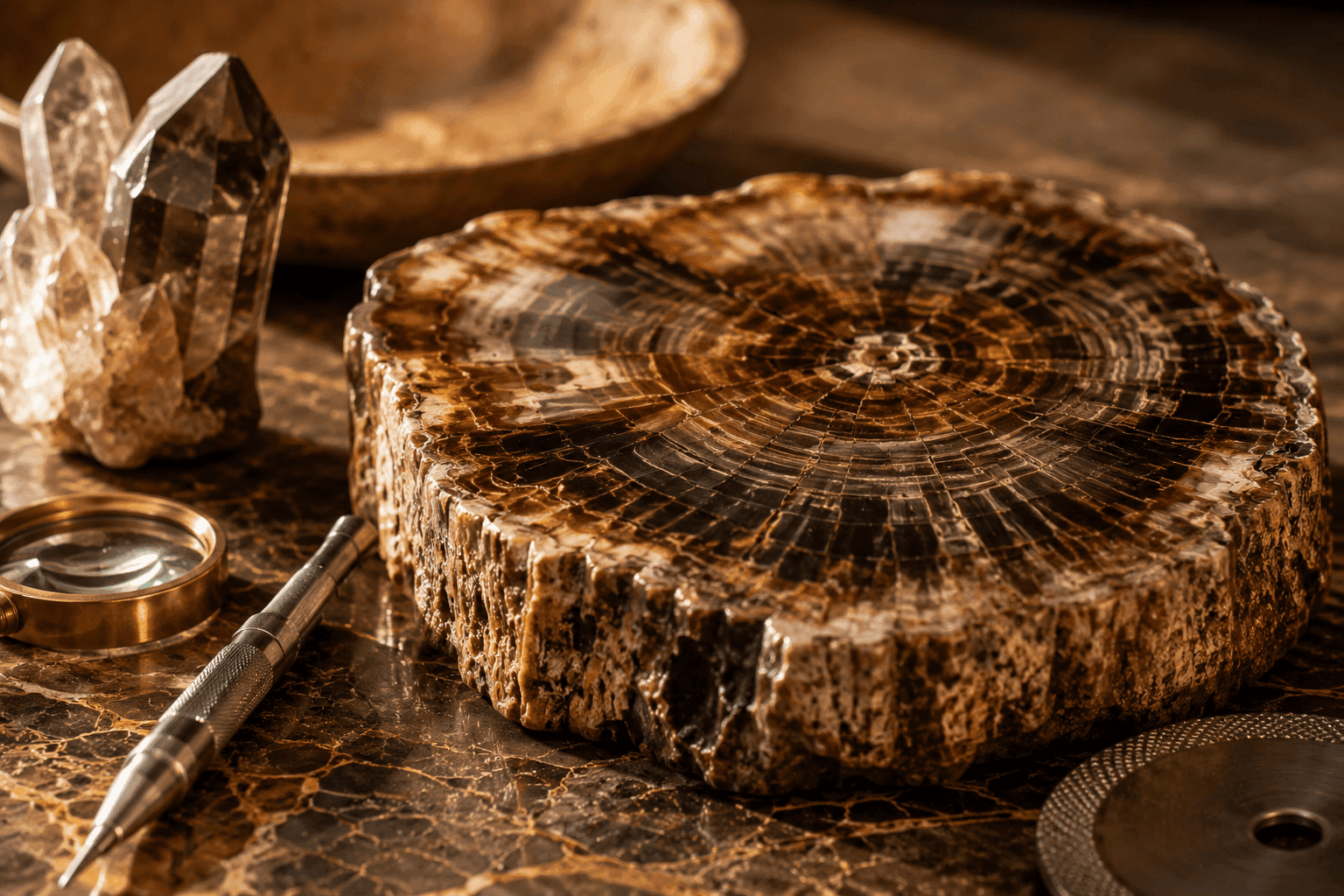
Petrified wood is quartz — 7 on the Mohs scale. That hardness is not a marketing flourish; it changes how the object behaves in a room. A petrified wood clock will not fade under direct sun, will not crack near a radiator, and will not soften with humidity. It is cold to the touch, dense in the hand, and largely indifferent to the conditions that degrade lacquered wood or painted resin.
- Insensitive to UV: colors do not bleach over years on a bright wall.
- Insensitive to heat and cold: safe near fireplaces, windows, or unheated rooms.
- Extremely hard surface: resists scratches from routine handling.
- Naturally heavy: the clock hangs with authority, not as a light decorative afterthought.
The mechanism inside is replaceable, like any clock's. The stone around it is not.
Set Into a Room
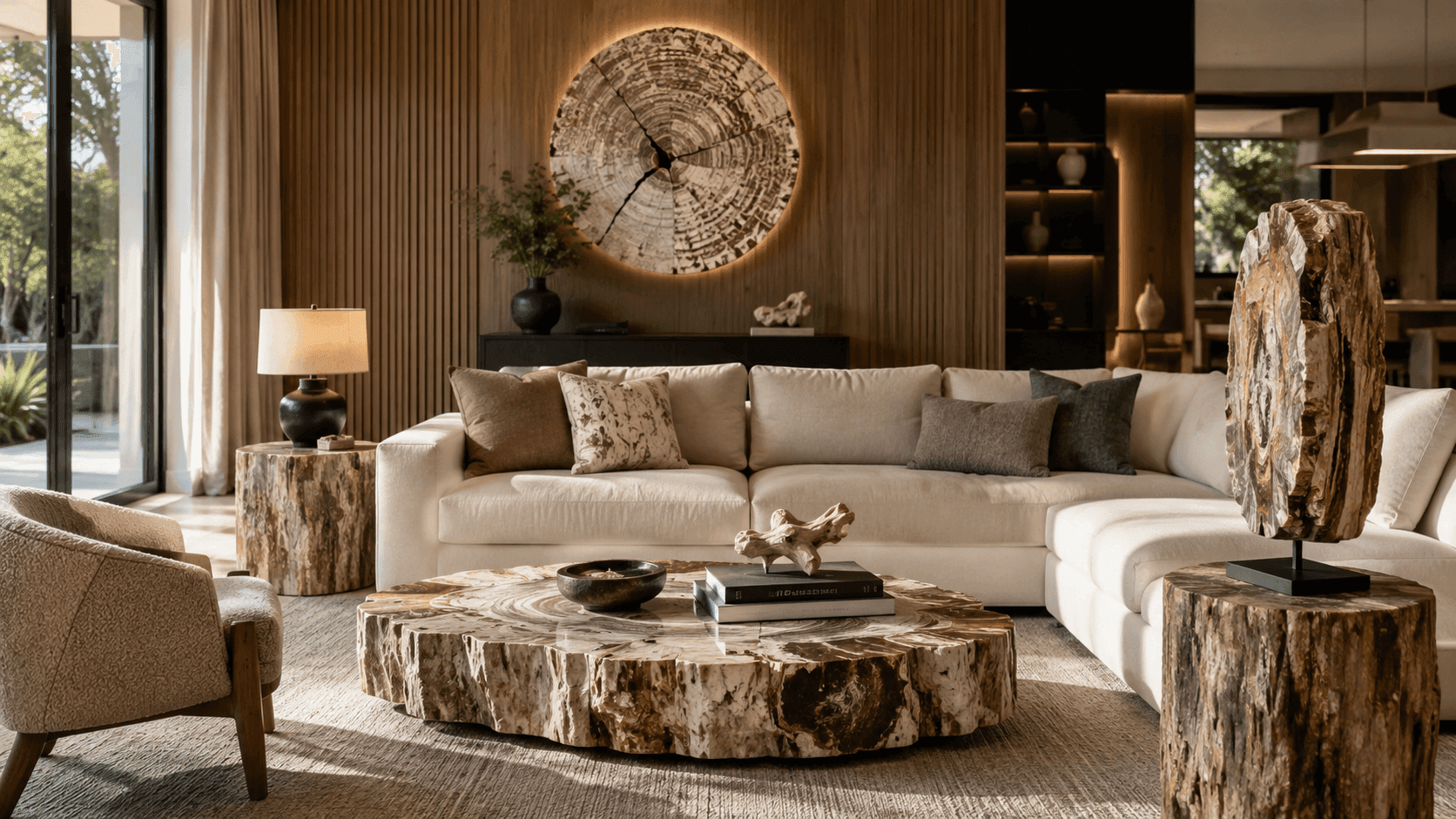
A petrified wood clock rarely sits among other wall decor as an equal — it tends to become the point the room organizes around. Its density in color and history contrasts naturally with the flatness of painted walls, and it pairs well with the same understated materials used for our tables and vasques: raw stone, brushed metal, unvarnished wood. It asks for space, not for company.
Because the face itself is a natural specimen, framing is kept minimal — often no frame at all, just the polished stone edge and the mechanism recessed into the back.
Every clock face comes from a named tree, and each one is sold once.
Discover the CollectionQuestions Fréquentes
Is every petrified wood clock genuinely one of a kind?
Yes. Each clock face is cut from a specific trunk with its own ring pattern and mineral coloring. Once that cross-section is used, the exact combination cannot be reproduced.
Does the clock face need any special care?
None beyond routine dusting. As quartz, it is unaffected by humidity, heat, or sunlight, and does not require oiling, sealing, or polishing to maintain its appearance.
Why do colors differ so much between clocks?
Color comes from trace metals present during the tree's fossilization 230 million years ago — iron for reds and ochres, manganese for blacks and violets, chromium or cobalt for greens and blues. Each named tree carries its own combination.
Can I request a clock cut from a specific named tree, like Umbra or Argentea?
Availability depends on the trunk currently being worked and the pieces it can yield. Contact us for a quote and we will confirm what is possible for that particular tree.