
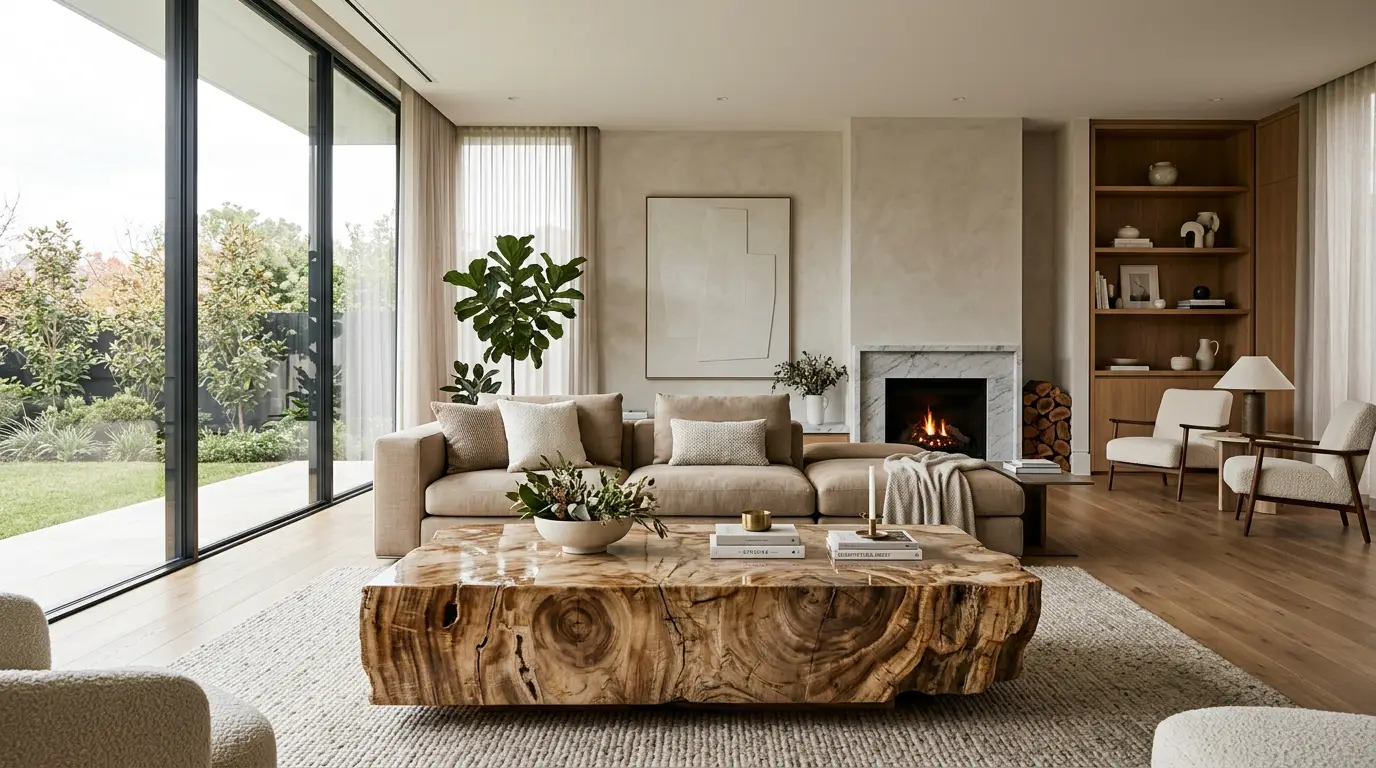
The Live Edge, Where the Tree Still Speaks
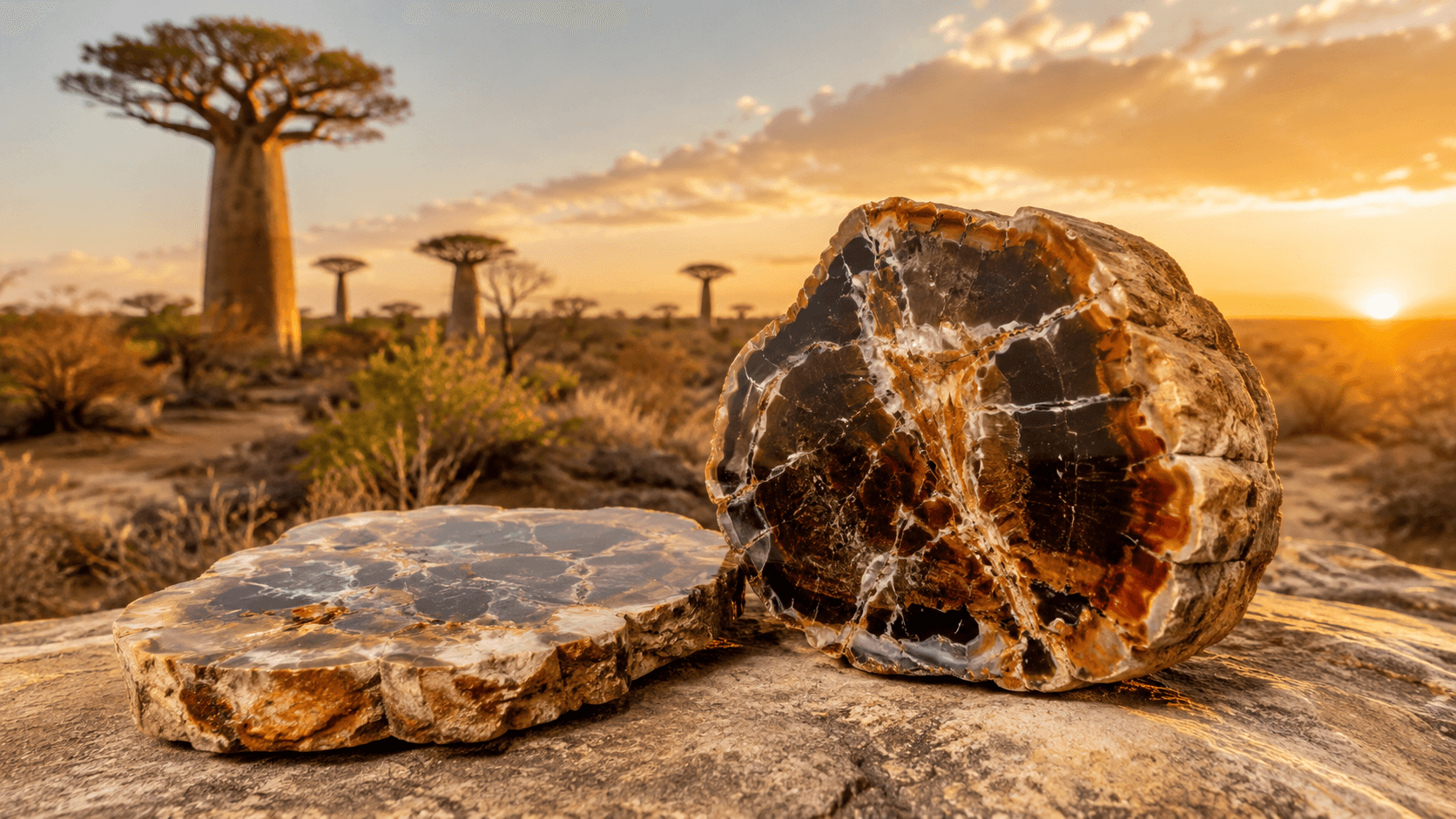
A live-edge table keeps the natural silhouette of the trunk instead of squaring it off. No two edges are alike, because no two trees grew alike. In petrified wood, this variant carries a weight that ordinary timber cannot: the edge you see was drawn by a tree that stood roughly 230 million years ago, before it was buried, mineralized, and turned to quartz. What you touch is stone, but what you see is still, unmistakably, bark and growth.
We work exclusively with trunks extracted from the sud-ouest of Madagascar, where geological conditions preserved this transformation in exceptional detail. A live-edge tabletop is our way of refusing to erase that history under a straight saw line.
One Trunk, One Name, One Color
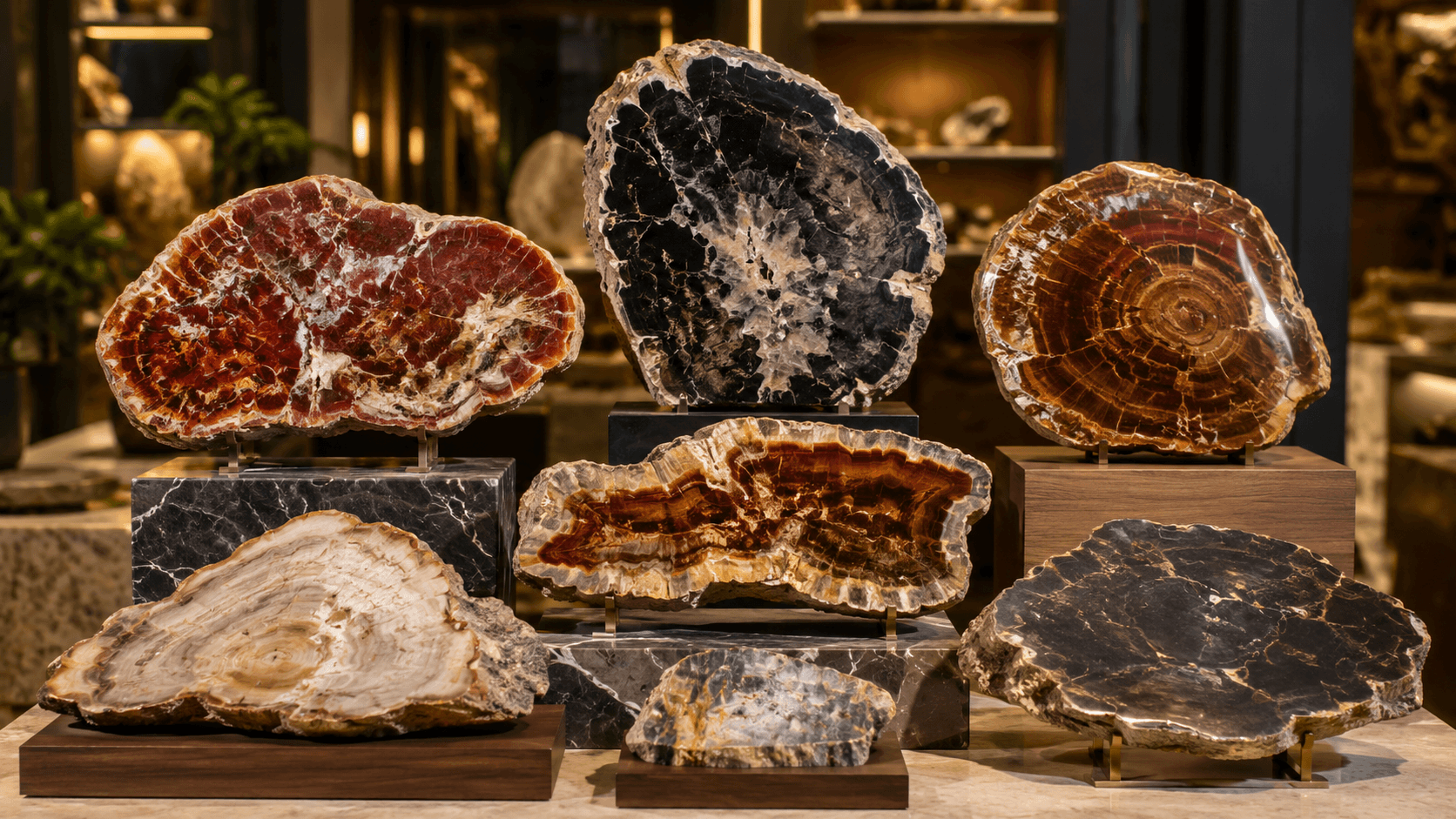
At Medusa, we do not sell a product category called "live-edge table." We sell a trunk — a specific tree, given a name the day it comes out of the ground. Ambra for amber tones, Argentea for silvered grays, Fusca for deep browns, Umbra for near-black density, Viridis for the rare greens. Each name refers to one individual trunk and to the mineral story written inside it.
The color is not a finish. It comes from trace metals absorbed during fossilization:
- Iron produces reds and ochres.
- Manganese produces blacks and violets.
- Chromium and cobalt, more rarely, produce greens and blues.
Once a trunk is cut, that particular balance of color is gone. There is no second Ambra, no way to reorder the same hue once the log has been fully milled. A live-edge table cut from a named trunk is, in the strictest sense, singular.
What Live Edge Means for a Petrified Table
Choosing live edge is choosing to keep the trunk's original perimeter — its curves, its narrowing, sometimes a knot or an old scar frozen in stone. This has real consequences for a petrified wood piece:
- The outline follows the tree's actual growth, not a template.
- Cross-sections often reveal growth rings and mineral banding that a straight-cut edge would trim away.
- The slab is usually thicker at the center of the trunk, giving the table a distinct presence rather than a uniform slab look.
Because the material is fossilized, the edge does not chip, splinter, or dry out the way live-edge hardwood can over years. The shape you choose today is the shape that stays.
Stone by Nature
A live edge in wood ages. A live edge in petrified wood does not — it simply remains.
This is quartz, not timber. The trunks we handle date to the Triassic, roughly 230 million years old, and register 7 on the Mohs hardness scale — harder than steel, close to hardened glass. That means:
- No sensitivity to water, heat, or direct sunlight.
- No warping, cracking, or fading over time.
- A cold, dense surface that carries genuine weight in the hand and in the room.
A live-edge line cut into this material stays exactly as sharp, or as soft, as the day it was finished.
From Trunk to Tabletop
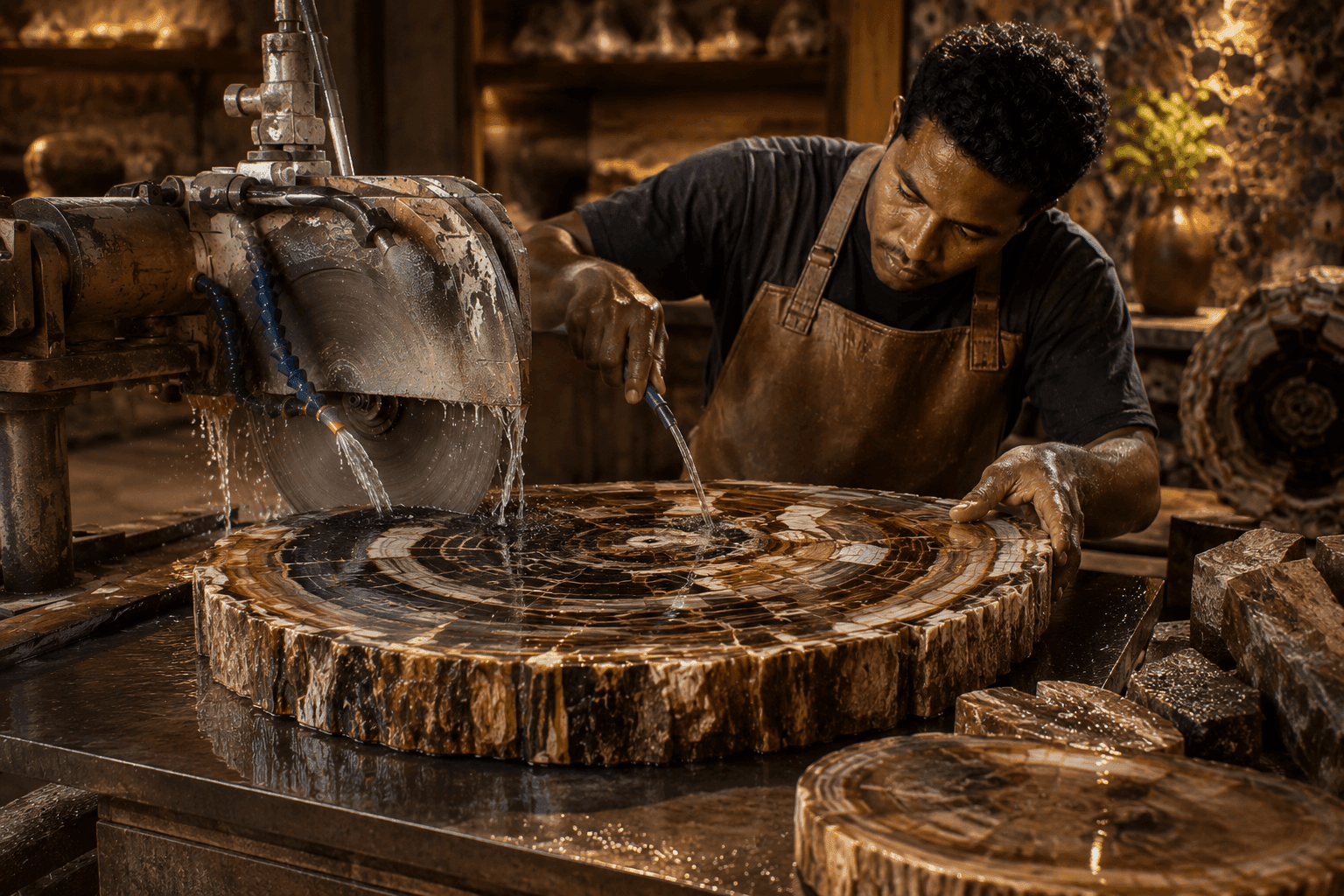
Turning a fossilized trunk into a live-edge table is slow, deliberate work. Each log is studied before a single cut is made: where the color is strongest, where the growth rings are most legible, where the natural edge deserves to be preserved rather than trimmed for convenience. Polishing is done by hand, in stages, to bring out the mineral banding without flattening the trunk's original relief at the border.
This is also why sizing is never fixed in advance. A live-edge petrified wood table is sized by what the trunk offers, not by a catalogue dimension. Each piece is priced and specified individually — nous consulter, or request a quote based on the trunk under consideration.
Living With a Live-Edge Table
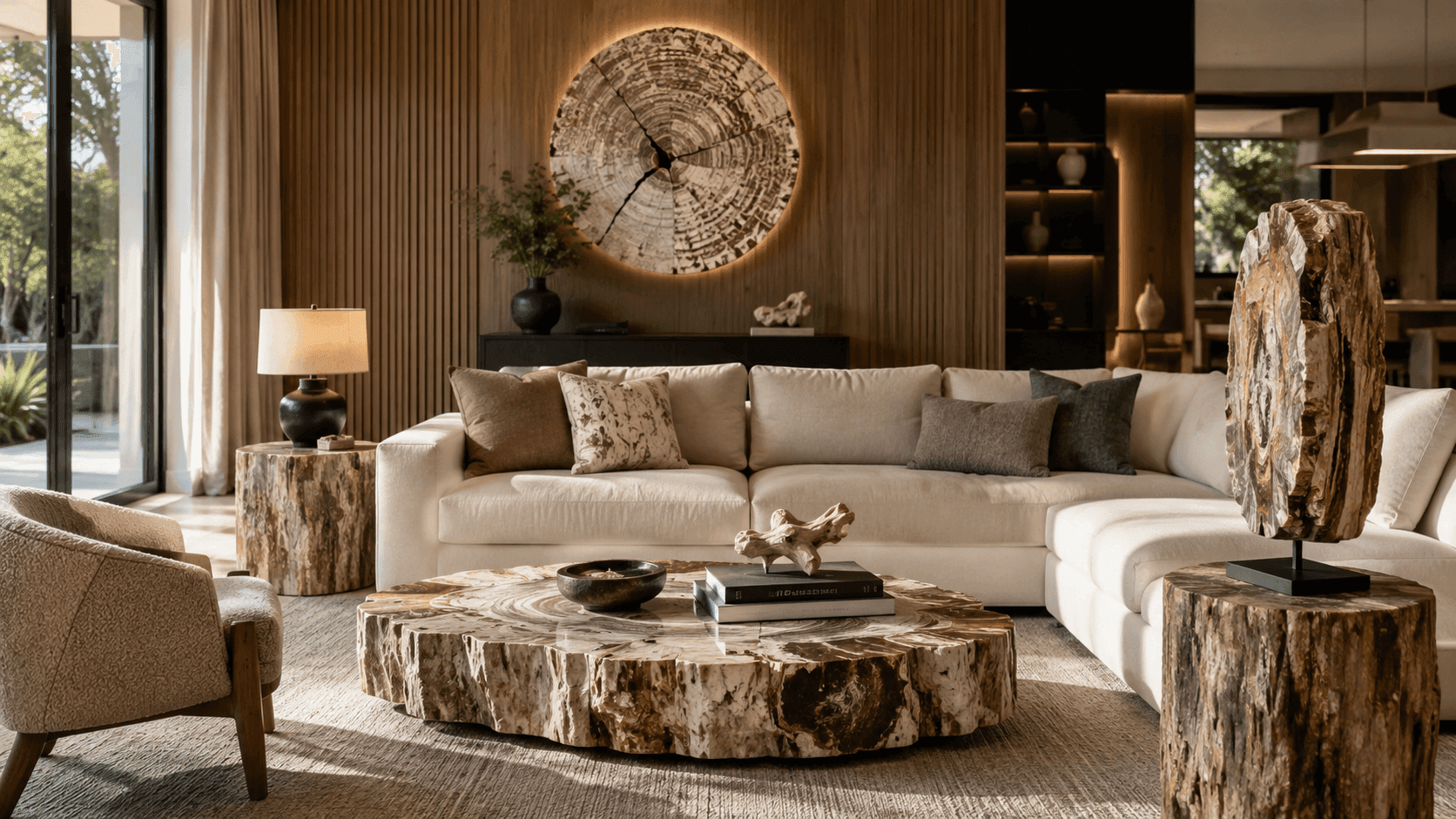
In a room, a live-edge petrified table behaves differently from a conventional one. Its irregular perimeter draws the eye along the tree's own logic rather than a straight line, and its density gives it a stillness that lighter materials don't have. It suits spaces where one strong object is meant to anchor the room — an entryway, a reading corner, a dining space built around a single striking piece rather than a matched set.
Because the surface is inert quartz, it takes coffee cups, condensation, and direct light without concern. The only real maintenance is occasional dusting; there is no oiling, no resealing, no seasonal care required.
Each live-edge trunk is available in limited quantity — see what is currently ready, or request a quote for a specific piece.
View the ShopFrequently Asked Questions
Is a live-edge petrified wood table heavier than a standard one?
Not necessarily heavier for its footprint, but always dense — this is quartz, so weight is substantial relative to size regardless of edge style.
Will the natural edge chip or crack over time?
No. The material is fully mineralized, not organic wood, so it does not dry out, splinter, or degrade the way a live-edge hardwood edge can.
Can I request a specific trunk by name?
Yes. Each named trunk (Ambra, Argentea, Fusca, Umbra, Viridis) is available while stock lasts; once a trunk is fully cut, that exact color combination cannot be reproduced.
Does the live edge affect the table's resistance to heat or sunlight?
No. Whatever the edge shape, the surface remains unaffected by heat, direct sunlight, or humidity, since it is quartz rather than organic timber.