
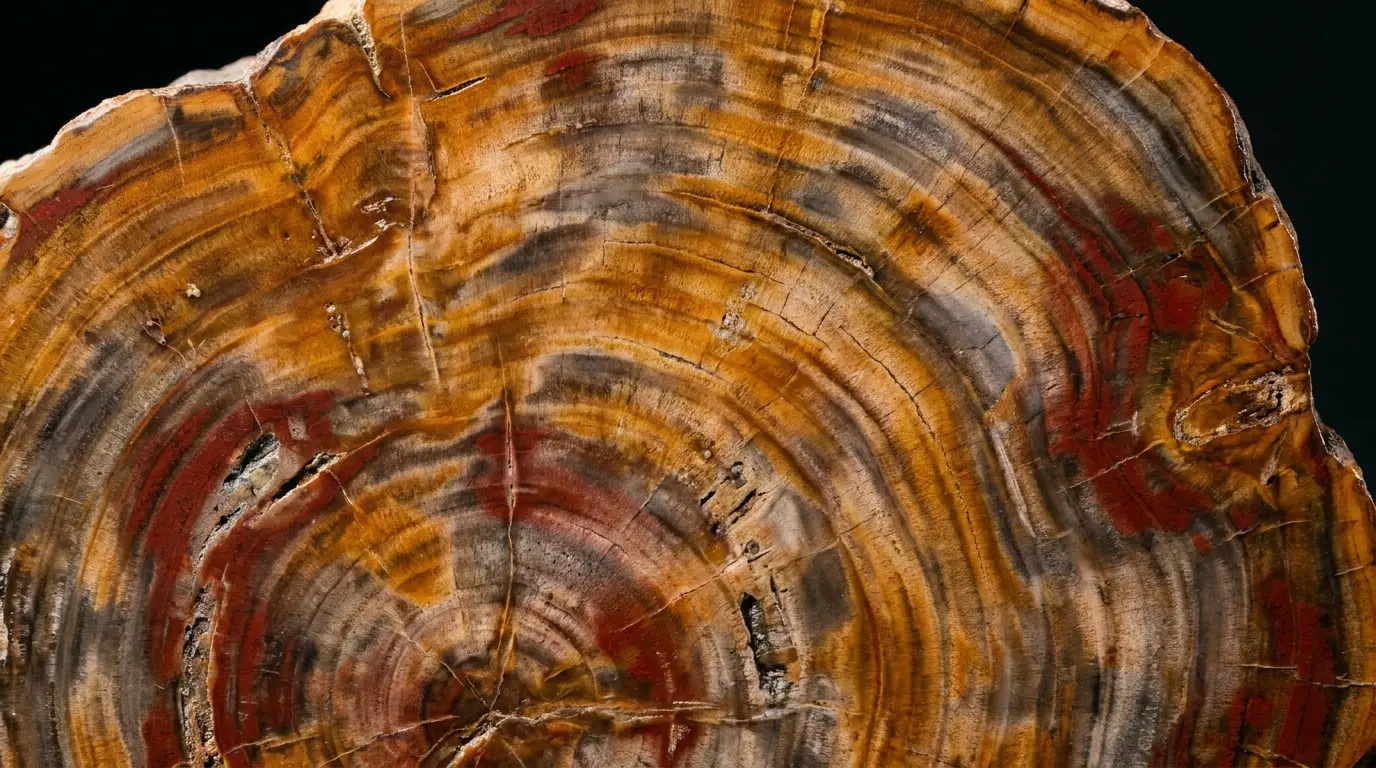
Is Petrified Wood Rare?
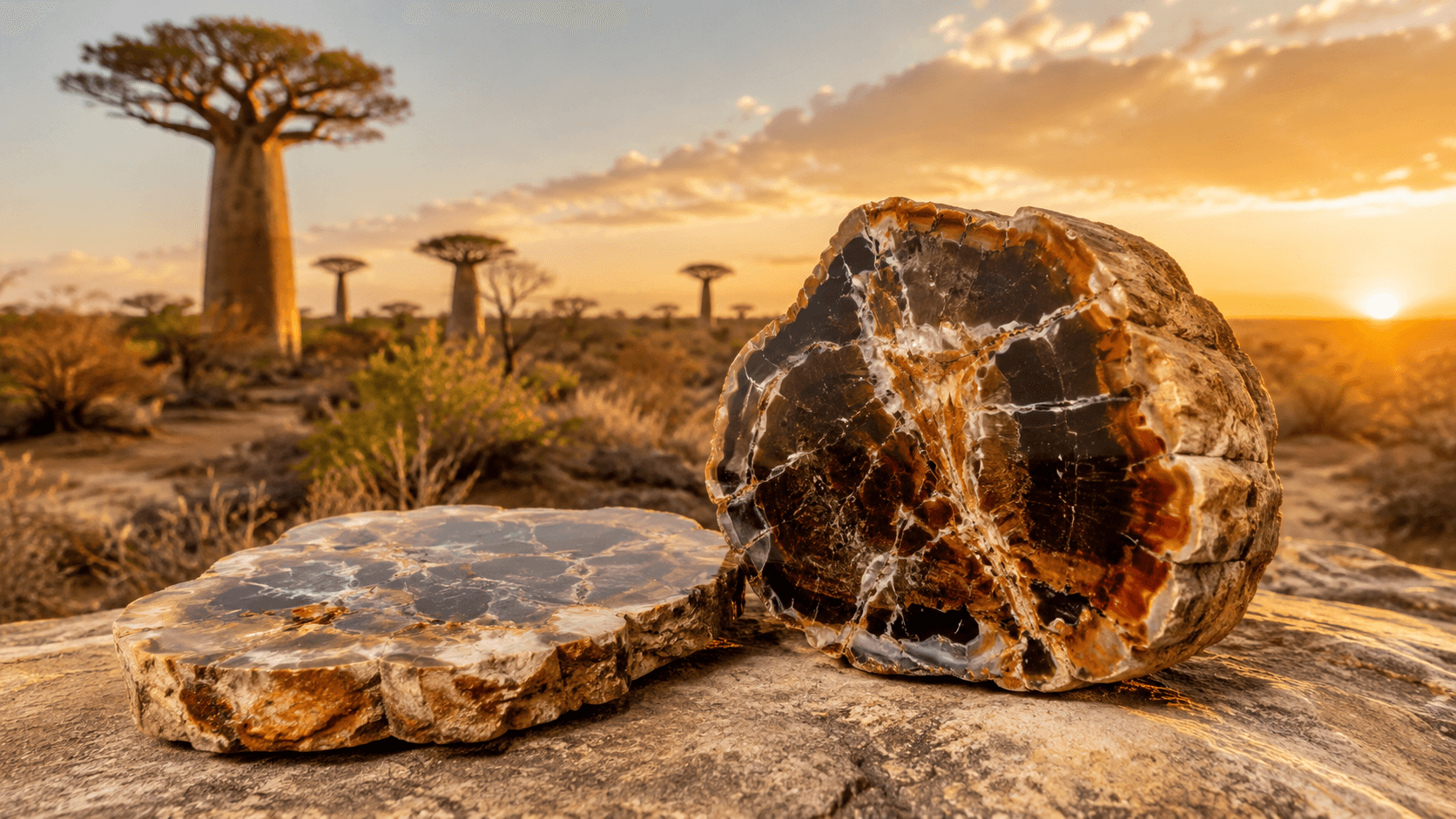
The question deserves a precise answer, not a marketing one. Petrified wood, as a material, is not vanishingly rare on a geological scale — deposits exist on several continents. What is genuinely rare is a specific trunk, with its specific colour, its specific grain, pulled whole from the ground in southwestern Madagascar. That distinction is the whole story. Rarity in petrified wood is not about the mineral. It's about the individual tree.
A Process That Cannot Be Repeated
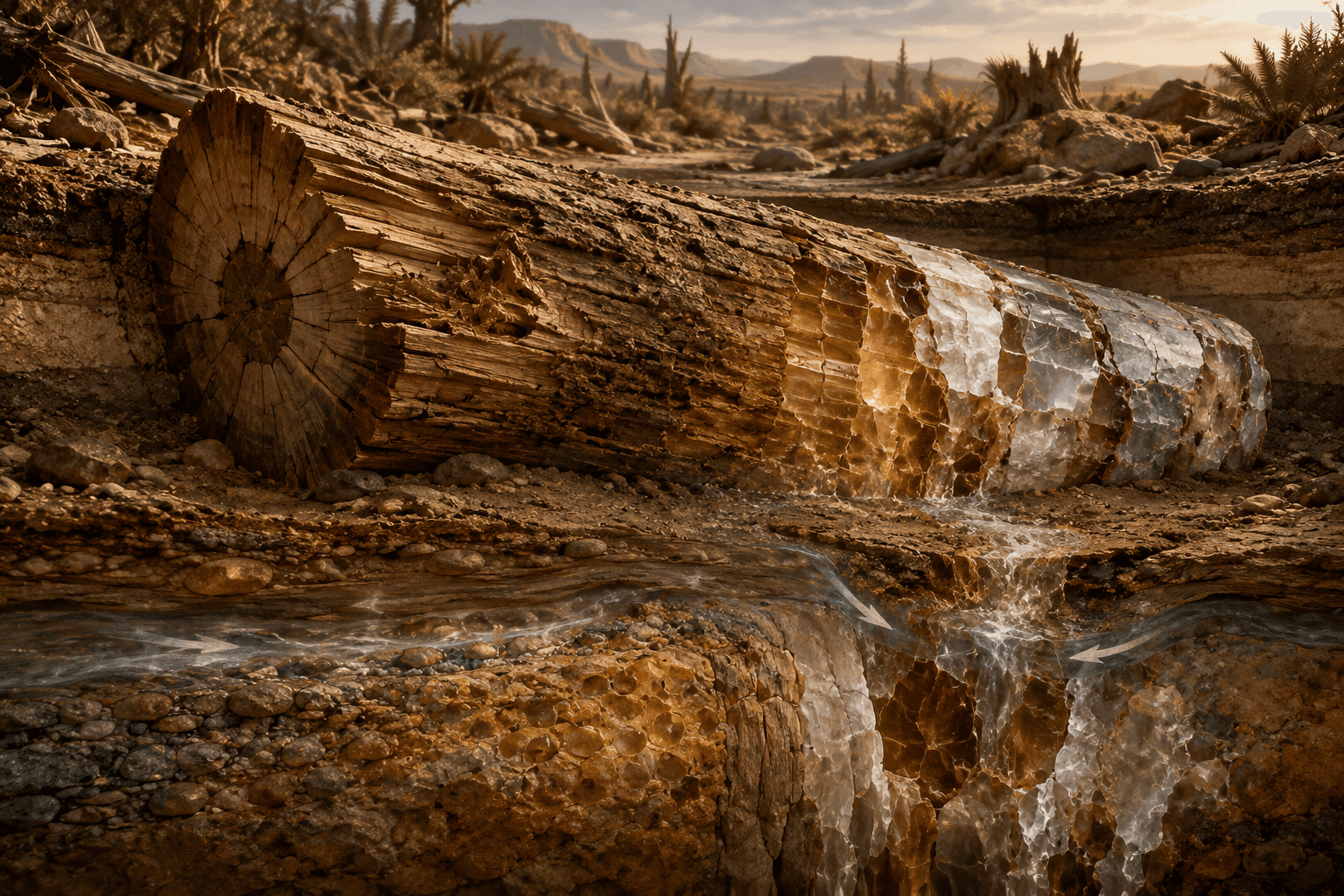
Every piece we work with began as an ordinary tree, roughly 230 million years ago, in the Triassic. It fell, and instead of decaying, it was buried under sediment that starved it of oxygen. Groundwater rich in dissolved silica infiltrated its cellular structure over an immense span of time, replacing organic tissue with quartz, cell by cell. The result preserves the wood's original architecture — its rings, its fractures, its texture — while transforming it into stone.
This is why petrified wood sits at 7 on the Mohs hardness scale, the same as quartz. It is heavy, cold to the touch, and entirely indifferent to water, heat, UV exposure, or frost. But none of that process can happen twice in the same way. The mineral content of the groundwater at that specific spot, the pressure, the duration of burial — all of it is unrepeatable. Each trunk fossilised under a distinct set of conditions, and that is precisely what produced its distinct colour.
Why Colour Is the Real Rarity
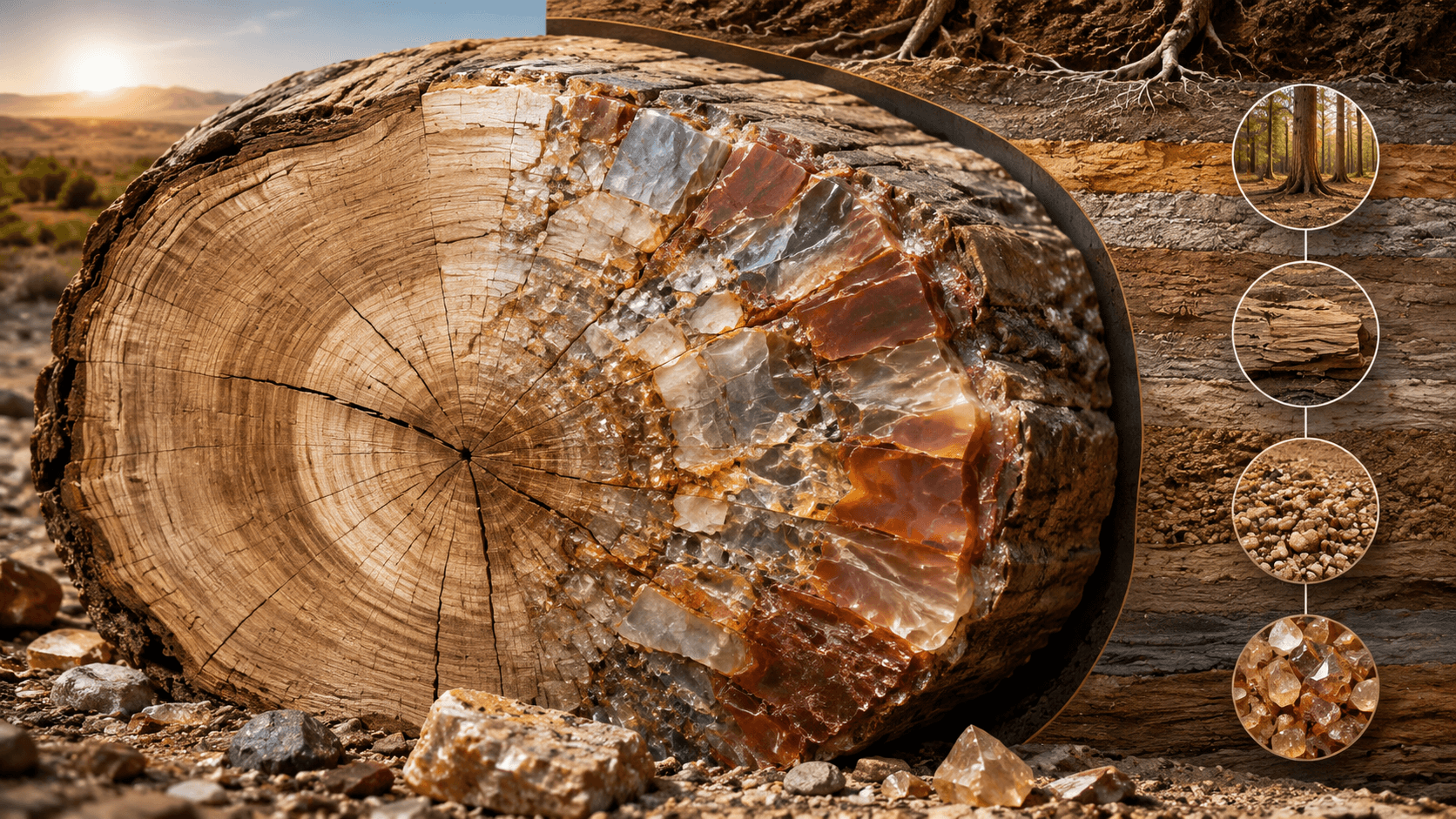
Colour in petrified wood comes from trace metals absorbed during mineralisation, not from the wood itself. Iron produces reds and ochres. Manganese produces blacks and violets. Chromium and cobalt, more rarely, produce greens and blues. The exact concentration and distribution of these metals varied from tree to tree, which is why no two trunks display quite the same palette.
At Medusa, we don't treat this as an abstract fact — we name it. Each trunk we bring up from the southwest of Madagascar receives its own name, tied to its dominant tone:
- Ambra — amber tones, warm and luminous
- Argentea — silvered greys, cooler and mineral
- Fusca — deep browns, dense and grounded
- Umbra — near-black, shadowed and severe
- Viridis — green undertones, the rarest register
A trunk named Ambra will never produce a second Ambra. When it is cut, its particular balance of iron oxides is gone from the world in that exact form. What remains are the slabs and pieces cut from it — the last expression of a colour that existed once.
A trunk is not a batch. It is a singular event in stone, extracted once and never repeated.
What Extraction From Madagascar Actually Means
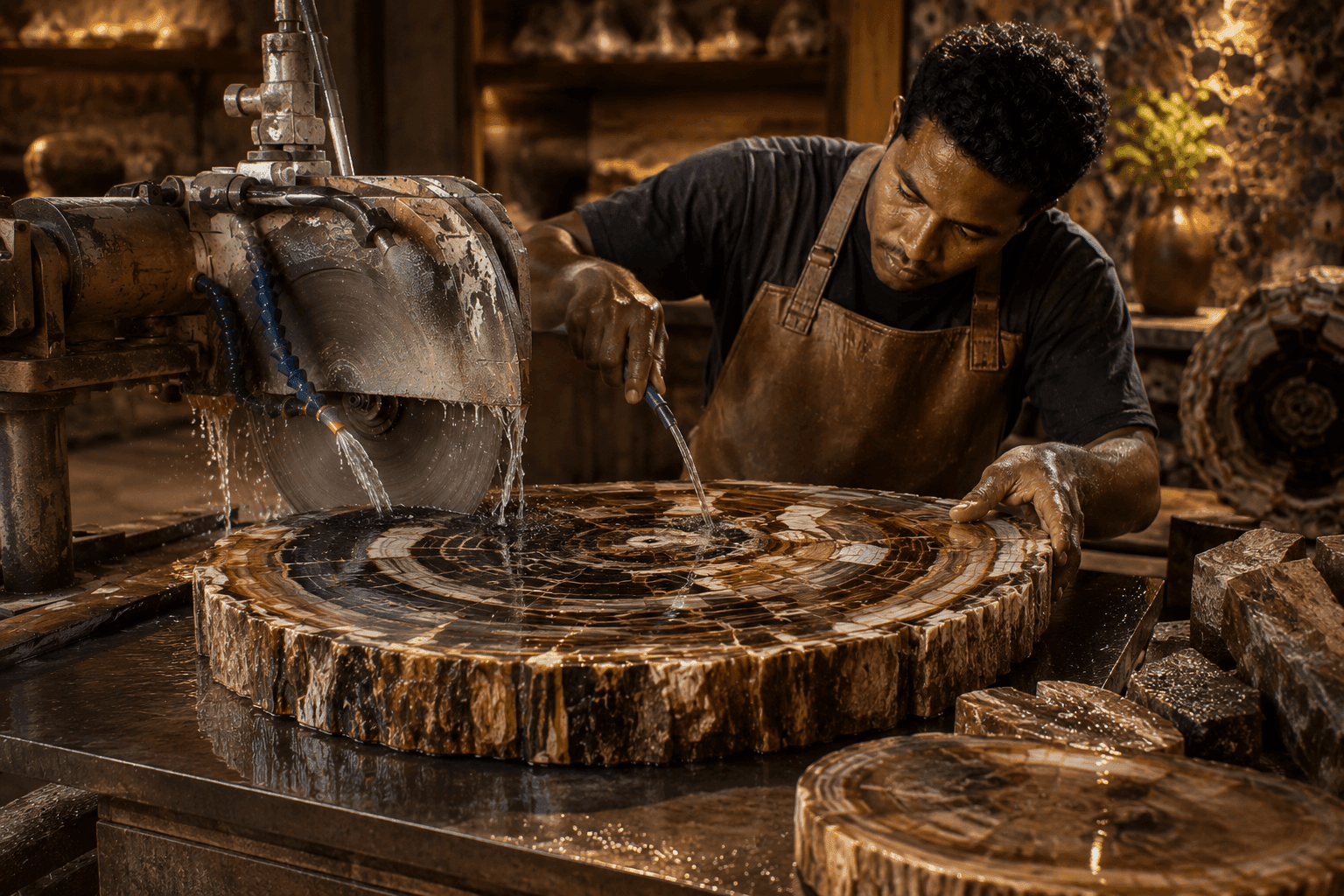
Rarity is not just geological — it's logistical. Trunks are located and raised one at a time from sites in the southwest of Madagascar, a region where deposits of this age and mineral richness are concentrated. Each recovery is its own operation: assessing the trunk's condition, its size, the way it sits in the ground, before any cutting decision is made.
Once raised, a trunk is studied before it is touched. Its density varies along its length. Its fracture lines dictate where a slab can be cut without loss. An artisan reads the piece the way a jeweller reads a rough stone — deciding what the trunk allows, not what a catalogue demands. This is why two tables from two different trunks, even in the same size, are never identical. The material refuses standardisation. It was never designed to be uniform; it simply happened to fossilise the way it did, in that place, at that time.
Rarity You Can Actually Feel
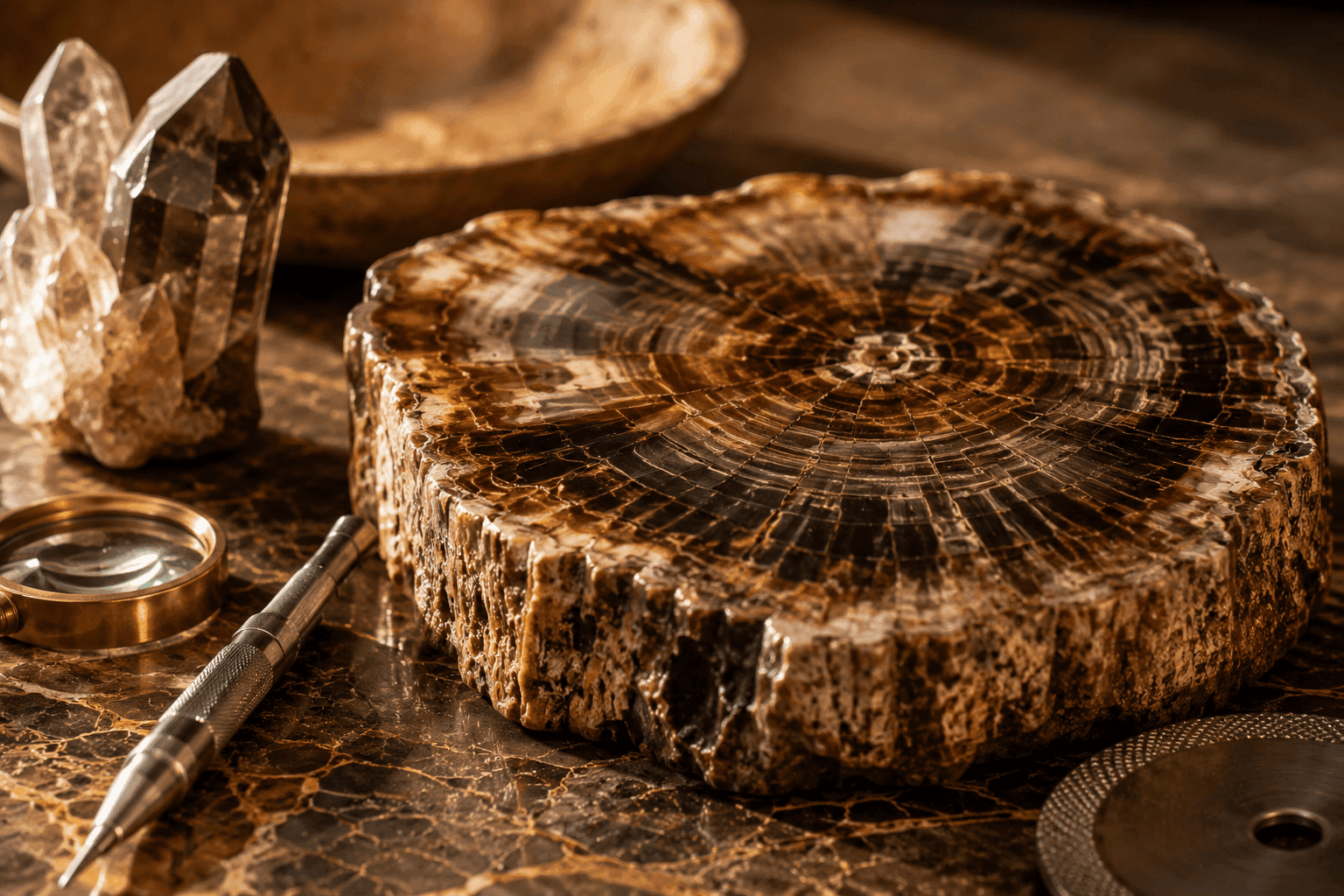
Rarity in decorative material is often claimed rather than demonstrated. With petrified wood, it's physical. Pick up a piece and the weight tells you immediately this is not wood — it's stone that used to be wood. Run a hand across a polished surface and the coldness confirms it. The hardness means a table surface or a washbasin carved from it resists scratching, staining, and heat in a way timber never could.
This tactile honesty is part of why collectors and interior designers treat petrified wood pieces as singular objects rather than furniture in the ordinary sense. A vasin or a low table isn't chosen from a range — it's chosen because that particular trunk, with that particular vein pattern, spoke to the space it will occupy.
Living With a Named Trunk
Placing a piece from a named trunk in a room changes how the room reads. It's not decoration in the passive sense — it's a fragment of a documented, individual tree, with a known origin and a known colour family. Knowing the trunk's name — Fusca, Viridis, Umbra — gives the object a biography rather than a SKU. That's a different relationship than buying a "petrified wood side table" off an undifferentiated shelf.
- Each piece is finite: once a trunk's slabs are sold, that exact colour and grain do not return.
- Each piece is documented: origin, trunk family, and general age are known, not assumed.
- Each piece is functional stone: usable as a table, a washbasin, or a standalone sculptural object, all while resisting water, heat, and scratching.
Discover the trunks currently available and find the one that matches your space.
Browse the ShopFrequently Asked Questions
Is petrified wood rare as a material?
Not on a global geological scale — deposits exist on several continents. What is genuinely rare is any single trunk's specific colour and grain, since each one fossilised under unrepeatable conditions.
Why does Medusa give names to its trunks?
Because each trunk is an individual tree with its own mineral history and colour, not a product category. Naming it — Ambra, Argentea, Fusca, Umbra, Viridis — reflects that a cut trunk's exact tone can never be reproduced.
How old is Madagascar's petrified wood?
Around 230 million years, dating to the Triassic period, based on the geological context of the deposits in southwestern Madagascar.
Why is petrified wood so hard and durable?
Because it is fossilised quartz, not organic wood. It sits at 7 on the Mohs hardness scale, making it heavy, cold to the touch, and unaffected by water, heat, UV light, or frost.