
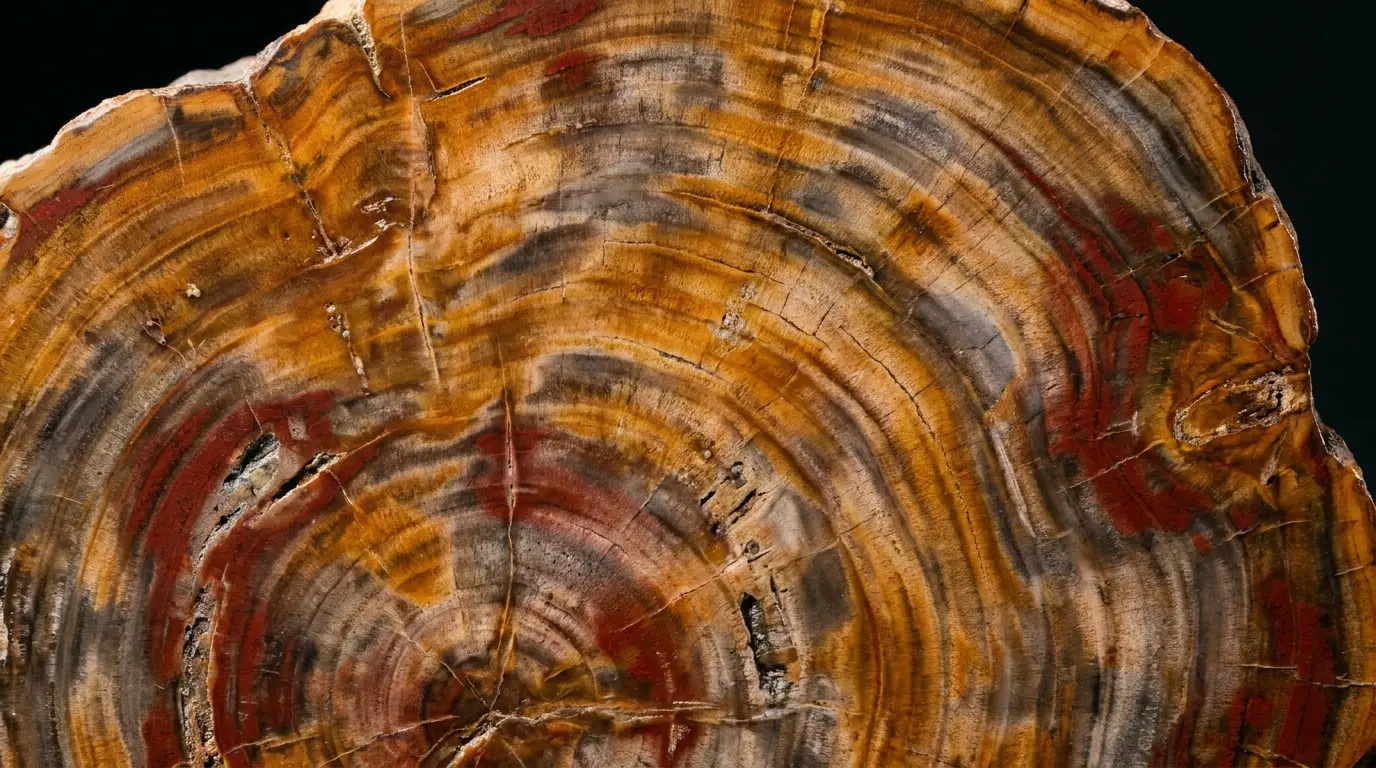
Umbra, the Dark Trunks of the Southwest
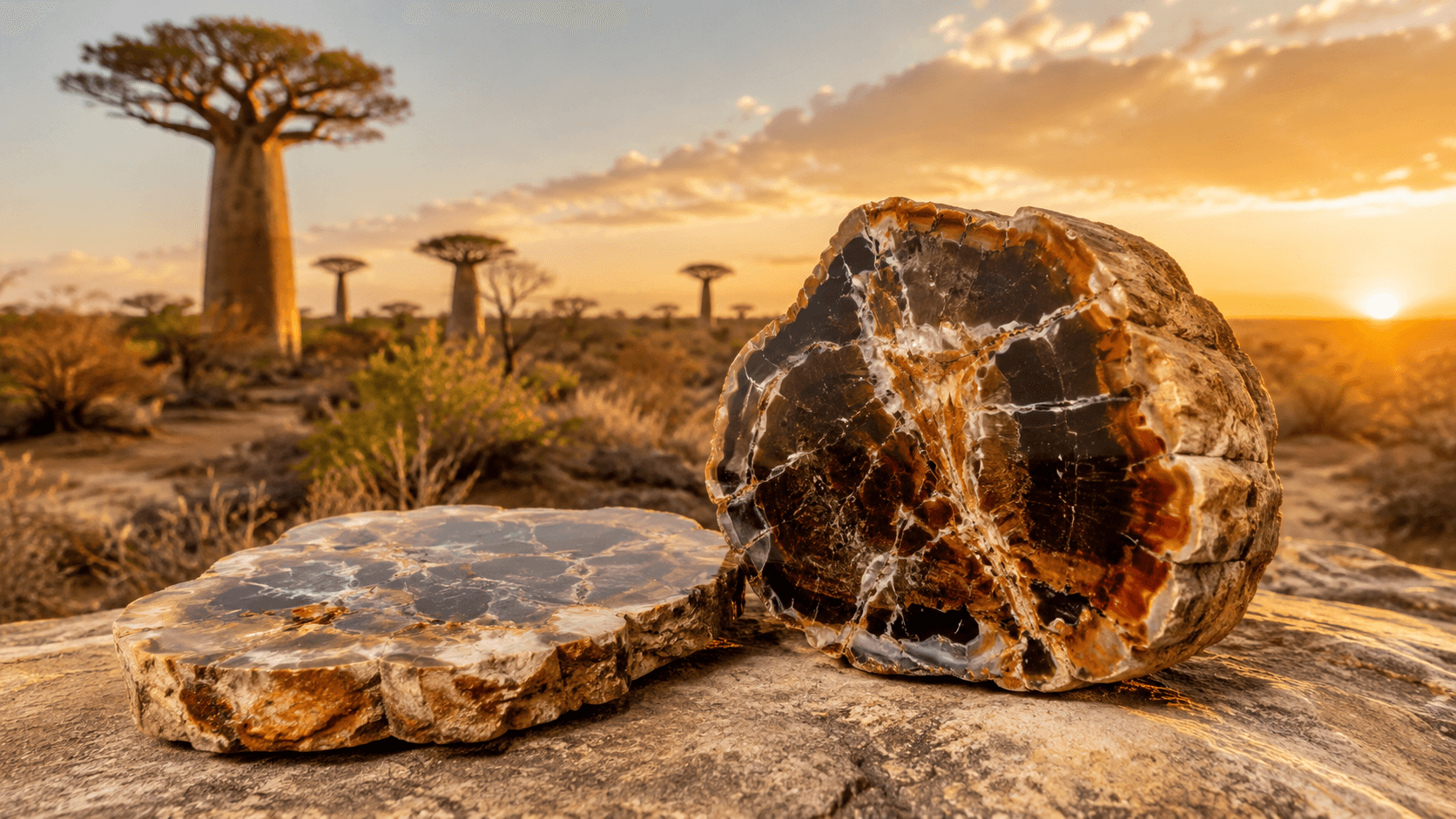
Not every fallen tree turns to stone the same way. In the sedimentary basins of southwestern Madagascar, some trunks spent their 230 million years steeped in water rich with manganese rather than iron. The result is a mineral memory unlike any other: black petrified wood, deep and almost lightless in places, streaked with violet where the mineral concentration shifts.
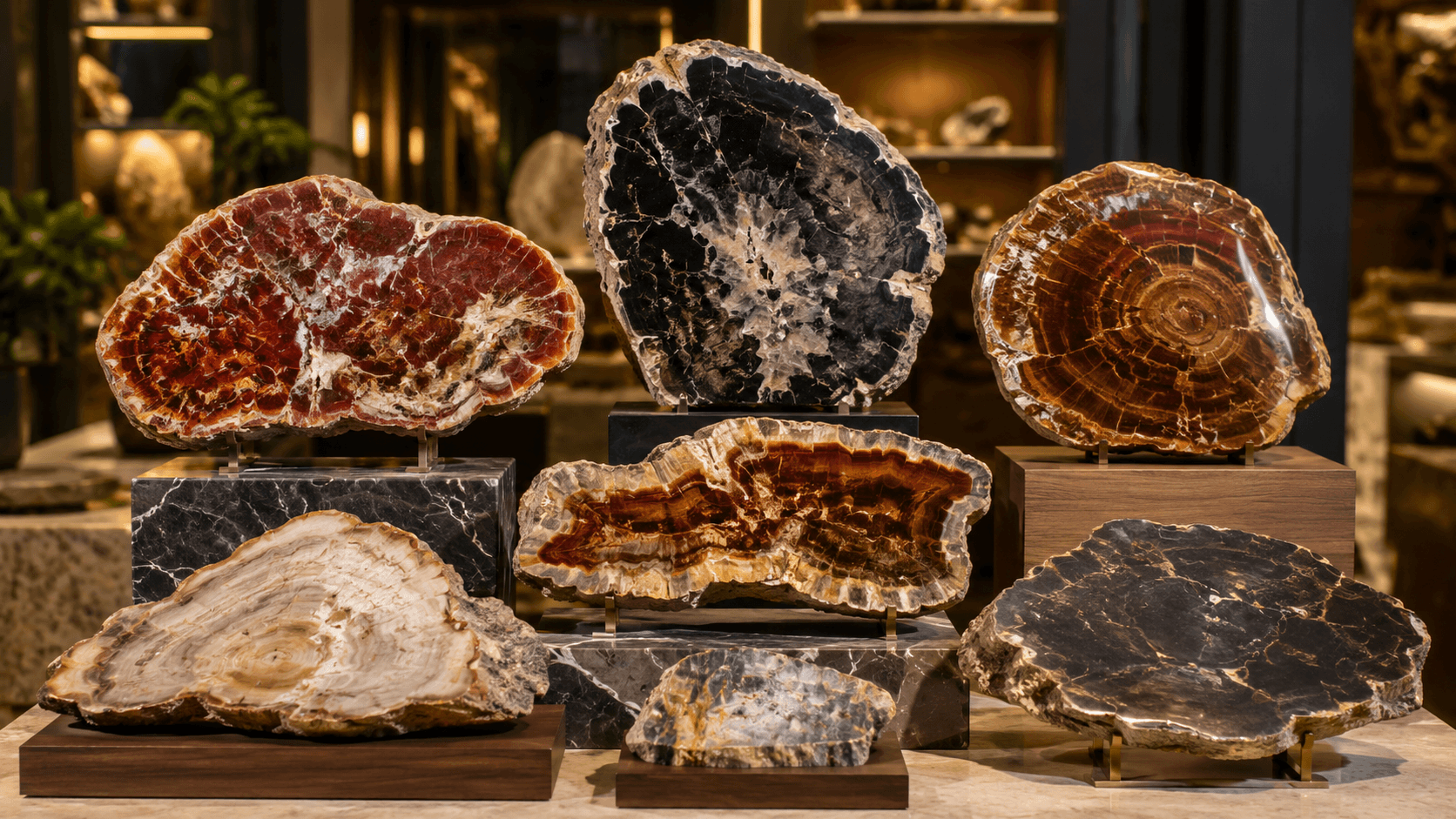
At Medusa, we call this family Umbra. Not a catalogue category — a name given to specific trunks, each one raised individually from the ground, each one carrying its own density of black. Once a trunk is cut, that particular balance of shade is gone. There will be other dark trunks, but never that one again.
Why Black, Specifically
Color in petrified wood is not applied — it is deposited, atom by atom, during silicification. As groundwater infiltrated the buried wood, it carried dissolved minerals into the cellular structure, replacing organic tissue with quartz while preserving the original form of the tree.
- Iron produces the ochres and reds seen in Ambra and Fusca trunks.
- Manganese produces the blacks and violets that define Umbra.
- Chromium and cobalt, rarer, yield greens and blues.
A black trunk therefore tells us something precise about the water that once moved through it — a higher manganese content, sustained over millennia. No two deposits are identical, which is why Umbra pieces vary from a near-graphite black to a charcoal shot through with plum-colored striations.
Stone Before It Was Ever Wood-Like
The word "petrified" is literal here: the material is quartz, registering 7 on the Mohs hardness scale. What looks like bark and growth rings is, chemically, silica. This has consequences that matter for how a piece lives in a home.
- Indifferent to water — no sealing, no swelling, no staining.
- Unaffected by heat, so a warm dish or a lit candle leaves no mark.
- Stable under UV exposure; color does not fade in sunlight.
- Resistant to frost, which makes outdoor placement possible.
A black trunk of Umbra does not darken with age. It was already as dark as it will ever be, 230 million years ago.
From Buried Trunk to Finished Piece
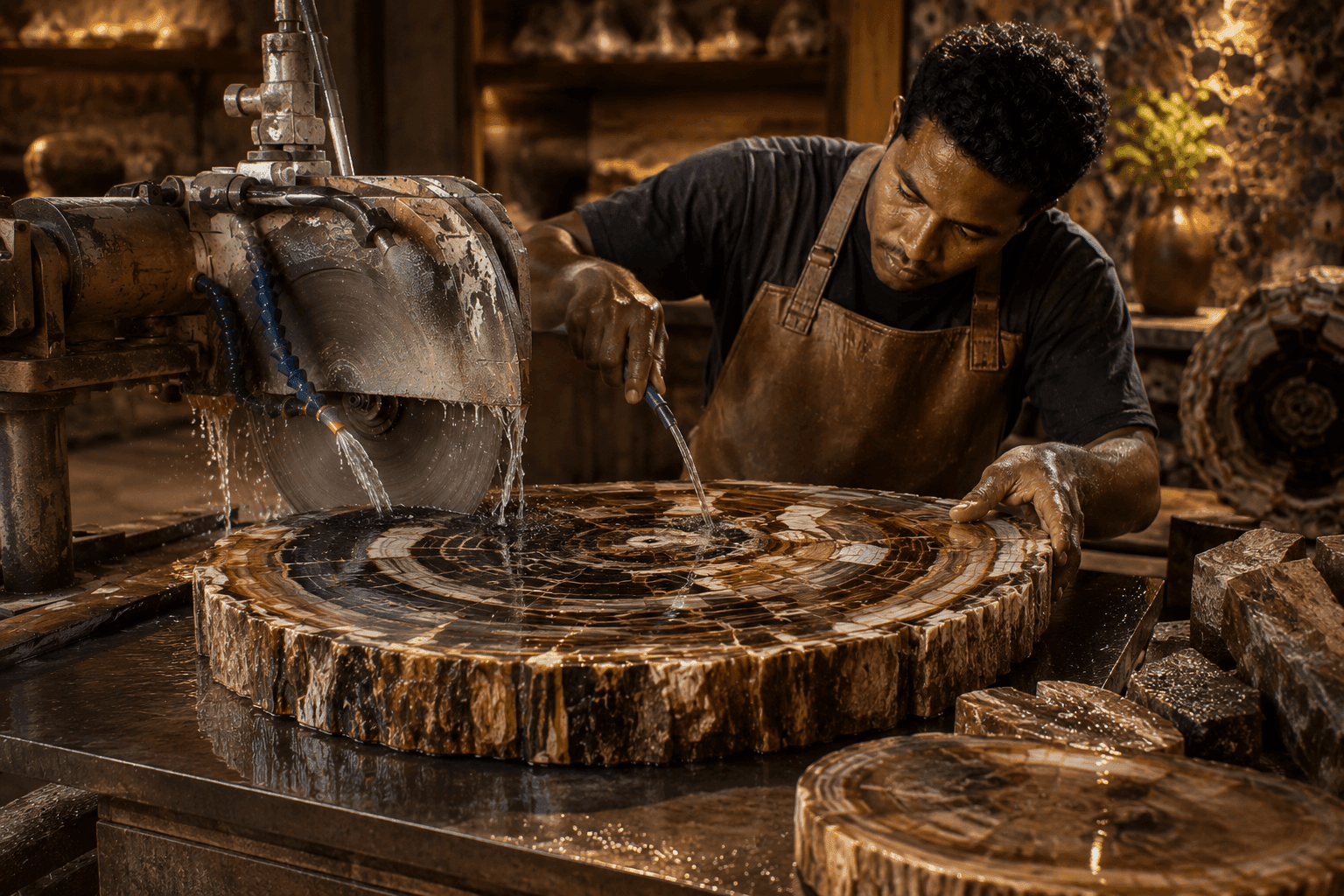
Each Umbra trunk arrives from the ground irregular, encrusted, and unpredictable. Only cutting reveals what the manganese has done inside — sometimes a uniform black, sometimes a marbling of black and deep violet that no drawing could have anticipated. This is the tension in every commission: the final tone is only ever confirmed once the saw has gone through.
Our artisans work with that unpredictability rather than against it. Polishing is slow, done in stages, to bring out the density of the stone without erasing the trunk's original contours — the swell of a former burl, the closing of an old wound in the wood, the growth rings still legible beneath the shine.
Living With Black Petrified Wood

Black petrified wood behaves differently from lighter varieties in a room. Where Ambra or Argentea catch and scatter light, Umbra absorbs it — a low table in black stone reads as a shadow with weight, an anchor rather than a highlight. It pairs naturally with brass, aged leather, and pale stone, where the contrast does the work that no ornament could.
As a vasque, the effect intensifies: water sitting in a black quartz basin takes on the surface's darkness, turning a functional object into something closer to a still pool. As a standalone sculptural piece, a raw or semi-polished Umbra trunk holds a room's attention by refusing to shine.
Discover the Umbra trunks currently available and request a tailored quote.
View the ShopFrequently Asked Questions
Is black petrified wood rarer than other colors?
Manganese-rich deposits are less common than iron-rich ones in the region, which is why deeply black trunks, especially with violet striations, are less frequently found intact than ochre or brown ones.
Does black petrified wood need any special care?
None. As quartz, it is inert to water, heat, and UV light. A simple wipe with a damp cloth is enough to maintain its finish.
Can an Umbra piece be used outdoors?
Yes. Its resistance to frost and sunlight makes it suitable for exterior settings, though placement should still account for the piece's considerable weight.
Why does the price vary so much between trunks?
Each trunk is unique in size, density, and the extent of visible veining after cutting. We do not list fixed prices for this reason — every piece is quoted individually. Please consult us for a tailored estimate.