
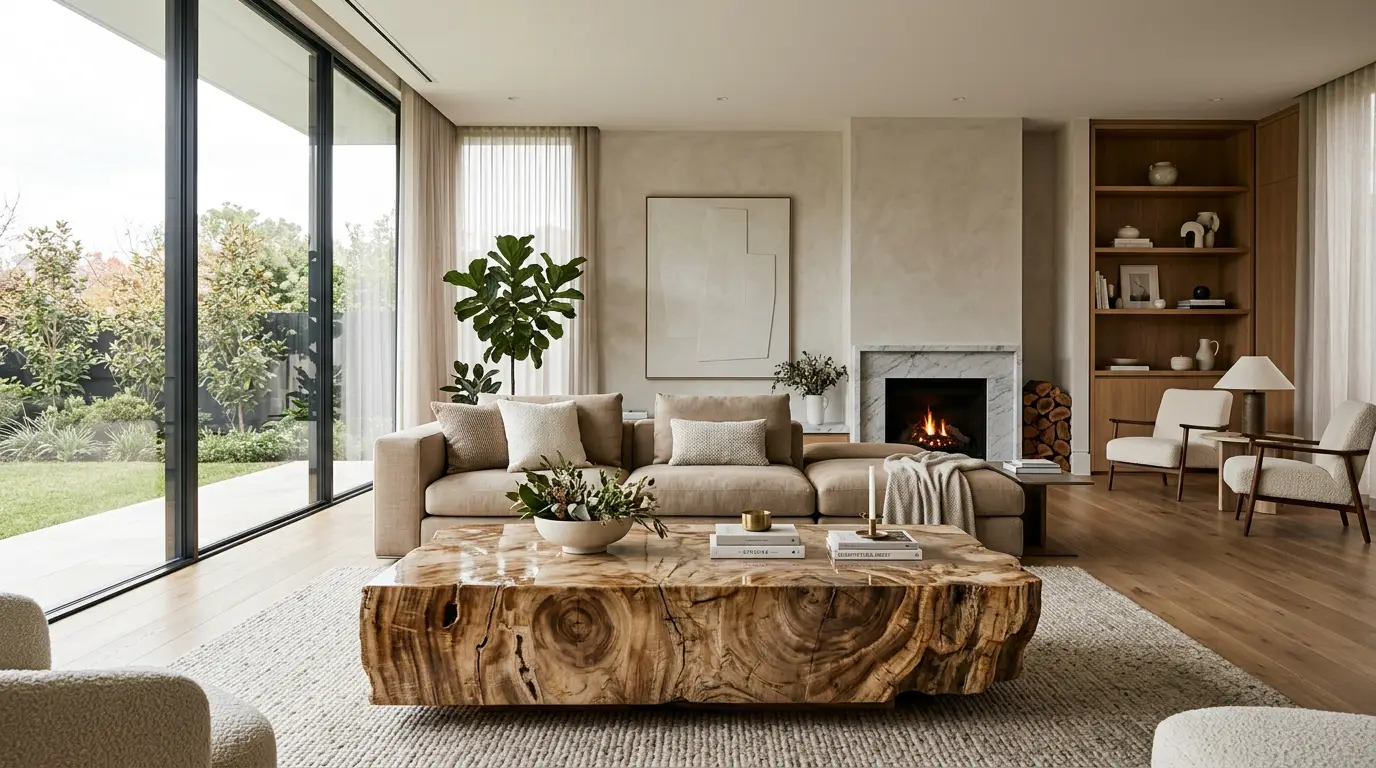
The Raw State: Wood Before the Cut
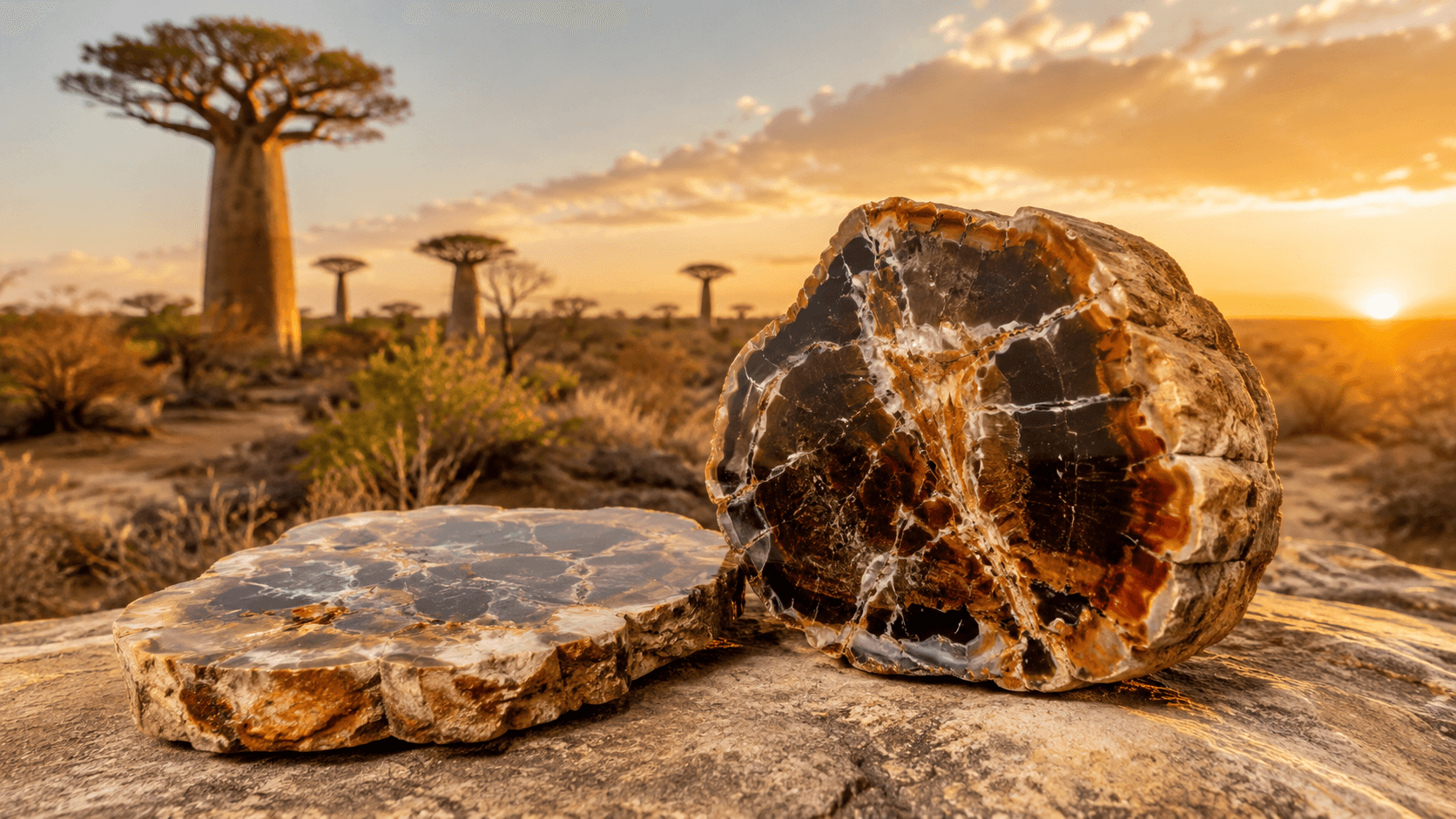
A raw trunk of petrified wood arrives exactly as it was pulled from the ground: crust intact, edges irregular, surface marked by two hundred and thirty million years underground. Nothing has been cut, polished, or corrected. What you see is the mineral record of a tree that grew in the Triassic, fell, and was slowly replaced — cell by cell — by silica carried through groundwater.
For decorators and collectors, this untouched state is the point. A raw piece doesn't imitate anything. It doesn't need to. Every ridge, every fracture line, every patch of oxidation tells you something true about how this particular tree mineralized, and no other trunk will show the same pattern twice.
One Tree, One Name, One Color
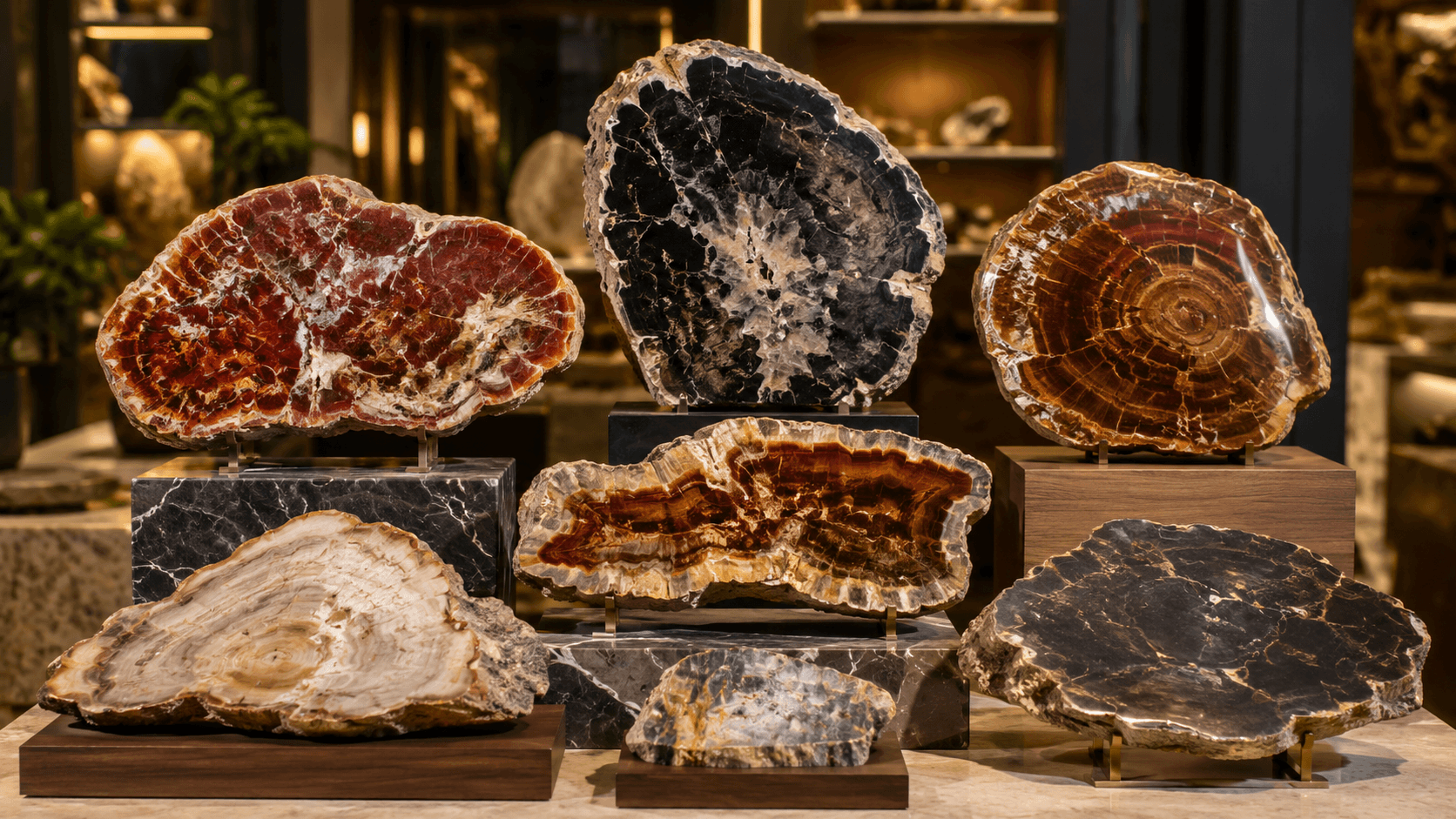
At Medusa, we don't sell "petrified wood" as an undifferentiated category. We name each tree we bring up from southwest Madagascar — Ambra for amber tones, Argentea for silvered grays, Fusca for deep browns, Umbra for near-black, Viridis for green. These aren't marketing labels. They correspond to the actual metals that infiltrated the wood during fossilization: iron gives reds and ochres, manganese produces blacks and violets, chromium and cobalt yield the rarer greens and blues.
Once a tree is felled from its resting place and cut into pieces, its particular color signature is gone. There is no second harvest. This is why raw trunks — before any cutting decision has been made — carry a kind of tension: the buyer sees the tree as a whole, still holding every possible outcome inside it.
Quartz, Not Wood: What "Petrified" Actually Means
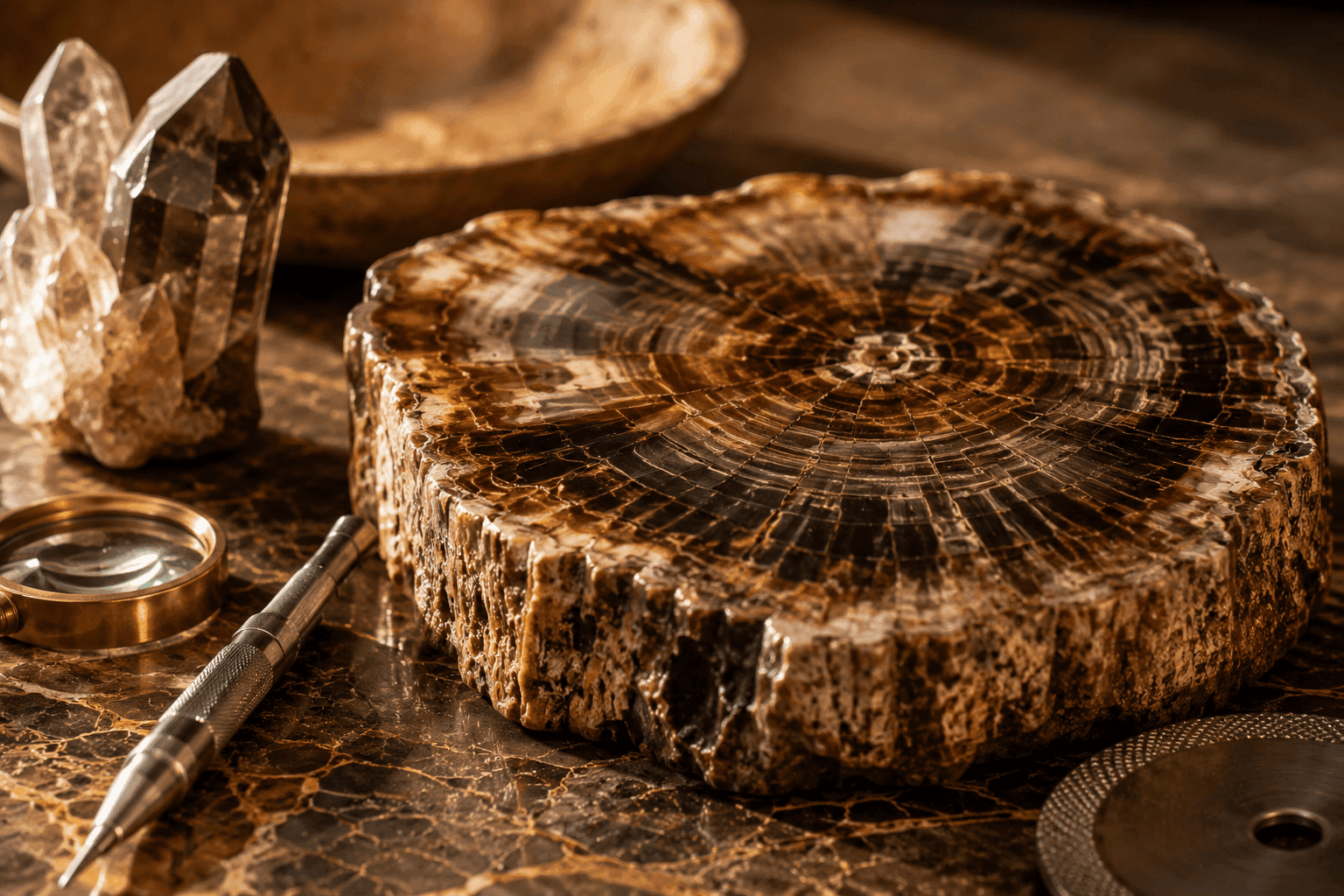
It helps to be precise about what a raw piece actually is. Despite appearances, this is not wood in any material sense. Silica has replaced the original organic tissue so completely that the trunk is now, chemically, quartz — hardness 7 on the Mohs scale. That single fact explains everything about how the piece behaves:
- Indifferent to water, so a raw or finished vasque never needs sealing against moisture.
- Unaffected by heat, making it suitable near fireplaces or in direct sun.
- Stable under UV exposure — colors don't fade with years of light.
- Resistant to frost, which allows outdoor placement without risk.
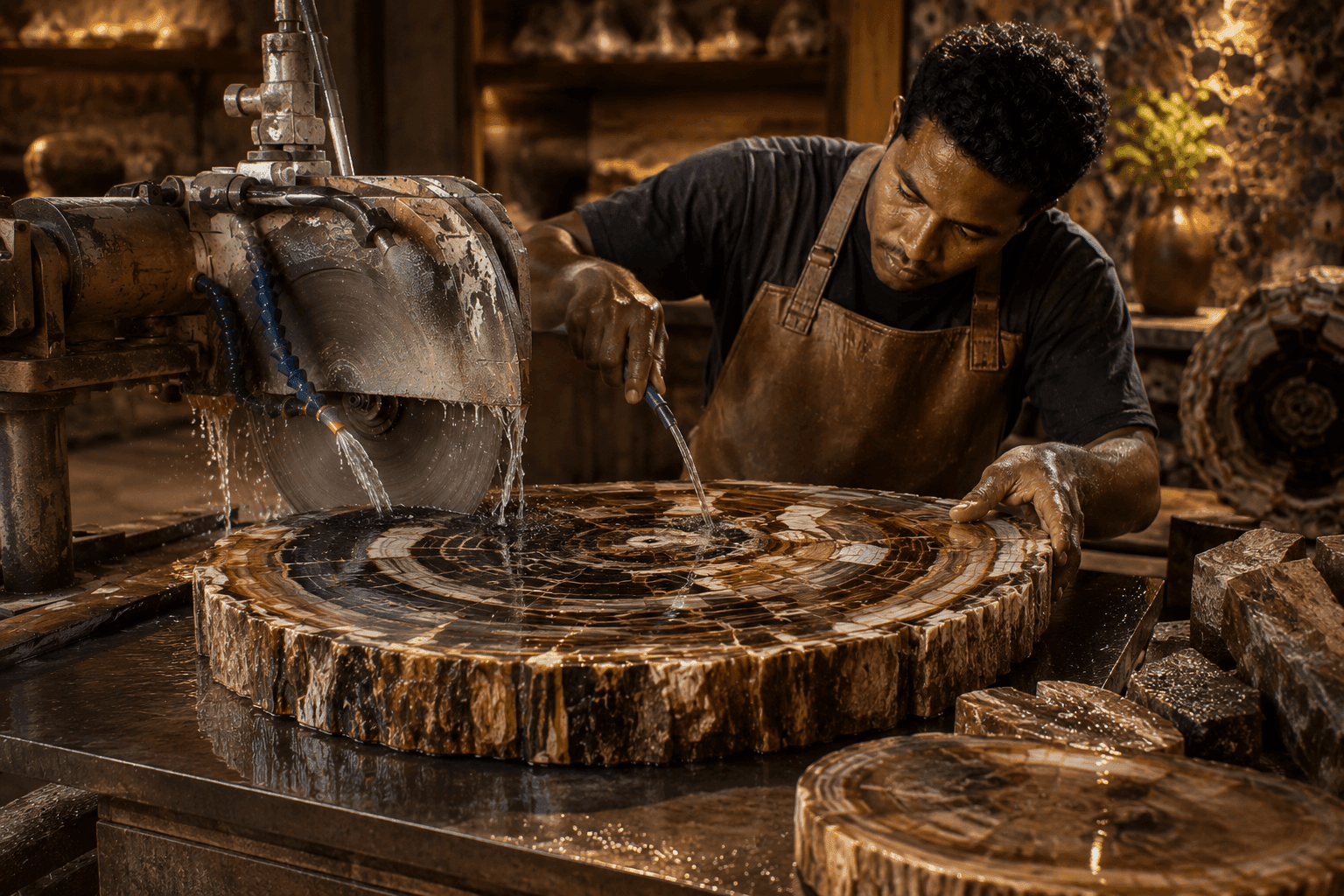
The wood grain you see in a cut section is not fiber. It's the fossilized echo of fiber, now expressed in mineral banding. A raw trunk left as-is preserves the bark texture and outer weathering; a polished cross-section, by contrast, exposes the internal rings — as visible in a finished cut.
Raw for Decorators, Raw for Collectors
Two very different audiences come to us for raw pieces, and both are well served by leaving the material untouched.
Decorators use raw trunks as sculptural anchors — a single Fusca or Umbra piece placed in an entryway or beside a staircase does more work than a room full of smaller objects. The irregular silhouette resists the sterility of finished furniture; it reads as geology, not decor.
Collectors are drawn to raw pieces precisely because they haven't been decided yet. A trunk referenced internally as Raw 140 or Raw 110 (KD1) is catalogued by its origin, its dimensions, and its visible mineral traits — but its interior remains unknown until a cut is made. An opalized specimen such as Opalized Raw 70 goes further still: opal replacement inside certain trunks produces a play of color across the surface that no two pieces repeat. These are acquired as they stand, kept raw by choice, valued for what they already are rather than what they could become.
A raw trunk is not unfinished. It is a tree that has chosen not to be cut yet.
Questions of worth come up often — what a given raw trunk is worth, what a piece like Opalized Raw 70 might be priced at, whether buying raw is a sound decision compared to a finished vasque. These depend entirely on the specimen: its size, its mineral content, its rarity of color, its condition after extraction. There is no fixed scale, which is exactly why each piece is assessed on its own terms rather than sold by weight or category.
Living With a Raw Piece
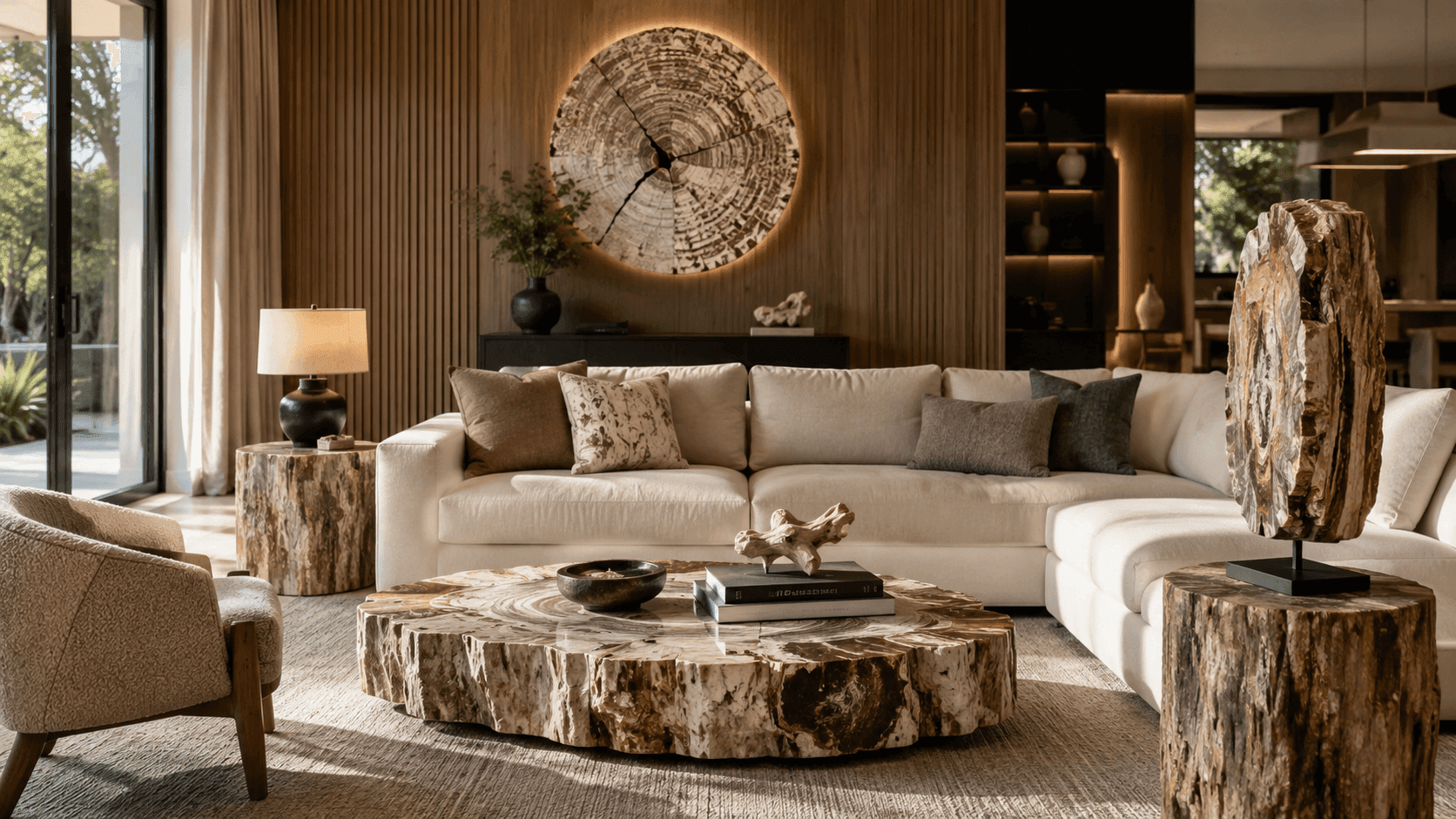
A raw trunk asks for very little. No maintenance regime, no protective coating, no worry about the surface marking over time — quartz doesn't age the way timber does. Positioning matters more than upkeep: a raw piece reads best with space around it, lit from the side so its ridges and mineral bands catch shadow rather than flat overhead light.
Some clients later choose to have a raw acquisition cut and polished into a tabletop or a vasque, once they've lived with it long enough to know what they want revealed inside. Others keep it exactly as found. Both are legitimate ways to hold a piece of Triassic forest in a room.
See which raw trunks are currently available and request a tailored quote.
Visit the ShopFrequently Asked Questions
Is raw petrified wood real fossilized wood, or a treated stone?
It is genuine fossilized wood: original plant tissue replaced by silica over millions of years. The result is structurally quartz, but the wood's cellular pattern is preserved in mineral form.
Why is each raw trunk given a name instead of a product code?
Because each trunk is an individual tree, not a manufactured item. The names — Ambra, Argentea, Fusca, Umbra, Viridis — refer to the specific coloration produced by the metals present during that tree's fossilization.
Can a raw piece be left outdoors?
Yes. Being quartz, it withstands frost, UV exposure, and moisture without treatment. Placement is a matter of design preference, not material limitation.
How is the worth of a raw trunk like Opalized Raw 70 determined?
Each specimen is evaluated individually — size, rarity of mineral coloration, condition, and opal content where present. We invite direct inquiry for a tailored quote rather than fixed pricing.