
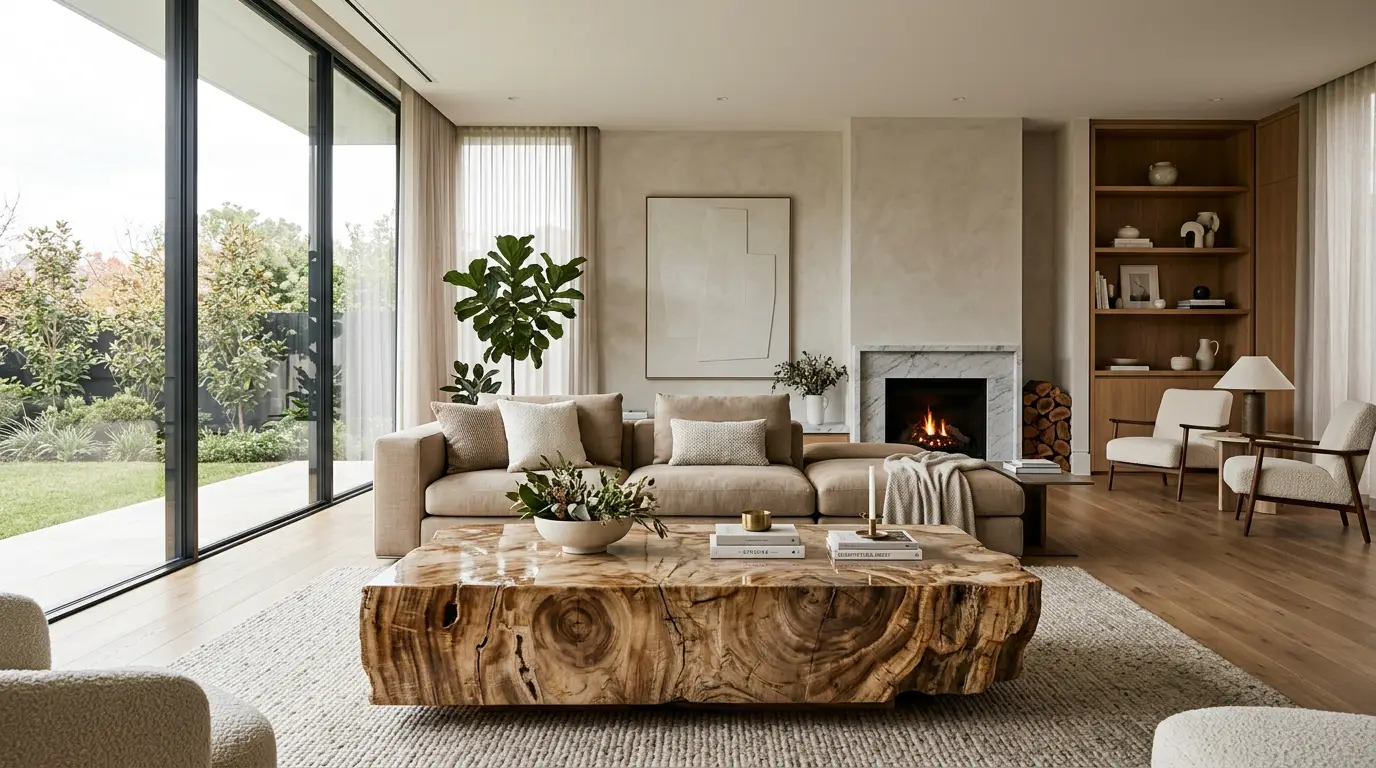
What a Petrified Wood Slab Really Is
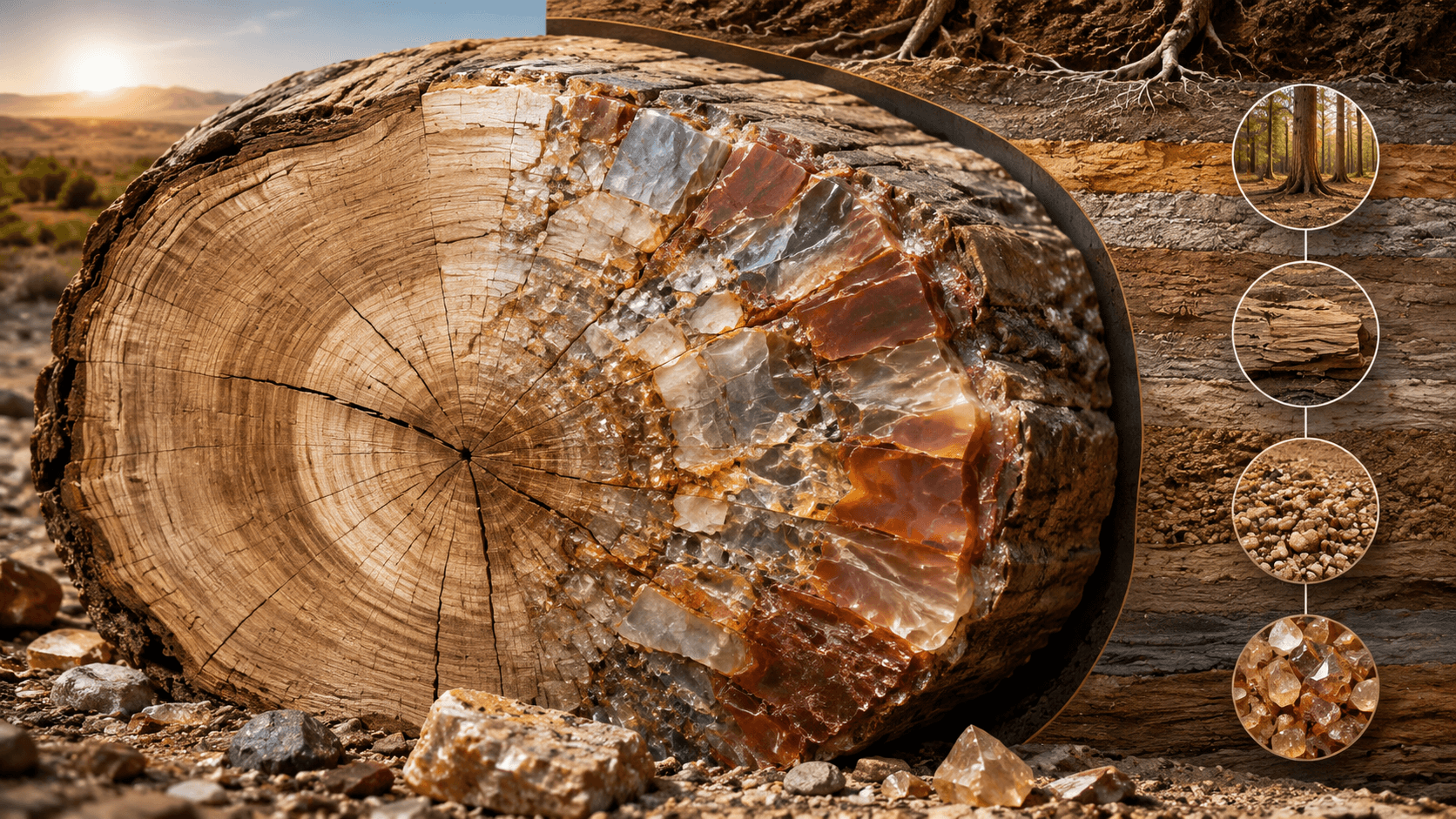
A petrified wood slab is a cross-section cut from a fossilized tree — a tree that turned to stone. Around 230 million years ago, during the Triassic, trees fell in what is now the south-west of Madagascar. Buried before they could rot, they were slowly infiltrated by mineral-rich water. Cell by cell, the wood was replaced by silica. What remains is no longer wood in any chemical sense: it is quartz that has kept the exact shape of the original trunk, down to the growth rings.
This is the paradox that makes the material compelling. You are looking at the anatomy of a living thing — bark, rings, the occasional knot — rendered in stone hard enough to scratch glass. The grain you trace with your finger was drawn by a tree that stood before the first dinosaurs.
Because it is quartz, a petrified wood slab is dense, cold to the touch, and completely indifferent to water, heat, UV light and frost. It does not warp, stain or fade. A slab used as a tabletop today will look identical in a century.
One Tree, One Name
At Medusa, a slab is never a "model" pulled from a bin of interchangeable stock. Every trunk is lifted from the ground individually, one by one, in the south-west of Madagascar. Before it is ever cut, it receives a name.
Those names describe its colour — the signature left by the minerals that petrified that particular tree:
- Ambra — amber, warm honeyed tones
- Argentea — silver, cool and pale
- Fusca — brown, deep and earthy
- Umbra — the darkest, shadowed and dense
- Viridis — green, the rarest expression
These are not product categories. They are individual arbres. Ambra is not "the amber range"; Ambra is a tree, with its own veining, its own inclusions, its own history in the soil.
When a trunk is cut, its colour disappears from the world for good. There is no second batch.
This matters practically. Once a slab is taken from a named trunk, that exact tone will never be reproduced, because the mineralization that created it was unique to that one tree. Choosing a slab from Medusa is choosing a specific arbre, not a reference number.
Where the Colour Comes From
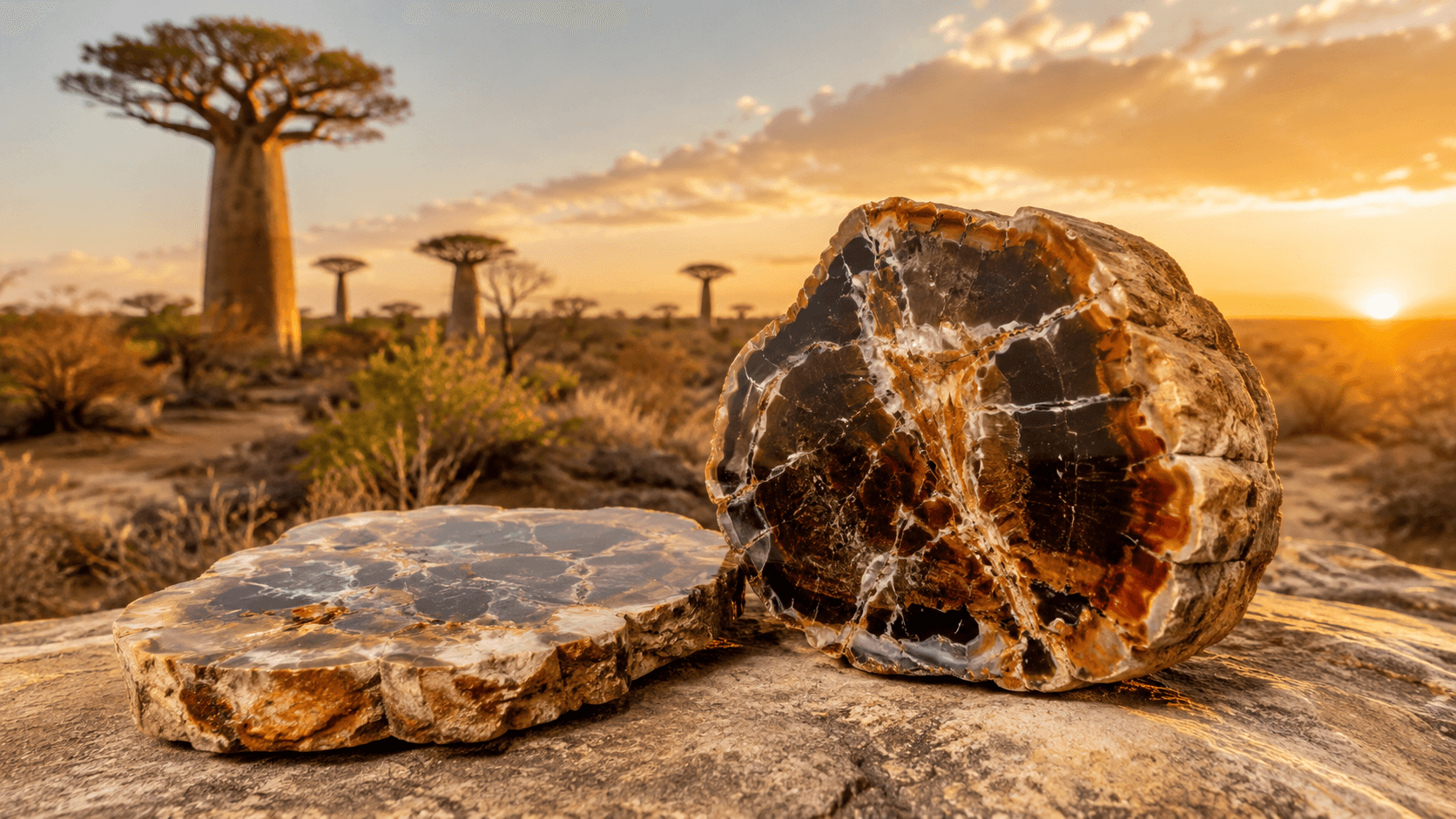
The colours in a petrified wood slab are not dyes or finishes. They are metals, deposited during the millions of years the silica took hold:
- Iron produces reds, ochres and rust tones.
- Manganese brings blacks and violets.
- Chromium and cobalt create the greens and blues that make trunks like Viridis so uncommon.
Because these metals were dissolved in groundwater that moved unevenly through the buried trunk, no two zones of the same slab are quite alike. A single face can carry an ochre heart bleeding into charcoal edges, with a thread of near-black tracing an old crack.
To understand how a fallen tree becomes a coloured stone in the first place, our detailed piece on how petrified wood forms follows the process step by step. And if it is the palette itself that draws you, the guide to petrified wood colours sets each named trunk against the minerals behind it.
Reading a Slab Before You Choose
A slab is a two-dimensional window onto a three-dimensional object, so a few things are worth reading closely.
The face
The polished face is where the tree's biography shows. Growth rings tell you the trunk's orientation; tighter rings mean slower-grown, denser wood. Look for the play between figure and colour — a strong ring pattern reads very differently in the pale tones of Argentea than in the depth of Umbra.
The edges
Slabs come with either a natural edge, keeping the original bark line and outer contour of the trunk, or a cut edge, squared for a cleaner, more architectural profile. A natural edge foregrounds the "this was a tree" story; a cut edge suits geometric interiors.
Inclusions
Cracks, voids and crystal pockets are part of the material, not flaws. Quartz-lined cavities catch light in a way no manufactured surface can. Where structure requires it, these are stabilized during finishing.
For the difference between a finished slab and material sold closer to its raw state, see our comparison of slabs versus raw logs, and our guide to choosing a petrified wood table if a dining or console surface is your goal.
Hardness, Weight and Living With Stone
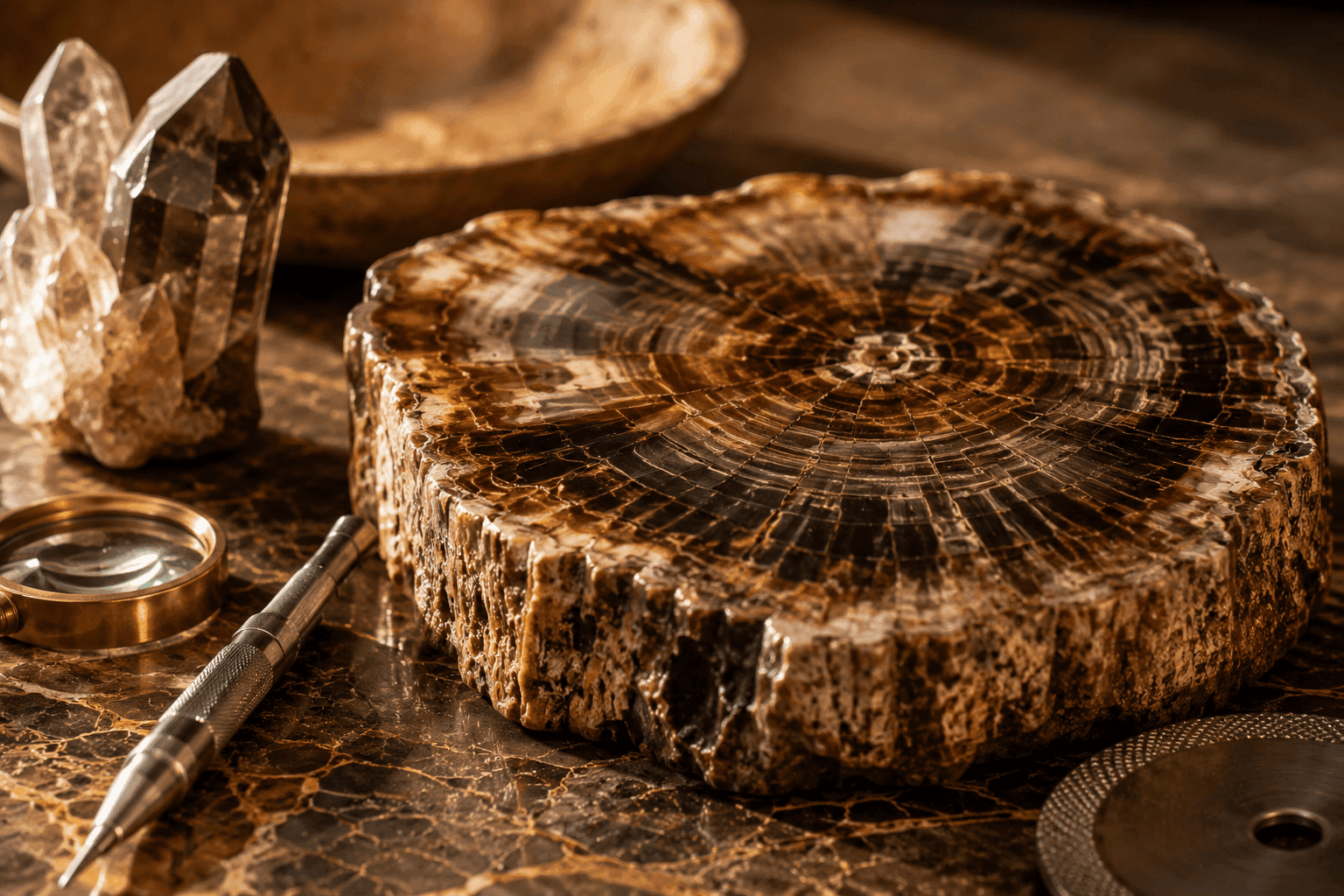
Petrified wood sits at 7 on the Mohs scale, the same as quartz — harder than a steel blade, harder than glass. In daily use this translates into a surface that shrugs off the things that ruin softer materials:
- Water — no absorption, no staining, safe for vasques and basins.
- Heat — a hot pan or cup leaves no mark.
- UV — the colour is mineral, so sunlight never fades it.
- Frost — stable outdoors, including through winter.
The trade-off is weight. A slab is solid quartz, and it is genuinely heavy. This shapes how pieces are supported, transported and installed — considerations our care and maintenance guide addresses alongside the (very short) list of things the material actually needs. In practice, maintenance is close to nothing: no sealing, no oiling, no special cleaners.
From Trunk to Finished Piece
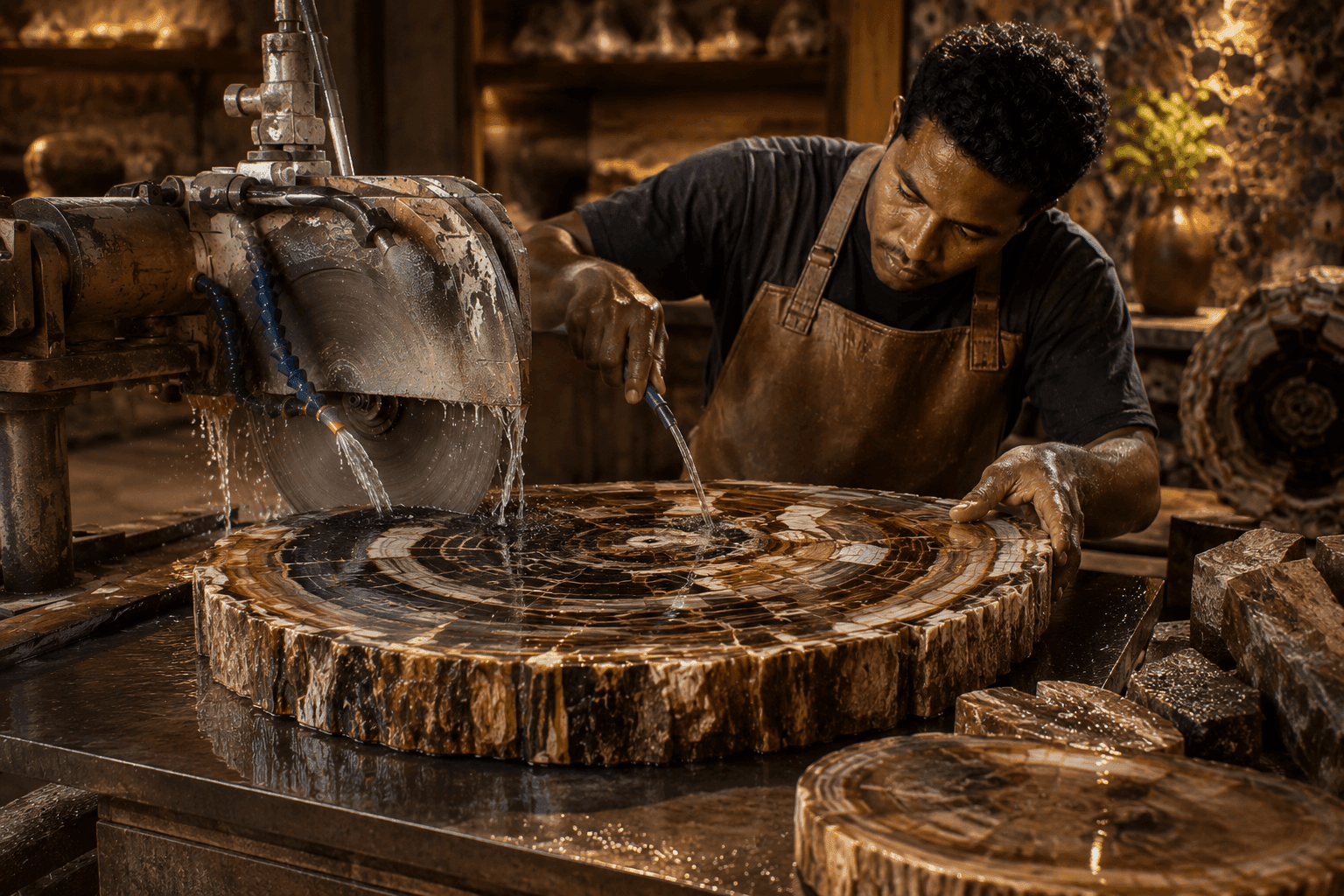
The work begins the moment a named trunk is opened. Diamond tooling is required to cut quartz, and the first pass is a small event: it is the first time anyone sees the interior of that particular tree. From there, the face is ground and polished through progressively finer stages until the mineral depth comes forward.
Every decision — where to cut, how thick, natural or squared edge, matte or high polish — is made for that specific arbre, because its figure and colour will never recur. This is the opposite of volume production, where identical parts flow off a line. Here, the slab dictates the piece.
The result finds its place as a tabletop, a console, a vasque, or a standing sculptural panel — each one carrying a colour that ended, definitively, the day its trunk was cut.
Discover the named trunks currently available, each one an individual tree with its own colour.
Explore the collectionFrequently Asked Questions
Is every petrified wood slab genuinely unique?
Yes. Each slab is cut from an individual trunk lifted one by one in south-west Madagascar. Its colour comes from the specific metals that petrified that tree, so once the trunk is cut, that exact tone cannot be reproduced.
Can a petrified wood slab be used as a kitchen or bathroom surface?
Absolutely. Because it is quartz at 7 on the Mohs scale, it is unaffected by water, heat, staining and UV. It suits worktops, basins and vasques with no sealing or special care.
How much does a petrified wood slab cost?
Every slab is a distinct piece, so pricing depends entirely on the trunk, its size and its finish. Browse the collection and contact us for a quote on any piece that speaks to you.
What do names like Ambra, Fusca and Viridis mean?
They are the names Medusa gives to individual trees, describing each one's colour — amber, brown, green, and so on. They are not product ranges but real trunks, each with a mineralization found in no other.