
What Makes a Piece Large
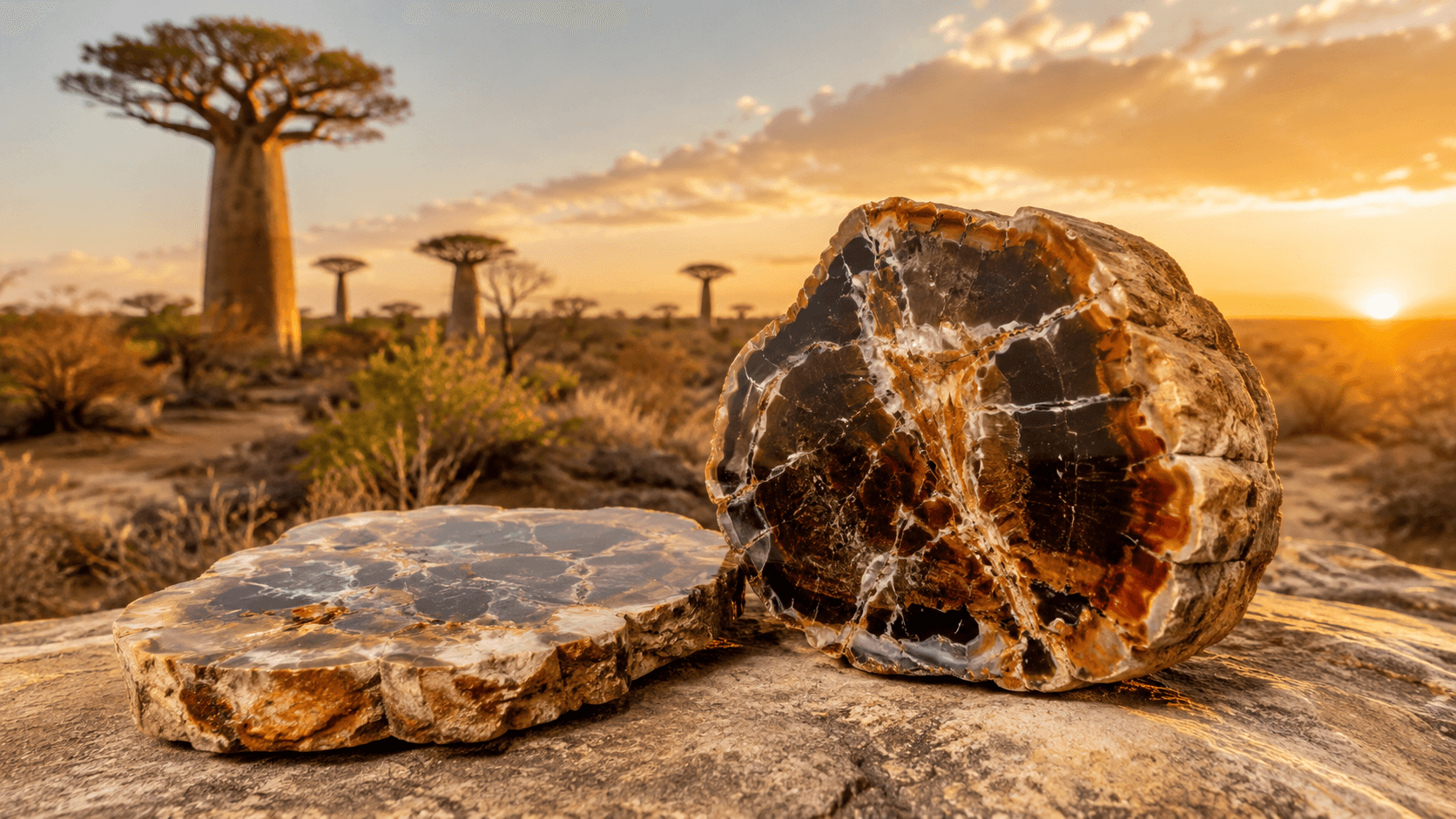
A large petrified wood piece is not a category we manufacture. It is the outcome of a single tree, once it has been raised whole from the ground in southwestern Madagascar. Some trunks measure over two meters across; others are narrower but exceptionally dense, heavier than their size suggests. Every one of them was a living conifer some 230 million years ago, during the Triassic, long before it turned to stone.
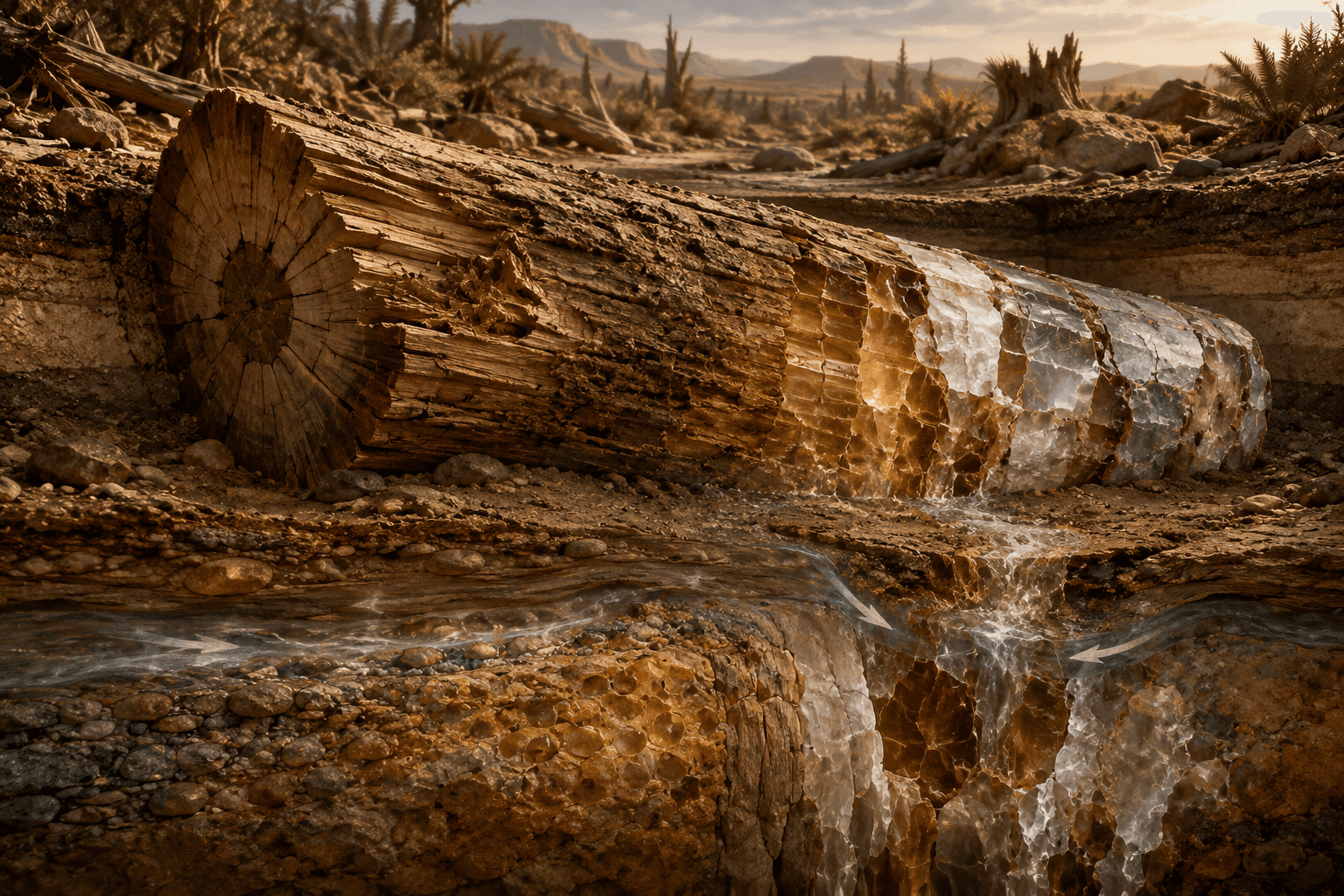
When we bring a trunk out of the earth, we don't yet know exactly what lies inside. Silica infiltrated the wood cell by cell, replacing organic tissue with quartz over an immense span of time. The result is a stone that keeps the tree's original architecture — its rings, its fractures, its growth pattern — while carrying a hardness of 7 on the Mohs scale. That is harder than steel blades, harder than window glass. Large pieces inherit all of this density at scale: they are heavy, cold to the touch, indifferent to water, heat, frost or UV light.
One Tree, One Name
Every trunk that reaches our workshop receives a name before it receives a single cut. Ambra for amber tones, Argentea for silver-grey, Fusca for deep browns, Umbra for near-black shadow, Viridis for green. These are not product lines. They are individuals — the way a vineyard names a parcel, or a forester marks a specific tree. No two trunks minéralize the same way, because no two spent 230 million years in exactly the same mineral bath.
This matters most with large pieces, precisely because the surface area is greater and the story more visible. A big slab or vasque shows more of the tree's internal life: the concentric rings, the radiating fractures filled with secondary quartz, the abrupt color changes where mineral conditions shifted underground. Iron produced the reds and ochres. Manganese produced blacks and violets. Chromium and cobalt, more rarely, produced greens and blues. Once a trunk is named and its coloration recorded, that particular palette is gone the moment the piece leaves our hands — there is no second trunk to match it.
A large piece isn't bigger decoration. It's a bigger fragment of one tree's singular history.
From Raw Trunk to Finished Object
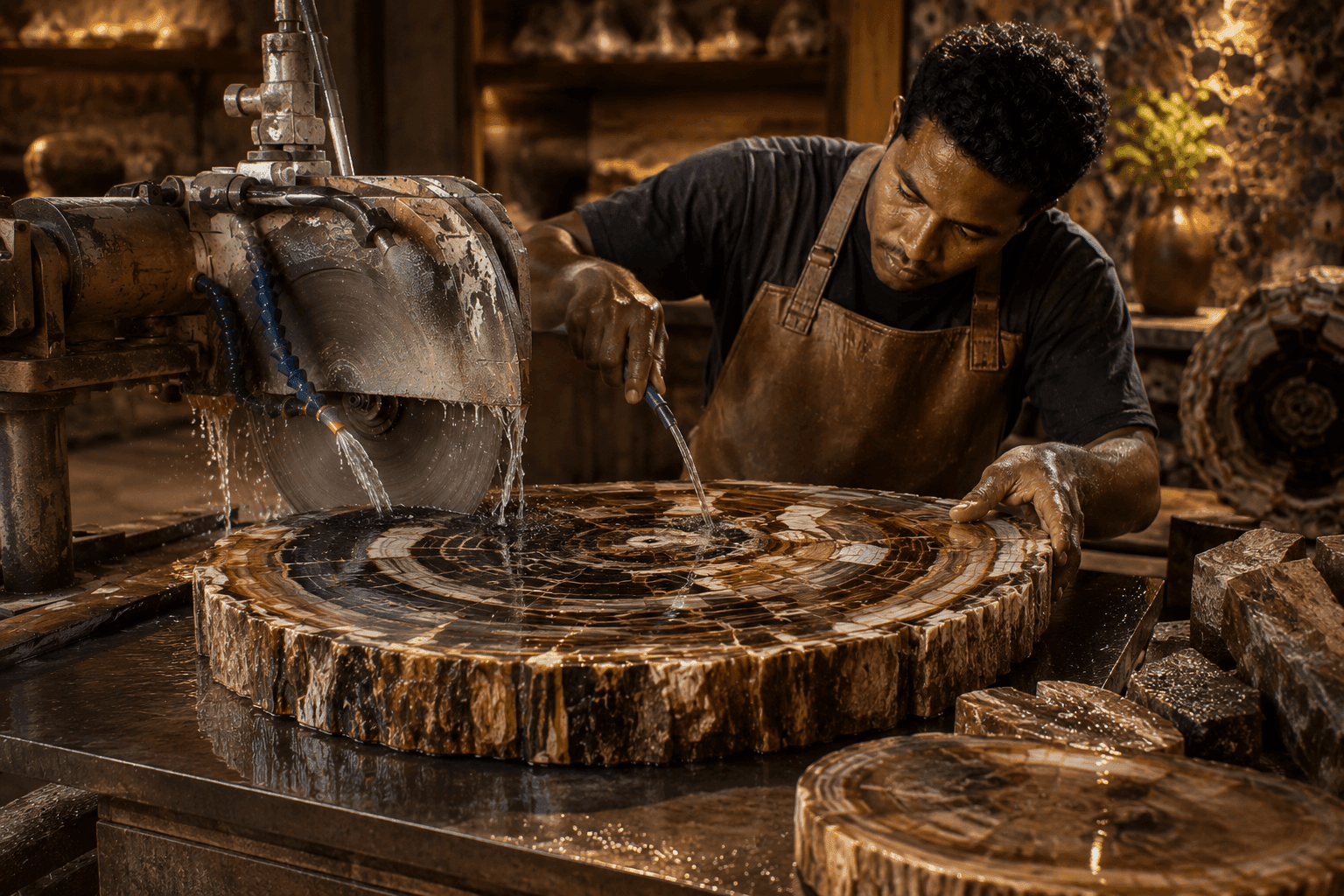
Large trunks demand a different kind of patience than smaller specimens. Before any tool touches the stone, the trunk is studied: its fracture lines, its hollow pockets, the direction its rings suggest for a table top or a vasque basin. Cutting quartz at this scale is slow work. A wrong angle can waste the one trunk that produced that exact vein pattern.
Our approach to large pieces follows a simple sequence:
- Extraction of the whole trunk, kept intact as long as possible to preserve its options.
- Reading of the stone — grain, density, existing fractures — before any structural decision.
- Cutting and shaping according to what the trunk itself allows, not a predetermined template.
- Polishing that reveals depth without erasing the tree's original texture.
- Naming and documentation, so the trunk's identity travels with the finished object.
The finished large piece — a table, a vasque, a freestanding sculptural block — is therefore singular by construction, not by marketing claim.
Living With a Large Petrified Wood Piece
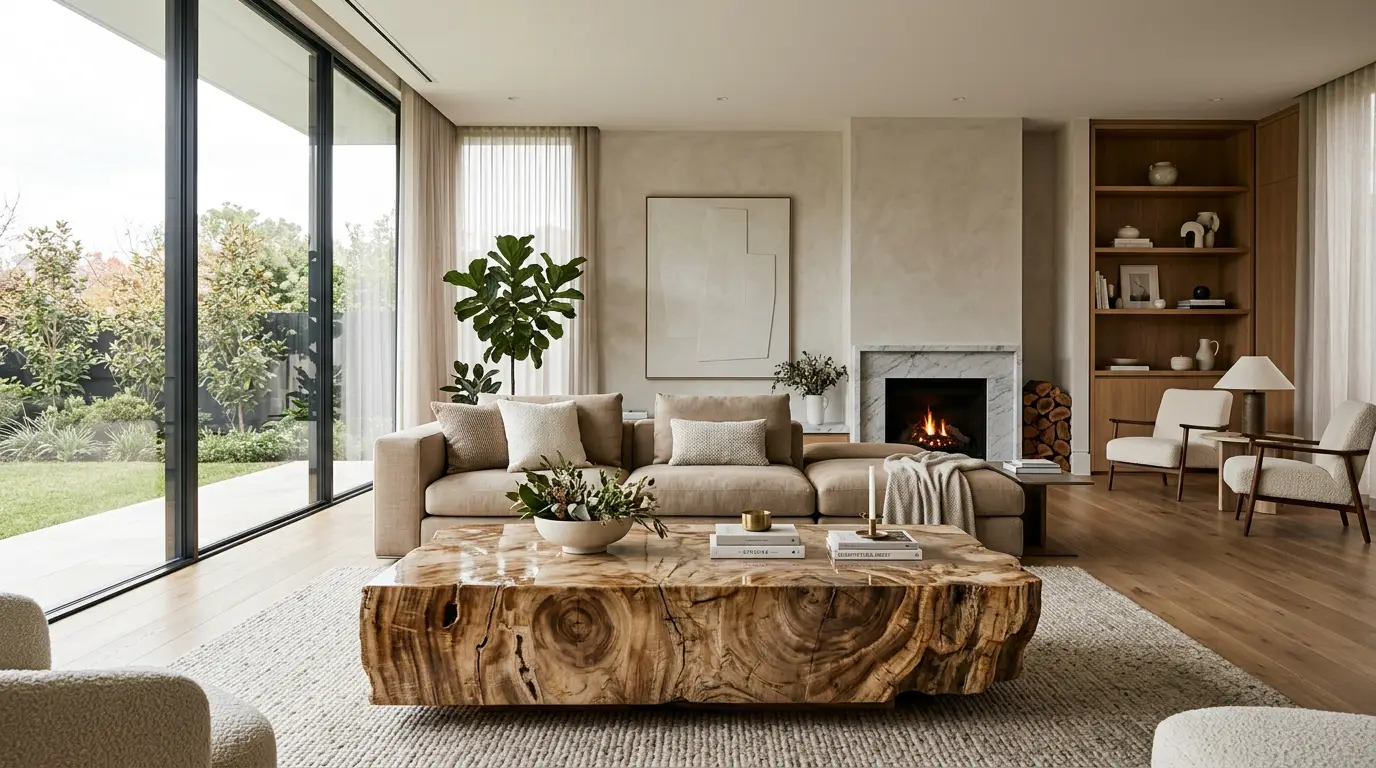
Scale changes how a material behaves in a room. A large petrified wood piece anchors a space rather than accompanying it. A vasque of this size becomes the room's focal point before any other object competes for attention. A table becomes the room's center of gravity, quite literally — quartz is heavy, and a large slab will not shift underfoot or wobble on uneven flooring the way lighter materials sometimes do.
Because the material is fossilized quartz rather than living wood, large pieces tolerate conditions that would ruin timber of the same size: direct sun near a window, splashed water around a basin, the heat of a nearby radiator. There is no oiling, no seasonal treatment, no risk of warping. The only real consideration is weight — large pieces require sound flooring and, often, planning before installation rather than after.
Reading the Stone Before You Choose
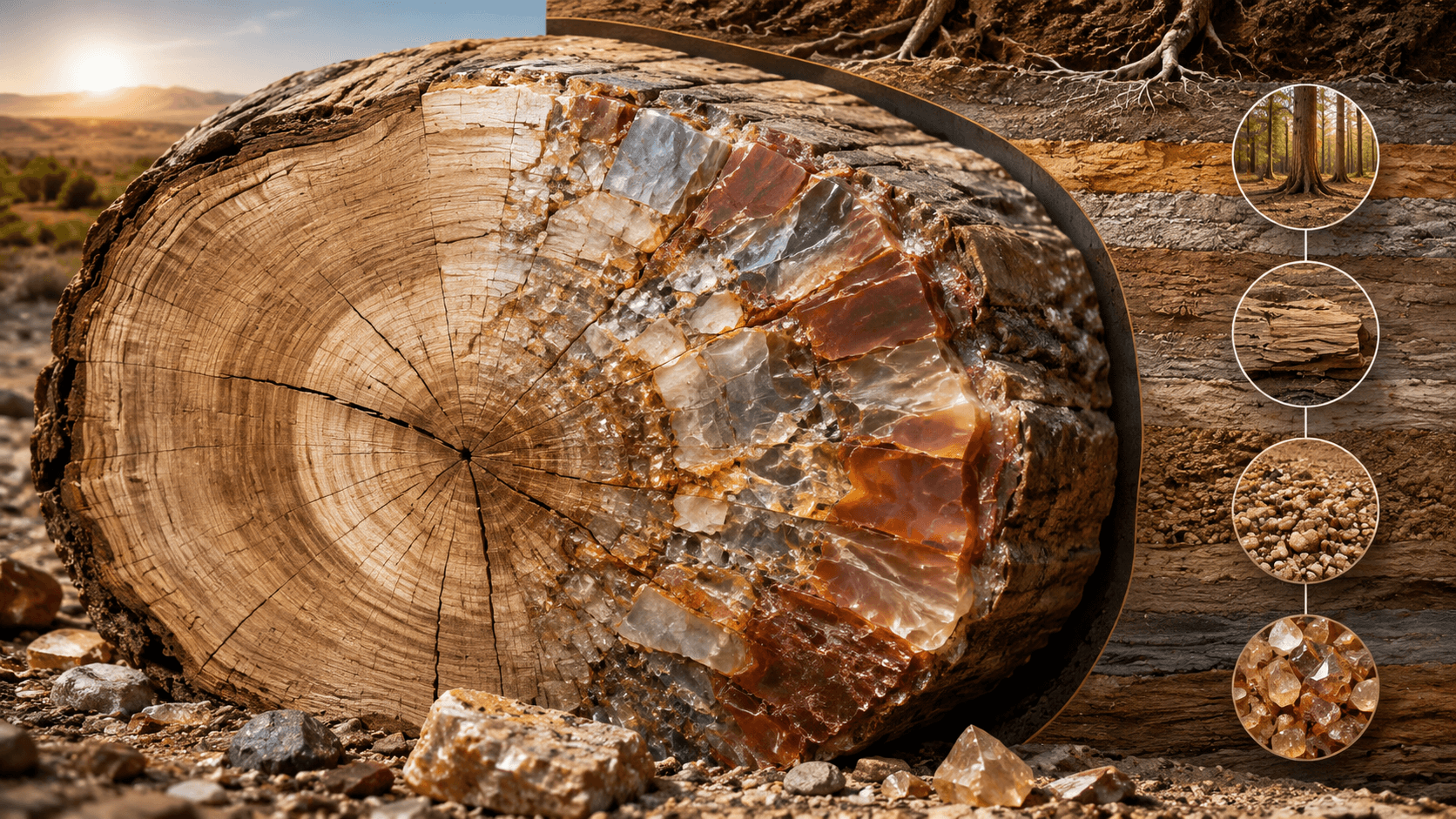
Choosing a large piece is less like choosing a finish and more like meeting a specific tree. We encourage clients to look closely at the ring pattern, the fracture geometry, and the color transitions before deciding — these details tell you which named trunk you are actually considering, and why its twin does not exist elsewhere in our collection.
- Ring density often indicates how the trunk grew before mineralization began.
- Fracture patterns, filled with secondary quartz, show how the stone settled underground over millions of years.
- Color zoning reveals which metals were present in the groundwater at each stage.
None of this is decorative flourish. It is the trunk's actual biography, visible on the surface.
See which named trunks are currently available for a large piece.
Browse the ShopFrequently Asked Questions
How old is a large petrified wood piece?
The wood itself dates back roughly 230 million years, to the Triassic period. Mineralization occurred gradually after the tree fell, long before the stone reached its current form.
Is petrified wood actually stone?
Yes. Through fossilization, organic wood tissue was replaced by silica, turning the trunk into quartz — with a hardness of 7 on the Mohs scale, while retaining the tree's original grain and rings.
Can a large piece be used outdoors or near water?
Yes. As quartz, it is unaffected by water, heat, frost, or UV exposure. The main practical concern for a large piece is its weight, which calls for adequate support at installation.
Why does each large piece look so different from another?
Because each trunk is an individual tree, named on arrival, whose color came from specific metals — iron, manganese, chromium, or cobalt — present in the ground during its mineralization. Once a trunk is cut, that exact coloration cannot be reproduced.