
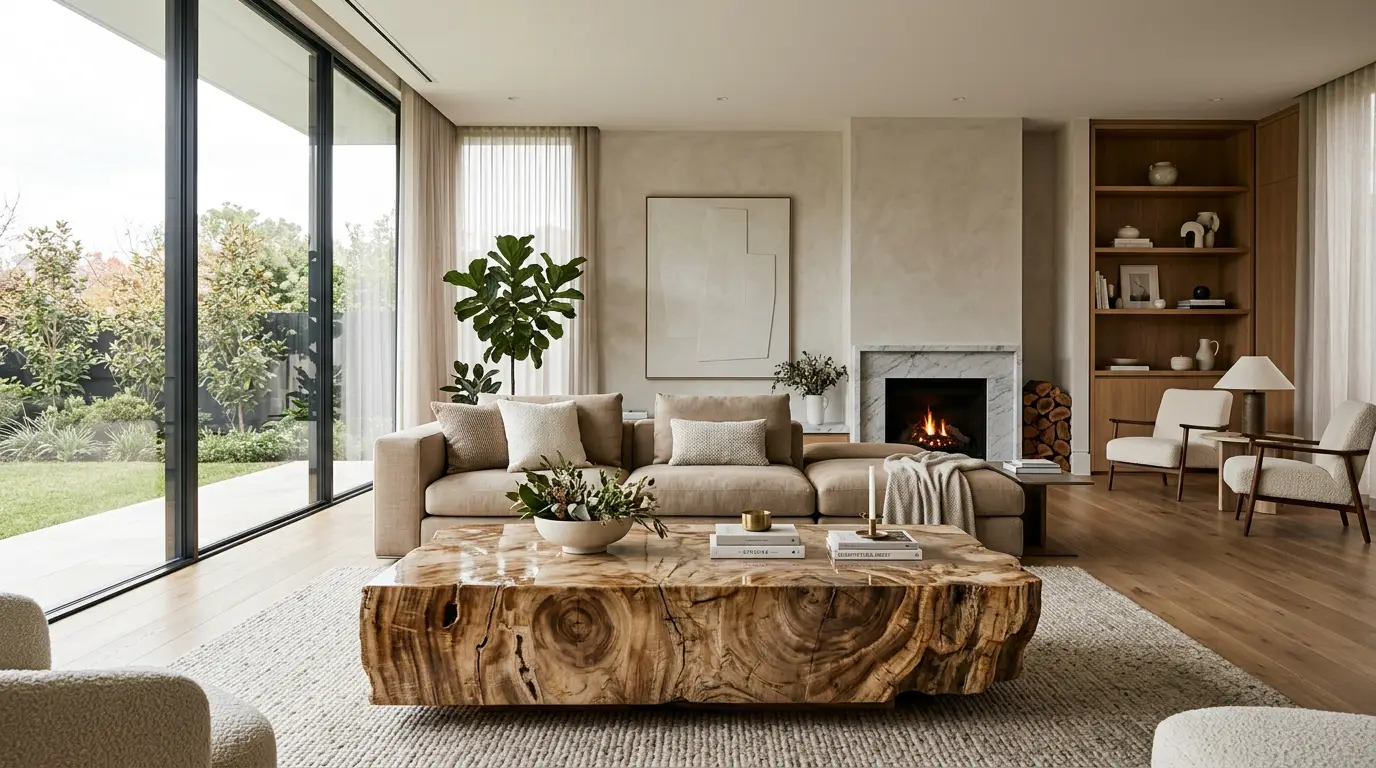
What a Polished Slab Actually Is
A polished petrified wood slab is a cross-section — or a long face — cut from a single fossilized trunk, then ground and buffed until the quartz beneath the bark reveals itself fully. Nothing is added, no dye, no resin fill for color. What you see is the mineral record left inside the tree roughly 230 million years ago, in the Triassic, when silica-rich water replaced its cellular structure atom by atom. The result is stone that still remembers it was wood: growth rings, grain, sometimes the shadow of a knot or a scar, now locked into quartz at 7 on the Mohs scale.
Polishing doesn't decorate the slab. It exposes what was already there.
One Tree, One Slab, One Name
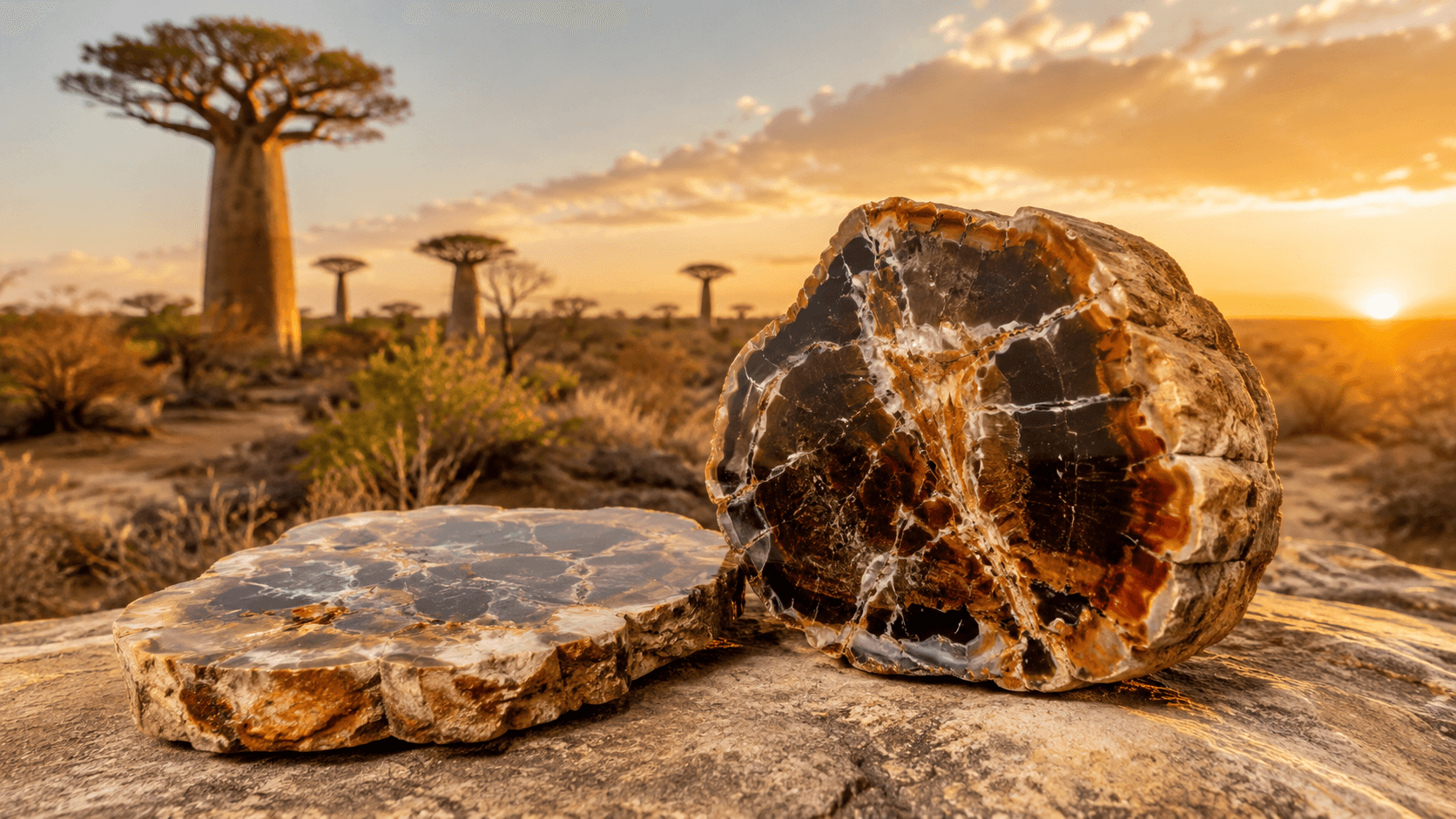
Every slab we polish comes from a trunk we've already named — Ambra, Argentea, Fusca, Umbra, Viridis — long before it reaches a workshop. This isn't a naming convention for product lines. Each name marks an individual tree, extracted one at a time from the arid soils of southwestern Madagascar, where mineral-rich groundwater created conditions found almost nowhere else on earth.
The color you see in a slab is not a finish choice. It's chemistry, fixed underground for millions of years:
- Iron oxides produce the reds and ochres — Ambra's warmth, Fusca's deep browns.
- Manganese gives blacks and violets — the density in Umbra.
- Chromium and cobalt, rarer, yield greens and blues — Viridis, the least common palette we work with.
Once a trunk is cut into slabs, that particular mineral signature is spent. There is no second Ambra. When we polish a slab, we're not producing a repeatable object — we're finishing one chapter of one tree's specific mineralization, which will not occur again in exactly the same way.
From Rough Block to Mirror Finish
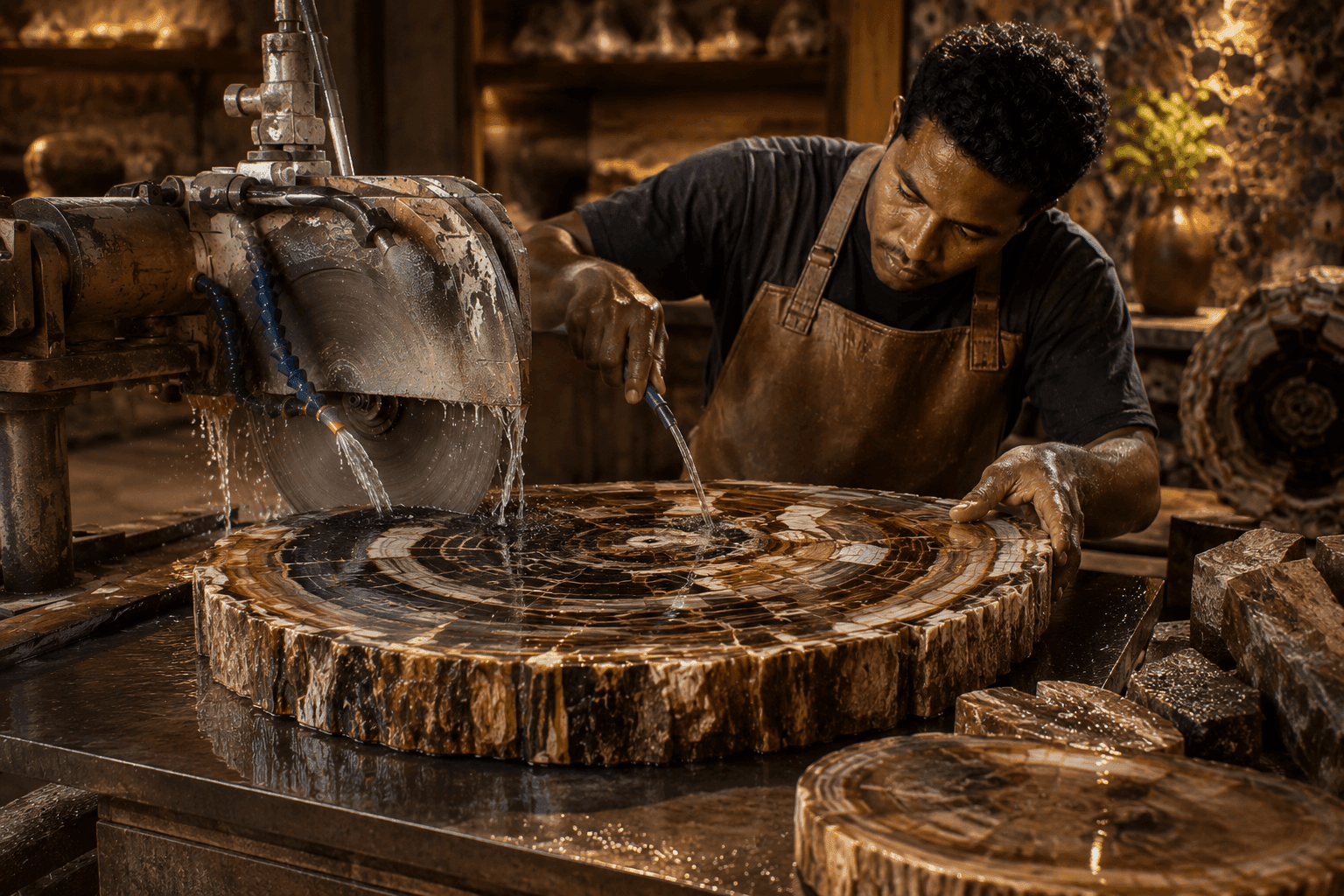
Cutting and polishing petrified wood is closer to lapidary work than to carpentry. Diamond blades and progressively finer abrasive discs are required — quartz doesn't yield to standard woodworking tools. The process is slow by necessity:
- The trunk is sliced to expose the desired face — often a cross-section, sometimes a long longitudinal cut that follows the grain.
- Successive grinding stages remove saw marks and flatten the surface.
- Fine polishing brings out the internal structure: rings, mineral veining, occasional voids left by the original wood's decay before fossilization.
Nothing here is fast, and nothing here is improvised. A slab that looks effortless in a living room usually represents days of grinding by hand.
Why the Surface Behaves Like Stone, Not Timber
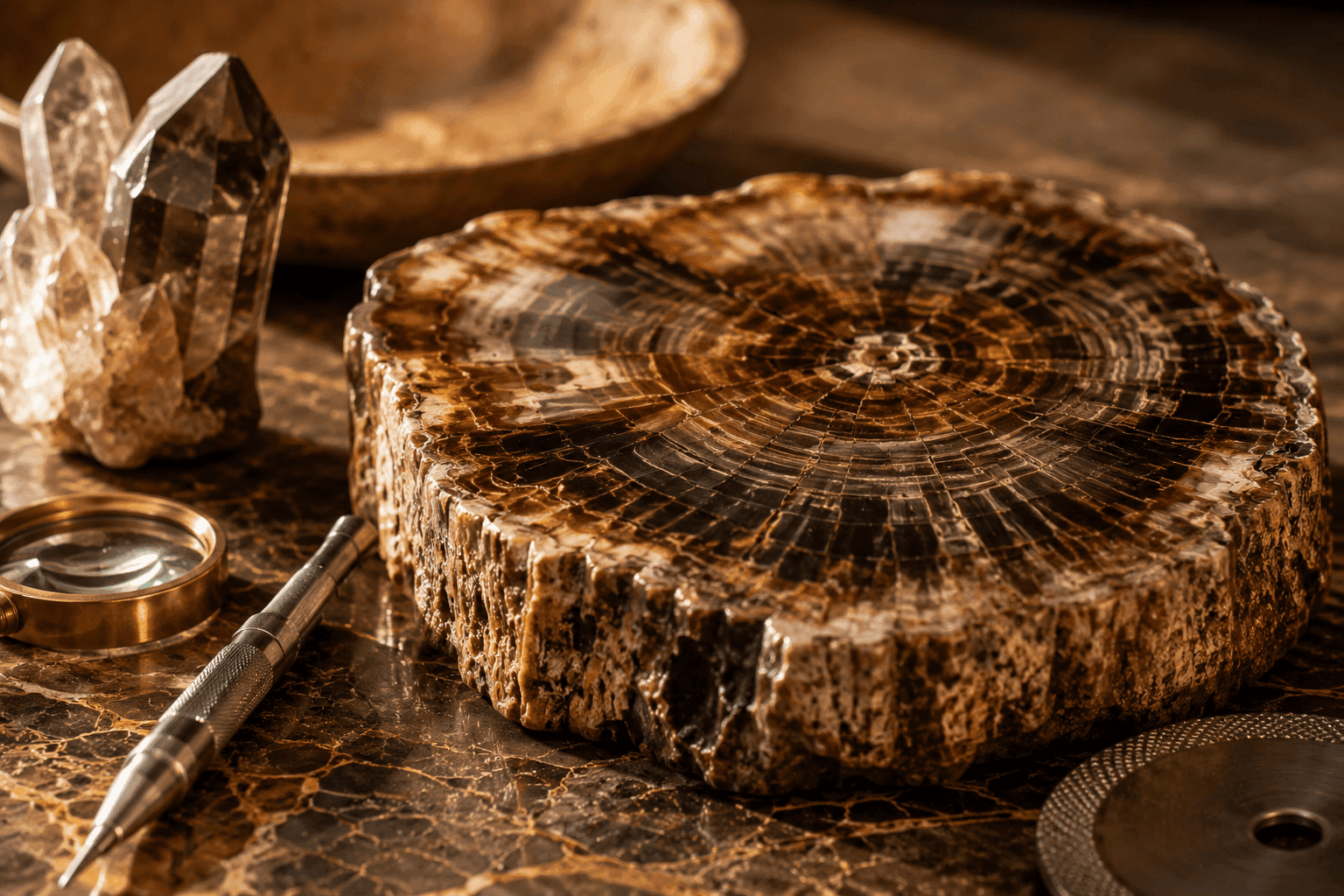
A polished slab is, physically, quartz. That has practical consequences worth stating plainly:
- It doesn't absorb water, so it won't stain, swell, or warp.
- It's indifferent to heat, direct sun, and UV — colors don't fade.
- It resists scratching far better than any hardwood surface, sitting at 7 on the Mohs scale.
- It's genuinely heavy — expect it to anchor a room rather than sit lightly in one.
These aren't marketing footnotes. They explain why a slab used as a table top or a wall piece will look the same in twenty years as it does the day it's installed.
A tree that fossilized before the first flowers existed doesn't ask for maintenance. It asks for placement.
Living With a Slab
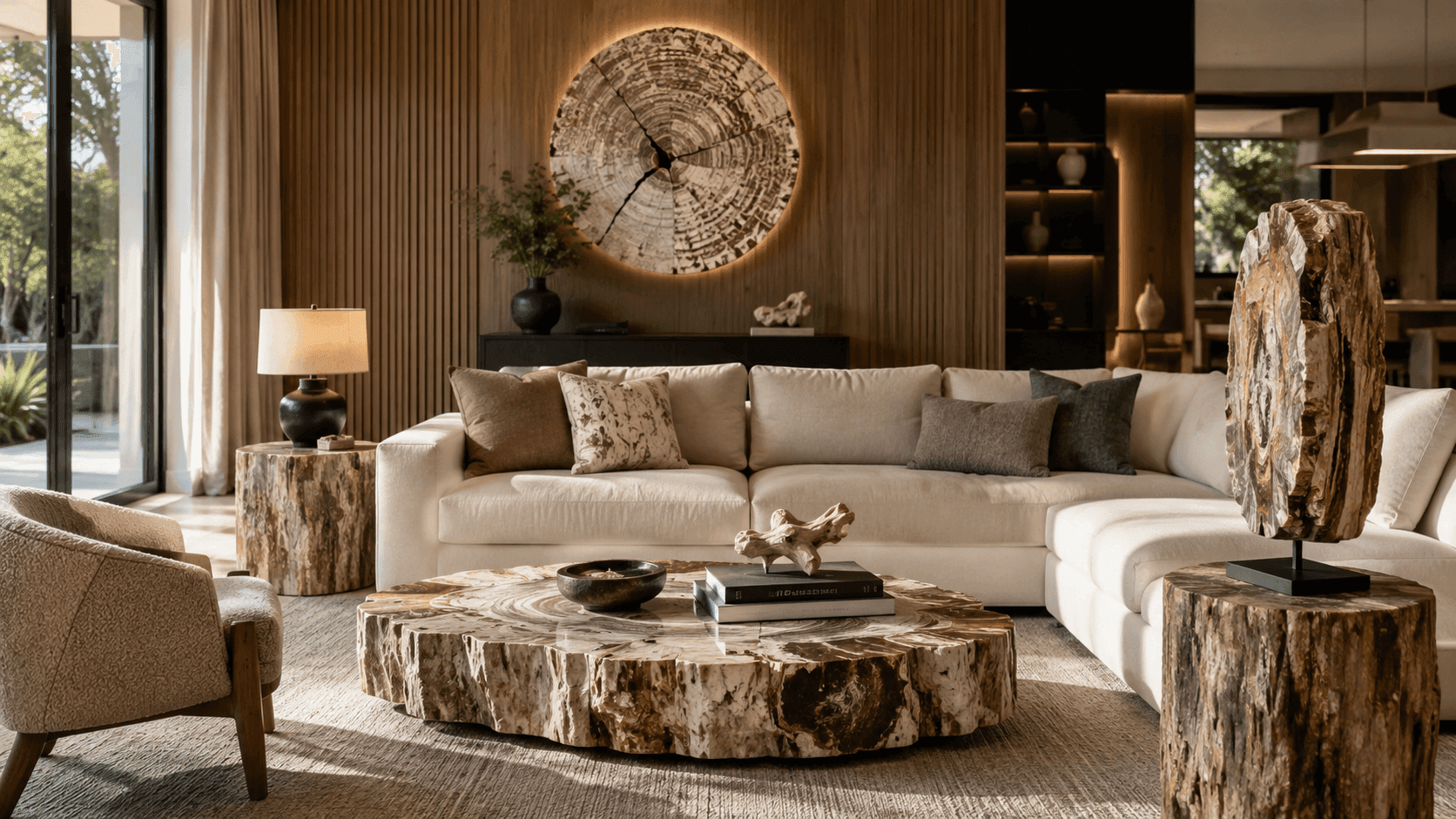
Polished slabs work as low tables, wall-mounted panels, plinths, or standalone sculptural objects — the choice depends on the trunk's original shape and the cut we take from it. Because each slab keeps the outline of its tree, no two are interchangeable, and none can be reordered once sold. Buyers aren't selecting a model number; they're selecting a specific cross-section of a specific tree that no longer exists as a whole.
This is worth considering before installation: a slab from Umbra will sit differently in a room than one from Argentea. The darker, denser trunks read as grounding, almost architectural. The paler, more silvered ones catch light and feel lighter in the same space — despite weighing exactly the same.
Browse the slabs currently available and speak with us about placement, size, and finish.
View the ShopQuestions fréquentes
How is a polished slab different from a raw or rough-cut piece?
A raw piece keeps its natural, unfinished surface — often textured, sometimes still bearing traces of the extraction. A polished slab has been ground and buffed to a smooth, reflective finish that fully reveals the internal grain and color.
Can a polished slab be used outdoors?
Yes. Since the material is quartz, it's unaffected by rain, frost, or UV exposure. The main consideration outdoors is simply the surface it rests on, given its weight.
Does the color of a slab change over time?
No. The coloration comes from mineral content fixed during fossilization, not from a surface treatment. It won't fade, oxidize, or shift with light exposure.
Is every slab a unique piece, or are there repeat patterns?
Every slab is unique. Because it comes from one specific trunk, and each trunk has its own mineral history, no two slabs share identical grain or color — and once a trunk is fully cut, that particular pattern is gone for good.