
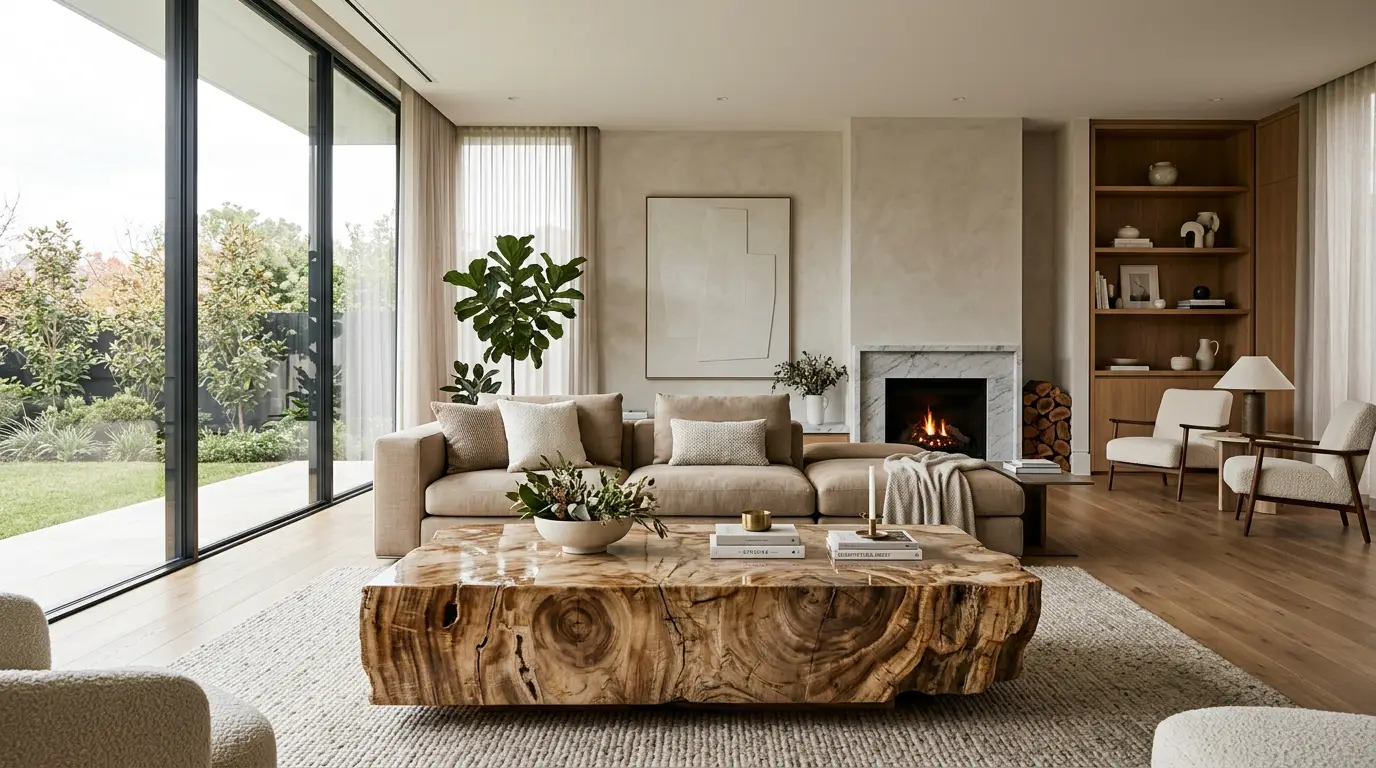
Petrified Wood Logs: One Tree, One Name, One Trunk
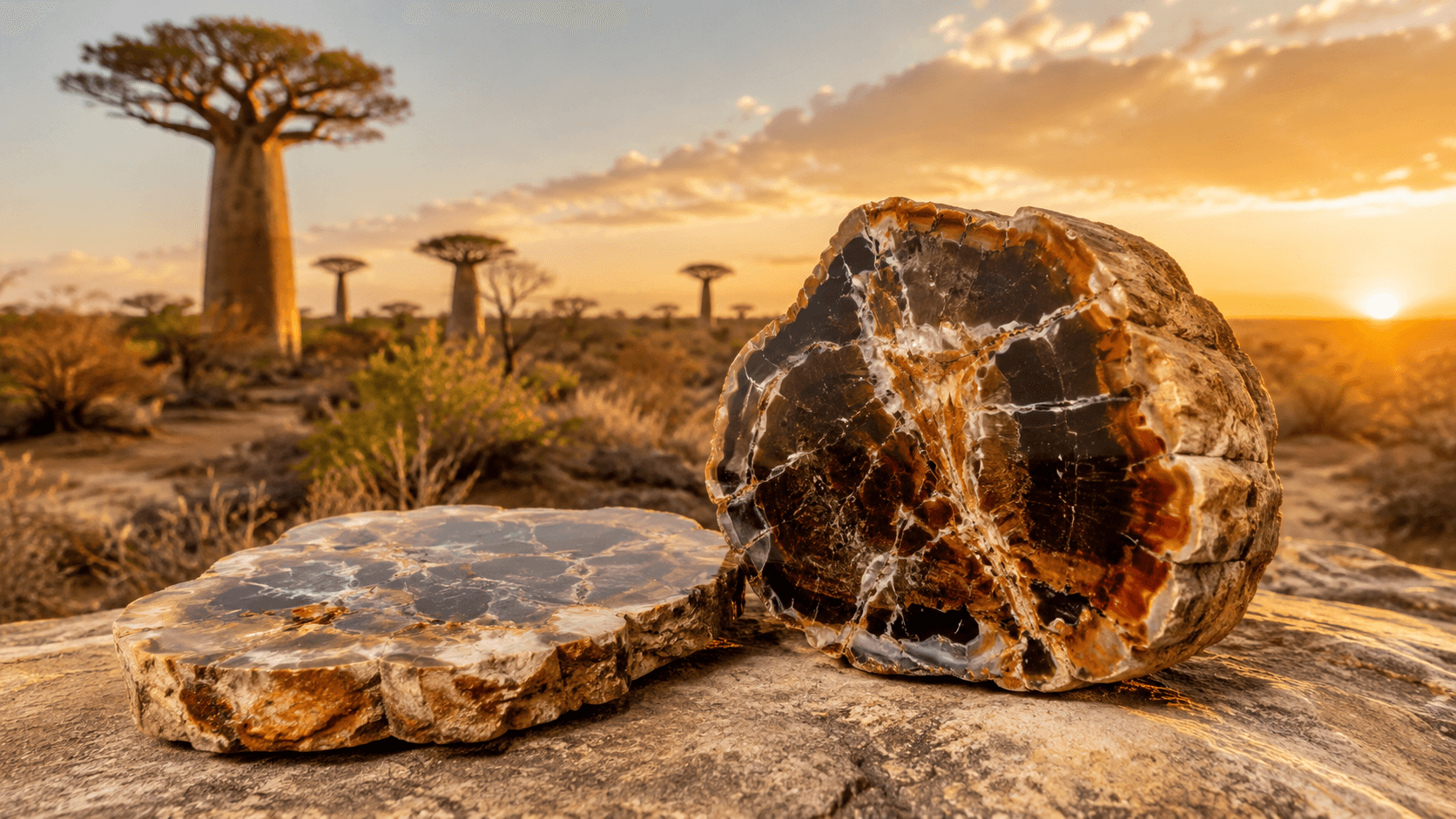
A petrified wood log is not a material sample. It is a tree — a single organism that grew, fell, and lay buried for millions of years before mineral silica took the place of its fibers, cell by cell. At Medusa, every log we bring up from the southwest of Madagascar keeps its own identity. We do not sell "petrified wood." We sell Ambra, Argentea, Fusca, Umbra, Viridis — trunks with names, each one unrepeatable.
This distinction matters more than it might seem. Once a log is cut, its particular palette of color and pattern is gone for good. There is no second Ambra. Choosing a log, or a piece cut from one, is choosing a specific tree — not a category of product.
From Triassic Forest to Riverbed
These logs are around 230 million years old, dating back to the Triassic period. The trees that became them grew long before the first dinosaurs walked the earth in their later, more familiar forms. Over time, groundwater rich in dissolved silica infiltrated the buried wood, replacing organic tissue with quartz while preserving the original structure — growth rings, bark texture, sometimes even insect galleries.
The result is a stone that remembers being a tree. Cut a log open and you are not looking at an abstract pattern; you are looking at the exact anatomy of a plant that lived in a world without flowers.
- Origin: exclusively southwestern Madagascar, where deposits of this quality are found
- Age: approximately 230 million years, Triassic period
- Composition: quartz, formed through silica replacement of organic wood
- Preservation: growth rings, bark lines, and structural detail often remain legible
What a Log Becomes: Reading the Grain
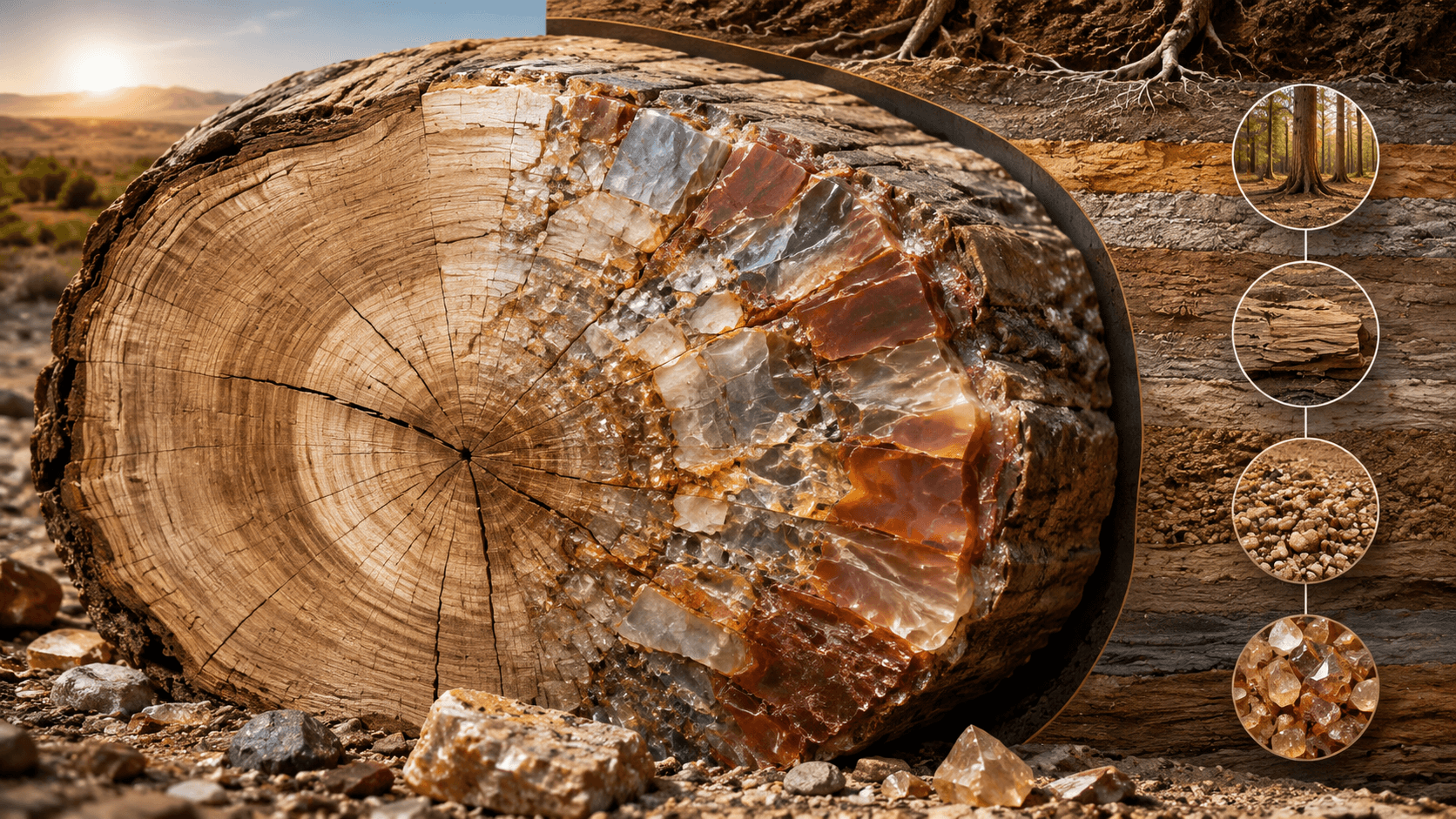
Cut and polish a log, and its interior opens like a page. Growth rings appear as concentric bands, sometimes tight and regular, sometimes interrupted by knots or fractures that occurred long before petrification. Color runs through these rings unevenly, following the mineral veins that infiltrated the wood at different stages.
This is why no two slabs from the same log are identical, and why a log's color cannot be replicated once it has been fully worked. The palette is fixed the moment silica finished its slow substitution, millions of years ago. What our artisans do today is simply reveal it — cutting, grinding, and polishing to expose what was already there.
A petrified log does not imitate wood. It is the wood, translated into stone.
Quartz Through and Through
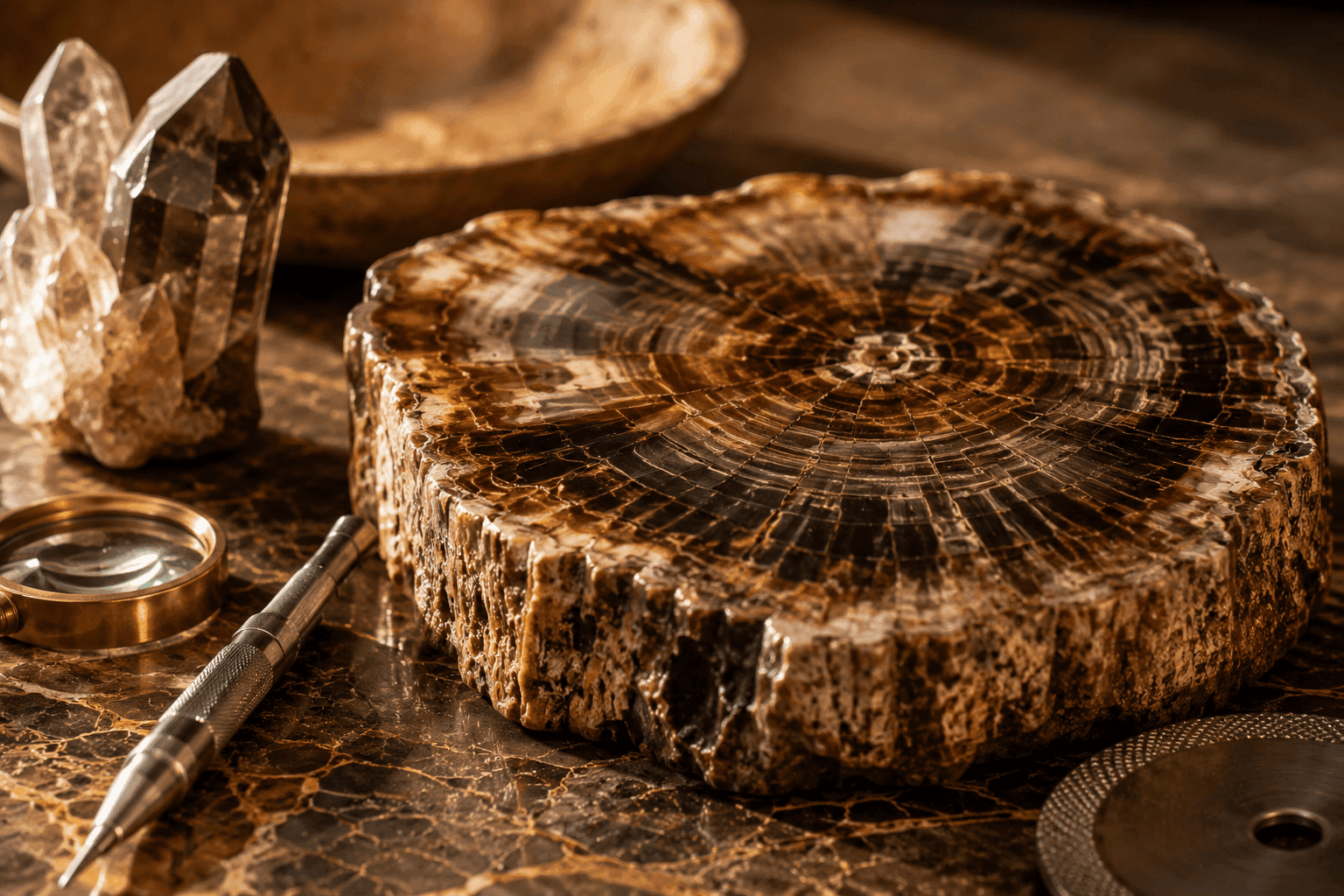
The transformation from organic wood to fossil is total: what remains is quartz, registering 7 on the Mohs hardness scale. This has direct consequences for how a log — or an object cut from it — behaves in daily life:
- Heavy and dense, with a cold touch typical of stone rather than timber
- Unaffected by water, so a vessel or basin cut from a log needs no sealing or maintenance
- Stable under heat and UV exposure, with no risk of fading or warping
- Resistant to frost, making outdoor placement possible where wood would fail
The colors themselves come from trace metals present during mineralization: iron produces reds and ochres, manganese gives blacks and violets, while chromium and cobalt yield the rarer greens and blues. These are not applied finishes. They are chemical signatures, fixed in the stone.
Named, Not Numbered: Our Logs
Every log we source is assessed on its own terms before it earns a name. Ambra carries the warm amber tones typical of iron-rich mineralization. Argentea shows the cooler, silvery grays that come from a different mineral balance. Fusca runs deep brown, dense and quiet. Umbra darkens further, toward black and violet, marked by manganese. Viridis, the rarest, holds the green and blue hues left by chromium and cobalt — a mineral combination Madagascar's deposits rarely produce in quantity.
This naming is not decoration. It reflects how we work: each trunk is handled individually, from extraction to the final piece, rather than pooled into an anonymous stock of "petrified wood slabs." When a log is gone, that particular name closes with it.
Living With a Log
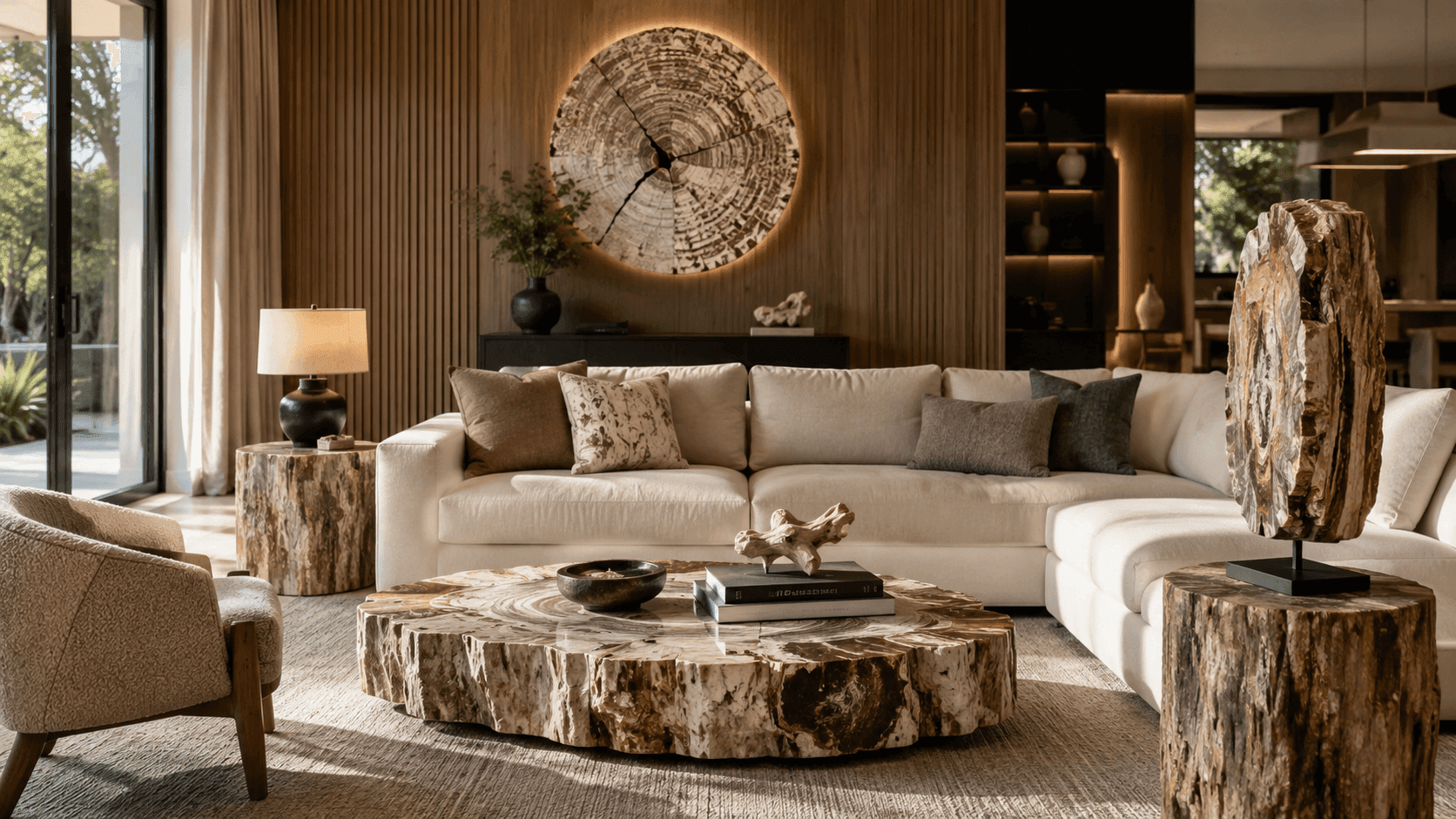
A raw or lightly worked log holds its own as an object, independent of any function. Placed in an entryway, a library, or beside a fireplace, it reads as sculpture — a fragment of deep time set into a room. Some clients choose a log left largely intact, polished on one face to reveal the grain while keeping its natural silhouette elsewhere. Others prefer it cut into a table base, a vasin, or paired sections for a console.
Because the material carries real weight — both physical and visual — a single log often anchors a room more decisively than several smaller objects combined. Our artisans work each trunk according to its own structure, following existing cracks and color bands rather than forcing a uniform shape.
Discover the logs currently available, each with its own name and story.
Browse the BoutiqueFrequently Asked Questions
How old is a petrified wood log from Madagascar?
The trunks we work with date to the Triassic period, roughly 230 million years ago. Silica infiltration replaced the original organic wood with quartz over an extended geological timescale.
Is petrified wood actually a type of stone?
Yes. Despite retaining the visible structure of wood — rings, bark, grain — the material is now quartz, registering 7 on the Mohs hardness scale. It behaves entirely as stone: heavy, cold to the touch, and unaffected by water or heat.
Why does each log have a different color?
Color comes from trace metals present during mineralization. Iron produces reds and ochres, manganese produces blacks and violets, and chromium or cobalt produce greens and blues. Since mineral conditions vary from trunk to trunk, no two logs share an identical palette.
Can a petrified wood log be placed outdoors?
Yes. The quartz composition makes it resistant to frost, UV exposure, and moisture, so it can be placed outdoors without the sealing or maintenance that timber would require. Placement should still account for the piece's considerable weight.