
The Search Bar Doesn't Lie
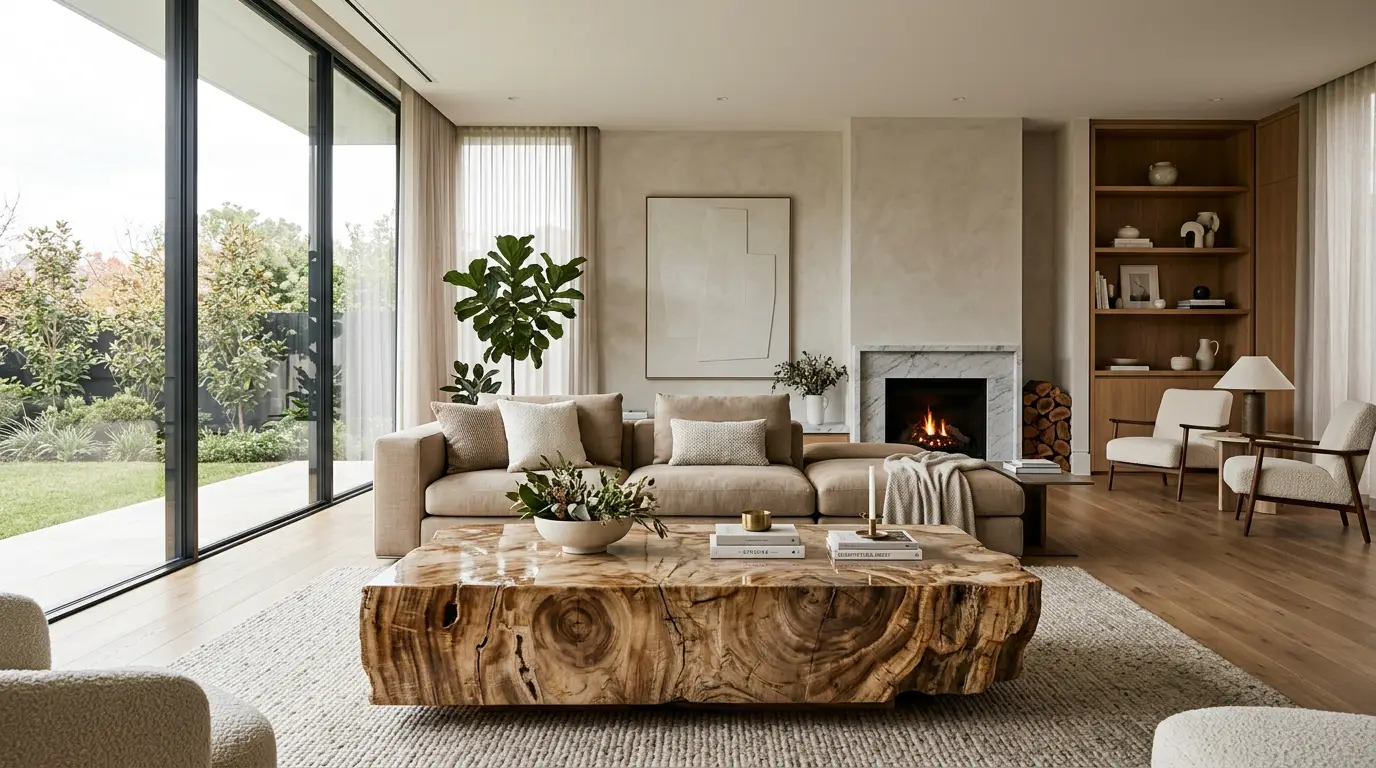
Type "petrified wood formica countertop" into any search engine and you'll find laminate sheets printed with a photograph of stone — a texture wrapped around particleboard, sold by the square foot, indistinguishable from its neighbor once installed. The search itself tells a story: people want the look of petrified wood in their kitchen or bathroom, but they're being offered a picture of it instead of the thing itself. This page exists to close that gap.
What a Laminate Surface Actually Is
Formica and comparable laminates are manufactured surfaces: layers of kraft paper impregnated with resin, topped with a printed decorative sheet, pressed under heat onto a substrate. The "petrified wood" pattern is a photograph — often a single photograph, repeated and mirrored across the sheet. It's a legitimate, practical product for many uses. It is not stone. It won't feel cold to the touch the way quartz does. It won't carry weight the way a solid trunk does. And it can't do the one thing petrified wood does effortlessly: age without changing.
Stone That Was Once a Tree
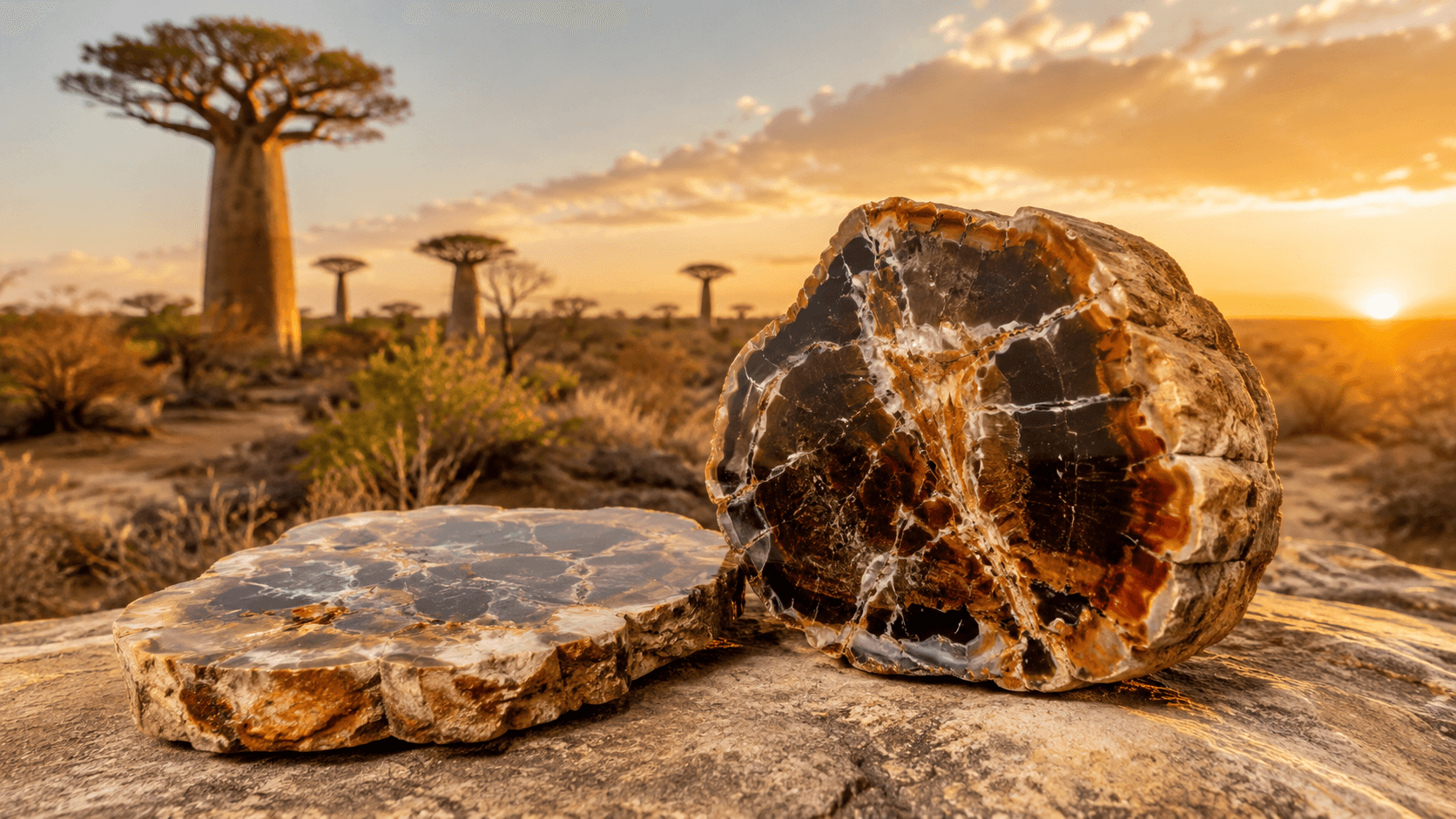
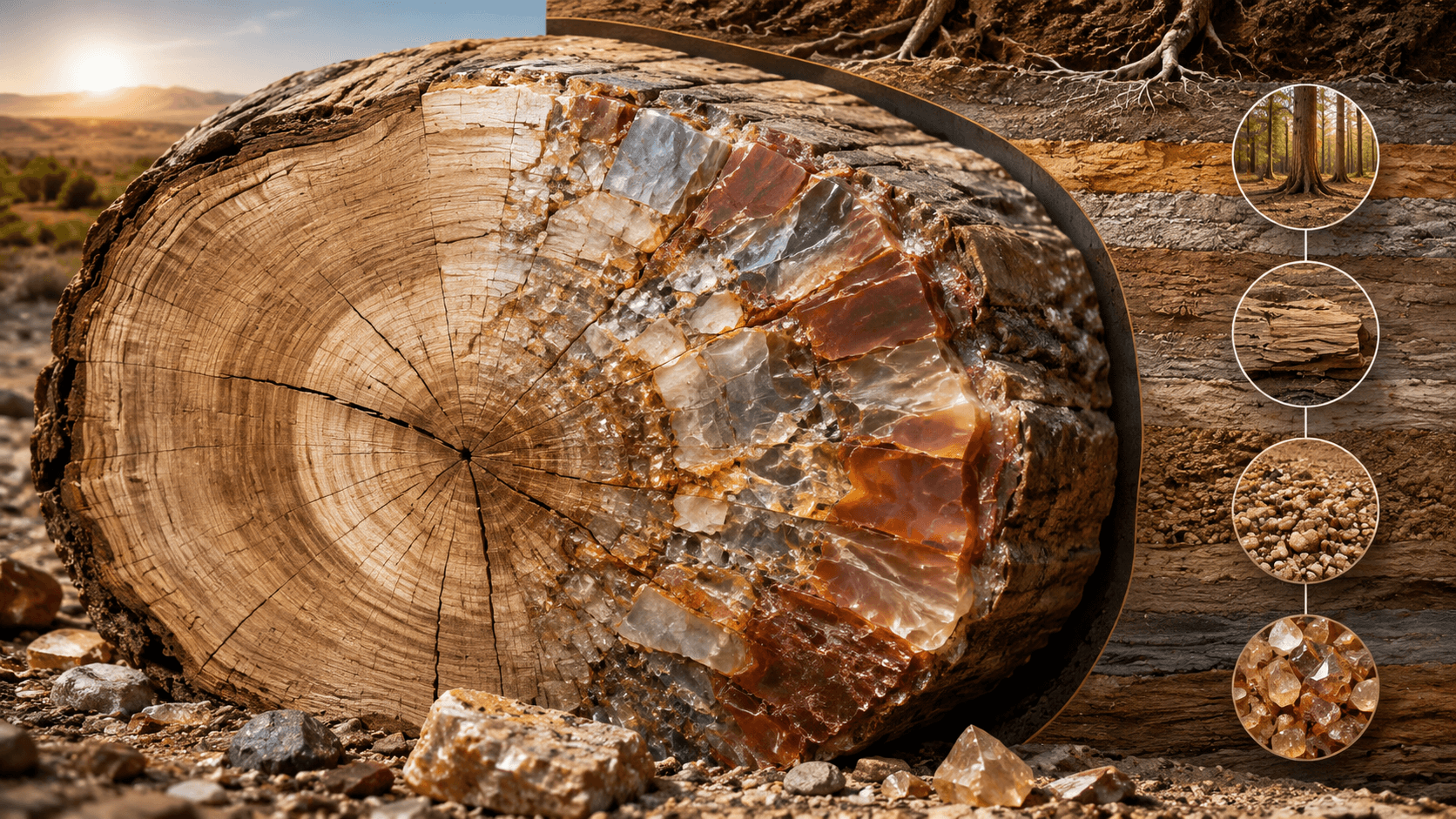
Real petrified wood begins as an actual tree. In the arid basins of southwestern Madagascar, trunks fell some 230 million years ago and were buried before they could rot. Groundwater carrying dissolved silica moved through the wood's cellular structure, replacing it cell by cell with quartz. The bark is gone. The tree is not. What remains is a stone that preserves the anatomy of the plant it once was — the growth rings, the fractures, the grain — while being, mineralogically, no different from a crystal.
That transformation is why petrified wood scores 7 on the Mohs hardness scale, the same as quartz. It's why it's indifferent to water, heat, UV light, and frost. And it's why the colors you see — ochre and red from iron, black and violet from manganese, occasional green or blue from chrome and cobalt — were set in the mineral itself, underground, long before anyone cut it.
Why Each Trunk Has a Name
At Medusa, every trunk we bring up from the sub-soil of southwestern Madagascar is treated as what it is: an individual tree, not a category of material. We give each one a name — Ambra for amber tones, Argentea for silvered grays, Fusca for deep browns, Umbra for near-black, Viridis for the rarer greens. These aren't marketing labels for a product line; they describe the specific mineralization of one specific trunk, formed by whichever metals happened to be present in that spot 230 million years ago.
This matters practically. Once a trunk is cut, that particular combination of color and pattern is gone. There is no reprinting the sheet, no reordering the batch. A laminate manufacturer can produce the same "petrified wood" pattern indefinitely. We cannot — and we don't try to.
A photograph of a tree can be copied infinitely. The tree itself cannot.
Living With the Real Material
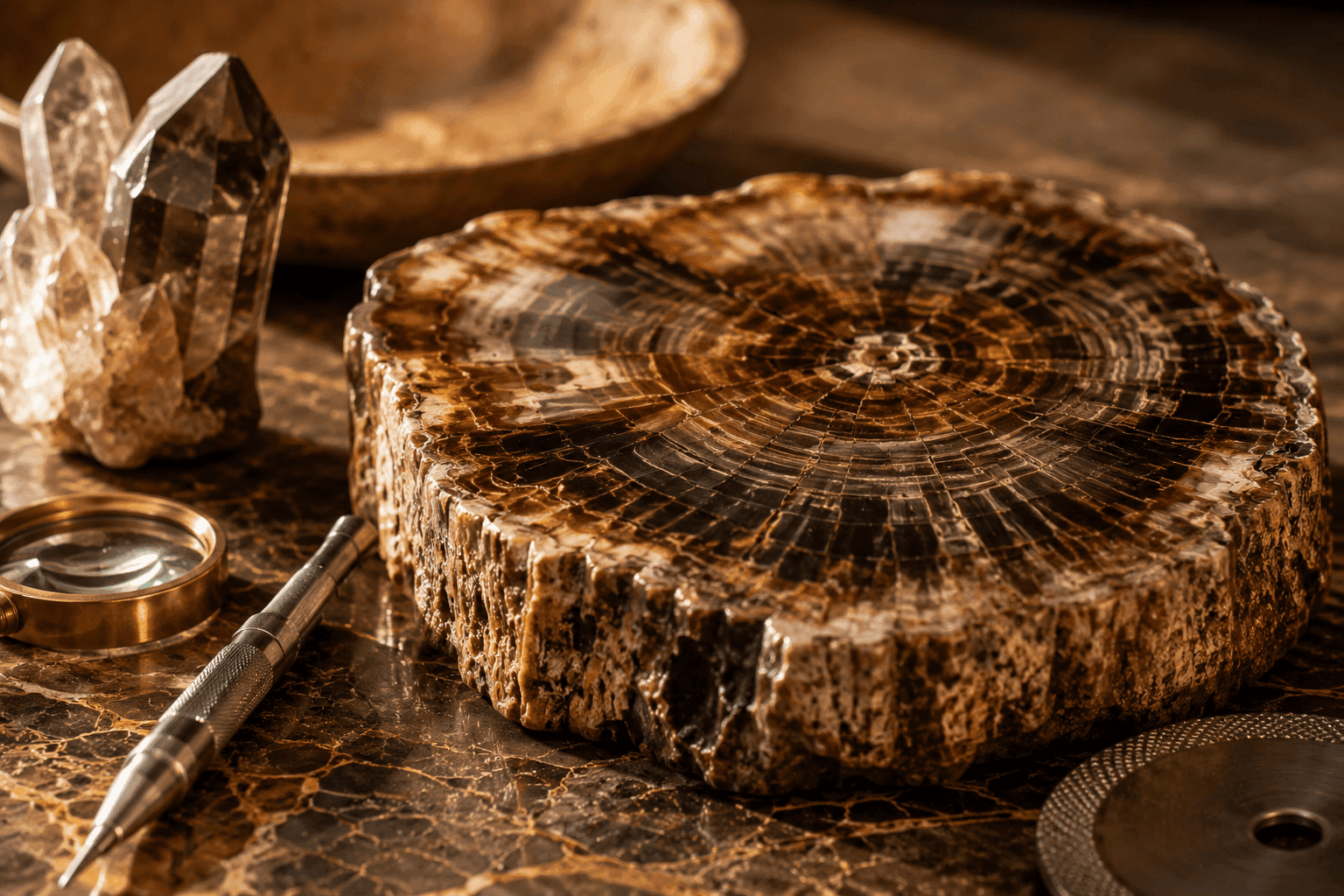
The practical difference between laminate and petrified wood shows up in daily use, not in photographs:
- Heat: a hot pan set directly on petrified wood does nothing to it; laminate can scorch or delaminate.
- Scratches: at Mohs 7, petrified wood resists everyday abrasion; laminate's printed layer can wear through with use.
- Water: petrified wood is entirely indifferent to moisture, indoors or out; laminate seams and edges are vulnerable points.
- Weight and presence: a slab of petrified wood is dense and solid underhand — laminate, by design, is light because it's a veneer over board.
- Longevity: petrified wood has already survived 230 million years underground; a laminate surface is expected to last a couple of decades before replacement.
The Honest Comparison
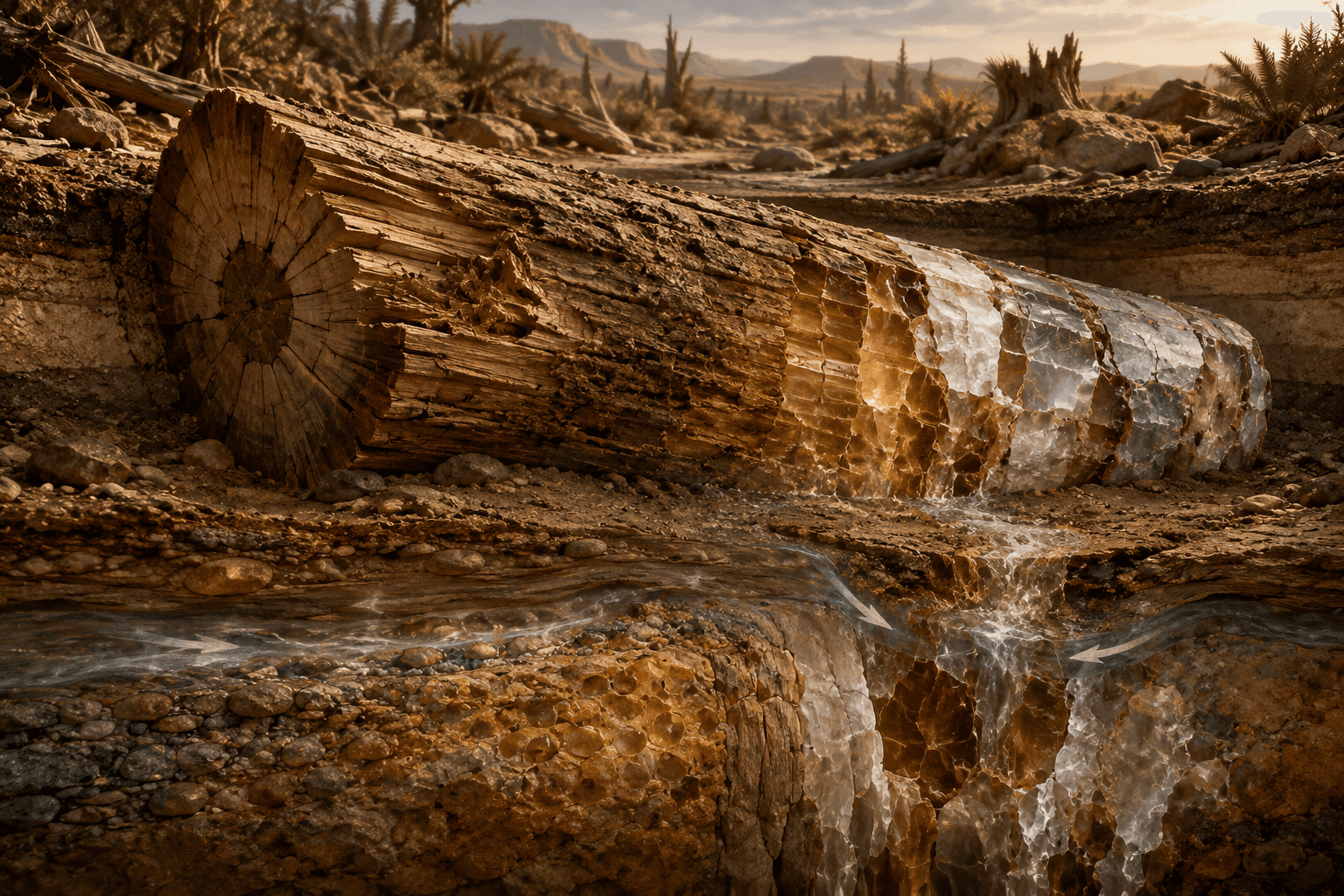
Laminate imitates an image. Petrified wood is the object the image was taken of. That's not a knock on laminate as a category — it serves budgets and applications where solid stone isn't practical. But calling it "petrified wood" is a stretch of language the material can't back up: no fossilization, no quartz, no individual trunk history, no metals coloring it from within. If the appeal was ever the idea of an ancient tree turned to stone, laminate can only gesture at that idea. The trunk itself delivers it.
See the actual trunks, each named and photographed as it is — no printed pattern involved.
Visit the ShopFrequently Asked Questions
Is petrified wood the same hardness as granite or quartzite countertops?
Petrified wood measures 7 on the Mohs scale, the hardness of quartz — comparable to or harder than many countertop stones, and considerably harder than any laminate surface.
Why do laminate "petrified wood" designs all look identical?
Because they're printed from a single photograph repeated across the sheet. Real petrified wood varies trunk to trunk, since each one mineralized differently underground.
Can petrified wood be used as a functional countertop or washbasin, like laminate is?
Yes — its hardness, water resistance, and heat resistance make it suitable for countertops, washbasins, and tabletops, generally finished and fitted piece by piece, on request.
Where does Medusa's petrified wood come from?
Southwestern Madagascar, where trunks around 230 million years old are found in the sub-soil and brought up individually, one tree at a time.