
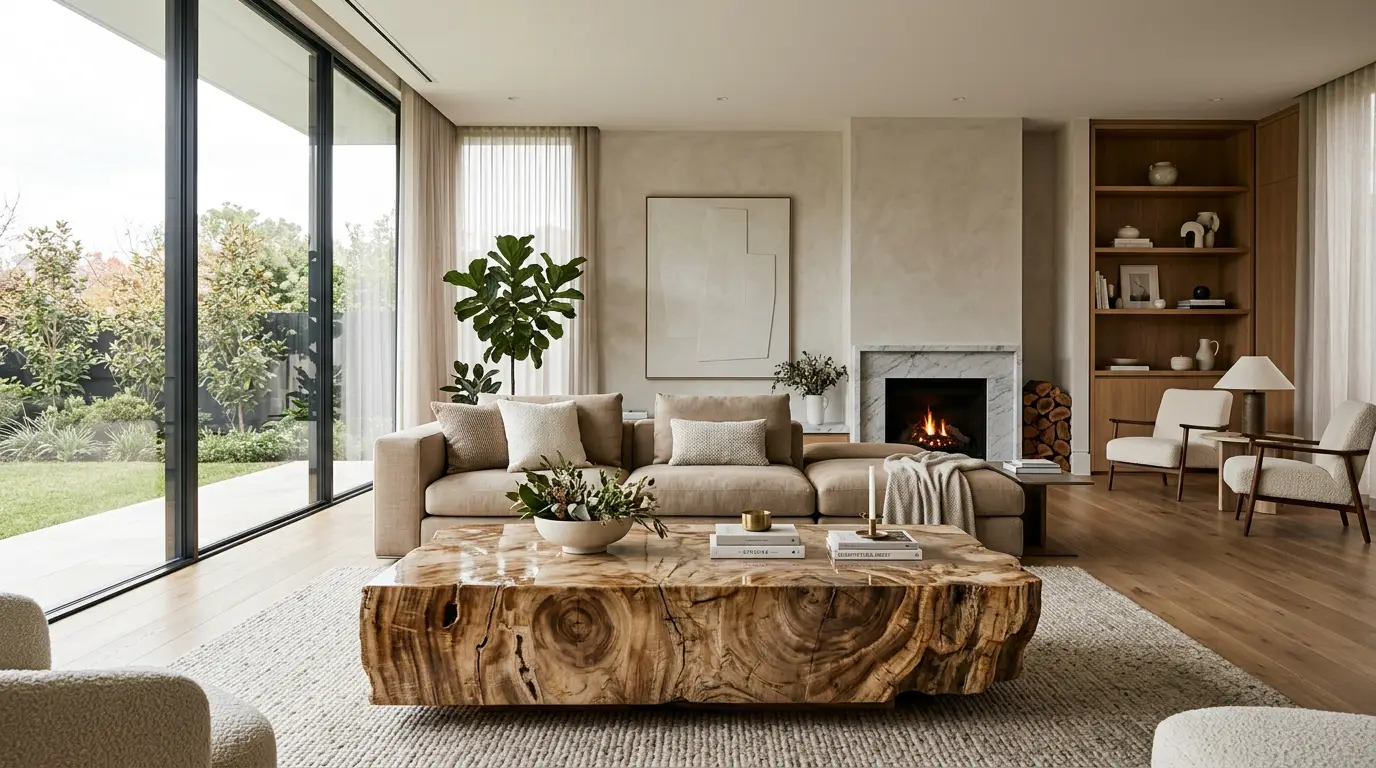
A Kitchen Counter That Was Once a Tree
Long before it becomes a countertop, each block in this collection was a living tree in what is now southwestern Madagascar. Some 230 million years ago, in the Triassic, it fell, was buried, and was slowly replaced — cell by cell — with silica. What remains is quartz: the tree's exact form, held in stone. At Medusa, we don't sell "petrified wood" as a generic material. We recover individual trunks, one at a time, and give each one a name — Ambra, Argentea, Fusca, Umbra, Viridis — because no two ever look alike, and once a trunk is cut, its particular palette is gone for good.
A kitchen countertop cut from such a trunk is not a surface. It is a cross-section of deep time, fitted to the room where you cook.
Why Quartz Belongs in a Kitchen
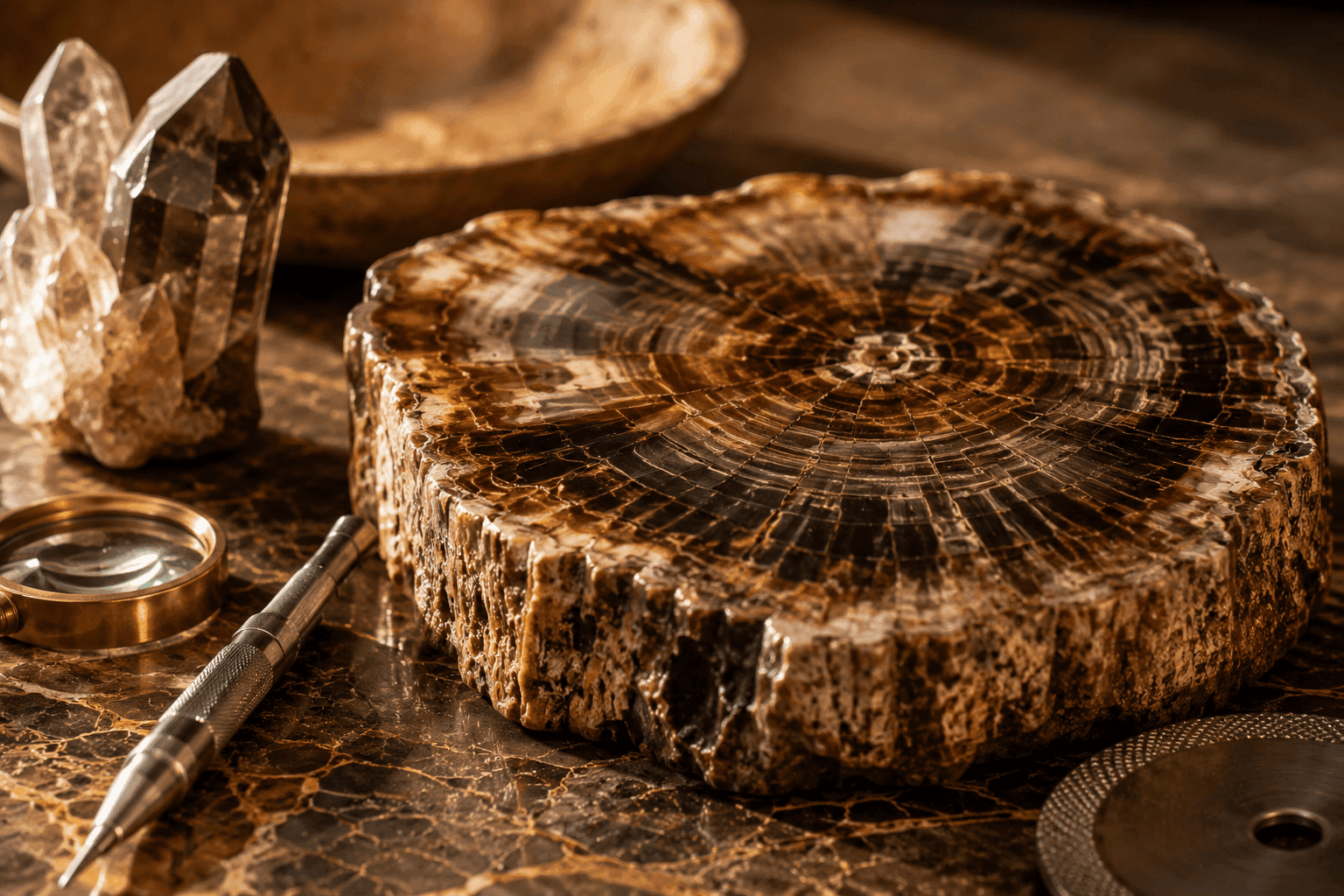
The kitchen is the harshest room in any home for a natural surface — heat, water, acid, knives, daily abrasion. Petrified wood was built for exactly this kind of punishment, long before it ever met a kitchen.
- Hardness 7 on the Mohs scale — harder than most steel blades, resistant to scratching from everyday use.
- Pure quartz composition — inert to water, heat, UV light, and frost. No sealing against staining, no fading near a window.
- Density and weight — a countertop that feels substantial underhand, cold to the touch even in a warm room, in the way only true stone can be.
Where marble scratches and etches under lemon juice, and wood scars under a hot pan, petrified wood simply endures. It was already stone when granite counters were still being marketed as "durable."
Every Trunk, Its Own Colour
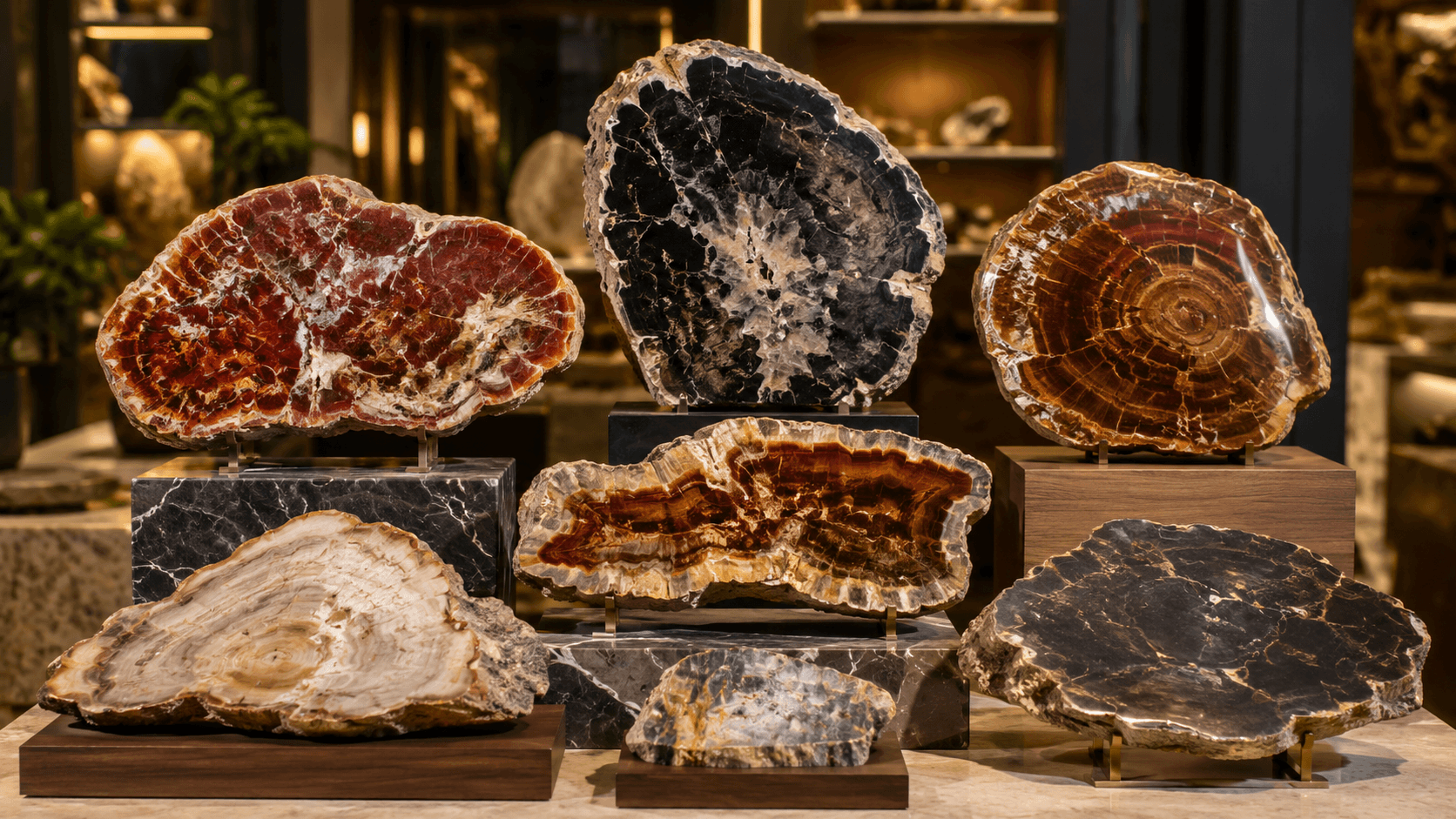
The colour of a countertop is not chosen from a chart — it is inherited from the specific minerals that infiltrated that specific tree. Iron produced the reds and ochres of Fusca. Manganese gave Umbra its near-black, violet-shadowed depth. Traces of chromium and cobalt turned parts of Viridis toward green and blue, a rarer occurrence in Madagascar's deposits.
This is why we work trunk by trunk rather than by "collection." A slab from Argentea, with its pale, silvered striations, will never be replicated once that particular tree has been fully cut. Choosing a Medusa countertop means choosing a tree, not a pattern.
From Trunk to Countertop
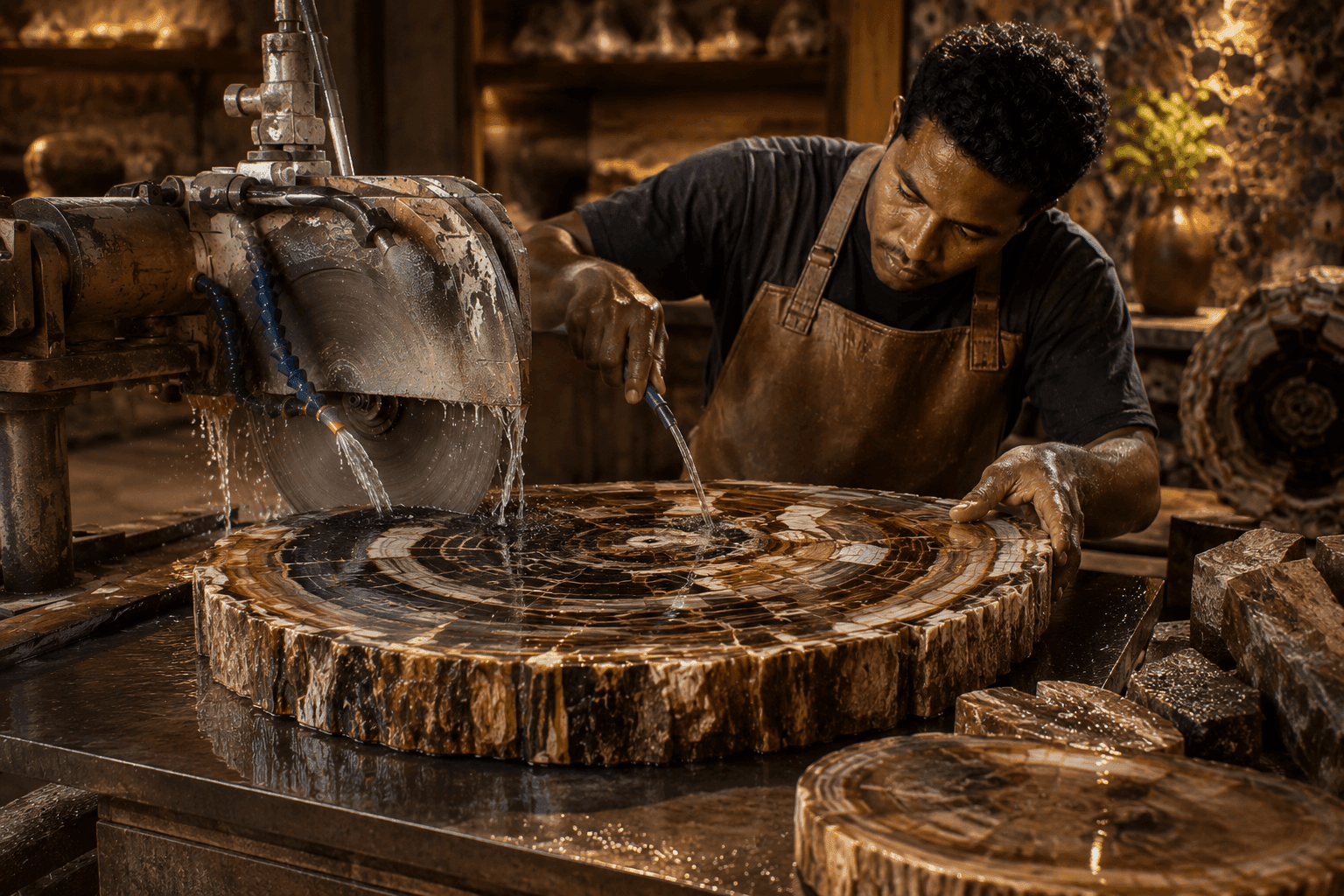
Turning a fossilized trunk into a functional kitchen surface asks for patience the material itself seems to demand. Each block is studied before a single cut is made — the direction of the grain, the density of veining, the way light will catch a polished growth ring.
- The trunk is sliced according to its internal structure, not forced into a standard template.
- Surfaces are polished progressively, since quartz takes an edge and a shine that softer stones cannot hold.
- Edges and undersides are finished to integrate with cabinetry, sinks, and cooktops on a case-by-case basis — every trunk yields a slightly different working size.
The result is a one-off surface: the same trunk will never produce a second, identical countertop.
A kitchen counter that has already survived 230 million years asks very little of the decades ahead of it.
Considerations Before You Choose Petrified Wood
Petrified wood countertops are not an everyday material, and they shouldn't be approached as one. A few practical points worth weighing:
- Weight — as with any solid quartz surface, cabinetry and support structures should be assessed beforehand; we advise on this per project.
- Availability by trunk — because each trunk is finite, sizes and continuous slabs vary; a large single-piece island counter is not always possible from every tree.
- Integration — sink cut-outs, appliance clearances, and edge profiles are worked out individually with our team, not selected from a catalogue.
None of this makes the material difficult — it makes it specific, the way a genuine material should be.
Living With It
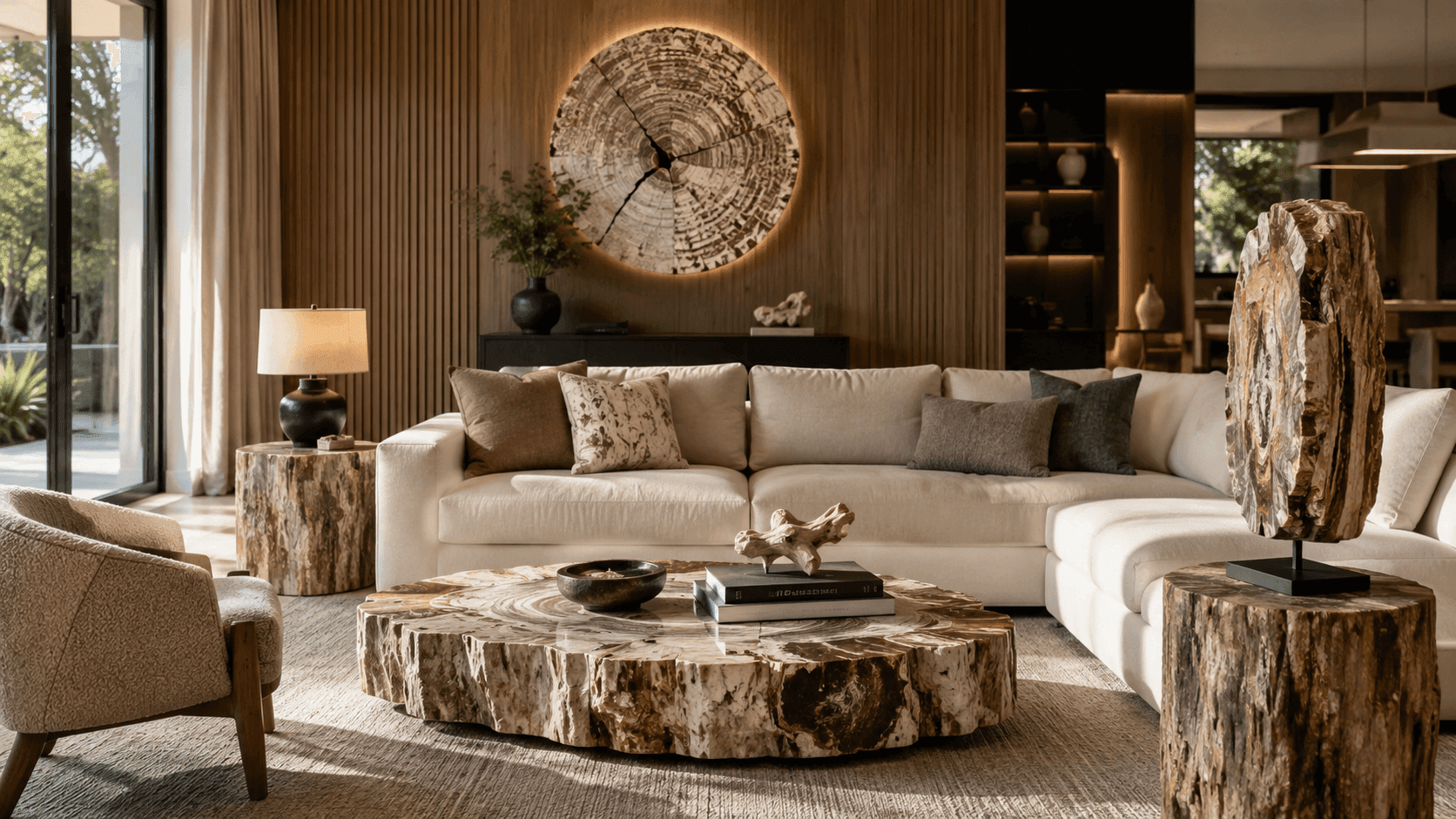
Beyond the kitchen, trunks from the same origin become vanities, low tables, and standalone sculptural objects — the material carries the same authority wherever it sits. But it is in the kitchen, under daily use, that its qualities are most tested and most appreciated: a surface that takes a scald without flinching, a stain without absorbing, a decade without dulling.
See the trunks currently available and discuss your project with us.
Explore the BoutiqueFrequently Asked Questions
Is petrified wood safe for direct contact with hot pans?
Yes. As pure quartz, it is unaffected by heat, so hot cookware placed directly on the surface will not damage or discolour it.
Does petrified wood stain like marble or wood?
No. Its quartz composition makes it non-porous in practice and resistant to staining from oils, acids, or pigments common in a kitchen.
Can I get a large single-slab island countertop?
It depends on the trunk. Since each block comes from one individual tree, the maximum continuous size varies — we advise on what a given trunk can provide, on a case-by-case basis.
Why do prices vary so much between pieces?
Each trunk is unique in size, colour, and density, so every countertop is priced individually. We invite you to request a quote for the specific piece you have in mind.