
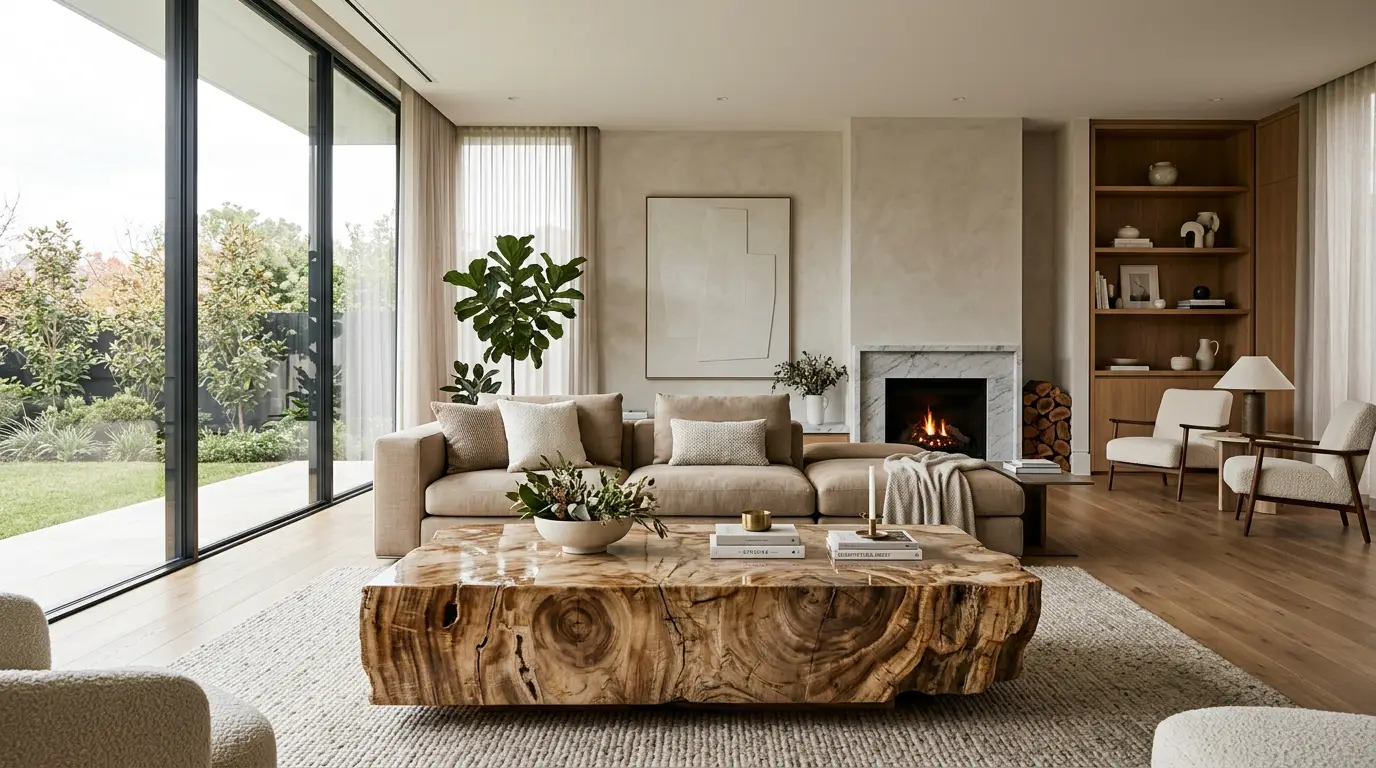
A Countertop That Is Also a Fossil
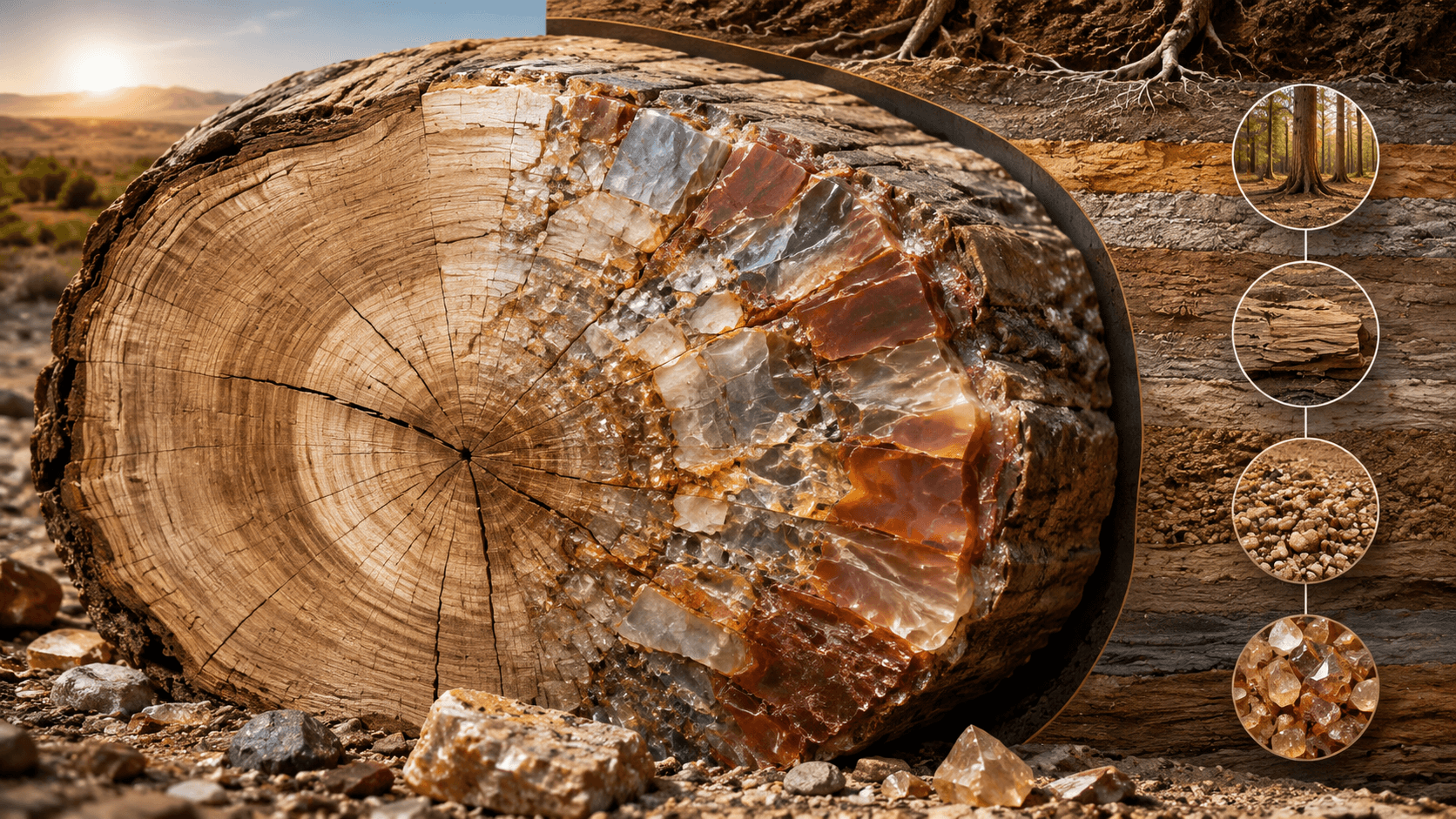
Most kitchen surfaces are manufactured. A petrified wood countertop is not. It is a slice of a tree that grew in the Triassic period, roughly 230 million years ago, and that slowly turned to stone while its structure remained intact. What you set your hands on is quartz — but quartz that still carries the memory of bark, grain, and growth rings.
This is the essential distinction. Marble and engineered stone are materials. A Medusa countertop is an object with a biography: one tree, one age, one mineralization, one name. When we cut it, we cut something that will never exist again in exactly that form.
Below, we explain what petrified wood is, why it performs so well in a kitchen, and how a surface is chosen and made at Medusa — one trunk at a time.
What Petrified Wood Actually Is
Petrified wood forms through a slow mineral substitution. A tree is buried, sealed away from oxygen, and over immense spans of time its organic tissue is replaced molecule by molecule with silica. The wood does not simply harden — it becomes quartz, faithfully preserving the original cellular architecture.
Our material comes from the south-west of Madagascar, where trees from the Triassic have surfaced after some 230 million years underground. Two consequences follow directly from this:
- It is stone, not wood. It behaves like quartz in every practical sense — dense, cold to the touch, indifferent to water.
- It reads like wood. Rings, knots, and grain are still visible, because the fossilization copied them precisely.
It grew as a tree. It survived as stone. On your counter, it does both at once.
Where the Colors Come From
The colors are not applied; they are chemistry. As silica filled the wood, dissolved metals settled into the structure and stained it:
- Iron produces reds, ochres, and warm browns.
- Manganese brings blacks and violets.
- Chromium and cobalt yield rarer greens and blues.
Because every trunk mineralized in its own ground, under its own conditions, no two carry the same palette. This is why we treat each tree individually rather than as a product line.
One Tree, One Name
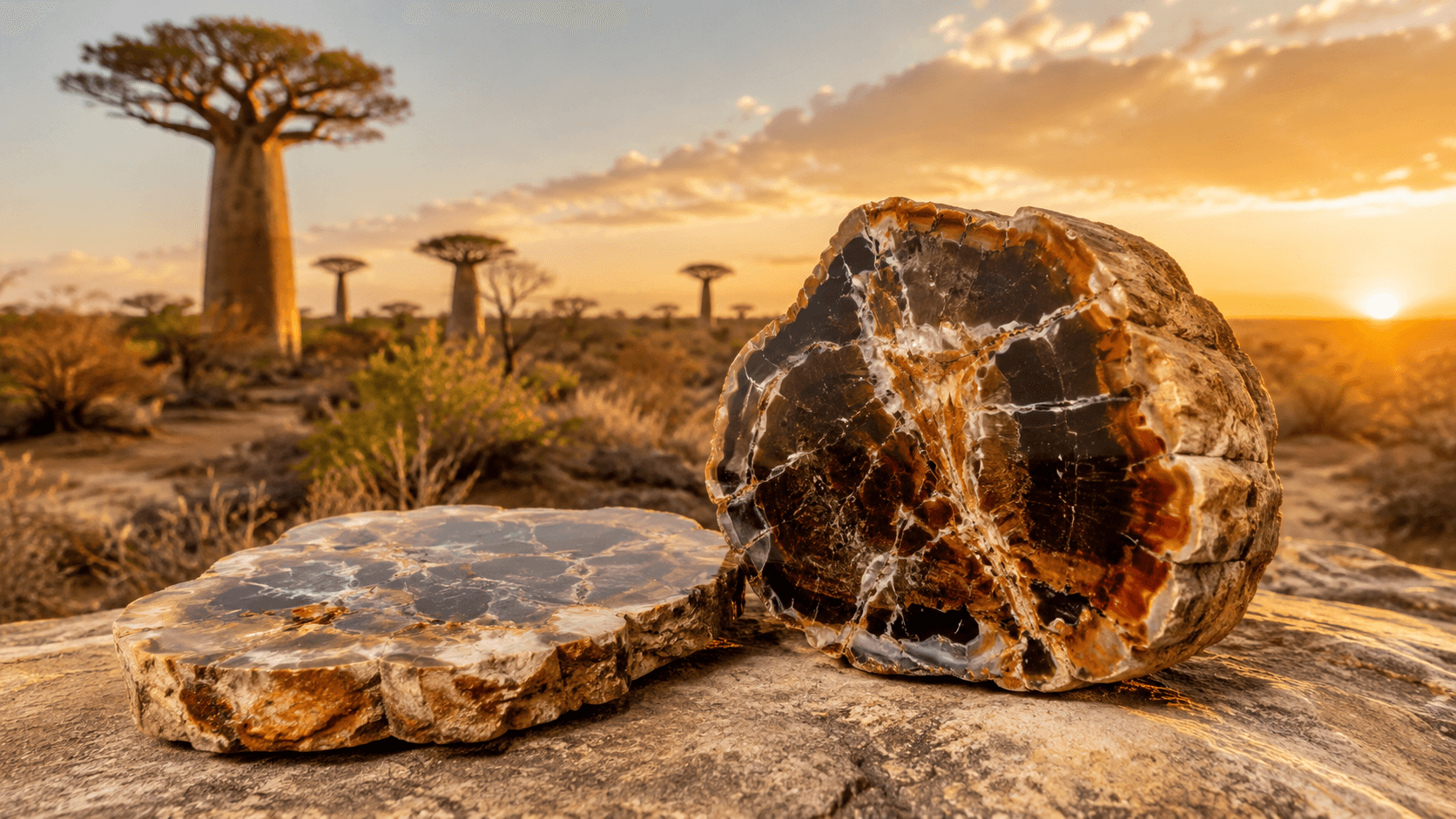
Here is what sets Medusa apart from sellers who move volume. We do not stock anonymous slabs. We raise each trunk one by one from the Malagasy soil, and we give each one a name that describes its own color:
- Ambra — amber, honeyed and luminous.
- Argentea — silvered, cool and pale.
- Fusca — deep brown, grounded and warm.
- Umbra — dark, dense, close to black.
- Viridis — the rare green tone born of chromium and cobalt.
These are not categories to pick from a catalogue. They are individual arbres. When a Fusca trunk is debited into a countertop, that particular brown leaves with it. Cut, it is gone for good. Choosing a Medusa surface therefore means choosing a specific tree — not a finish that can be reordered next year.
If you want to understand the naming logic in depth, our dedicated pieces on each name go further into how tone and mineralization relate.
Why It Belongs in a Kitchen
A kitchen is demanding: heat, blades, acids, spills, daily wear. Petrified wood answers each of these on its own terms, because it is quartz.
Hardness. It measures 7 on the Mohs scale — the hardness of quartz itself. That places it above ordinary steel. Knives do not scratch it; in practice, the surface will dull a blade before the blade marks it.
Heat. Having already endured geological time, a hot pan is trivial. It does not scorch, blister, or discolor from heat.
Water and stains. As dense mineral, it is effectively non-porous. It does not swell, warp, or rot. Wine, lemon, oil, and coffee sit on the surface rather than soaking in.
Light and time. UV does not fade it. Frost does not crack it. The color you see is fixed in stone, not a coating that ages.
The trade-off is mass. Quartz is heavy and cold to the touch, which is part of its presence but also a real consideration for installation — worktops and islands need proper support.
A Note on Feel
There is a sensory dimension people rarely anticipate. The surface stays cool. Run a hand across it and you feel polished mineral broken by the faint topography of grain. It is stone that remembers being alive, and the hand notices.
From Trunk to Worktop
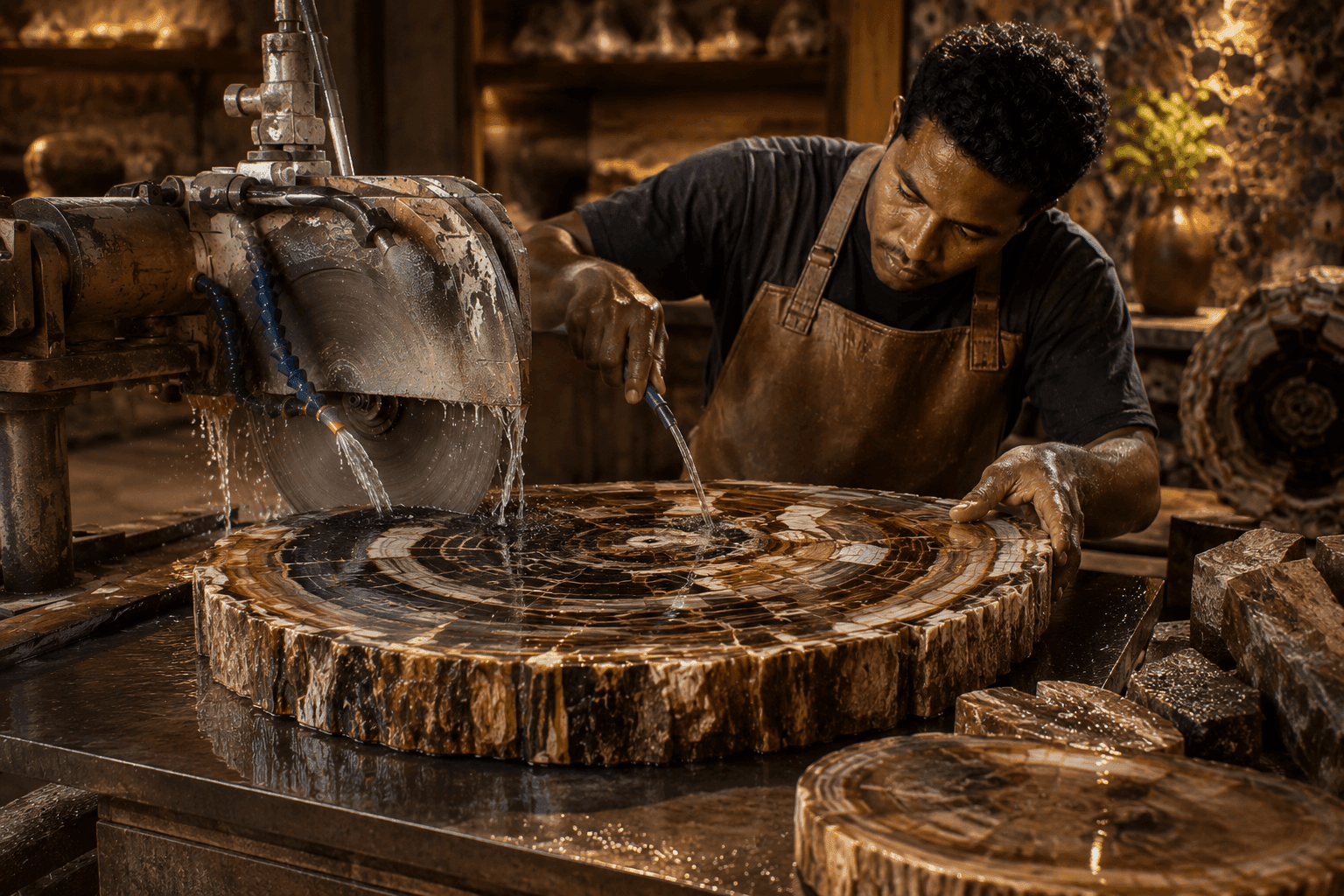
Turning a fossilized trunk into a usable countertop is patient work, and hardness cuts both ways. The same quality that protects your kitchen for a lifetime makes the material difficult to shape.
The process runs roughly as follows:
- Reading the trunk. We assess the whole tree — its dominant tone, its veining, the placement of natural voids — and decide how it should be opened to honor the grain.
- Cutting. Diamond tooling is required to slice quartz. This is slow, and it is where the tree's internal drawing is first revealed.
- Stabilizing. Natural fissures and cavities are consolidated so the surface can carry daily use without weakness.
- Polishing. Progressive polishing brings out the depth of color and the mineral sheen. The finish can be brought to a high gloss or left more restrained, depending on the piece.
Because every trunk is unique, no two countertops are dimensionally or chromatically identical. We work with what the tree gives, rather than forcing it toward a standard format.
Explore the trunks currently available and let us guide you toward the right one.
Visit the shopChoosing Your Surface
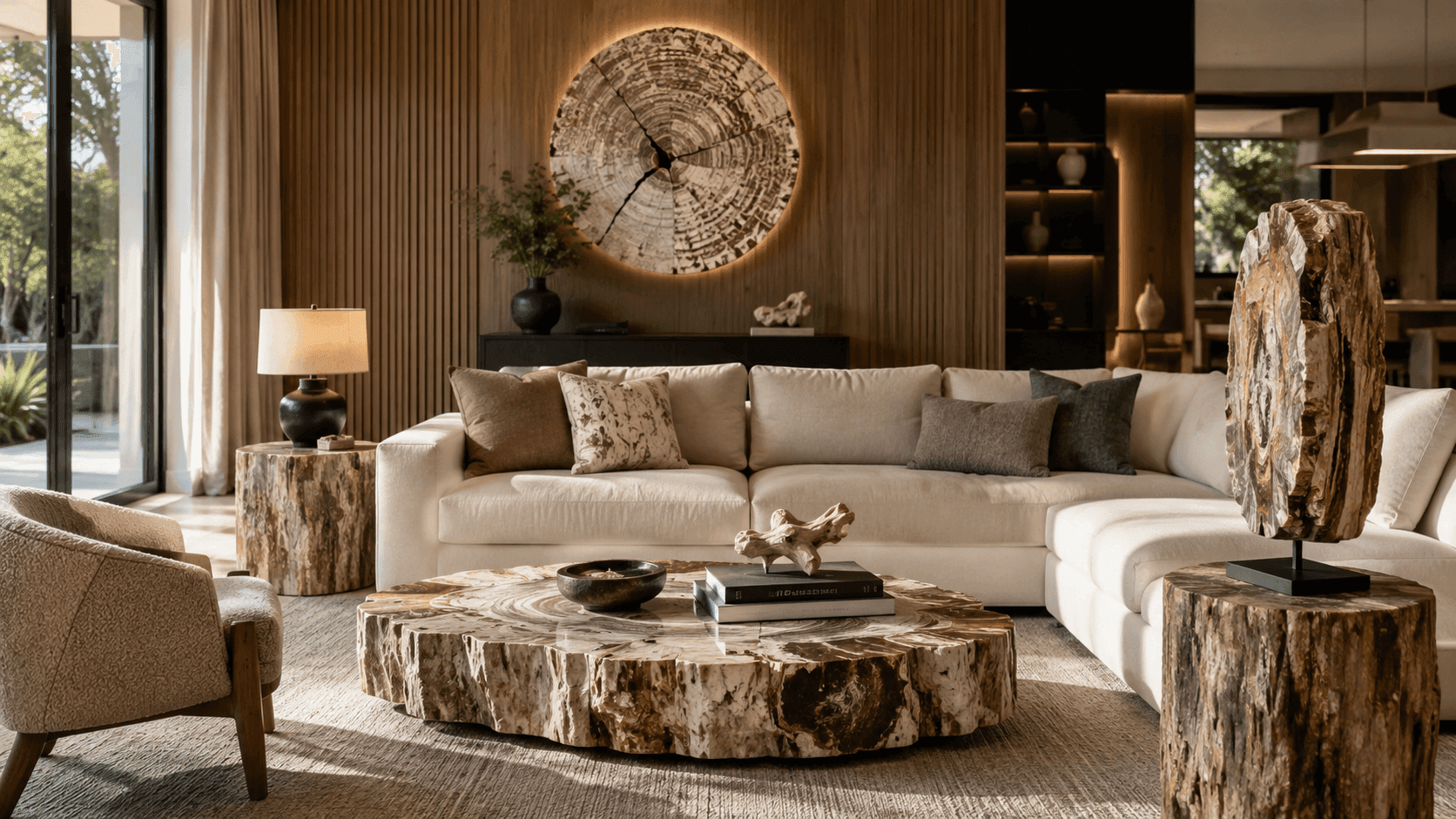
Selecting a petrified wood countertop is less like ordering a product and more like commissioning one. A few questions help frame the choice:
- What tone do you want the room to hold? A warm Ambra or Fusca grounds a space; a cool Argentea lightens it; a rare Viridis becomes the focal point.
- What scale? An island, a full worktop, a vanity top — each draws differently on a trunk's dimensions and figure.
- How much movement? Some trunks are quiet and even; others are crossed with dramatic veining. Both are authentic; it is a matter of temperament.
Because each piece is singular, we do not publish fixed prices — the surface is priced according to the specific tree, its dimensions, and the work it requires. The honest way to proceed is a conversation. Tell us what you have in mind, and we will match it to a trunk and prepare a quote.
Frequently Asked Questions
Can you really cut on a petrified wood countertop?
You can, and the surface will not mind — at 7 on the Mohs scale it is harder than steel. But it will dull your knives faster than a wooden board would, so a cutting board remains kinder to your blades.
Does a petrified wood countertop need sealing?
No. Unlike marble or many natural stones, fossilized wood is dense, effectively non-porous quartz. It resists water, oils, and acids without a sealant. Simple cleaning is enough to keep it as it is.
Can I order two matching countertops?
Not identically. Each countertop comes from a single, named trunk, and its color and figure vanish once that trunk is cut. We can select pieces that harmonize, but we cannot reproduce a given tone — that is precisely the point of the material.
How do I know the price?
Because every trunk is unique, pricing depends on the specific tree, its dimensions, and the work involved. Tell us your project through the shop and we will prepare a quote suited to the piece — please consult us.