
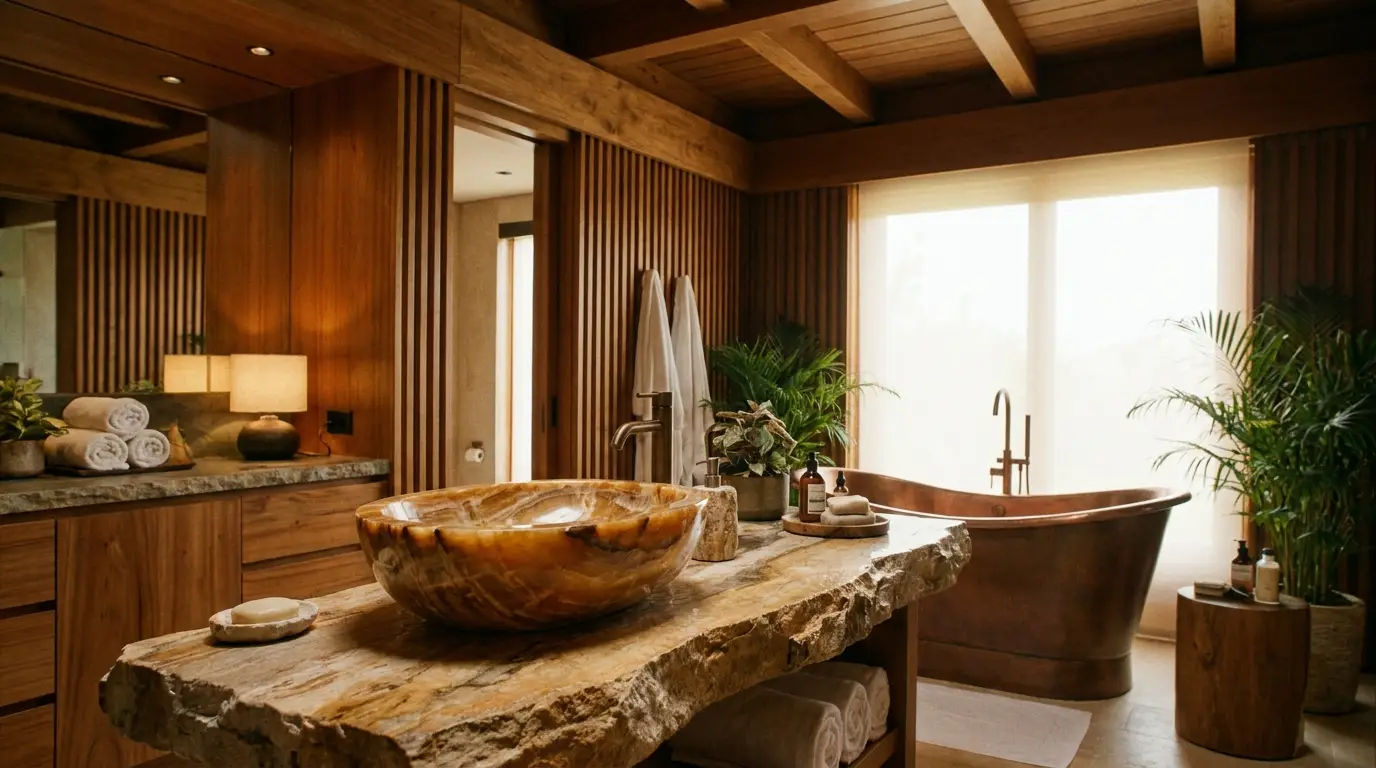
A Vessel Sink Carved From a Single Ancient Tree
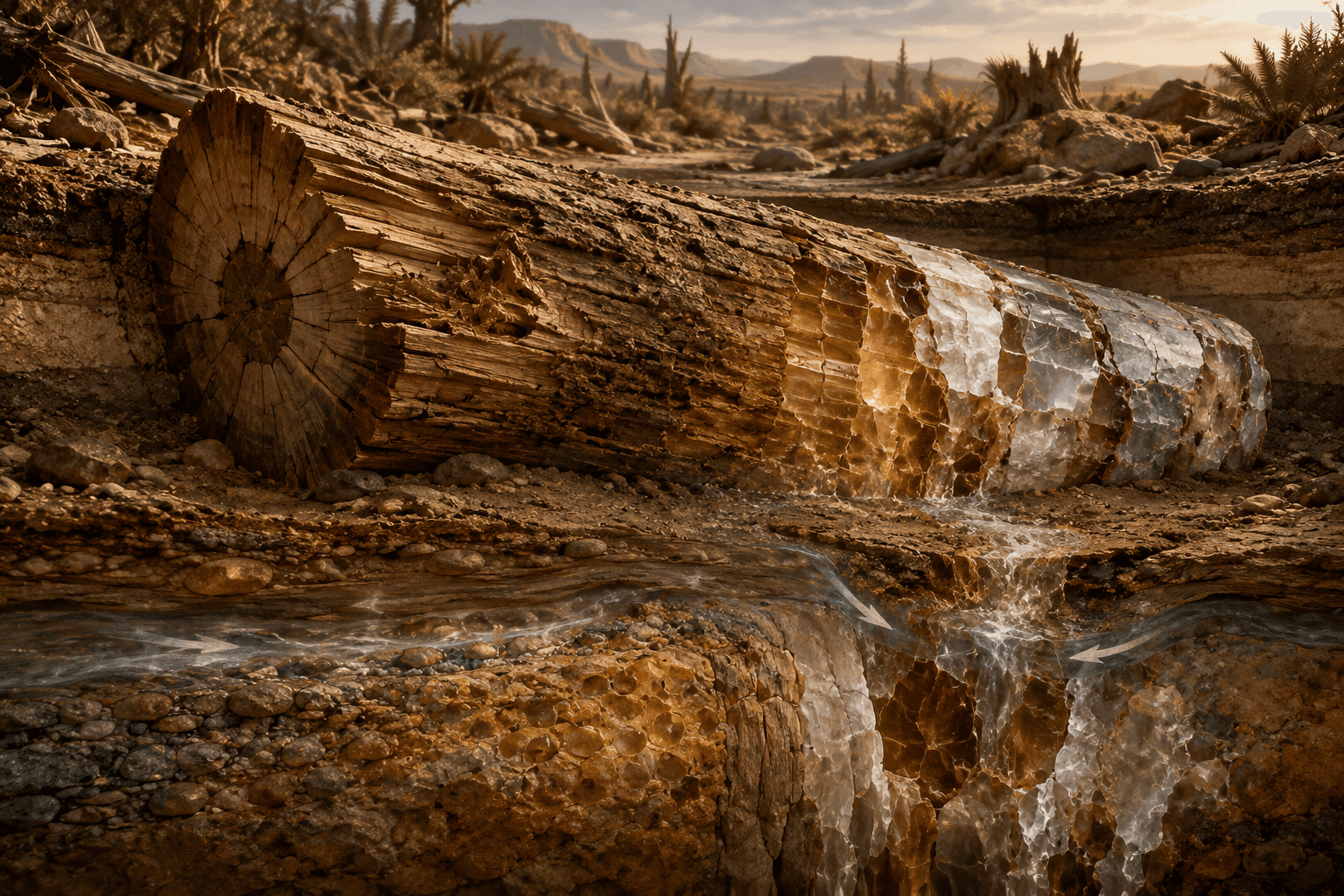
A petrified wood vessel sink is not shaped from a slab of stone quarried by the ton. It is hollowed from one tree — a single trunk that grew in the forests of southwestern Madagascar some 230 million years ago, fell, and was buried before it could decay. Groundwater rich in silica moved through its cells over millennia, replacing wood fiber with quartz, cell by cell, ring by ring. What emerges from the ground today is not a fossil in the sense of a print or a cast. It is the tree itself, translated into stone, with its grain, its knots, and its growth rings intact.
At Medusa, each trunk we bring up is named before it is touched by a single tool. Ambra for the amber-toned ones, Argentea for the silvered, Fusca for deep browns, Umbra for near-black density, Viridis for the rare greens. A name is not decoration — it is a record. It tells you which tree this basin came from, and it tells you that once this particular trunk is cut, that exact palette of color will not exist again.
Why the Color Never Repeats
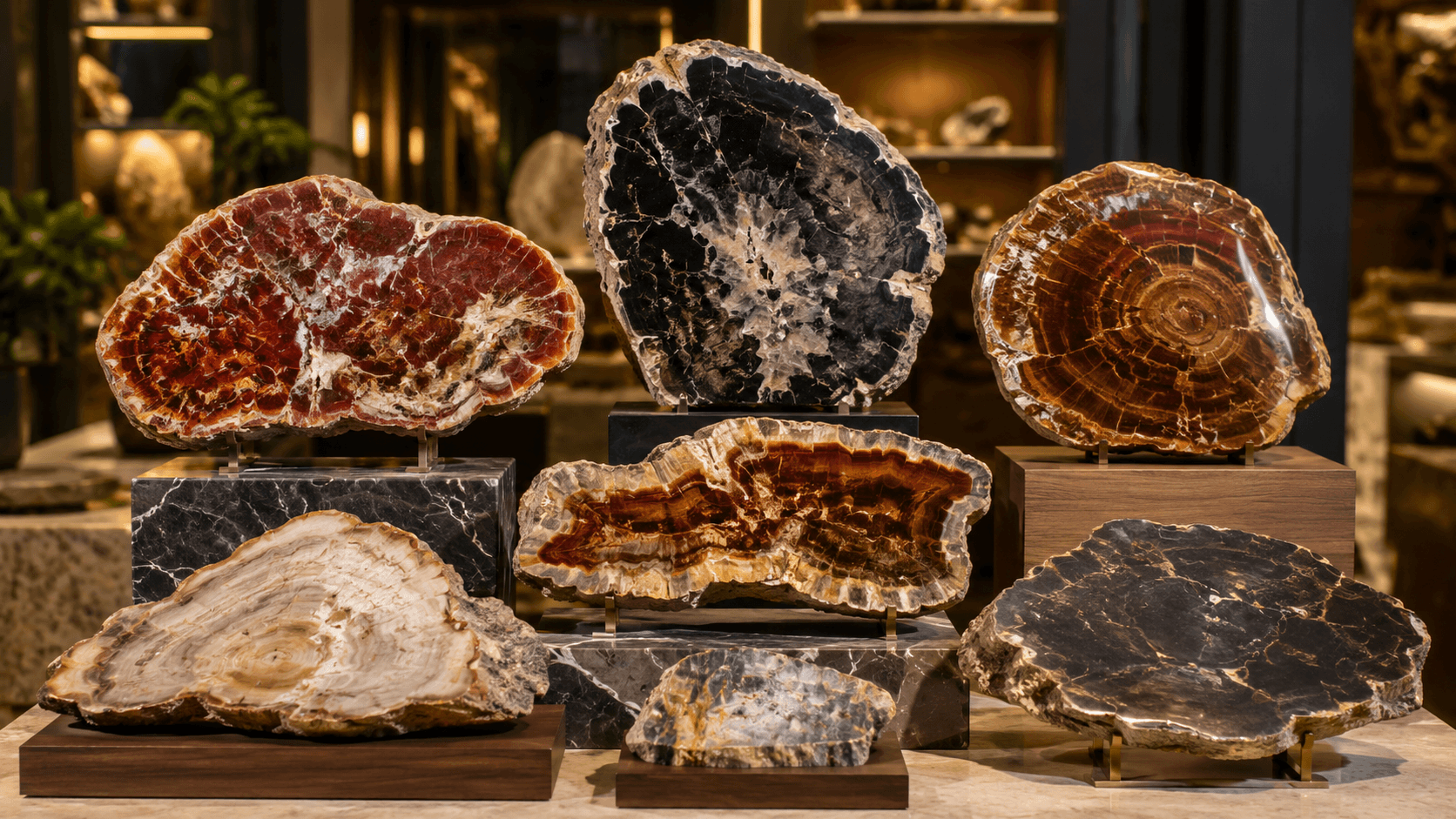
The wood itself contributed nothing to the final color. Every hue in a petrified trunk comes from trace metals present in the groundwater at the moment of mineralization:
- Iron produced the reds, rusts, and ochres.
- Manganese produced the blacks and violets.
- Chromium and cobalt, far rarer, produced the greens and blues.
No two trunks sat in identical mineral conditions for identical spans of time, so no two trunks carry identical color. This is why Medusa does not sell "petrified wood" as a generic material category. We sell Ambra, or we sell Fusca — a specific tree, with a specific mineral history, that can be shown to you before it becomes a sink. Once a trunk is cut into vessels, its particular seam of color is spent. There is no second batch.
A vessel sink cut from petrified wood is not manufactured. It is uncovered.
From Buried Trunk to Vessel Sink
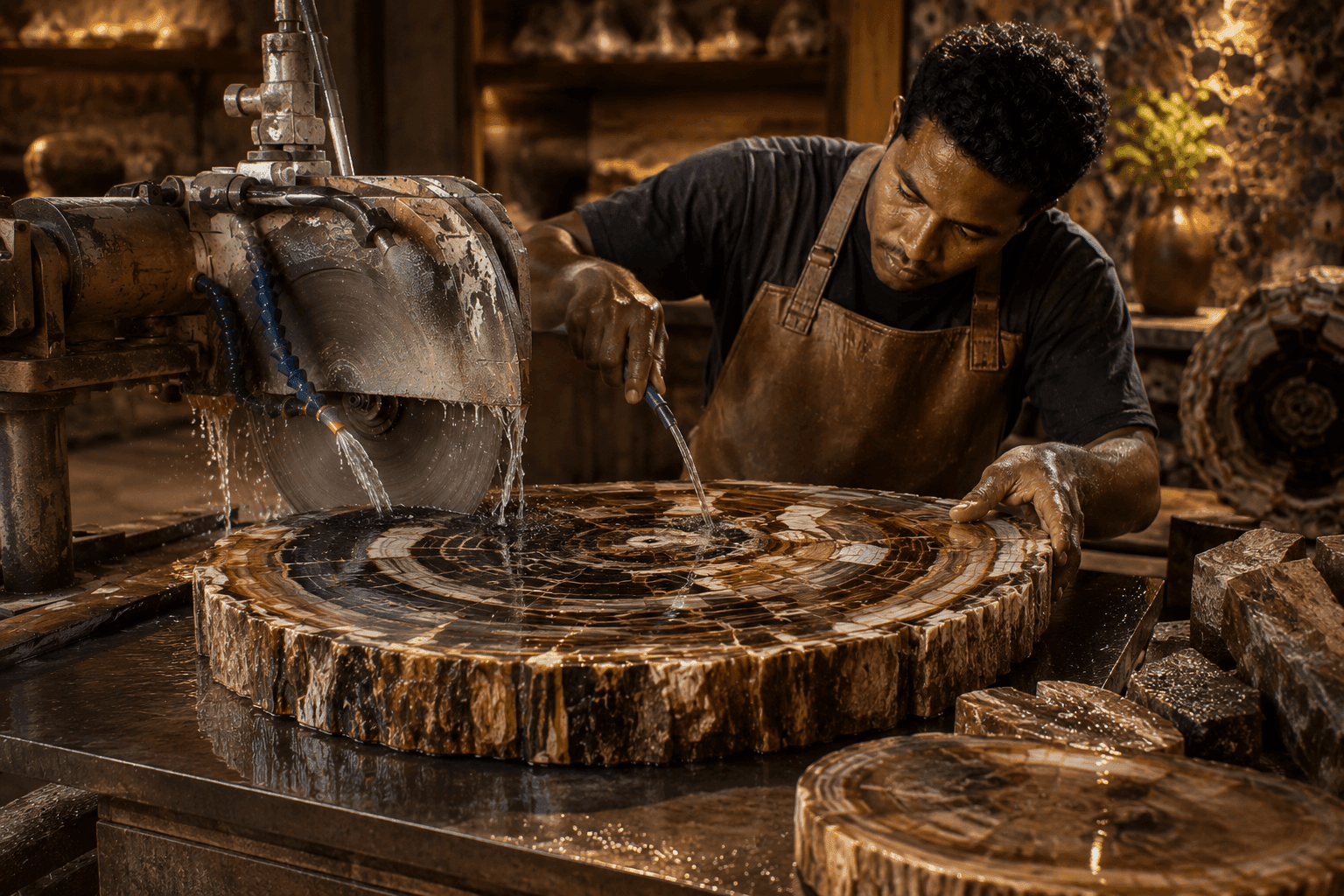
Turning a trunk into a vessel sink is slow work by necessity. The stone is quartz — 7 on the Mohs hardness scale, harder than a steel blade — so nothing about the process is fast. A cross-section is selected for wall thickness and grain, then hollowed and polished by hand, working with the trunk's natural rings rather than against them. The goal is never to impose a shape on the material. It is to find the vessel that was already latent in that particular section of tree, and to reveal it without erasing what makes it recognizable as that specific trunk.
This is also why our cluster of sixteen vessel sinks — the 16 KW cluster — reads less like a product line and more like a gathering of individuals. Each basin in the set carries its own trunk's signature: a darker whorl here, a paler ring there, a vein of manganese cutting across the bowl's interior. Placed side by side, they do not match. They correspond.
A Stone That Owes Nothing to Maintenance
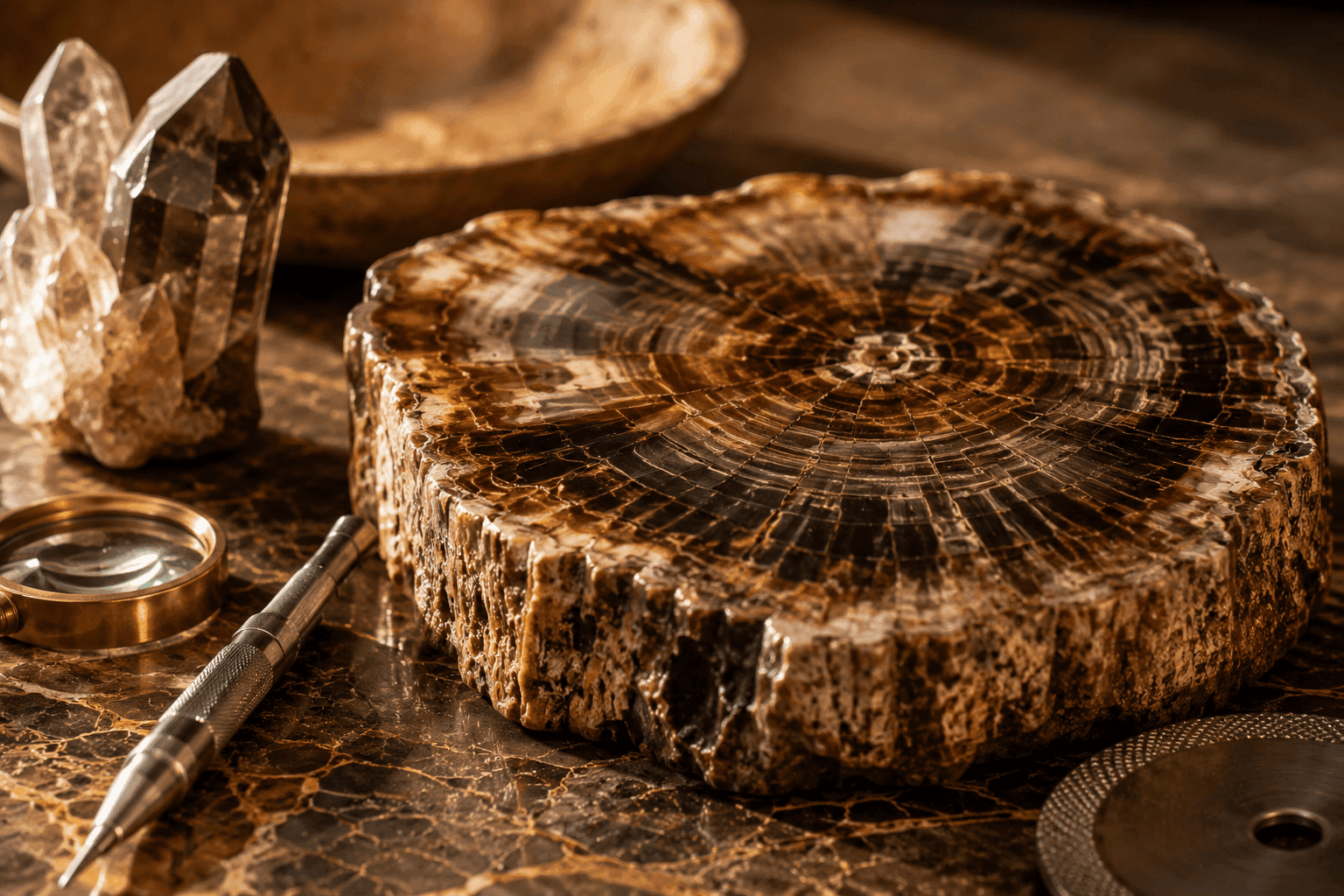
Because the trunk has been replaced by quartz, a petrified wood vessel sink behaves like stone in every practical sense, not like wood. It is heavy, cold to the touch, and entirely indifferent to water — an essential quality for a basin that will hold standing water daily. It resists heat, resists UV fading, and tolerates frost without cracking. There is no sealing schedule, no oil treatment, no seasonal care. The surface you install is, barring deliberate damage, the surface you will have in twenty years.
This durability is part of what separates a Medusa vessel sink from a poured composite or a resin-finished basin made to imitate wood grain. Here, the grain is not printed on. It is the fossil record of an actual tree, fixed permanently in mineral form.
Setting the Sink
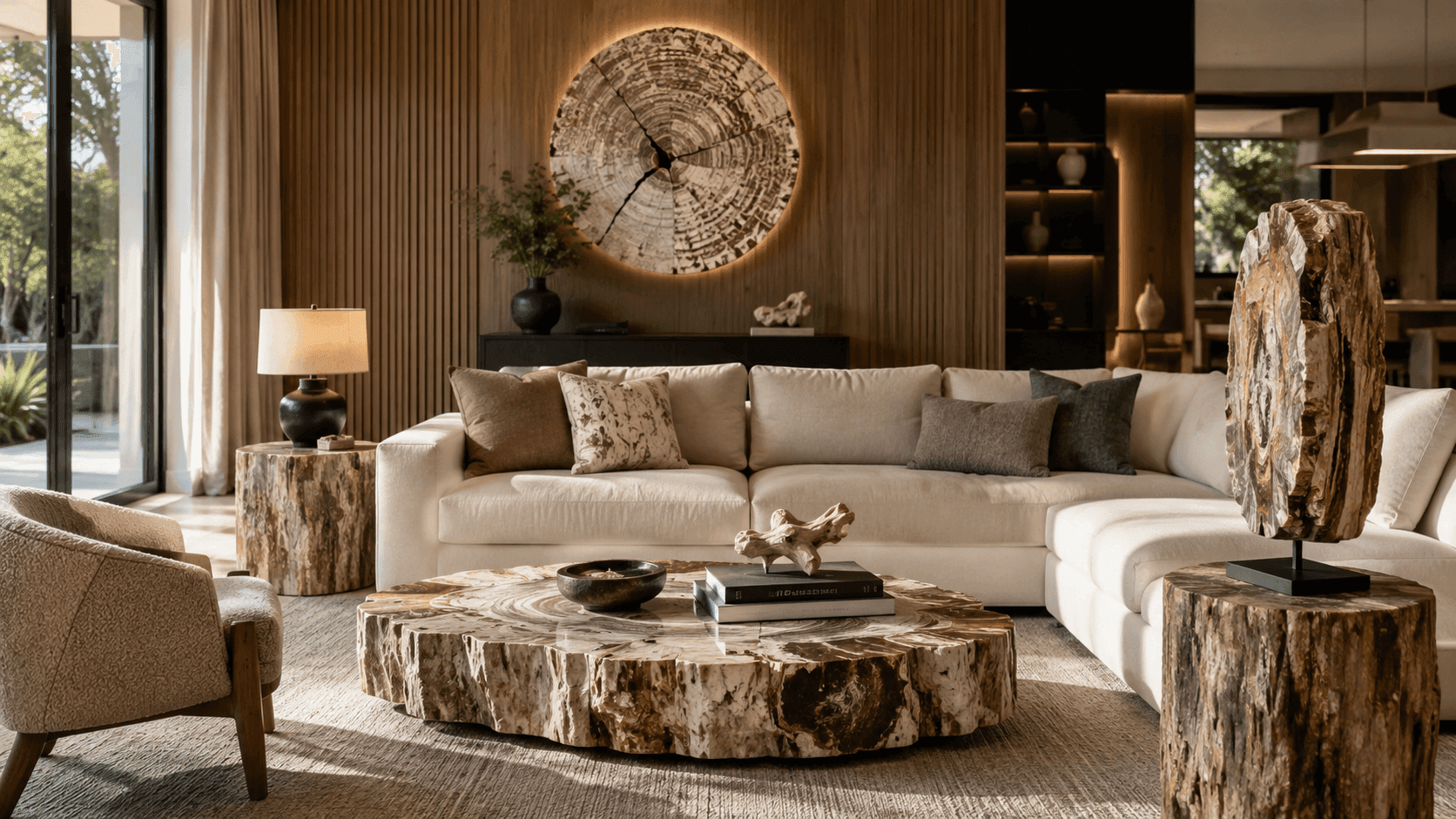
A vessel sink sits above the counter rather than within it, which means the basin itself is the visible object — not a fixture hidden beneath a countertop lip, but a sculptural piece that happens to hold water. This suits petrified wood particularly well. The rings, the color banding, the occasional mineral vein are all displayed rather than concealed. In a bathroom or a powder room, the sink becomes the room's focal point rather than one fixture among several.
Because each basin is a one-off, siting one well is less about matching a "collection" and more about pairing the stone's tone with its surroundings — a pale Argentea trunk against dark wood cabinetry, a deep Umbra basin on a light stone counter. We advise on this pairing directly, piece by piece, since no catalog photograph substitutes for seeing the actual trunk section in question.
See the current trunks available as vessel sinks.
View the ShopFrequently Asked Questions
Is a petrified wood vessel sink actually stone, or is it wood?
It is stone — fully silicified quartz. The original wood has been entirely replaced at the cellular level over roughly 230 million years, so what you install is mineral, not organic material.
Can it handle daily water contact without damage?
Yes. Quartz is inert to water. There is no absorption, no swelling, no risk of rot — the material behaves exactly as any other dense natural stone basin would.
Why do prices vary so much between vessel sinks?
Each trunk is unique in size, density, color rarity, and the labor required to hollow and polish it. We price per piece, on request — please consult us or request a quote for the trunk that interests you.
Will the color of my sink match another piece from the same "type"?
Not exactly, and that is intentional. Colors are named by trunk (Ambra, Argentea, Fusca, Umbra, Viridis) but each individual tree produced its own precise mineral banding. Two Fusca basins will share a family resemblance, never an identical pattern.