
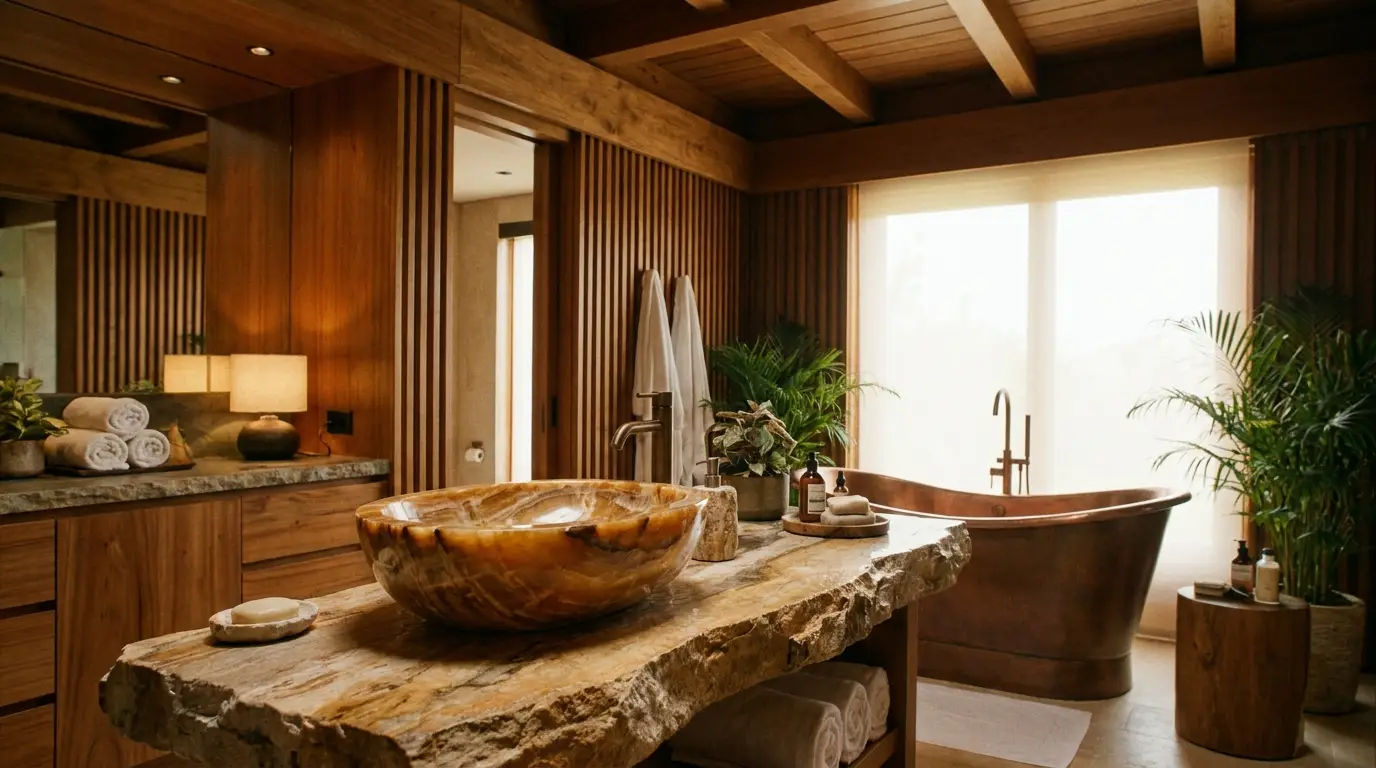
A Basin That Was Once a Tree
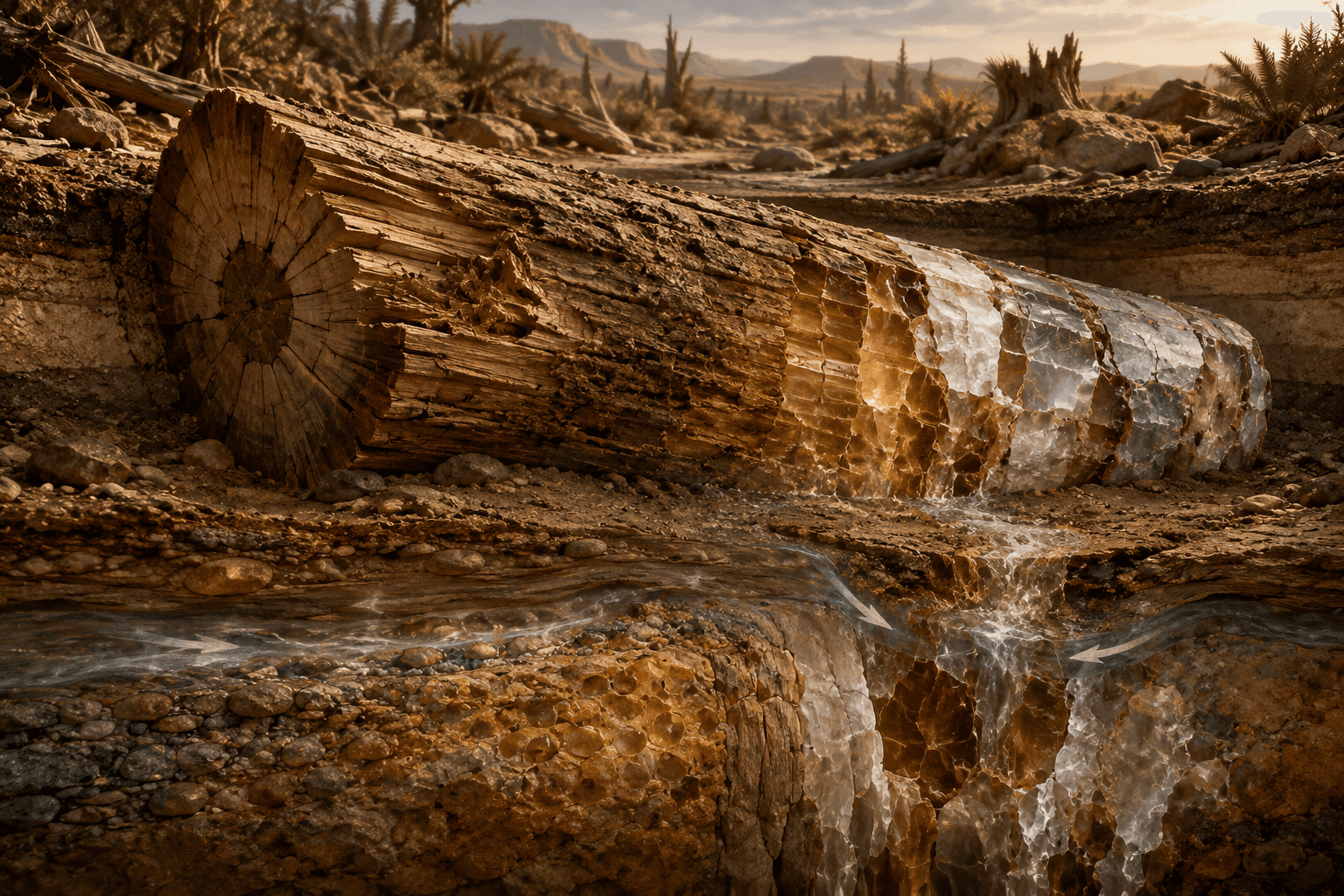
A petrified wood sink is not a manufactured object dressed up to look natural. It is a fragment of a tree that stopped being wood some 230 million years ago, during the Triassic, and slowly became stone. What you place in your bathroom is the cross-section of a trunk that grew, fell, was buried, and was mineralized cell by cell until every fiber turned to quartz.
At Medusa, we work only with trunks raised one by one from the south-west of Madagascar. Each is an individual. Each carries its own colour, its own grain, its own history of minerals. When we shape a basin from one of them, we are not producing a model — we are revealing a face of that particular tree that no other sink on earth will ever repeat.
This is the whole promise of a petrified wood sink: a functional piece that is also a geological specimen, dense, cold to the touch, and effectively indestructible.
What Petrified Wood Actually Is
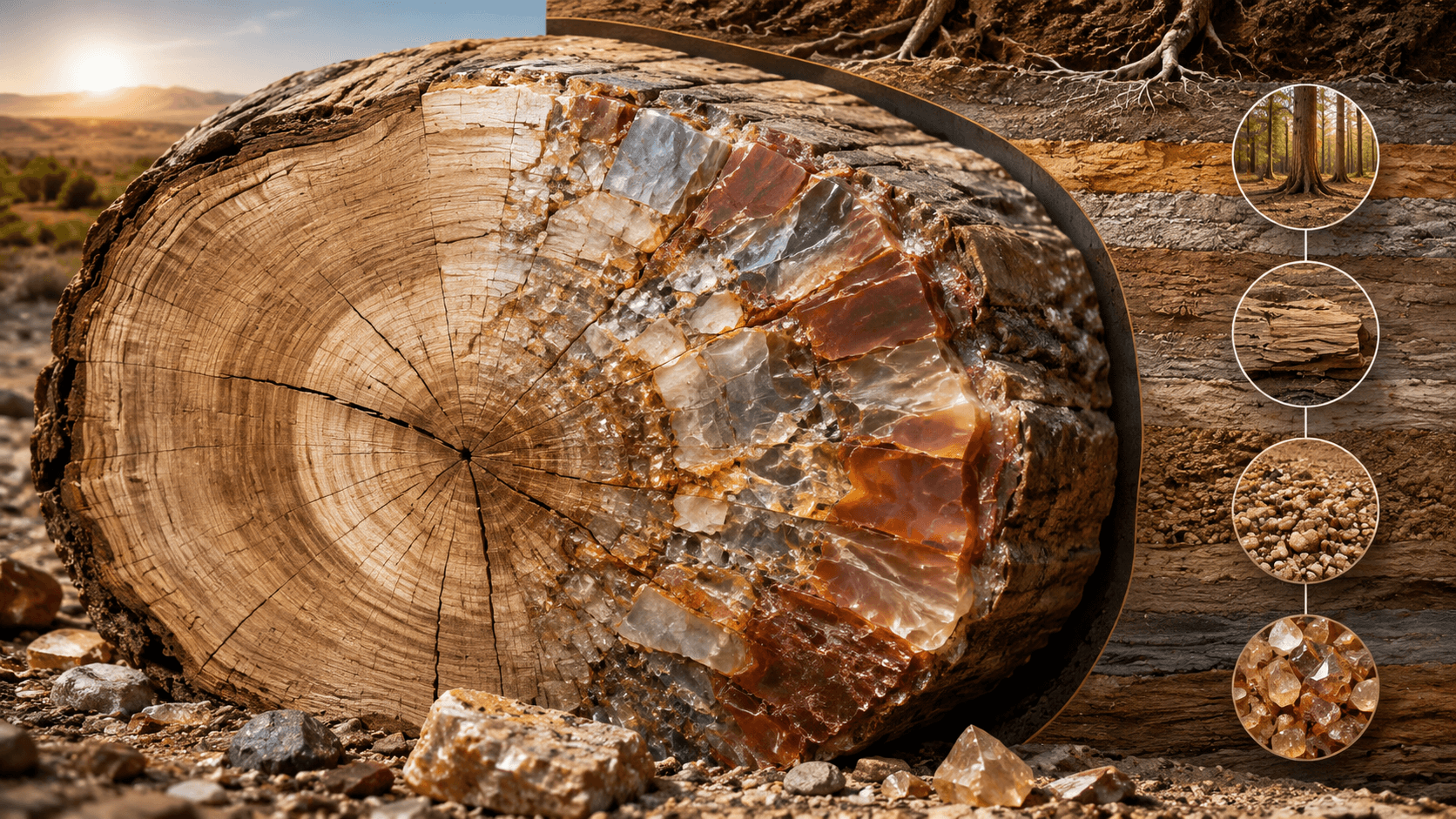
Petrification is a slow substitution. Groundwater loaded with dissolved silica seeps through buried wood and, over immense time, replaces the organic matter molecule by molecule. The structure remains — rings, knots, bark lines — but the substance becomes quartz.
That single fact governs everything about how a petrified wood sink behaves:
- It is quartz, which sits at 7 on the Mohs scale. It resists scratching from almost anything found in a home.
- It is dense and heavy, and stays cool to the touch the way stone does.
- It is indifferent to water, heat, UV, and frost. Daily use, hot taps, sunlight through a window — none of it affects the material.
The colours are not dyes or finishes. They come from the metals present in the ground during mineralization:
- Iron produces reds, ochres, and warm browns.
- Manganese brings blacks and violets.
- Chromium and cobalt yield the rarer greens and blues.
Wood remembers its shape; the earth lends it a colour. What you see was written into the stone long before there were bathrooms to put it in.
Why Each Trunk Has a Name
Most sellers treat petrified wood as a commodity — cubic metres of material, sorted roughly by tone. We take the opposite view.
Every trunk we bring up is examined, and given a name that reflects its dominant colour:
- Ambra — the amber-toned trunks, warm and honeyed.
- Argentea — silvered, pale, close to grey stone.
- Fusca — deep brown, grounded and quiet.
- Umbra — the darkest trunks, verging on black.
- Viridis — the green ones, coloured by chromium and cobalt, and the scarcest of all.
These are not product categories. Ambra is not a range; it is a tree. When that trunk is cut, its exact mineralization — the precise blend of iron and manganese that gave it its tone — is used up. Once the pieces are sold, that colour is gone. There is no reorder, no second batch.
Choosing a Medusa sink means choosing a specific trunk, by name, before it is dispersed. It is closer to acquiring a fossil than to buying furniture.
From Malagasy Ground to Finished Basin
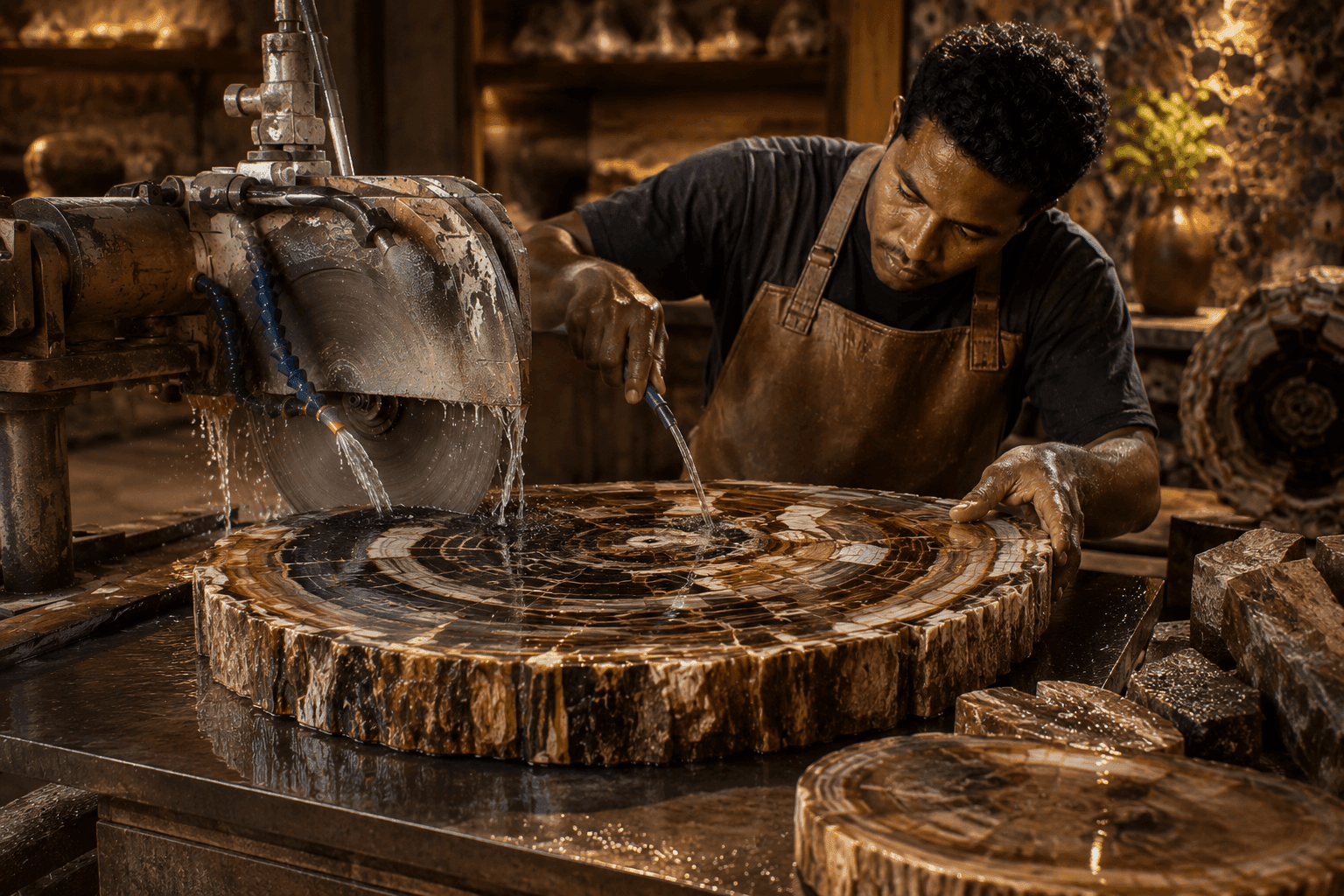
The journey of a petrified wood sink is long and largely manual.
Extraction. In the south-west of Madagascar, trunks are lifted from the ground one at a time. There is no seam of identical material to quarry — each tree comes up on its own terms, whole or in sections.
Selection. We assess colour, density, and the pattern of the grain. The tree is named. Only trunks that hold together as sound quartz go forward.
Shaping. Because the material is quartz at 7 on Mohs, it is worked with diamond tooling. The basin is hollowed from the solid, following the tree's own geometry rather than forcing a standard form onto it. The outer surface is often left with its natural bark line, so the piece keeps the silhouette of the trunk it came from.
Polishing. The interior is polished to a smooth, sealed-feeling surface that reveals the full depth of the colour. Quartz needs no chemical sealant — the polish is mechanical, and permanent.
The result is a sink where two faces coexist: a raw, geological exterior and a mirror-deep interior that shows off the mineral colours at their fullest.
Choosing and Living With a Petrified Wood Sink
A petrified wood basin is a heavy object, and that changes a few practical things worth knowing before you choose one.
Form. Most of our basins are vessel sinks — they sit on top of a vanity or counter rather than being recessed. This suits their sculptural presence and lets the outer trunk profile stay visible.
Support. Because the material is dense quartz, the piece is heavy. A solid vanity and correct plumbing are all that is required; no exotic maintenance follows.
Care. This is the easiest part. Quartz at 7 Mohs is unbothered by everyday soaps, toothpaste, hot water, or sunlight. A wipe with a soft cloth is enough. There is nothing to reseal, nothing that stains, nothing that fades.
Colour choice. Decide first on the mood you want — the warm honey of Ambra, the calm of Fusca, the pale restraint of Argentea, the depth of Umbra, or the rarity of Viridis — and let the individual trunk guide the rest. Since no two are alike, we work with you on the specific piece.
Because every sink is a single named trunk, we do not publish a fixed price list. Each is quoted according to the piece itself — its size, its colour, its rarity.
Discover the trunks currently available and reserve one before it is cut.
Explore the collectionWhere to Go Next in the Collection
A petrified wood sink is the centre of a wider bathroom conversation. To go deeper into specific aspects, these companion articles cover:
- Colours and mineralization — how iron, manganese, chromium and cobalt shape each tone, and what makes Viridis so rare.
- Vessel basins and vanity pairing — matching a trunk to a counter, and the practicalities of installation.
- Care and durability — why quartz at 7 Mohs needs nothing more than a cloth.
- The named trunks — a closer look at Ambra, Argentea, Fusca, Umbra and Viridis as individuals.
Together they map the whole world of petrified wood in the bathroom, with this article as the trunk from which the rest branch out.
Frequently Asked Questions
Is a petrified wood sink durable enough for daily use?
Yes. It is quartz, rated 7 on the Mohs scale, and completely insensitive to water, heat, UV, and frost. It resists scratching and staining, and requires no sealant. In practical terms, it outlasts the room around it.
Are two petrified wood sinks ever identical?
No. Each basin is cut from a single trunk raised individually in Madagascar, with a colour set by its own mineralization some 230 million years ago. When that trunk is cut, its exact tone disappears for good. Yours is unrepeatable.
How do I clean a petrified wood basin?
A soft cloth and mild soap are enough. Because the surface is polished quartz, nothing penetrates it — no reapplication of sealant, no special products, no risk from hot water or sunlight.
How much does a petrified wood sink cost?
Because every piece is a distinct trunk, we quote each one individually according to its size, colour, and rarity. The best way is to tell us what you are looking for — please consult us, and we will guide you to the right piece.